Overview
- The Moche (c. 100–700 CE) were a complex pre-Columbian society on Peru's arid north coast that built massive adobe pyramids — including the Huaca del Sol and Huaca de la Luna — and produced some of the ancient Americas' most accomplished ceramic art, metallurgy, and irrigation engineering without a writing system or centralized imperial government.
- The 1987 excavation of the royal tombs at Sipán by Walter Alva revealed intact elite burials with gold, silver, and copper regalia that matched Sacrifice Ceremony iconography, providing direct archaeological confirmation of ritual practices previously known only from painted vessels.
- Current models interpret the Moche not as a unified empire but as a politically fragmented mosaic of at least two regional traditions — a southern tradition centred on the Moche Valley and a northern tradition in the Lambayeque and Jequetepeque valleys — whose collapse around 550–700 CE was driven by convergent pressures including severe El Niño flooding, prolonged drought, and internal political fragmentation.
The Moche civilization flourished along the arid north coast of Peru from approximately 100 to 700 CE, occupying a narrow but fertile strip of river valleys between the Pacific Ocean and the western slopes of the Andes.1 Despite lacking a writing system, the Moche produced some of the most technically accomplished ceramic art, metalwork, and monumental architecture in the pre-Columbian Americas. Their irrigation networks transformed desert valleys into productive agricultural zones, and their elaborate ritual life — now partially reconstructed from painted vessels and excavated tomb assemblages — reveals a society deeply preoccupied with themes of warfare, sacrifice, and cosmic renewal.1, 4 The Moche are not to be confused with the later Inca Empire, which conquered the same coastal valleys roughly eight centuries after the Moche collapse.

Geography and chronology
The Moche heartland stretched across roughly ten river valleys on Peru’s north coast, from the Piura Valley in the north to the Huarmey Valley in the south — a span of some 550 kilometres.1 Each valley is an isolated ribbon of irrigable land fed by Andean snowmelt, separated from its neighbours by barren desert. This geography imposed constraints on political integration: unlike the highland basins that later supported the Inca Empire, the coastal valleys were ecologically self-contained units whose interconnection depended on overland travel through waterless terrain.9
Chronological frameworks for the Moche remain debated. The most widely used ceramic sequence, originally established by Rafael Larco Hoyle in the 1940s, divides Moche ceramics into five phases (I through V), spanning roughly 100 to 700 CE.1 More recent radiocarbon-based chronologies have refined these dates and revealed that the stylistic sequence developed by Larco applies primarily to the southern Moche valleys, while northern valleys followed a partially independent trajectory.9, 13 The civilization’s origins lie in the Moche and Chicama valleys, where earlier Gallinazo-period communities were gradually incorporated into an expanding Moche polity during the first and second centuries CE.10
Monumental architecture
The most imposing Moche structures are the paired pyramids of Huaca del Sol and Huaca de la Luna in the Moche Valley, which served as the political and ceremonial centre of the southern Moche tradition for several centuries.2 The Huaca del Sol, measuring roughly 340 by 160 metres at its base and originally standing over 40 metres high, is the largest adobe structure in the pre-Columbian Americas. It was constructed from an estimated 143 million sun-dried mud bricks, many bearing maker’s marks that suggest corvée labour organized by distinct kin groups or communities.1, 2 The Huaca de la Luna, located approximately 500 metres to the east at the foot of Cerro Blanco, was the primary ceremonial platform. Excavations directed by Santiago Uceda and Ricardo Morales since 1991 have revealed multiple superimposed building phases, each sealed beneath a new layer of construction, preserving polychrome murals depicting fanged deities, frontal warrior figures, and scenes of captive sacrifice in vivid mineral pigments.2
Between the two huacas lay an urban zone of residences, workshops, and storage facilities that housed artisans, administrators, and ritual specialists. Archaeological work at this intervening area has demonstrated that the site functioned as a true urban centre, not merely a vacant ceremonial precinct visited periodically.2, 10 Other major Moche centres include Sipán and Pampa Grande in the Lambayeque Valley, El Brujo in the Chicama Valley, and Dos Cabezas in the Jequetepeque Valley, each exhibiting its own monumental platform mounds and associated settlement.13, 11
Ceramic art and portrait vessels
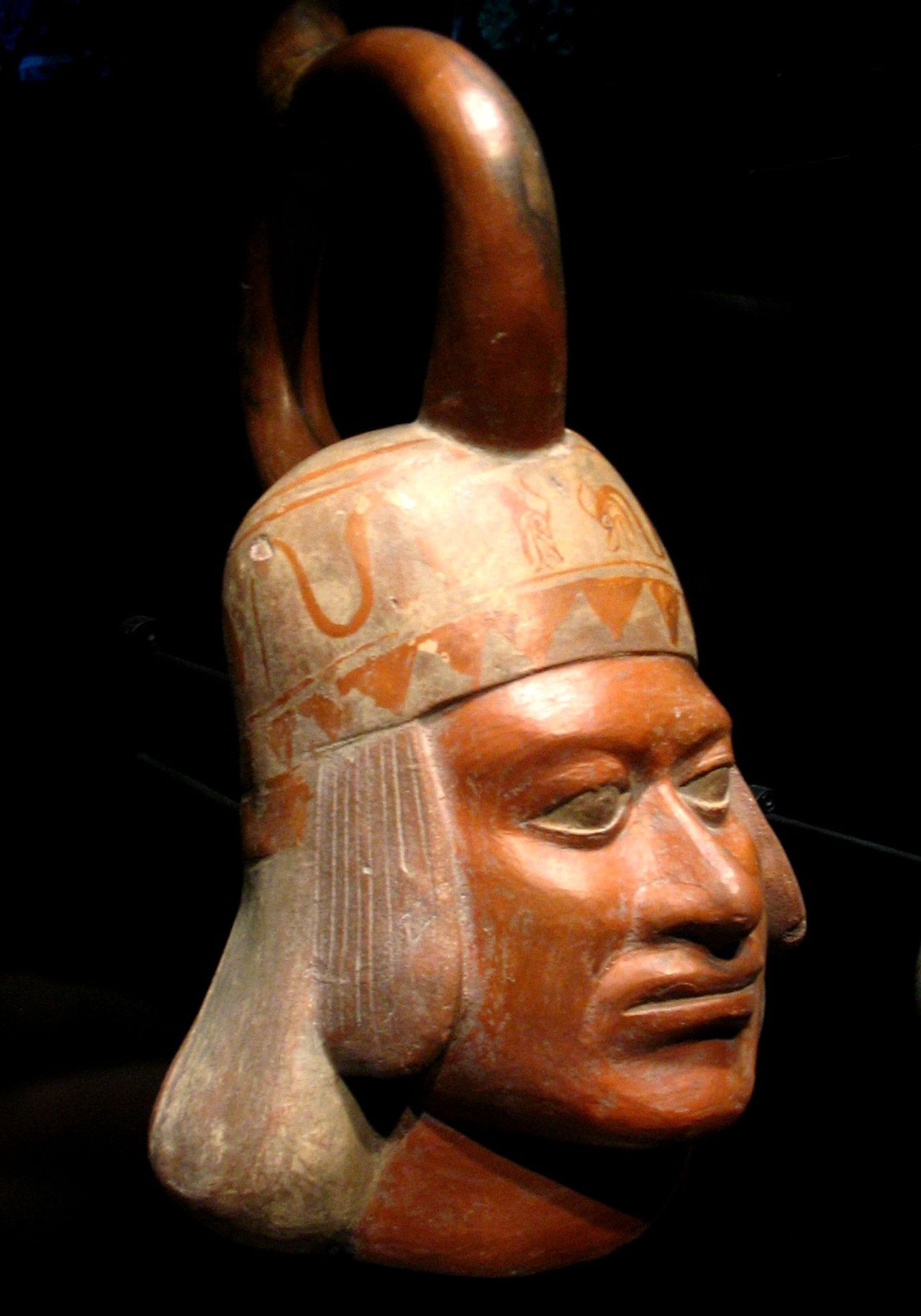
Moche ceramics are among the most expressive and technically refined in the ancient Americas. Two broad categories dominate the corpus: modelled three-dimensional vessels depicting human faces, animals, plants, architectural forms, and erotic scenes; and stirrup-spout bottles decorated with intricate fineline painting in cream and red-brown slip.4 The fineline tradition, systematically catalogued by Christopher Donnan and Donna McClelland, depicts complex narrative scenes involving supernatural beings, ritual combat, the presentation of blood offerings, and the burial of the dead — providing an unparalleled visual record of Moche ideology.4
The so-called portrait vessels are particularly distinctive. These modelled heads render individual faces with such specificity — depicting scars, facial asymmetries, distinctive headdresses, and expressions — that scholars have long debated whether they represent actual individuals or idealized social types.5 Donnan’s comparative study demonstrated that certain faces recur across multiple vessels found at different sites, suggesting that the subjects were real people of sufficient importance to merit repeated portraiture.5 Some portrait subjects appear at different ages, implying that their likenesses were updated over the course of their lifetimes. No other pre-Columbian tradition achieved this degree of individualized representation in clay.
Metallurgy
Moche metalworkers were among the most skilled in the ancient Americas, producing objects in gold, silver, copper, and a range of alloys.14 They mastered techniques including lost-wax casting, hammering and annealing, soldering, and — most distinctively — depletion gilding, a process by which a copper-gold alloy (tumbaga) is repeatedly heated and treated with acidic plant solutions to dissolve surface copper, leaving a microscopically thin but visually brilliant layer of pure gold on the surface.14 This technique allowed Moche artisans to create objects that appeared to be solid gold while using only a fraction of the precious metal that solid casting would require. Heather Lechtman’s pioneering analyses showed that this was not mere economy but reflected an Andean conception of material essence, in which the “golden” quality of an object was understood to pervade its entirety rather than reside only on its surface.14
The metalwork recovered from elite tombs at Sipán demonstrates the full range of Moche technical achievement: crescent-shaped nose ornaments, elaborate ear spools inlaid with turquoise and shell, peanut-shaped gold beads, and a spectacular set of gilded copper backflaps depicting the Decapitator deity.3 Copper was also used for utilitarian objects including agricultural tools, needles, and tweezers, indicating that metallurgical knowledge was not confined to elite prestige production.14
The royal tombs of Sipán
In February 1987, archaeologist Walter Alva was alerted to looting at a mud-brick platform mound near the village of Sipán in the Lambayeque Valley. His subsequent excavation revealed the first unlooted royal Moche tomb ever scientifically documented, transforming understanding of Moche elite culture.3 The principal burial, dubbed the Lord of Sipán, contained the remains of a man in his late thirties interred with an extraordinary assemblage of gold and silver regalia, ceramic vessels, sacrificed attendants, and a dog. The grave goods included a gold-and-turquoise pectoral, crescent-shaped headdress ornaments, backflaps, sceptres, and hundreds of ceramic vessels.3
The significance of Sipán extended beyond its material richness. Donnan recognized that the Lord of Sipán’s regalia precisely matched the costume worn by the central figure in the Sacrifice Ceremony, a complex ritual scene depicted on hundreds of Moche fineline vessels.6 In this scene, a warrior-priest figure presides over the presentation of goblets filled with the blood of defeated captives. The correspondence between the painted iconography and the actual tomb assemblage demonstrated that Moche fineline painting depicted real ritual roles performed by identifiable elite individuals — not mythological abstractions — and that the occupant of the Sipán tomb had himself enacted the role of the principal sacrificer during his lifetime.3, 6
The Sacrifice Ceremony and ritual violence
The Sacrifice Ceremony is the most thoroughly analysed iconographic theme in Moche art. As reconstructed from hundreds of fineline vessels and murals, it depicts a sequence in which warriors engage in ritual combat, captives are stripped and bound, their throats are cut, and their blood is collected in goblets that are presented to presiding figures wearing elaborate regalia.6 The scene includes a series of recurring characters — the Warrior Priest, the Priestess, the Bird Priest, and others — each identifiable by distinctive costume elements that have been matched to actual burial assemblages at Sipán, San José de Moro, and other sites.3, 6
Archaeological evidence has confirmed that these scenes reflect actual practice. At the Huaca de la Luna, Steve Bourget excavated a plaza containing the remains of at least 70 individuals, predominantly young adult males, who had been killed by throat-cutting, blunt-force trauma, or exposure, with their bodies left in the open rather than formally buried.7 John Verano’s osteological analyses of these remains revealed perimortem injuries consistent with the violence depicted in Moche art, including cut marks on cervical vertebrae and evidence of defleshing.8 The sacrificial deposits at Huaca de la Luna were interbedded with layers of water-laid sediment, suggesting that the rituals were performed during or immediately after heavy rainfall events — possibly El Niño episodes — in an attempt to propitiate forces causing environmental disruption.7, 12
The Lady of Cao
In 2006, excavations at the Huaca Cao Viejo complex at El Brujo in the Chicama Valley, directed by Régulo Franco, uncovered the elaborately furnished tomb of a woman who died in her late twenties around 400 CE.11 Her body bore extensive tattoos depicting serpents, spiders, and supernatural figures, and she was buried with war clubs, spear-throwers, gold nose ornaments, crown-like headdresses, and other regalia previously associated exclusively with male warrior-priests.11 The discovery of the Lady of Cao fundamentally challenged assumptions about gender and political authority in Moche society, demonstrating that women could occupy the highest ritual and political roles. Her grave goods closely parallel those of the Sacrifice Ceremony’s presiding figures, raising the possibility that she too enacted the role of sacrificer or priestess during her lifetime.11, 1
Irrigation and agriculture
The Moche economy rested on intensive irrigation agriculture in the coastal desert valleys, where rainfall is negligible and all cultivation depends on canal systems diverting water from Andean rivers.15 Archaeological survey of the Moche Valley by Brian Billman documented an extensive network of intervalley canals that expanded over several centuries, eventually linking the Moche and Chicama river systems and irrigating tens of thousands of hectares of previously uncultivable land.15 Principal crops included maize, beans, squash, peanuts, chilli peppers, avocados, and cotton, supplemented by marine resources — fish, shellfish, and sea mammals — harvested from the rich waters of the Humboldt Current.1
The construction and maintenance of these canal systems required coordinated labour mobilization at a scale that implies centralized management, at least at the valley level. Billman argued that the expansion of irrigation infrastructure in the Moche Valley correlated with the consolidation of political authority at the Huacas de Moche site, suggesting that control over water was a primary mechanism of elite power.15 The vulnerability of these systems to flood damage during El Niño events would become a critical factor in the civilization’s decline.12
Political organization
Early interpretations described the Moche as a unified state or empire that expanded militarily from its capital in the Moche Valley to dominate the entire north coast.1 This model has been substantially revised. Current scholarship, particularly the work of Luis Jaime Castillo and Santiago Uceda, distinguishes at least two largely independent Moche polities: a southern tradition centred on the Moche Valley (with its capital at the Huacas de Moche) and a northern tradition in the Jequetepeque and Lambayeque valleys (with major centres at Sipán, San José de Moro, and Pampa Grande).9 The two traditions shared broad stylistic and ideological conventions — including the Sacrifice Ceremony iconography and the stirrup-spout vessel form — but differed in ceramic style, architectural practices, and political trajectory.9, 13
Within each region, individual valleys may have been governed by semi-autonomous lords who acknowledged shared cultural identity without submitting to a single ruler. The diversity of elite burial assemblages across sites supports a model of competing peer polities rather than a hierarchical empire.9 This political fragmentation may explain both the civilization’s dynamism — competition among centres drove artistic and architectural innovation — and its vulnerability to disruption when environmental or social crises overwhelmed the capacity of individual valley-level polities to respond.12
El Niño, drought, and collapse
The Moche civilization did not end in a single catastrophic event but underwent a protracted transformation between approximately 550 and 700 CE, with the southern and northern polities following different trajectories of decline.12 Izumi Shimada and colleagues proposed a model in which a severe El Niño event around 550–600 CE caused catastrophic flooding that destroyed irrigation canals and adobe architecture in the southern valleys, precipitating the abandonment of the Huacas de Moche and a shift of population to the inland site of Galindo.12, 10 Geological evidence of massive flood deposits at Huaca de la Luna supports this reconstruction.7
In the north, the pattern differed. Pampa Grande in the Lambayeque Valley emerged as a major centre after 600 CE, absorbing populations from disrupted southern valleys, before it too was abandoned around 700 CE — possibly after deliberate burning of its principal platform mound.13 Shimada’s climate model further proposes that the El Niño flooding was followed by a prolonged drought lasting several decades, a one-two punch that would have been devastating for an agricultural system entirely dependent on river flow.12 However, more recent scholarship cautions against monocausal environmental explanations, emphasizing that internal political competition, ideological crisis, and the emergence of new cultural identities (including the Lambayeque and Wari traditions) all contributed to the Moche transformation.9, 13
Legacy
The Moche legacy persisted in the cultural traditions that succeeded them on Peru’s north coast. The Lambayeque (Sicán) civilization, which arose in the same valleys after 750 CE, inherited Moche metallurgical techniques, iconographic motifs, and architectural forms, adapting them to new political and religious frameworks.13 When the Inca Empire conquered the north coast in the fifteenth century, they encountered populations whose cultural memory still preserved elements of Moche heritage. Today, the excavated sites of Sipán, Huaca de la Luna, and El Brujo are among Peru’s most visited archaeological destinations, and the Moche are recognized as one of the most artistically accomplished civilizations of the pre-Columbian world.1, 3
References
Moche Sociopolitical Organization: Rethinking the Role of War and the Warriors in the Moche World