Overview
- The Ottoman Empire, founded around 1299 by Osman I in northwestern Anatolia, expanded over six centuries into a transcontinental Islamic state stretching from Vienna to the Persian Gulf and from the Crimea to Algeria, ruling for 623 years under a single dynasty — one of the longest continuous monarchies in world history.
- At its sixteenth-century peak under Suleiman the Magnificent (r. 1520–1566), the empire combined a meritocratic slave-elite (the devshirme system and Janissary corps), a flexible religious order (the millet system granting Christian and Jewish communities legal autonomy), a codified Islamic-imperial legal framework, and the architectural genius of Mimar Sinan, whose mosques crystallized Ottoman classical style.
- The empire endured a long transformation rather than a simple decline: the Köprülü reforms of the seventeenth century, the nineteenth-century Tanzimat modernization, the 1908 Young Turk Revolution, and finally collapse in World War I, ending with the abolition of the sultanate in 1922 and the Treaty of Lausanne (1923) that recognized the borders of the Republic of Turkey.
The Ottoman Empire was a transcontinental Islamic state founded around 1299 by Osman I in the northwestern Anatolian frontier and dissolved in 1922 with the abolition of the sultanate by the Grand National Assembly of Turkey. Across more than six centuries, the dynasty Osman founded ruled an empire that at its seventeenth-century peak stretched from the gates of Vienna to the Persian Gulf and from the Crimean steppe to the deserts of Algeria, governing tens of millions of subjects from dozens of linguistic and confessional traditions under a single sovereign.1, 2 The Ottomans transformed a small frontier principality into one of the most durable and institutionally sophisticated states in early modern world history, integrating Turkish dynastic tradition, Persian court culture, Byzantine administrative practice, and Islamic law into a hybrid imperial order whose endurance through six centuries places it among the longest continuous monarchies of any era.3, 5
The empire's history resists the older European narrative of a sudden rise and prolonged decline. Recent scholarship presents the Ottoman state as undergoing successive phases of expansion, consolidation, transformation, and reform, punctuated by crises that produced institutional adaptation rather than collapse. From the conquest of Constantinople in 1453 to the Tanzimat reforms of the nineteenth century, Ottoman elites repeatedly reinvented their state to meet new internal and external pressures, finally succumbing only to the combined catastrophes of the First World War.4
Origins on the Anatolian frontier
The Ottoman state took shape in the late thirteenth century in the borderlands of Bithynia, the corner of northwestern Anatolia where Byzantine Greek, Turkish nomadic, and various Muslim and Christian populations intermingled. Osman I (c. 1299–1324), the founder of the dynasty, was a chieftain of the Kayi tribe of Oghuz Turks whose father Ertugrul had received pastoral lands near Sögüt from the Seljuk sultans of Rum. The Seljuk state had been broken by the Mongol invasions of the mid-thirteenth century, leaving a constellation of small Turkish principalities (beyliks) along the frontier with Byzantium.1, 2 Osman's principality, initially indistinguishable from its many neighbours, expanded steadily through raids and conquests against weakened Byzantine outposts, culminating in the capture of Bursa under his son Orhan in 1326.
The character of these early Ottoman warriors has been the subject of intense scholarly debate. The historian Paul Wittek argued in the 1930s that the Ottomans were animated by a religious zeal for ghaza — holy war against Christians on the frontier — and that this ideology supplied the dynamism and legitimacy of their early conquests. Cemal Kafadar, in his influential Between Two Worlds: The Construction of the Ottoman State (1995), revised this thesis, showing that early Ottoman ghazis often cooperated with Christian neighbours, that the boundary between “orthodox” and “heterodox” Islam was permeable in fourteenth-century Anatolia, and that the meaning of ghaza shifted across time.5 Whatever its precise religious content, the frontier ethos drew warriors of diverse origins — Turkish, Greek, Slavic, Albanian — into a politically inclusive military enterprise that absorbed and remade the local populations of conquered districts.
By the mid-fourteenth century the Ottomans had crossed the Dardanelles into Europe and were rapidly extending their power across Thrace. Under Murad I (r. 1362–1389) the empire annexed Adrianople (renamed Edirne and made the new capital), defeated Serbian and Bulgarian coalitions at the Battle of Kosovo in 1389, and incorporated much of the Balkans into a state still governed from Europe rather than Asia.1, 3 Bayezid I, called “the Thunderbolt” (Yildirim), continued this expansion until his catastrophic defeat at the hands of Timur (Tamerlane) at the Battle of Ankara in 1402, an event that fragmented the empire and inaugurated an interregnum (Fetret) of civil war among Bayezid's sons. The state was reunified under Mehmed I and his successors during the early fifteenth century, recovering its lost territories and resuming its drive against the remnants of Byzantium.
Mehmed II and the conquest of Constantinople
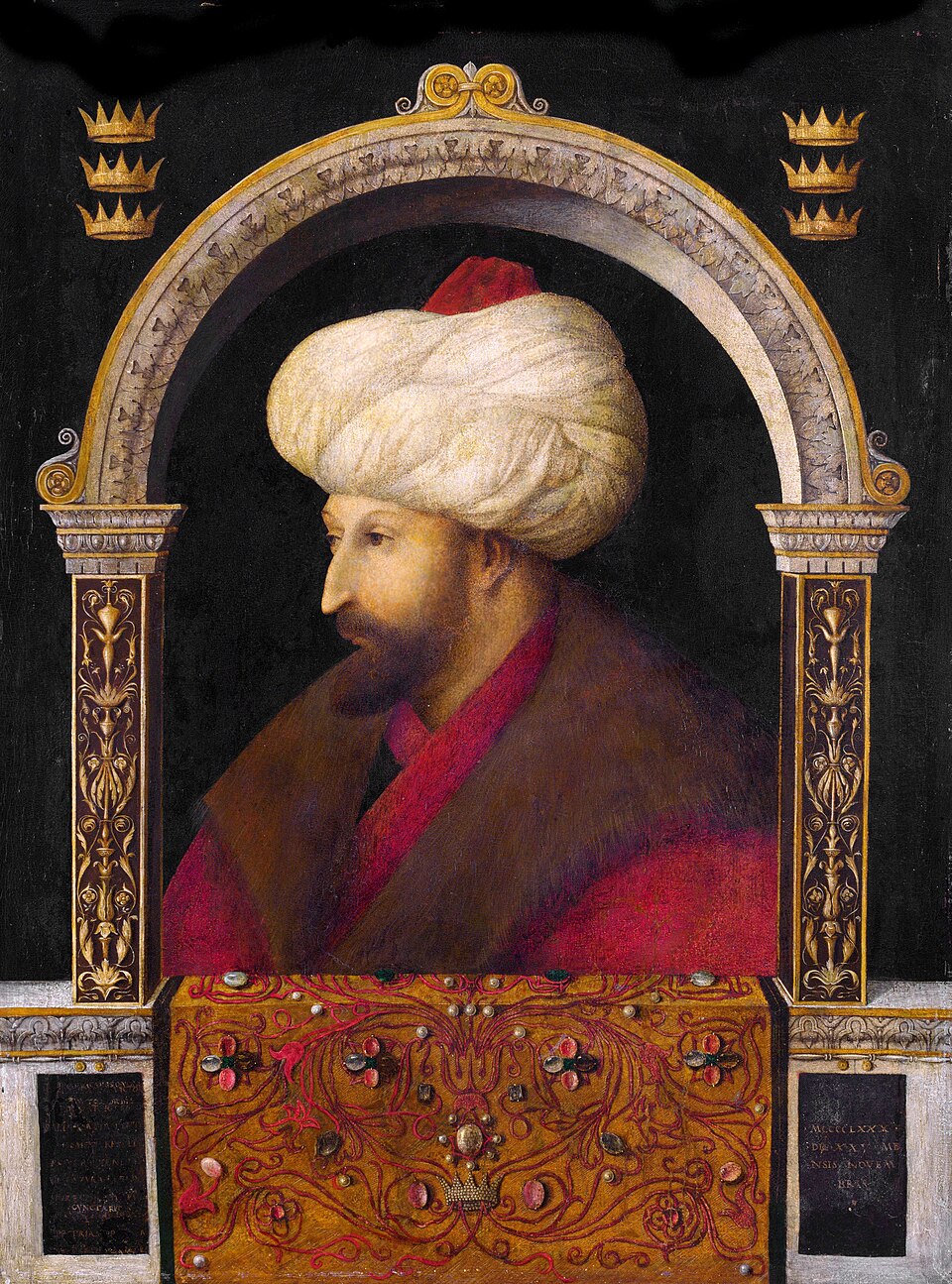
The defining moment of early Ottoman history came on 29 May 1453, when Sultan Mehmed II — called Fatih, “the Conqueror” — took Constantinople after a siege of fifty-five days, ending the eleven-century reign of the East Roman emperors and elevating the Ottoman state to the rank of a world power. Mehmed had ascended the throne in February 1451 at the age of eighteen, determined to capture the Byzantine capital that had eluded earlier sultans and that bisected his European and Asian territories. He spent the winter of 1452 building Rumeli Hisari, a massive fortress on the European shore of the Bosporus that gave him control of the strait, and assembling an army that ancient and modern estimates place at 50,000 to 80,000 troops against perhaps 7,000 to 10,000 defenders inside the Theodosian Walls.6, 7

The decisive technical innovation of the siege was Mehmed's use of large gunpowder artillery. The most famous of his cannons, designed and cast by the Hungarian engineer Orban, was a bronze monster approximately eight metres long with a calibre of around seventy-six centimetres, capable of firing stone shot weighing roughly half a ton. Orban had reportedly offered his services first to the Byzantine emperor Constantine XI, who could not afford his price; Mehmed paid him four times the requested sum and set him to work in Edirne. The cannon required teams of oxen and hundreds of men to drag it to Constantinople, where it pounded the land walls in a two-month bombardment that gradually battered them into ruin. Smaller guns, sappers, and a famous overland transfer of Ottoman warships across the hill behind Galata into the Golden Horn completed the encirclement.6, 7
The final assault began before dawn on 29 May. Successive waves of irregulars, Anatolian troops, and finally the elite Janissaries breached the walls near the Romanos Gate. Emperor Constantine XI Palaiologos was killed in the fighting; his body was never identified with certainty. The city was subjected to three days of looting under traditional Islamic rules of conquest, after which Mehmed regularized affairs, repopulated the depopulated city with Muslims, Christians, and Jews, restored the Greek Orthodox patriarchate, and made Constantinople — renamed Istanbul in common usage and Konstantiniyye in official documents — the new imperial capital.6, 1 The conquest gave Mehmed the prestige to claim the universal sovereignty of a Roman emperor (Kayser-i Rúm) and the legitimacy to consolidate the Anatolian and Balkan halves of his realm into a single integrated state. Conventional European historiography uses the date 1453 to mark the end of the Middle Ages.7
The dynasty across six centuries
Across the 623 years from Osman I to Mehmed VI, the Ottoman dynasty produced thirty-six sultans whose reigns map onto distinct phases of imperial development. The list below shows the most consequential rulers and the periods their reigns define, drawing on the standard chronology compiled in the secondary literature and the imperial archives.1, 3
Major Ottoman sultans and their reigns1, 3
| Sultan | Reign | Defining events |
|---|---|---|
| Osman I | c. 1299–1324 | Founder; expansion in Bithynia |
| Orhan | 1324–1362 | Conquest of Bursa (1326); first Janissary corps |
| Murad I | 1362–1389 | Capture of Edirne; Battle of Kosovo (1389) |
| Bayezid I | 1389–1402 | Defeated by Timur at Ankara (1402) |
| Mehmed I | 1413–1421 | Reunification after the interregnum |
| Murad II | 1421–1444; 1446–1451 | Recovery of the Balkans; Varna (1444) |
| Mehmed II | 1444–1446; 1451–1481 | Conquest of Constantinople (1453) |
| Bayezid II | 1481–1512 | Reception of expelled Iberian Jews (1492) |
| Selim I | 1512–1520 | Conquest of Egypt and Syria; caliphate |
| Suleiman I | 1520–1566 | Mohacs (1526); Vienna siege (1529); legal codification |
| Selim II | 1566–1574 | Battle of Lepanto (1571); Cyprus conquered |
| Murad III | 1574–1595 | Persian wars; harem politics ascendant |
| Murad IV | 1623–1640 | Recapture of Baghdad (1638) |
| Mehmed IV | 1648–1687 | Koprulu reforms; Vienna failure (1683) |
| Mahmud II | 1808–1839 | Abolition of Janissaries (1826); centralization |
| Abdulmejid I | 1839–1861 | Tanzimat begins; Edict of Gulhane |
| Abdulhamid II | 1876–1909 | Suspended constitution; Hamidian autocracy |
| Mehmed VI | 1918–1922 | Last sultan; sultanate abolished |
Each phase corresponds to a recognizable shift in the empire's military, fiscal, and ideological character. The first two and a half centuries from Osman to Suleiman are conventionally called the “classical age,” in which the institutions analysed by Halil Inalcik and Colin Imber matured: the central palace bureaucracy, the timar system of cavalry maintenance, the kanun-name (sultanic law) tradition, and the slave-elite recruited through the devshirme.2, 3 The seventeenth and eighteenth centuries saw fiscal and military transformation under the pressures of European competition. The nineteenth century was the age of reform, ending in revolution and dissolution.
The devshirme and the Janissary corps
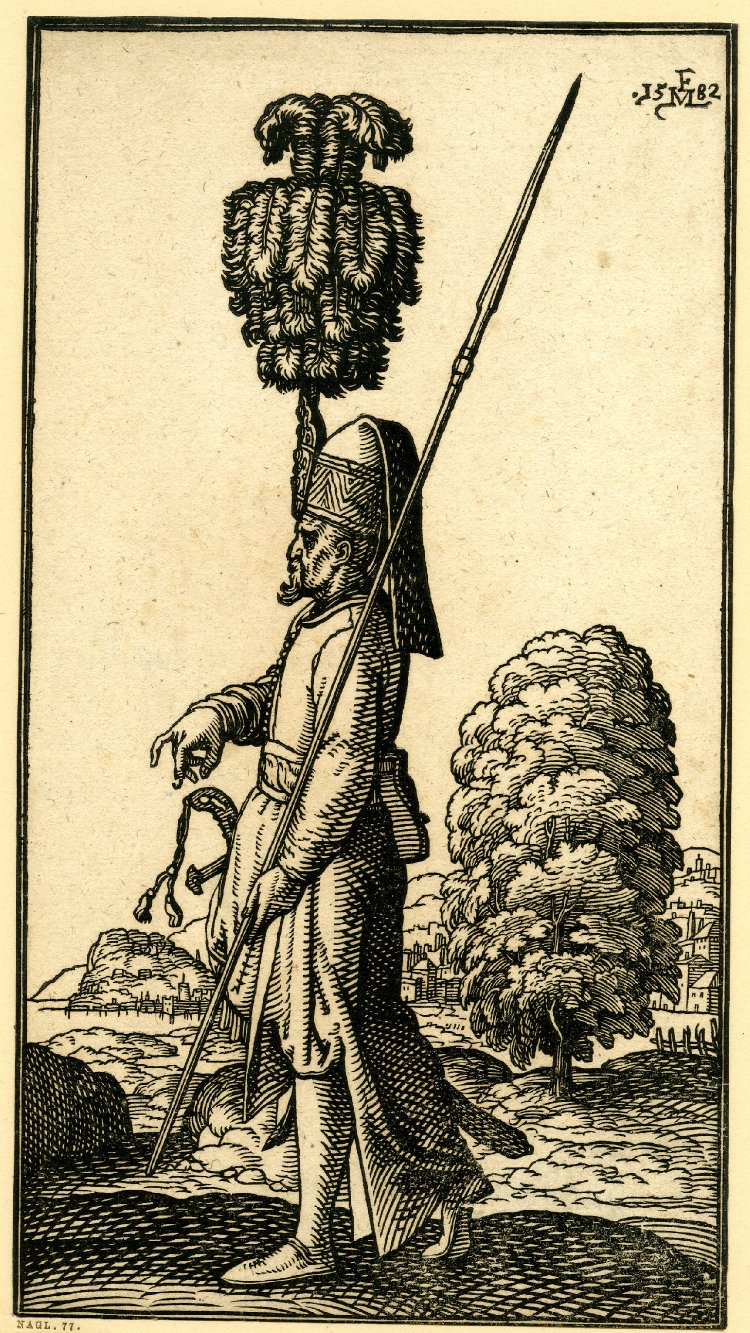
The most distinctive Ottoman institution was the recruitment system known as the devshirme (“collection” or “gathering”), through which Christian boys from the Balkan provinces were periodically conscripted, converted to Islam, trained in palace schools, and channelled either into the Janissary infantry corps or into the imperial administration. The system began under Murad I in the late fourteenth century, expanded sharply in the fifteenth and sixteenth centuries, and provided the empire with its standing army and a substantial portion of its senior administrators until its formal abolition in the mid-seventeenth century.9, 10
.jpg)
Under the system as it functioned in its classical form, every three to seven years officials toured designated Balkan villages and selected one boy in roughly forty households, usually aged between eight and eighteen, on criteria of physical fitness, intelligence, and character. The recruited boys were marched to Istanbul, converted to Islam, and assigned according to their abilities. The most promising were enrolled in the palace schools (Enderun) in the Topkapi Palace, where they received an elite education in Turkish, Arabic, Persian, the Quran, history, mathematics, military arts, and a craft, before entering the imperial service. The remainder were boarded with Turkish peasant families to learn the language and customs of their new society and were then enrolled in the Janissary corps.9, 10
The Janissaries (Turkish yeniçeri, “new soldiers”) were the empire's elite standing infantry and one of the first salaried professional armies in Europe. Their numbers grew from fewer than a thousand around 1400 to roughly 7,800 in 1484, 13,600 in 1574, and approximately 37,600 by 1609, before the corps swelled and degenerated through the recruitment of free-born Muslims into a much larger and more politically restive body that would dominate Istanbul politics for two centuries. Trained in the use of firearms earlier and more systematically than most European armies, the Janissaries provided Mehmed II with the assault force that broke the walls of Constantinople and Suleiman with the disciplined infantry that defeated the Hungarian nobility at Mohacs.10, 3
The political logic of the system was meritocratic and patrimonial at once. Because devshirme recruits were technically the personal slaves (kullari) of the sultan, severed from family and clan, they owed loyalty to him alone and could be rewarded or punished without offending entrenched interests. Through the sixteenth century the system produced grand viziers, provincial governors, fleet admirals, and master architects from villages in Albania, Bosnia, Greece, and Anatolia. Sokollu Mehmed Pasha, the great grand vizier under Suleiman and his successors, came from a Bosnian Serbian family; Mimar Sinan, the empire's greatest architect, was a Greek or Armenian Christian recruited from Cappadocia.10, 12 The system gradually broke down in the seventeenth century as Janissaries acquired the right to marry, to enrol their sons, and to engage in trade, transforming a slave army into a hereditary urban militia.
Suleiman and the classical age
The reign of Suleiman I, called Kanuni (“the Lawgiver”) in Ottoman tradition and “the Magnificent” in European usage, lasted forty-six years from 1520 to 1566 and marked the apogee of Ottoman power.14 Suleiman inherited an empire whose territories had been doubled by his father Selim I through the conquests of Mamluk Syria and Egypt in 1516–1517, which made the Ottoman sultans the protectors of Mecca, Medina, and Jerusalem and gave them custody of the Sunni caliphal tradition. Suleiman built on this base with a series of campaigns that pushed the empire's frontiers deep into central Europe and across the eastern Mediterranean.
The most consequential of his European campaigns was the Hungarian war of 1526. On 29 August at the Battle of Mohacs, an Ottoman army of approximately 45,000 troops, including Janissaries, sipahi cavalry, and a substantial artillery train, destroyed a Hungarian field army of around 25,000 to 30,000 men in less than two hours of fighting. King Louis II of Hungary was killed in the rout, ending the Jagiellonian dynasty in Hungary and Bohemia and clearing the way for the partition of the Hungarian kingdom between the Ottomans, the Habsburgs, and the Transylvanian principality.15, 14 Three years later Suleiman besieged Vienna itself, the first Ottoman attempt on the Habsburg capital. The siege of 1529 failed because of bad weather, overstretched supply lines, and the difficulty of moving heavy siege artillery so far from base; it nonetheless marked the geographical maximum of Ottoman expansion into central Europe.
Suleiman's title Kanuni reflected his role in codifying secular imperial law (kanun) alongside Islamic religious law (shariah). His jurists revised the existing kanun-names governing taxation, land tenure, criminal procedure, and provincial administration into a coherent code that remained in force for centuries. The dual legal system — with shariah courts under the kadis handling personal status, contracts, and inheritance, and the kanun providing a flexible imperial overlay — gave the Ottoman state both Islamic legitimacy and administrative pragmatism.14, 3 Under Suleiman the empire's population stood at perhaps fifteen million subjects and its territory at roughly two and a quarter million square kilometres, with revenues that surpassed those of any contemporary Christian state.22, 8

.jpg)
Religion, the millet system, and imperial pluralism
The Ottoman Empire ruled a population of remarkable confessional and ethnic diversity. Sunni Muslim Turks, Kurds, Arabs, and Bosniaks lived alongside Greek Orthodox, Armenian Apostolic, Syriac, Maronite, and Coptic Christians, Sephardic and Romaniote Jews, Druze, Alawites, Yazidis, and other smaller communities. The Ottoman approach to governing this diversity has come to be called the millet system, from the Arabic and Ottoman Turkish word for a religious community or nation. Under this arrangement, recognized non-Muslim communities — classically the Greek Orthodox, Armenian, and Jewish millets — were granted broad legal autonomy over personal status, family law, education, and internal taxation, with their religious leaders serving as the empire's intermediaries with the state.11
Recent scholarship has cautioned against treating the millet system as a single, uniform institution from the moment of the conquest of Constantinople. Bruce Masters and others have shown that what later sources call millets developed gradually over several centuries, that the system varied greatly by region and period, and that its modern, codified form belongs largely to the nineteenth century. In the early period the Greek patriarchate of Constantinople, restored by Mehmed II in 1454, exercised broad authority over Orthodox Christians of all ethnicities, while the Armenian patriarchate of Istanbul (established in 1461) and the chief rabbinate (hahambasi) governed their respective communities under similar terms.11
The system produced both genuine tolerance and structural inequality. Non-Muslims (dhimmis) paid the head tax (cizye), were generally barred from bearing arms, faced restrictions on dress and on the construction of new churches and synagogues, and were subordinated in court testimony involving Muslims. Within those limits, however, communities flourished: Sephardic Jews expelled from Spain in 1492 were welcomed by Sultan Bayezid II and settled mainly in Salonica and Istanbul, where they revived urban commerce and printing; Greek and Armenian merchants dominated long-distance trade; Christian artisans built much of the empire's monumental architecture.1, 11 The 1906 Ottoman census recorded the empire's population as approximately 74 percent Muslim, 14 percent Greek, 5 percent Armenian, 4 percent Bulgarian, and 1 percent Jewish — a snapshot of a polyglot state already shrinking under the pressures of European nationalism.21
Sinan and the architecture of empire
The Ottoman classical age produced a distinctive architectural tradition whose summit was the work of Mimar Sinan (c. 1490–1588), chief imperial architect under Suleiman, Selim II, and Murad III. Sinan was born to a Greek or Armenian Christian family in Cappadocia, recruited through the devshirme, and trained as a military engineer in the Janissary corps. He served on Ottoman campaigns from Belgrade and Rhodes to Vienna and Baghdad, building bridges, fortifications, and ships, before being appointed chief architect (mimar agasi) in 1539. Over the following half century he and his workshop designed and supervised the construction of more than three hundred and seventy buildings across the empire, including mosques, madrasas, hospitals, caravanserais, public kitchens, baths, and tombs.12, 13
Sinan's central architectural problem was the same one the Byzantine builders of the Hagia Sophia had confronted a thousand years earlier: how to roof a vast, unobstructed prayer hall with a single soaring dome. His solution evolved through a series of experiments at progressively larger scales. The Sehzade Mosque in Istanbul (1548), which he later called his “apprentice work,” introduced a perfectly symmetrical plan with four equal half-domes around a central dome. The Suleymaniye Mosque (1550–1557), the centerpiece of Suleiman's imperial foundation in Istanbul, set its 26.5-metre central dome 53 metres above the floor on two half-domes and four piers, creating a clear interior of unprecedented spaciousness within a complex (külliye) that included madrasas, a hospital, a public kitchen, and the founder's tomb.13, 12 Sinan considered his masterpiece to be the Selimiye Mosque in Edirne (1568–1574), where a single dome 31.3 metres in diameter rests on eight massive piers, creating an interior whose breadth and height surpassed even the Hagia Sophia by some measures.
Beyond his individual buildings, Sinan codified the visual vocabulary of Ottoman imperial architecture: the cascading semi-domes, slender pencil-shaped minarets, courtyard arcades, blue Iznik tilework, and integrated charitable complexes that defined the urban landscape of Istanbul, Edirne, Bursa, Damascus, and other Ottoman cities. His students and successors carried this tradition into the seventeenth century with works such as the Sultan Ahmed (Blue) Mosque in Istanbul, completed in 1616. Ottoman classical architecture in turn influenced builders across the eastern Mediterranean and the Balkans for centuries afterwards.12
Lepanto and the limits of Ottoman power
The half century after Suleiman's death in 1566 brought the first clear signs that Ottoman expansion had reached its outer limits. In the western Mediterranean, decades of contest with the Spanish Habsburgs and their Italian allies came to a head at the Battle of Lepanto on 7 October 1571, when a Christian Holy League fleet assembled by Pope Pius V and led by Don Juan of Austria, half-brother of Philip II of Spain, defeated an Ottoman armada in the Gulf of Patras off western Greece. More than four hundred fifty galleys and small craft and roughly 150,000 men were engaged in what was the largest naval battle in European waters since classical antiquity. The Christian fleet sank or captured over a hundred Ottoman ships, killed or captured tens of thousands of Ottoman sailors and soldiers, and freed thousands of Christian galley slaves.16
Lepanto was the first major Ottoman naval defeat in over a century, and it had a profound psychological impact on European observers, who treated it as a deliverance from an apparently invincible Turkish threat. Its strategic consequences were more limited. The Ottomans rebuilt their fleet within a year, completed the conquest of Cyprus from Venice in 1571, and continued to dominate the eastern Mediterranean. The grand vizier Sokollu Mehmed Pasha is reported to have told the Venetian envoy that “in wresting Cyprus from you we have cut off one of your arms; in defeating our fleet you have only shaved our beard.”16, 1 Yet Lepanto did mark the de facto division of the Mediterranean into Ottoman and Christian zones, ended the era of large-scale Ottoman amphibious offensives in the western basin, and signalled the beginning of the long shift in the balance of military innovation from the empire toward Atlantic Europe.
Land warfare followed a similar pattern. The Long Turkish War with the Habsburgs (1593–1606) and the protracted Cretan War with Venice (1645–1669) were costly and indecisive struggles that consumed resources without yielding the rapid expansions of the classical age. The decisive turning point on the European front came in 1683 with the second Ottoman siege of Vienna, when an army under grand vizier Kara Mustafa Pasha laid siege to the Habsburg capital and was crushed by a Polish-German relief army under King Jan Sobieski on 12 September. The Habsburg-led Holy League followed this victory with a sixteen-year war of reconquest that ended with the Treaty of Karlowitz in 1699, by which the Ottomans formally ceded most of Hungary and Transylvania to Austria, the Morea to Venice, and Podolia to Poland — the first major territorial losses in the empire's history.1, 3
The Köprülü era and the limits of decline
Earlier historians characterized the long period from Suleiman's death in 1566 to the Tanzimat as one of unrelieved Ottoman decline, citing internal corruption, the degeneration of the Janissaries, palace intrigues, and successive military defeats. Recent scholarship, especially the work of Donald Quataert, has dismantled this “decline thesis,” arguing that the empire underwent a long process of transformation that included real crises but also significant adaptation, recovery, and innovation.4 The most striking evidence of institutional resilience came in the second half of the seventeenth century with the Köprülü era of administrative reform.
Mehmed Köprülü Pasha, an elderly Albanian-born official, was appointed grand vizier in September 1656 at a moment when Istanbul was paralyzed by Janissary mutinies, the Venetians had blockaded the Dardanelles, and provincial revolts were spreading through Anatolia. He accepted the office only on condition of a free hand to govern. Over the next five years he restored order through ferocious measures, executing rebels, purging corrupt officials, lifting the Venetian blockade, and reasserting central authority over the provinces. After his death in 1661 his son Fazil Ahmed succeeded him as grand vizier, beginning a dynasty within a dynasty that would supply the empire with five grand viziers between 1656 and 1710.17
Under the Köprülüs the empire balanced its budget, modernized its tax collection, completed the long conquest of Crete from Venice in 1669, and launched the offensive that ended at the walls of Vienna in 1683. The Vienna disaster discredited the family and revealed the limits of the Köprülü restoration, but the period nevertheless demonstrated that the Ottoman state retained substantial capacity for institutional self-correction more than a century after Suleiman.17, 1 The eighteenth century saw further fiscal and administrative experimentation, including the spread of life-tenure tax farming (malikane), which delegated revenue collection to private contractors but tied them to the state through inheritance and capital investment. By 1800 the empire's institutions looked very different from those of Suleiman's day, but they were neither stagnant nor collapsing.
The Tanzimat and nineteenth-century reform
The nineteenth century opened with a series of catastrophic shocks that compelled the Ottoman state to undertake the most ambitious reorganization in its history. Russia annexed the Crimea in 1783, defeated the empire repeatedly in the Black Sea wars, and emerged as the dominant Christian power in eastern Europe. The French invasion of Egypt in 1798 demonstrated the vulnerability of Ottoman provinces to European arms. Greek rebels won independence in the 1820s with British, French, and Russian help. Mehmed Ali Pasha, the Albanian governor of Egypt, built a modernized army that defeated Ottoman forces in 1832 and 1839 and reduced the empire to a Russian protectorate. The reformers concluded that survival required wholesale European-style modernization.18
The first major step was Sultan Mahmud II's destruction of the Janissary corps in June 1826, an event the regime celebrated as the “Auspicious Incident” (Vaka-yi Hayriye). After the Janissaries mutinied against his proposed military reforms, Mahmud unleashed loyal troops and artillery on their barracks, killing thousands and abolishing the corps that had been the empire's military backbone for four centuries. With the Janissaries removed, the sultan built a new conscript army on European lines, established government ministries, opened a translation bureau and modern schools, and centralized provincial administration.18
The Tanzimat (“reorganization”) proper began in November 1839 with the Edict of Gülhane, issued by Sultan Abdulmejid I and drafted by his foreign minister Mustafa Resid Pasha. The edict promised security of life, property, and honour to all subjects regardless of religion; reform of taxation; fair conscription; and equality before the law. A subsequent Reform Edict of 1856 (Hatt-i Hümayun) reaffirmed and extended these guarantees, abolished the head tax on non-Muslims, and opened state offices to all subjects. New legal codes followed: the Land Code of 1858, the Penal Code of 1858, a Commercial Code modelled on French law, and the codified civil law of the Mecelle. The first Ottoman parliament met in 1877 under the constitution of 1876, drafted by the reformer Midhat Pasha.18, 4
The reforms produced real institutional change — modern ministries, secular courts (nizamiye), telegraph and railway networks, modern schools producing a new bureaucratic and military class — but they also generated political crises. Rising fiscal pressures from European loans bankrupted the state in 1875 and led to the establishment of the Ottoman Public Debt Administration in 1881, a body controlled by foreign creditors that collected key revenues directly. Sultan Abdulhamid II suspended the constitution in 1878 and ruled as an autocrat for thirty years, pursuing a different path of modernization that combined administrative rationalization with pan-Islamic ideology and increasingly violent repression of nationalist movements among the empire's Christian populations.4, 18
Young Turks, World War, and dissolution
Opposition to Abdulhamid's autocracy coalesced in the late nineteenth century around a constellation of exile groups and military officers loosely known as the Young Turks. The most important of these was the Committee of Union and Progress (CUP), founded as a secret society among medical students in Istanbul in 1889 and expanded through cells in the army garrisons of Macedonia. In July 1908 army units in Macedonia rose in revolt, demanding the restoration of the 1876 constitution; Abdulhamid, faced with the threat of a march on Istanbul, capitulated on 23 July, restored parliamentary government, and inaugurated the Second Constitutional Era.19
The constitutional regime quickly proved fragile. A counter-revolution in April 1909 led to Abdulhamid's deposition and replacement by his weaker brother Mehmed V. Italy seized Libya in 1911. The Balkan Wars of 1912–1913 cost the empire almost all of its remaining European territory in less than a year. The CUP responded by tightening its grip on government through a coup in January 1913, after which a triumvirate of officers — Enver Pasha, Talaat Pasha, and Cemal Pasha — effectively governed the empire. Their alignment of the empire with Germany on the eve of the First World War proved catastrophic.19, 1
Ottoman entry into World War I in November 1914 brought four years of attritional warfare on multiple fronts. Ottoman armies repulsed the Allied landings at Gallipoli in 1915–1916 in one of the empire's last great military feats, but suffered devastating defeats in the Caucasus against Russia and in Mesopotamia and Palestine against British forces and their Arab allies. The Armenian Genocide of 1915–1916, organized by the CUP regime, killed an estimated 600,000 to 1.5 million Armenian civilians through massacres, deportations, and death marches into the Syrian desert — the foundational atrocity of the twentieth century and a defining trauma in modern Ottoman history.4, 1 The empire signed an armistice in October 1918 and was occupied by Allied forces.
The Treaty of Sèvres of August 1920 dismembered what remained of the Ottoman state, transferring Arab provinces to British and French mandates, awarding eastern Anatolia to a projected Armenian republic and an autonomous Kurdistan, ceding Smyrna and surrounding territory to Greece, and reducing the Ottoman government to a rump state under Allied supervision. The treaty was rejected by the Turkish nationalist movement led by Mustafa Kemal Pasha (later Atatürk), which won the Turkish War of Independence (1919–1922) against Greek, Armenian, and French forces. The Grand National Assembly in Ankara abolished the sultanate on 1 November 1922, and the last Ottoman sultan, Mehmed VI, fled Istanbul aboard a British warship two weeks later. The Treaty of Lausanne, signed on 24 July 1923 in Switzerland, recognized the boundaries of the new Republic of Turkey and remains the only major peace settlement of the First World War still in legal force today.20, 19 The caliphate, retained briefly in symbolic form, was abolished in March 1924, ending the dynastic and religious institutions of the Ottoman state after more than six centuries.
References
The Cambridge History of Turkey, Volume 2: The Ottoman Empire as a World Power, 1453–1603