Overview
- Big Bang nucleosynthesis (BBN) theory predicts the primordial abundance of lithium-7 with high precision, but observations of the oldest, most metal-poor halo stars consistently show lithium-7 abundances a factor of 3–4 below the predicted value — a discrepancy known as the cosmological lithium problem.
- The observed lithium abundances in metal-poor stars form a remarkably uniform plateau (the Spite plateau), discovered in 1982, which was initially interpreted as reflecting the primordial abundance but is now known to lie significantly below BBN predictions calibrated by the CMB baryon density.
- Proposed solutions span astrophysics (stellar depletion of surface lithium through turbulent mixing, gravitational settling, or rotational transport), nuclear physics (revised reaction rates or resonances), and new physics (decaying or annihilating particles in the early universe), but no single explanation has achieved consensus.
Big Bang nucleosynthesis and light element predictions
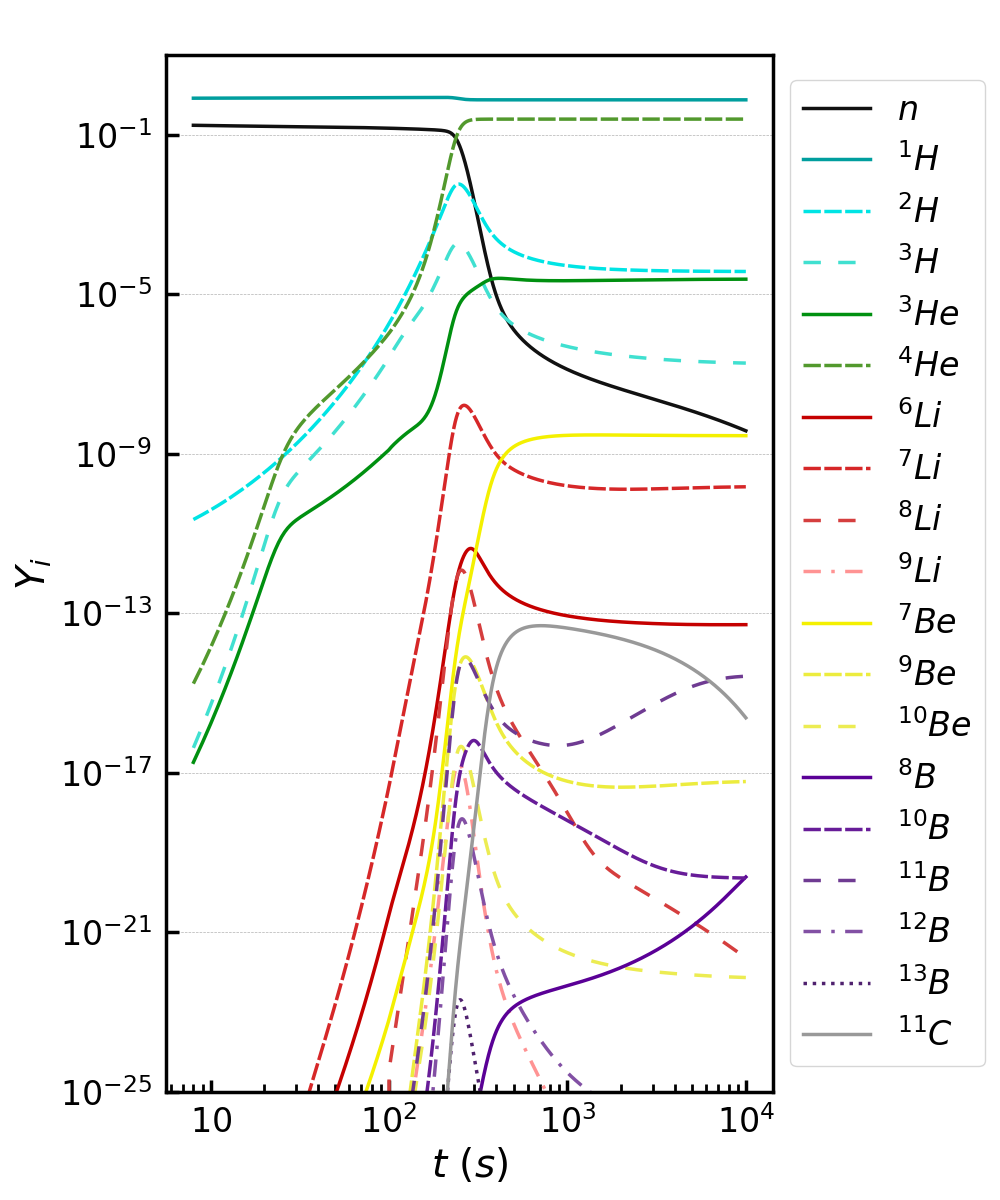
Big Bang nucleosynthesis (BBN) is the process by which the lightest atomic nuclei — deuterium, helium-3, helium-4, and lithium-7 — were synthesized in the first few minutes after the Big Bang, when the universe was hot and dense enough for nuclear reactions to proceed. The predicted abundances of these elements depend almost entirely on a single free parameter: the baryon-to-photon ratio, η, which sets the density of baryonic matter available for nuclear reactions.2, 3
.png)
The Spite plateau
The observational foundation of the lithium problem is the Spite plateau, discovered by Francois and Monique Spite in 1982. They measured lithium abundances in a sample of warm (Teff > 5,700 K), metal-poor halo stars and found that, unlike most other elements, lithium showed no correlation with metallicity: stars spanning a wide range of iron abundance all had essentially the same lithium abundance, A(Li) ≈ 2.05–2.2 (on the standard astronomical logarithmic scale where hydrogen is 12).1
This uniformity was initially interpreted as strong evidence that the plateau value represented the primordial lithium abundance, preserved essentially unchanged in the atmospheres of these old, unevolved stars. The flatness of the plateau argued against significant stellar depletion, which would be expected to produce a spread in abundances because different stars deplete at different rates depending on their mass, temperature, and rotational history.1, 8
Subsequent observations with larger samples and improved spectroscopic techniques confirmed the reality and thinness of the Spite plateau while refining its value. Analysis of lithium isotope ratios in metal-poor stars further constrained the problem, as the 6Li/7Li ratio provides additional diagnostics of possible depletion or production mechanisms.15 Bonifacio and colleagues (2007) found A(Li) = 2.10 ± 0.09 for a sample of extremely metal-poor turnoff stars, with a very small intrinsic scatter.5 Sbordone and colleagues (2010) obtained a similar value of A(Li) = 2.08 ± 0.10 using homogeneous analysis techniques.11
The discrepancy
The BBN-predicted primordial lithium-7 abundance, using the Planck baryon density, is A(Li) = 2.67–2.75, depending on the nuclear reaction rate compilations used.3, 14 The observed Spite plateau value of A(Li) ≈ 2.1 falls short of this prediction by a factor of 3 to 4 (0.5–0.6 dex on the logarithmic scale). The discrepancy is statistically significant at more than 4σ and has persisted despite three decades of improved observations, updated nuclear reaction rates, and revised stellar atmosphere models.3, 6
Importantly, the problem is specific to lithium-7. The BBN predictions for deuterium (D/H ≈ 2.5 × 10⁻⁵) agree with observations of deuterium absorption in high-redshift quasar spectra to within a few percent, and the predicted helium-4 mass fraction (Yp ≈ 0.247) agrees with observations to better than 1 percent.3, 4 The lithium-7 discrepancy thus stands alone as the one significant failure of standard BBN.
Astrophysical solutions: stellar depletion
The most conservative class of proposed solutions invokes astrophysical processes that deplete lithium from the surfaces of old stars over their multi-billion-year lifetimes, so that the observed Spite plateau represents a uniformly depleted value rather than the true primordial abundance.
Several mechanisms have been proposed. Gravitational settling (atomic diffusion) causes heavier elements to sink slowly out of the convective envelope of a star into deeper, hotter layers where lithium is destroyed by proton capture. Richard and colleagues (2005) showed that models combining atomic diffusion with a small amount of turbulent mixing below the convection zone can reproduce the observed lithium plateau at a level consistent with the BBN prediction, provided the turbulence is finely tuned to produce uniform depletion across a range of stellar parameters.7
Observational support for diffusion came from Korn and colleagues (2006), who detected systematic trends in the abundances of iron, calcium, and other elements along the subgiant branch of the globular cluster NGC 6397 that are consistent with the gravitational settling predicted by diffusion models. They inferred a lithium depletion of approximately 0.25 dex due to diffusion, which would account for a significant fraction but not all of the discrepancy.16
However, several challenges face the stellar depletion hypothesis. The very small scatter of the Spite plateau — only 0.03–0.05 dex of intrinsic dispersion — is difficult to explain if depletion depends on stellar parameters such as mass, rotation, and age, which vary from star to star. The required fine-tuning of turbulent mixing to produce uniform depletion is considered ad hoc by some researchers.6, 11 Additionally, non-LTE (non-local thermodynamic equilibrium) corrections to the spectroscopic lithium abundance increase the derived values by approximately 0.05–0.10 dex but do not close the gap.12
Nuclear physics solutions
A second class of solutions proposes that the nuclear reaction rates used in BBN calculations are incorrect, such that the true predicted primordial lithium-7 abundance is lower than current calculations indicate. The production of lithium-7 in BBN proceeds primarily through the decay of beryllium-7, which is itself produced by the reaction 3He(α,γ)7Be. Any reaction that efficiently destroys beryllium-7 before it decays to lithium-7 would reduce the final lithium abundance.3, 10
Various nuclear reactions have been investigated as potential “lithium destroyers,” including 7Be(d,p)2α and 7Be(n,p)7Li followed by 7Li(p,α)4He. Coc and colleagues (2015) investigated the 7Be(d,p)2α reaction and found that even with optimistic cross-section estimates, it could not reduce lithium-7 sufficiently to resolve the discrepancy.9 Comprehensive sensitivity studies have shown that no known nuclear reaction, when varied within its experimental uncertainty, can reduce the predicted lithium-7 to the observed level without simultaneously disrupting the successful predictions for deuterium and helium-4.3, 10
The possibility of unknown or poorly measured resonances in key reactions remains open, but the required changes to cross-sections are large enough that they would likely have been detected in laboratory experiments.6
New physics solutions
The most speculative class of solutions invokes physics beyond the Standard Model of particle physics to modify the conditions during BBN. Proposed mechanisms include the late decay or annihilation of massive particles that inject energetic photons or hadrons into the primordial plasma after BBN, selectively destroying beryllium-7 and lithium-7 while leaving deuterium and helium-4 relatively unaffected.13
Supersymmetric particles, particularly the next-to-lightest supersymmetric particle (NLSP) decaying during or after BBN, have been explored as candidates. If such particles existed with the right mass and lifetime, their decay products could photodisintegrate beryllium-7 nuclei and reduce the lithium-7 yield by the required factor. However, these scenarios require specific parameter choices and have not received independent support from particle physics experiments.13
Variations in fundamental constants (such as the fine-structure constant or the deuteron binding energy) during the BBN epoch have also been considered, but the constraints from the successful prediction of other light elements severely limit the allowed parameter space.6
The meltdown at lowest metallicities
Recent observations of extremely metal-poor stars with [Fe/H] below approximately −3.0 have introduced an additional complication to the lithium problem: the Spite plateau appears to break down at the lowest metallicities, with lithium abundances dropping below the plateau value and showing increased scatter. Aoki and colleagues found that several stars with metallicities below [Fe/H] = −3.5 have lithium abundances as low as A(Li) = 1.0–1.5, well below the canonical plateau value of approximately 2.1.17 This “meltdown” of the plateau at the lowest metallicities complicates the interpretation of the Spite plateau as a uniform depletion of the primordial abundance, because the most metal-poor stars — which should in principle best preserve the primordial composition — show the greatest departures from the expected pattern.17, 6
Several explanations have been proposed for this behaviour. Some metal-poor stars may have undergone additional lithium depletion due to deeper convective mixing, longer main-sequence lifetimes, or mass transfer in binary systems. Alternatively, the most metal-poor stars may have formed from gas that was pre-processed by an earlier generation of stars that had already destroyed some lithium. The meltdown phenomenon suggests that the relationship between metallicity and lithium depletion may be more complex than a simple uniform reduction, and it has motivated comprehensive surveys of lithium in extremely metal-poor stellar populations to better characterise the full range of observed abundances.17, 18
The lithium-6 puzzle
A related but distinct problem involves lithium-6, the rarer isotope of lithium. Standard BBN predicts a negligible primordial 6Li/7Li ratio of approximately 10−5, yet several observational analyses have reported detections of 6Li in metal-poor halo stars at ratios of a few percent — many orders of magnitude above the BBN prediction.15 If confirmed, these detections would constitute a “second lithium problem” requiring pre-galactic production of 6Li, possibly by cosmic-ray interactions or by decaying exotic particles in the early universe. However, subsequent studies using three-dimensional stellar atmosphere models and careful treatment of line asymmetries have shown that most or all of the apparent 6Li detections can be explained as artifacts of inadequate one-dimensional spectral modelling, calling the observational evidence for enhanced 6Li into question.12, 18
Current status
As of the mid-2020s, the cosmological lithium problem remains unresolved. No single proposed solution has achieved consensus acceptance, and the problem continues to motivate research across astrophysics, nuclear physics, and particle physics.3, 6 The leading contender among astrophysical solutions — atomic diffusion with turbulent mixing — can account for a depletion of 0.2–0.4 dex, which brings observed and predicted values closer but may not fully close the gap.7, 16 The combination of modest stellar depletion with small systematic effects in spectroscopic analysis (non-LTE corrections, 3D atmosphere effects) may ultimately explain the discrepancy within standard physics, but this remains to be demonstrated convincingly.
The lithium problem is notable because it represents the only significant quantitative failure of the otherwise spectacularly successful BBN framework. Whether its resolution lies in mundane stellar astrophysics or points toward genuinely new physics is one of the outstanding questions at the intersection of cosmology and particle physics.3, 6, 13
References
Updated Big Bang nucleosynthesis compared to WMAP observations and the abundance of light elements