Overview
- Interstellar dust consists of sub-micron solid particles — primarily silicates and carbonaceous grains — that make up roughly 1% of the mass of the interstellar medium but profoundly affect astronomical observations by absorbing and scattering starlight, causing extinction of up to 30 magnitudes in the densest molecular clouds and systematically reddening the light of background objects.
- Dust grains serve as catalytic surfaces for the formation of molecular hydrogen and other molecules essential to interstellar chemistry, and they provide the shielding from ultraviolet radiation that allows molecular clouds to remain cold and gravitationally unstable, making dust a critical ingredient in the physics of star formation.
- The lifecycle of interstellar dust — formed in the envelopes of evolved stars and supernovae, processed by shocks and radiation in the diffuse medium, and destroyed or incorporated into new stars and planets — is intimately connected to the cosmic cycle of chemical enrichment that builds the heavy-element inventory of galaxies over time.
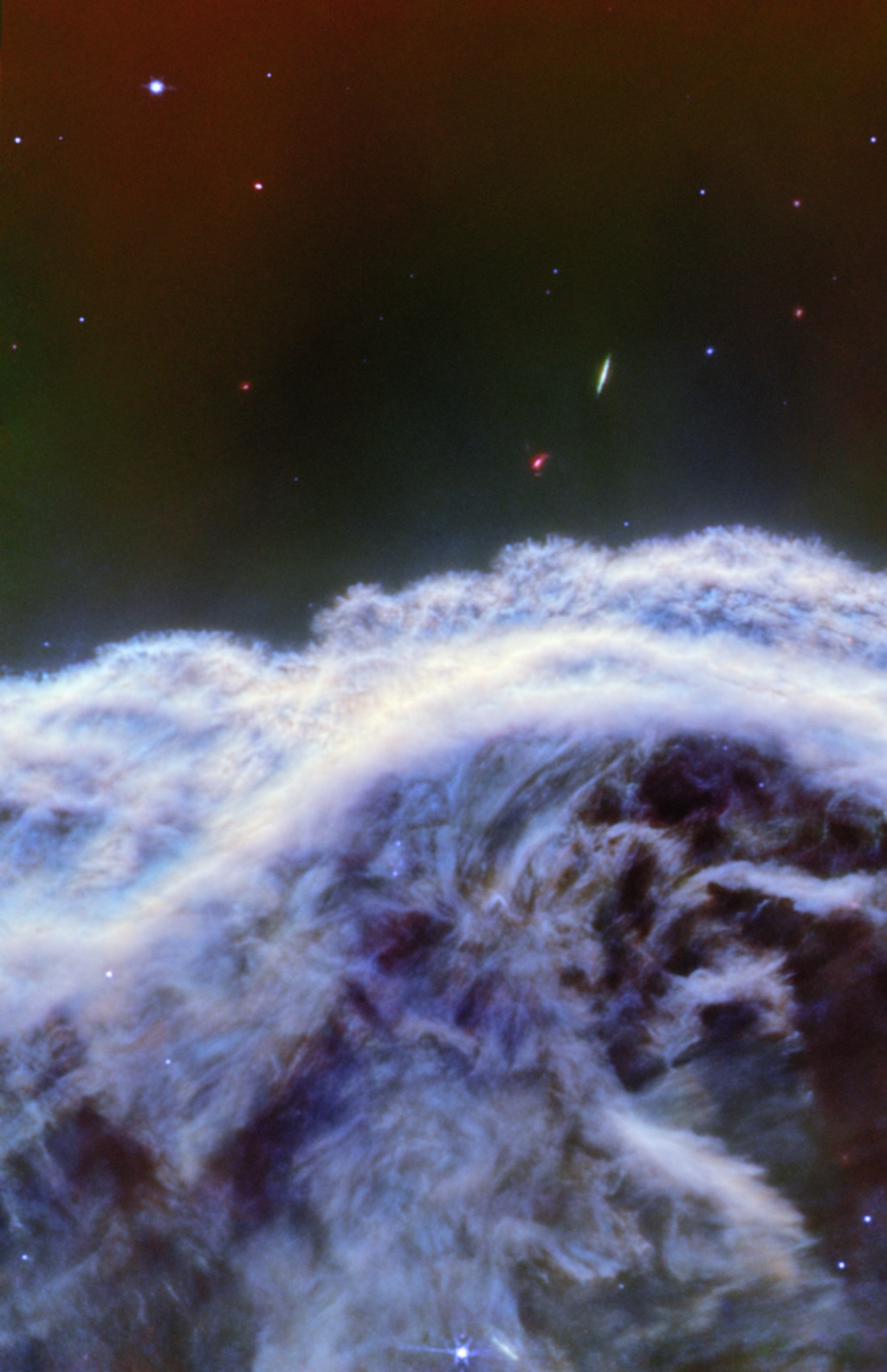
Interstellar dust consists of tiny solid particles — typically 0.001 to 1 micron in diameter — dispersed throughout the gas of the interstellar medium (ISM). Although dust accounts for only about 1% of the ISM by mass, its influence on astronomy and astrophysics is far out of proportion to its abundance. Dust absorbs and scatters starlight across a broad range of wavelengths, dimming and reddening the light of distant objects; it reradiates the absorbed energy at infrared and submillimeter wavelengths, making the far-infrared sky a map of the Galaxy’s dust distribution; and it provides the catalytic surfaces on which molecular hydrogen — the most abundant molecule in the universe and the raw material of star formation — is assembled. The existence of interstellar dust was first conclusively demonstrated by Robert Trumpler in 1930, who showed that the apparent sizes of open star clusters implied a general absorption of starlight that increased with distance.1, 3
.jpg)
Composition and grain properties
The composition of interstellar dust grains has been inferred from a combination of observational evidence: the wavelength dependence of interstellar extinction, infrared emission and absorption features, interstellar depletions of refractory elements from the gas phase, and laboratory studies of meteoritic presolar grains. The two principal grain populations are silicates and carbonaceous materials. Silicate grains, composed primarily of magnesium- and iron-rich amorphous silicates (olivine and pyroxene compositions), produce a characteristic broad absorption feature at 9.7 microns due to the Si–O stretching vibration, along with a weaker feature at 18 microns from the O–Si–O bending mode. Carbonaceous grains include amorphous carbon, hydrogenated amorphous carbon, and possibly graphitic material; the prominent 2175 Å bump in the ultraviolet extinction curve, one of the strongest spectral features in all of interstellar spectroscopy, has long been attributed to small graphitic or aromatic carbon grains, though its precise carrier remains debated.5, 15, 8
The grain size distribution was first quantitatively modeled by Mathis, Rumpl, and Nordsieck in 1977, who showed that the observed interstellar extinction curve from the infrared to the ultraviolet could be reproduced by a power-law distribution of grain radii, dn/da ∝ a−3.5, with radii ranging from roughly 0.005 to 0.25 microns. This MRN model, as it became known, demonstrated that small grains dominate by number while large grains dominate by mass. Subsequent refinements have incorporated polycyclic aromatic hydrocarbons (PAHs) — large planar molecules of 50 to several hundred carbon atoms that produce a family of emission features at 3.3, 6.2, 7.7, 8.6, and 11.3 microns when excited by ultraviolet radiation. PAHs may constitute as much as 10–20% of the total interstellar carbon budget and bridge the gap between large molecules and small solid grains.5, 1
Extinction and reddening of starlight
The most directly observable effect of interstellar dust is the extinction of starlight: the combined absorption and scattering of photons by dust grains along the line of sight. Extinction is wavelength-dependent, with shorter (bluer) wavelengths scattered and absorbed more efficiently than longer (redder) wavelengths. The result is that stars observed through dust appear both fainter (due to the total extinction) and redder (due to the differential wavelength dependence) than they would in the absence of dust. This interstellar reddening was Trumpler’s key insight, and it must be corrected for in virtually all photometric and spectroscopic studies of Galactic and extragalactic objects. The standard parameterization of the Milky Way extinction law, established by Cardelli, Clayton, and Mathis in 1989, relates the extinction at any wavelength to the color excess E(B−V) through a single parameter, RV, which has a typical value of 3.1 in the diffuse ISM but can range from 2.5 to 5.5 in different environments.4, 3
In the densest molecular clouds, visual extinction can exceed 30 magnitudes, rendering the cloud completely opaque at optical wavelengths. These regions are observed instead at infrared and submillimeter wavelengths, where dust extinction is much lower. Dust grains that are aligned by the interstellar magnetic field produce polarization of the light passing through them, with the degree and orientation of polarization providing a diagnostic of the magnetic field geometry along the line of sight. The Serkowski law describes the wavelength dependence of interstellar polarization, which peaks at optical wavelengths and is attributed to aligned non-spherical silicate grains. Planck satellite observations of polarized thermal emission from dust at submillimeter wavelengths have provided all-sky maps of the magnetic field structure in the Milky Way’s ISM, revealing the ordered and turbulent components of the Galactic magnetic field with unprecedented detail.6, 12
Role in star formation
Interstellar dust plays several essential roles in the process of star formation. The most fundamental is the formation of molecular hydrogen (H2) on grain surfaces. In the gas phase, the formation of H2 from two hydrogen atoms is extremely inefficient because the molecule must radiate away its binding energy to remain bound, and the two-body radiative association rate is vanishingly small at interstellar densities. On dust grain surfaces, however, hydrogen atoms can adsorb, migrate, meet, and combine, with the excess energy absorbed by the grain lattice. This catalytic process, first analyzed quantitatively by Hollenbach and Salpeter in 1971, is believed to account for essentially all of the molecular hydrogen in the ISM. Without dust, the molecular clouds in which stars form would not exist.10, 2
Dust also provides critical shielding from the interstellar ultraviolet radiation field. In the outer layers of a cloud, ultraviolet photons dissociate molecules and heat the gas, preventing gravitational collapse. As the column density of dust increases toward the cloud interior, the ultraviolet field is progressively attenuated, allowing the gas temperature to drop to 10–20 K and molecules to survive. At these temperatures, thermal pressure is low enough that the cloud’s self-gravity can overcome it, initiating the collapse that leads to the formation of protostars and, ultimately, planetary systems. In the later stages of star formation, dust in protoplanetary disks serves as the raw material from which planets are assembled: grain growth through collisional sticking leads to progressively larger aggregates, from micron-sized particles to millimeter-sized pebbles and eventually to kilometer-sized planetesimals.2, 1
The dust lifecycle and cosmic chemical enrichment
Interstellar dust is produced primarily in the outflows and ejecta of evolved stars. Asymptotic giant branch (AGB) stars, which undergo thermal pulsations and intense mass loss in the final stages of their evolution, are major dust factories: carbon-rich AGB stars produce carbonaceous dust, while oxygen-rich stars produce silicate grains. Core-collapse supernovae also produce dust in their expanding ejecta, as demonstrated by infrared and submillimeter observations of young supernova remnants. However, the fraction of supernova-produced dust that survives the passage of the reverse shock and enters the ISM remains uncertain, with estimates ranging from less than 10% to more than 50% depending on the shock conditions and grain properties. Additional dust growth in the ISM itself — the accretion of gas-phase metals onto existing grain surfaces in dense clouds — is increasingly recognized as a significant source that may dominate over stellar production in maintaining the observed dust mass of the Milky Way.7, 9, 13
Dust destruction occurs primarily through sputtering and grain-grain collisions in the fast shocks generated by supernovae. A single supernova remnant can destroy more dust than its progenitor star produced, which creates a budget problem: the rates of dust production by stars alone appear insufficient to balance the rate of destruction, implying that grain growth in the ISM must be an important replenishment mechanism. In galaxies at high redshift, where large dust masses have been observed within the first billion years of cosmic history, the rapid production of dust is particularly challenging to explain, since the timescales for AGB star evolution are comparable to the age of the universe at those epochs. Supernovae and rapid grain growth in the ISM are the leading candidates for producing the observed dust in early galaxies, with implications for the chemical enrichment and star formation efficiency of the first generation of galaxies.14, 11, 7
References
The effect of a general interstellar absorption on the apparent distribution of the spiral nebulae