Overview
- Magnetar giant flares are the most powerful magnetic eruptions in the universe, releasing up to 1046–1047 erg in a fraction of a second — more energy than the Sun emits in hundreds of thousands of years — driven by catastrophic rearrangements of the ultra-strong magnetic field threading a neutron star.
- The 27 December 2004 giant flare from SGR 1806−20 was the most energetic event ever recorded from within the Milky Way, briefly saturating detectors across the solar system and producing quasi-periodic oscillations in the decaying tail that revealed seismic vibrations of the neutron star crust, opening a window onto the interior physics of ultra-dense matter.
- The 2020 detection of a luminous radio burst from the Galactic magnetar SGR 1935+2154, coincident with an X-ray burst, established a direct connection between magnetar activity and fast radio bursts, suggesting that magnetar giant flares or intermediate events in external galaxies may account for at least some of the extragalactic fast radio burst population.
Magnetar giant flares are among the most energetic events in the universe, releasing up to 1046–1047 erg in a fraction of a second through the catastrophic release of energy stored in the ultra-strong magnetic field of a neutron star. Only three confirmed giant flares have been observed from magnetars in the Milky Way and its satellites — in 1979, 1998, and 2004 — but these events have profoundly shaped our understanding of magnetic field physics at extreme strengths, the interior structure of neutron stars, and the connection between magnetar activity and other high-energy transient phenomena including fast radio bursts and gamma-ray bursts.7, 1
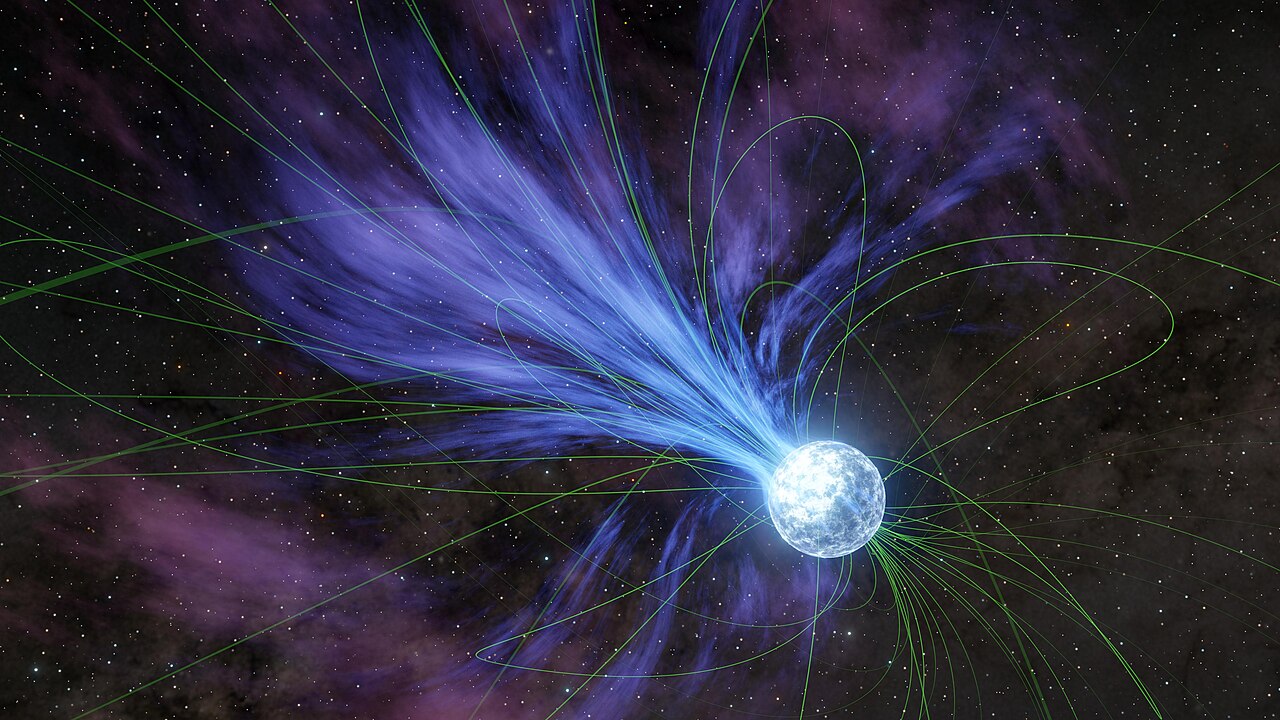

The three observed giant flares
The first magnetar giant flare was detected on 5 March 1979, when a burst of hard gamma rays from the direction of the supernova remnant N49 in the Large Magellanic Cloud overwhelmed the detectors of multiple spacecraft. This event, later attributed to the soft gamma repeater SGR 0526−66, reached a peak luminosity of approximately 1045 erg/s and was followed by a pulsating tail with a period of 8.0 seconds — the rotation period of the underlying neutron star. At the time, no known physical process could account for such an extraordinary energy release from a neutron star, and the event remained enigmatic for over a decade until the magnetar model was developed by Duncan and Thompson in the early 1990s.8, 6
The second confirmed giant flare occurred on 27 August 1998, from SGR 1900+14, a magnetar located approximately 6 kiloparsecs away in the Milky Way. This event released approximately 1044 erg in its initial spike, followed by a pulsating tail lasting several minutes at the source’s 5.16-second rotation period. The 1998 flare was notable for demonstrating that the pulsating tail arises from a trapped fireball of electron-positron pairs and radiation, confined near the neutron star surface by the extreme magnetic field and rotating with the star. This observation provided strong support for the Thompson-Duncan magnetar model, in which the energy source for giant flares is the reconfiguration of the internal and external magnetic field, analogous to a solar flare but scaled up by a factor of 1015 in magnetic field strength.9, 5
The third and most powerful observed giant flare erupted from SGR 1806−20 on 27 December 2004. The initial hard spike lasted approximately 0.2 seconds and released an estimated 2 × 1046 erg — more energy than the Sun emits in 250,000 years — making it the brightest transient event ever recorded from outside the solar system. The gamma-ray flash was so intense that it ionized the Earth’s upper atmosphere from a distance of approximately 15 kiloparsecs, producing a measurable disturbance in the ionosphere. The pulsating tail, modulated at the 7.56-second rotation period of the magnetar, lasted over 400 seconds and provided a wealth of timing information about the trapped fireball and the neutron star.1, 2
Physical mechanism
The energy source for magnetar giant flares is the magnetic field itself. Magnetars possess surface dipole fields of 1014 to 1015 gauss, corresponding to magnetic energy densities that exceed the gravitational binding energy per unit volume of the neutron star crust. The interior field is believed to be even stronger, potentially reaching 1016 gauss or more in toroidal configurations. Over time, the internal magnetic field evolves through a combination of Hall drift and Ohmic diffusion, building up stresses in the rigid neutron star crust. When the accumulated stress exceeds the mechanical yield strength of the crust, a sudden fracture occurs — a starquake — allowing the external magnetic field to reconfigure catastrophically. This reconfiguration annihilates magnetic flux and converts magnetic energy into a fireball of electron-positron pairs and photons, much as magnetic reconnection powers solar flares but on a vastly larger scale.5, 6, 7
The initial spike of a giant flare is thought to result from the sudden release of energy in the magnetosphere as the field lines reconnect and rearrange. The energy is released on a timescale of milliseconds to hundreds of milliseconds, far faster than can be accounted for by thermal processes in the stellar interior. The subsequent pulsating tail arises from a hot, optically thick fireball trapped near the stellar surface by closed magnetic field lines. The fireball cools and contracts over minutes, with its emission modulated at the stellar rotation period as different portions of the trapped plasma come into and out of view. The total energy budget, spectral evolution, and pulsation properties of the three observed giant flares are broadly consistent with this picture, though the detailed physics of the reconnection process, the trigger mechanism for the crustal fracture, and the geometry of the trapped fireball remain areas of active theoretical investigation.5, 7
Quasi-periodic oscillations and neutron star seismology
One of the most remarkable discoveries to emerge from the 2004 giant flare was the detection of quasi-periodic oscillations (QPOs) in the decaying X-ray tail. Israel and colleagues identified oscillations at frequencies of 18, 26, 30, 92.5, 150, 625, and 1840 Hz, while independent analyses by Strohmayer and Watts confirmed several of these frequencies and identified additional features. These QPOs have been interpreted as seismic vibrations of the neutron star crust, excited by the violent energy release of the giant flare — the neutron star equivalent of the normal modes excited in the Earth by a large earthquake. The observed frequencies correspond to torsional oscillation modes of the elastic crust, and their values depend on the thickness, composition, and shear modulus of the crust as well as the density and equation of state of the underlying neutron star matter.3, 4
Neutron star seismology — the study of these oscillation modes — offers a unique probe of the interior physics of matter at densities exceeding nuclear saturation density, conditions that cannot be reproduced in terrestrial laboratories. Theoretical models of magnetar oscillations have shown that the coupling between the elastic crust and the fluid core, as well as the influence of the extreme magnetic field on the mode frequencies and damping rates, must be taken into account to match the observed QPO spectrum. The magnetic field threads both the crust and the core, coupling the seismic modes to Alfvén oscillations in the magnetized fluid interior and potentially allowing constraints on the interior field strength and geometry. While the precise identification of each observed QPO frequency with a specific oscillation mode remains model-dependent, the overall agreement between observations and magnetar seismology models supports the picture of a neutron star with an elastic crust, a superfluid core, and an ultra-strong magnetic field.14, 4
Connection to fast radio bursts and gamma-ray bursts
In April 2020, the Galactic magnetar SGR 1935+2154 produced a millisecond-duration radio burst (designated FRB 200428) that was detected simultaneously by the CHIME and STARE2 radio telescopes, coincident with a hard X-ray burst observed by multiple space-based instruments. The radio burst was orders of magnitude more luminous than any previously known Galactic radio pulse, and if placed at extragalactic distances, it would have been detectable as a fast radio burst — the enigmatic class of millisecond-duration radio transients of which thousands have now been observed from cosmological distances. This event established the first direct link between magnetar activity and fast radio bursts, demonstrating that magnetars can produce radio emission in the FRB luminosity range.10, 11, 15
Giant flares from magnetars have also been connected to a subset of short-duration gamma-ray bursts. Because giant flares are so luminous, a flare like the 2004 event from SGR 1806−20 would be detectable as a short gamma-ray burst if it occurred in a galaxy out to distances of approximately 30–50 megaparsecs. In 2021, a short gamma-ray burst (GRB 200415A) localized to the nearby galaxy NGC 253 was identified as the most probable extragalactic magnetar giant flare, based on its temporal profile, spectral properties, and association with a star-forming galaxy at a distance of 3.5 megaparsecs. A systematic reanalysis by Burns and colleagues identified a small sample of other short GRBs from nearby galaxies that are consistent with a magnetar giant flare origin rather than a neutron star merger. These findings imply that magnetar giant flares may contaminate the sample of short GRBs historically attributed to compact binary mergers, and that the true rate of giant flares in the local universe is higher than the three Galactic events alone would suggest.12, 13, 2
References
An Exceptionally Bright Flare from SGR 1806−20 and the Origins of Short-Duration γ-ray Bursts
Quasi-periodic Oscillations during Magnetar Flares: the Case of SGR 1806−20 and SGR 1900+14
The Soft Gamma Repeaters as Very Strongly Magnetized Neutron Stars — I. Radiative Mechanism for Outbursts
Formation of Very Strongly Magnetized Neutron Stars: Implications for Gamma-Ray Bursts
Identification of a Local Sample of Gamma-Ray Bursts Consistent with a Magnetar Giant Flare Origin
INTEGRAL Discovery of a Burst with Associated Radio Emission from the Magnetar SGR 1935+2154