Overview
- Planetary rings are systems of countless particles — ranging from micrometre-sized dust grains to house-sized boulders — orbiting within the Roche limit of a planet, where tidal forces prevent the material from coalescing into a single moon. Saturn’s rings, first observed by Galileo in 1610 and correctly identified as a disk by Christiaan Huygens in 1655, are by far the most massive and visually spectacular, composed of more than 95 percent water ice and spanning roughly 280,000 kilometres in diameter while averaging only about 10 metres in thickness.
- All four giant planets in the solar system possess ring systems, each with distinctive characteristics: Jupiter’s faint dusty rings are continuously replenished by meteoroid impacts on small inner moons; Uranus’s narrow, dark rings were discovered during a stellar occultation in 1977; and Neptune’s rings contain enigmatic arcs of concentrated material confined by gravitational resonances with the moon Galatea.
- The Cassini mission (2004–2017) revolutionised ring science by measuring ring mass, discovering ring rain (water flowing from the rings into Saturn’s atmosphere at rates that would drain the rings in roughly 300 million years), and providing evidence that Saturn’s rings may be surprisingly young — perhaps only 100 to 400 million years old — while rings have also been discovered around the Centaur object Chariklo and the dwarf planet Haumea, demonstrating that ring systems are not exclusive to giant planets.
Planetary rings are systems of innumerable particles — from micrometre-sized dust to boulders several metres across — orbiting a planet within or near its Roche limit, the distance inside which tidal forces from the planet exceed the self-gravity holding a body together. The most famous ring system belongs to Saturn, whose bright, icy rings have been observed for over four centuries and remain among the most visually striking features in the solar system. Yet rings are not unique to Saturn: all four of the solar system’s giant planets possess ring systems, each with distinct compositions, structures, and dynamics. The discovery of rings around the Centaur object Chariklo in 2014 and the dwarf planet Haumea in 2017 demonstrated that ring systems can form around far smaller bodies as well, broadening the scope of ring science beyond the giant planets.10, 11, 16
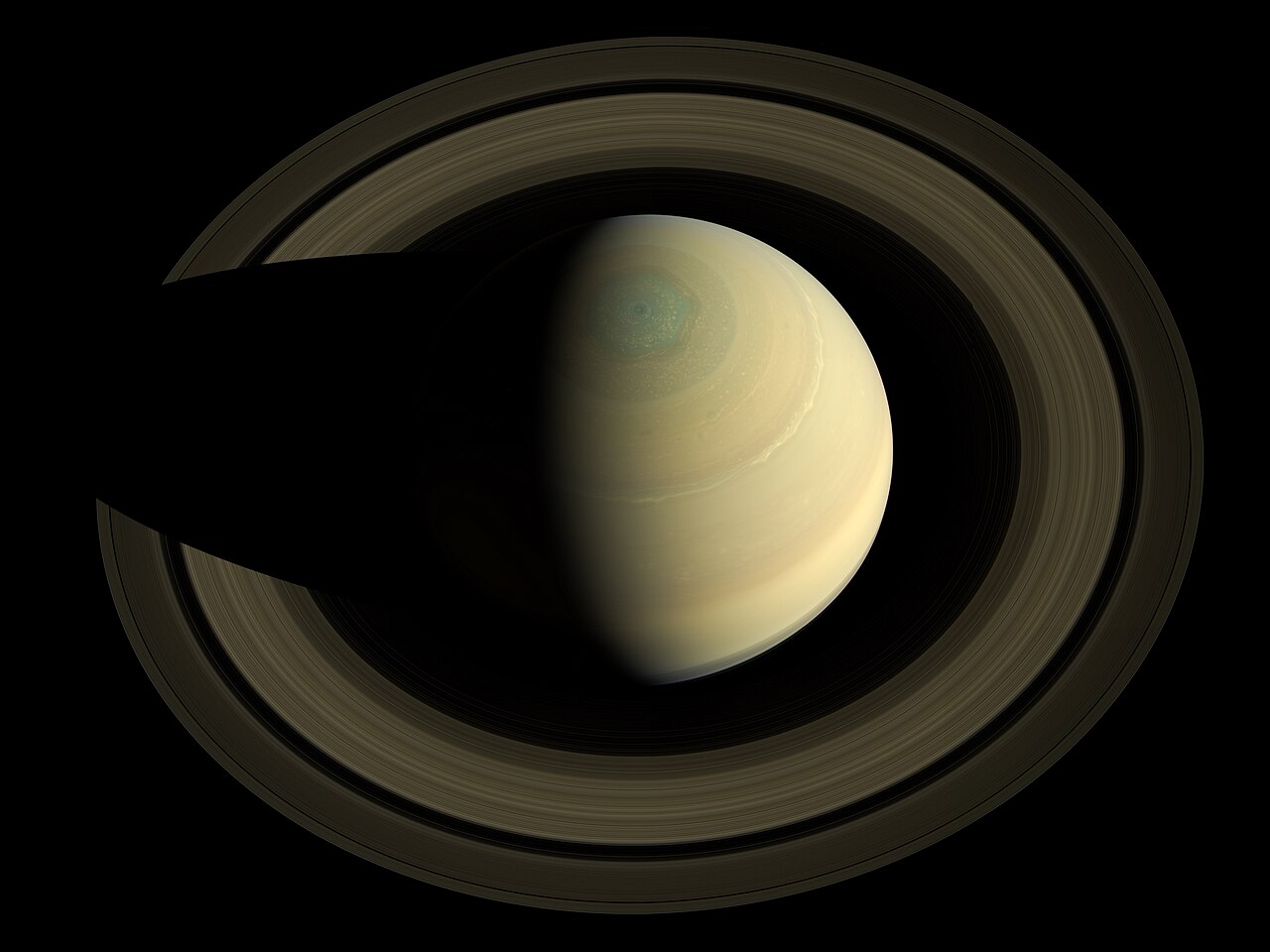

Ring systems provide a natural laboratory for studying the physics of disk dynamics, gravitational resonances, and collisional processes on scales that are directly observable. The same physical principles that govern planetary rings — Keplerian shear, collisional dissipation, resonant perturbations by embedded or nearby satellites — operate in protoplanetary disks, accretion disks around black holes, and galactic disks, making planetary ring science a testing ground for disk physics more broadly.16
Discovery and early observations
Galileo Galilei was the first to observe Saturn’s rings through a telescope in 1610, but the limited resolution of his instrument led him to interpret what he saw as two large companions flanking the planet. He described Saturn as having “ears” or appearing as a triple body, and was further puzzled when the appendages seemed to vanish two years later — an effect now understood as the result of Earth passing through Saturn’s ring plane, rendering the extremely thin rings invisible edge-on.1
The true nature of the rings was identified by Christiaan Huygens, who in 1655 used a more powerful telescope of his own design and proposed that Saturn was surrounded by “a thin, flat ring, nowhere touching, inclined to the ecliptic.” He published this interpretation in Systema Saturnium in 1659, correctly explaining the periodic disappearances as a consequence of the ring’s thinness and its tilt relative to Earth’s orbital plane.2 In 1675, Giovanni Domenico Cassini discovered a dark gap dividing the ring into two concentric components — the outer A ring and the brighter, broader B ring — a feature now known as the Cassini Division. James Clerk Maxwell demonstrated in 1859 that a solid or liquid ring would be gravitationally unstable and concluded that the rings must consist of a vast number of independently orbiting particles, a prediction confirmed spectroscopically by James Keeler in 1895 through Doppler measurements showing that the inner ring particles orbit faster than the outer ones, precisely as Keplerian mechanics requires.3, 16
Saturn’s rings
Saturn’s ring system is by far the most massive and extensive in the solar system, spanning approximately 280,000 kilometres from the inner edge of the D ring to the outer edge of the main rings, yet averaging only about 10 metres in vertical thickness. The main rings are conventionally designated D, C, B, A, F, G, and E in order of increasing distance from the planet, with the letters reflecting the historical order of their discovery rather than their spatial arrangement. The B ring is the densest and most opaque component, containing the majority of the ring mass; the A ring is less dense but still optically thick; the C ring is translucent; and the D ring, closest to the planet, is faint and tenuous.3, 5
Spectroscopic and photometric observations, refined extensively by the Cassini spacecraft, have established that Saturn’s ring particles are composed of more than 95 percent water ice by mass, with minor contaminants including silicates, tholins, and iron-bearing compounds that lend a subtle reddish tint to parts of the rings. Particle sizes follow a broad distribution, ranging from centimetre-sized ice chunks to boulders several metres across, with few particles smaller than about a centimetre in the main rings — the absence of fine dust reflecting the rapid removal of small particles by radiation pressure, plasma drag, and electromagnetic forces.4
The Cassini Division, the most prominent gap in the ring system at roughly 4,800 kilometres wide, is not truly empty but contains a low optical depth of ring material. Its inner edge is maintained by a 2:1 orbital resonance with the moon Mimas: particles at that location complete exactly two orbits for every one orbit of Mimas, receiving periodic gravitational kicks that clear them from the resonance zone. This is the most dramatic example of a resonance gap in the rings, though many narrower gaps and density waves throughout the A and B rings are similarly associated with resonances with Saturn’s moons.5, 15
The F ring, a narrow and kinked structure just outside the A ring, is confined and sculpted by two small shepherd moons, Prometheus and Pandora, whose gravitational influence prevents the ring material from spreading. Shepherd moons represent a broader dynamical phenomenon in which nearby satellites confine ring edges through angular momentum exchange — Prometheus, orbiting just inside the F ring, removes angular momentum from particles it encounters, pushing them inward, while Pandora, orbiting just outside, adds angular momentum, pushing particles outward. The net effect is a narrow, well-defined ring that would otherwise spread diffusively.3, 16
Among the more enigmatic features of Saturn’s rings are the spokes — dark radial markings that appear intermittently in the B ring, extending across thousands of kilometres and rotating nearly rigidly with Saturn’s magnetic field rather than following Keplerian orbital velocities. First photographed by the Voyager spacecraft in 1980–1981, spokes are composed of fine dust particles levitated above the ring plane by electrostatic forces generated by the interaction between the rings and Saturn’s magnetosphere. They appear preferentially near Saturn’s equinoxes, when the rings are edge-on to the Sun and solar illumination is reduced, suggesting that photoelectric charging modulates their formation.18
Rings of the other giant planets
Jupiter possesses a faint ring system discovered by the Voyager 1 spacecraft in 1979. The Jovian rings are composed almost entirely of micrometre-sized dust particles rather than the centimetre-to-metre-sized ice chunks that dominate Saturn’s rings, giving them extremely low optical depth and making them invisible from Earth under normal observing conditions. The main ring and the inner halo are continuously replenished by meteoroid impacts on the small inner moons Metis and Adrastea, which eject dust into orbit; without this continuous supply, radiation pressure and electromagnetic forces would sweep the ring clean within roughly 1,000 years. The tenuous gossamer rings extend outward beyond the main ring and are similarly sourced from the moons Amalthea and Thebe.6
The rings of Uranus were discovered on 10 March 1977, when astronomers James Elliot, Edward Dunham, and Douglas Mink observed a stellar occultation — the passage of Uranus in front of a background star — from the Kuiper Airborne Observatory. They detected a series of brief dips in the star’s brightness both before and after the planet itself blocked the starlight, revealing nine narrow, dark rings orbiting Uranus. Subsequent ground-based observations and Voyager 2’s 1986 flyby increased the total to thirteen known rings.7 Uranus’s rings are strikingly different from Saturn’s: they are extremely narrow (most are only a few kilometres wide), very dark (reflecting only about 2 percent of incident sunlight), and separated by broad gaps. The ring particles are thought to be composed of radiation-darkened organic compounds or carbon-rich material rather than the bright water ice of Saturn’s rings.8, 16
Neptune’s ring system, confirmed by Voyager 2 during its 1989 flyby, contains five named rings, the most scientifically intriguing of which is the Adams ring. Unlike complete, uniform rings, the Adams ring contains discrete ring arcs — stable concentrations of material spanning only a few degrees of arc rather than the full 360 degrees. The arcs were initially explained as being confined by a corotation inclination resonance with the moon Galatea, whose gravitational perturbations create potential energy maxima that trap ring particles. However, subsequent observations from the Keck telescope and the Hubble Space Telescope have shown that the arcs are evolving on decadal timescales, with some fading and others brightening, suggesting that the confinement mechanism is more complex than the simple resonance model predicts.9
Roche limit and tidal forces
The existence of ring systems is fundamentally governed by the Roche limit, first derived by the French astronomer Édouard Roche in 1848. Inside this critical distance, the differential gravitational force (tidal force) exerted by the planet across the diameter of an orbiting body exceeds the body’s own self-gravity, preventing loose aggregates from coalescing and capable of disrupting bodies held together only by gravity. For a fluid satellite with the same density as the planet, the classical Roche limit lies at approximately 2.44 planetary radii; for rigid bodies or bodies with significant material strength, the effective Roche limit is somewhat smaller. All of the main ring systems of the giant planets lie within or very near their respective Roche limits, consistent with the interpretation that ring material either formed in place from debris that could never accrete into a moon or resulted from the tidal disruption of a body that ventured too close to the planet.16, 17
Outside the Roche limit, the same material can accrete into satellites, and the boundary between rings and moons is a recurring theme in planetary ring dynamics. Several of Saturn’s small moons orbit at or near the outer edge of the ring system, and some — such as Pan, orbiting within the Encke Gap of the A ring — have accumulated equatorial ridges of ring material, blurring the distinction between ring particles and moonlets. The transition from rings to moons is thus not a sharp boundary but a continuum governed by the balance between tidal disruption and self-gravitational accretion.3, 16
Ring particle dynamics
Ring particles orbit their host planet on nearly circular, nearly coplanar Keplerian orbits, but the rings are far from static structures. Particles in the inner portions of a ring orbit faster than those farther out (in accordance with Kepler’s third law), creating a continuous velocity shear across the ring. This Keplerian shear, combined with frequent low-velocity collisions between particles (typically at speeds of millimetres to centimetres per second), drives the viscous spreading of the ring: angular momentum is transferred outward while mass drifts inward, gradually broadening the ring unless some confining mechanism intervenes.16
Density waves and bending waves are among the most prominent large-scale structures generated by gravitational perturbations within rings. When an external moon exerts a periodic gravitational force on ring particles at a location where the particles’ orbital frequency is a simple ratio of the moon’s orbital frequency (a Lindblad resonance), the resulting perturbation launches a tightly wound spiral density wave that propagates through the ring. These waves, first predicted theoretically and then observed in exquisite detail by the Voyager and Cassini spacecraft, provide a powerful diagnostic tool: by measuring the wavelength and damping length of the wave, scientists can determine the local surface mass density and viscosity of the ring material with precision unavailable from any other technique.5, 16
Shepherd moons, embedded moonlets, and gravitational resonances with more distant satellites collectively maintain the sharp edges, gaps, and fine-scale structure observed in ring systems. The interplay between these dynamical mechanisms produces an astonishing variety of structures — from the smooth, featureless expanses of Saturn’s C ring to the thousands of narrow ringlets and gaps resolved in the B ring by Cassini — making ring systems among the most dynamically complex structures in the solar system.3, 5
Origin theories
The origin of planetary ring systems remains an active area of research, with three principal hypotheses under consideration. The primordial hypothesis proposes that rings are remnants of the circumplanetary disk of gas and dust from which a planet’s regular satellites accreted during the formation of the solar system. Material within the Roche limit could never coalesce into a moon and has persisted in ring form for 4.5 billion years. This hypothesis is attractive for its simplicity but faces difficulties explaining the high ice purity of Saturn’s rings, which should have been darkened and polluted by billions of years of meteoroid bombardment.16, 19
The disrupted moon hypothesis proposes that a ring formed from the tidal destruction of a satellite that migrated inward past the Roche limit or was shattered by a large impact. Crida and Charnoz developed a model in which a Titan-sized differentiated moon spiralled inward due to tidal interactions with the young Saturn, crossing the Roche limit and being progressively stripped of its icy mantle while its rocky core continued to fall toward the planet. This model naturally explains the high ice fraction of Saturn’s rings (the icy mantle was stripped while the rocky core was lost) and is consistent with the rings being younger than the solar system.20
The captured comet hypothesis suggests that a comet or Kuiper Belt object was tidally disrupted during a close passage by the planet, distributing its debris into a ring. This mechanism may be more relevant for the thin, dark rings of Uranus and Neptune than for Saturn’s massive ice rings, given the difficulty of capturing enough material to account for Saturn’s ring mass (estimated at roughly 1.5 × 10¹⁹ kilograms, comparable to the mass of the moon Mimas) through a single cometary disruption event.13, 16
Cassini mission discoveries
The Cassini spacecraft, which orbited Saturn from 2004 to 2017, transformed ring science through thirteen years of sustained, close-range observations. Among its most consequential discoveries was ring rain — a flow of water molecules and nanograin ice particles from the innermost D ring into Saturn’s upper atmosphere, channelled along the planet’s magnetic field lines. Ground-based observations by O’Donoghue and colleagues confirmed that ring rain deposits water into Saturn’s ionosphere at latitudes corresponding to the magnetic footprints of the ring edges, at rates estimated at 432 to 2,870 kilograms per second. At the upper end of this range, ring rain alone would drain the entire ring system in roughly 300 million years, implying that the rings cannot be primordial if this process has operated throughout their history.12
During its Grand Finale orbits in 2017, Cassini passed between Saturn and the inner edge of the D ring, enabling direct gravitational measurements of the ring mass for the first time. The results, published by Iess and colleagues in 2019, yielded a total ring mass of approximately 1.54 × 10¹⁹ kilograms — about 0.41 times the mass of Mimas and roughly half of previous estimates based on optical depth models. Combined with the measured rate of meteoroid bombardment and the observed ice purity of the rings, the low mass strongly favours a young age for Saturn’s rings, most likely between 100 and 400 million years, placing their formation in the Cretaceous Period of Earth history or later rather than at the dawn of the solar system.13
The ring age debate received further support from Kempf and colleagues in 2023, who used Cassini’s Cosmic Dust Analyzer to measure the flux of interplanetary micrometeoroids passing through the Saturn system. By combining this flux with the observed low fraction of non-icy contaminants in the rings (no more than a few percent by mass), they constrained the exposure age of the ring material to no more than a few hundred million years, independently confirming the young-ring conclusion from the mass measurements. The convergence of multiple independent lines of evidence — ring mass, meteoroid flux, ice purity, and ring rain loss rates — has shifted the scientific consensus toward young rings, though the mechanism that created them so recently remains a matter of active investigation.14
Rings around minor bodies
The discovery that ring systems are not exclusive to giant planets came in 2014, when Braga-Ribas and colleagues announced the detection of two narrow, dense rings around (10199) Chariklo, a Centaur object approximately 250 kilometres in diameter orbiting between Saturn and Uranus. The rings were detected through a stellar occultation observed simultaneously from multiple sites in South America: sharp, symmetric dips in the occulted star’s brightness on either side of the main body occultation revealed two rings with radii of approximately 391 and 405 kilometres and widths of roughly 7 and 3 kilometres, respectively. Chariklo’s rings are dense enough to be opaque and may be composed of water ice, though their confinement mechanism remains unclear — no shepherd moons have been detected at the limits of current observations.10
In 2017, Ortiz and colleagues reported the detection of a ring around the trans-Neptunian dwarf planet Haumea, again through a multi-site stellar occultation. The ring orbits at a radius of approximately 2,287 kilometres from Haumea’s centre, near the 3:1 spin-orbit resonance with the rapidly rotating (3.9-hour period) elongated body, with a width of roughly 70 kilometres and an optical depth of about 0.5. Haumea’s ring is the first detected around a trans-Neptunian object and orbits well outside the classical Roche limit, suggesting that it may have formed from debris ejected by a collision or that the Roche limit concept requires modification for rapidly rotating, non-spherical bodies.11
These discoveries have opened a new chapter in ring science. Subsequent stellar occultation campaigns have searched for rings around other Centaurs, trans-Neptunian objects, and even some asteroids, and the minor-body ring population appears to be more common than previously assumed. The existence of rings around bodies as small as Chariklo challenges models that link ring formation exclusively to the deep gravitational wells and tidal environments of giant planets and suggests that collisional debris, outgassing, or satellite disruption can produce ring systems across a wide range of parent body sizes.10, 11, 16
Comparative ring properties
Ring systems of the solar system3, 6, 7, 9, 10, 11
| Body | Discovery | Composition | Distinctive features |
|---|---|---|---|
| Saturn | 1610 (Galileo) | >95% water ice | Massive, bright; Cassini Division; spokes; shepherd moons |
| Jupiter | 1979 (Voyager 1) | Silicate dust | Faint; replenished by moon impacts |
| Uranus | 1977 (occultation) | Dark, carbon-rich | Narrow, dark; 13 known rings |
| Neptune | 1989 (Voyager 2) | Dust and ice | Ring arcs in Adams ring |
| Chariklo | 2014 (occultation) | Likely water ice | First rings around a minor body |
| Haumea | 2017 (occultation) | Unknown | First rings around a TNO; outside Roche limit |
The diversity of ring systems in the solar system underscores that rings are not a monolithic phenomenon but arise from multiple formation mechanisms, are maintained by different dynamical processes, and evolve on timescales that range from thousands to hundreds of millions of years. Saturn’s massive ice rings, Jupiter’s evanescent dust rings, the narrow dark rings of Uranus, the arc-bearing rings of Neptune, and the compact rings of Chariklo and Haumea each represent a distinct solution to the problem of how particulate debris can persist in orbit around a central body — and together they illuminate the rich physics of gravitationally bound disk systems throughout the cosmos.16
References
Voyager’s eleventh discovery of a satellite of Uranus and photometry and the first size measurements of nine satellites
The size, shape, density and ring of the dwarf planet Haumea from a stellar occultation