Overview
- Protoplanetary disks are rotating structures of gas and dust that surround newly formed stars, and they are the birthplaces of planets, moons, asteroids, and comets in every planetary system observed to date.
- High-resolution observations by the Hubble Space Telescope and the Atacama Large Millimeter Array have revealed detailed disk substructures including concentric gaps, rings, and spiral arms that are interpreted as signatures of actively forming planets.
- Disk lifetimes of roughly 1 to 10 million years set a strict clock on giant planet formation, favoring the core accretion model for most systems while gravitational instability may operate in the most massive disks during their earliest stages.
A protoplanetary disk is a rotating circumstellar disk of dense gas and dust surrounding a young star from which planets and other solid bodies eventually form. These structures are a natural consequence of angular momentum conservation during the gravitational collapse of a molecular cloud core: as material falls inward, it flattens into a disk orbiting the central protostar.8 Protoplanetary disks are the birthplaces of every known type of planetary body, from gas giants and ice giants to rocky terrestrial worlds, asteroids, and comets. Their study sits at the intersection of stellar astrophysics, planetary science, and astrochemistry, and over the past three decades, advances in infrared and millimetre-wavelength observing technology have transformed them from theoretical constructs into directly imaged, physically characterized objects.5, 7, 8
The nebular hypothesis
The idea that the solar system formed from a rotating disk of material surrounding the young Sun dates to the eighteenth century. In 1755, the German philosopher Immanuel Kant proposed that the Sun and planets condensed from a diffuse cloud of gas and particles, with rotation naturally flattening the cloud into a disk from which individual planets coalesced.1 Independently, the French mathematician Pierre-Simon Laplace developed a more detailed version of this model in 1796, suggesting that the cooling and contracting solar nebula shed successive rings of material that each collapsed to form a planet.2 This Kant-Laplace nebular hypothesis, despite requiring substantial revision in the centuries that followed, established the conceptual foundation for all modern theories of planet formation.
The nebular hypothesis fell out of favour in the early twentieth century, partly because physicists could not explain how a contracting nebula would transfer enough angular momentum outward to leave the Sun rotating as slowly as it does while concentrating most of the system's mass at the centre. The problem was not resolved until the mid-twentieth century, when Viktor Safronov and others developed quantitative models of a minimum-mass solar nebula — a disk containing just enough solid and gaseous material to account for the planets — and identified viscous processes, magnetic fields, and gravitational torques as mechanisms capable of redistributing angular momentum within a disk.18 Hayashi's 1981 formalization of the minimum-mass solar nebula model provided the standard reference disk against which subsequent theoretical work and observations have been compared.18
Observational evidence
The first direct evidence that young stars are surrounded by disks of gas and dust came from infrared observations in the 1980s, which detected excess thermal emission beyond what the stellar photosphere alone could produce. This infrared excess was interpreted as radiation from warm dust grains orbiting close to the star, heated by stellar radiation.8


However, the disks remained spatially unresolved until the 1990s, when the Hubble Space Telescope (HST) provided the first images of protoplanetary disks seen in silhouette against the bright background of the Orion Nebula. C. Robert O'Dell and colleagues identified dozens of these objects, which they termed proplyds (protoplanetary disks), as dark, compact structures surrounding young stars in the Trapezium Cluster.4 HST also resolved the edge-on disk of HH 30 in Taurus, revealing a flared dust disk bisected by a dark midplane lane with bipolar jets emerging perpendicular to the disk surface.3
The transformative leap in disk imaging came with the Atacama Large Millimeter/submillimeter Array (ALMA), which began full science operations in 2013. ALMA observes thermal emission from cool dust grains at millimetre wavelengths, penetrating the optically thick surface layers that obscure disk interiors at shorter wavelengths. In 2014, ALMA's long-baseline campaign produced a stunning image of the disk around HL Tauri, a young star in the Taurus star-forming region approximately 140 parsecs from the Sun. The image revealed a series of bright concentric rings separated by dark gaps extending to radii of roughly 100 astronomical units (au), a level of substructure that had not been anticipated in a system estimated to be less than one million years old.5 The HL Tau image demonstrated that the processes responsible for concentrating dust and clearing gaps — widely interpreted as signatures of planet formation — begin far earlier than previously assumed.
Subsequent ALMA observations of TW Hydrae, the nearest classical T Tauri star at approximately 60 parsecs, resolved gaps as narrow as one au in the disk, including a prominent gap at approximately 22 au that may correspond to a forming Neptune-mass planet.6 The ALMA large programme known as the Disk Substructures at High Angular Resolution Project (DSHARP) surveyed twenty nearby protoplanetary disks at a resolution of approximately 5 au and found that rings and gaps are ubiquitous, appearing in disks spanning a wide range of stellar masses, ages, and environments.7 These observations have established that disk substructure is the norm rather than the exception and that planet formation is likely a universal process accompanying star formation.
Disk structure and composition
A typical protoplanetary disk extends from the inner dust sublimation radius (roughly 0.1 au for a solar-type star, where temperatures exceed approximately 1,500 K and silicate grains are destroyed) out to several hundred au, with the bulk of the mass concentrated within the inner 50 to 100 au.8 The disk is composed primarily of molecular hydrogen and helium gas, which together account for roughly 99 percent of the mass, with the remaining one percent in solid dust grains ranging from sub-micrometre interstellar silicates and carbonaceous particles to millimetre-sized aggregates that have already begun the process of grain growth.8 Total disk masses in nearby star-forming regions typically range from 0.001 to 0.1 solar masses, though measurement uncertainties related to the gas-to-dust ratio and optical depth effects make precise mass determinations challenging.8, 21
The thermal structure of the disk establishes a series of condensation fronts, or snow lines, at characteristic radial distances where the midplane temperature drops below the sublimation point of specific volatile species. The water ice line, located at approximately 2.7 au in the early solar nebula (at a temperature of roughly 170 K), is the most consequential: beyond this radius, water vapour freezes onto dust grains, roughly doubling the surface density of available solid material and dramatically accelerating the growth of planetesimals.9 Farther from the star, additional snow lines for carbon dioxide (at roughly 10 au), carbon monoxide (at roughly 20 to 30 au), and molecular nitrogen mark transitions in the ice composition of the outer disk.9 The location of the water snow line is thought to have separated the rocky inner planets from the gas and ice giants in the solar system, and its position in observed disks is a key parameter in models of exoplanetary system architecture.9, 23
Vertically, the disk is not a simple slab but a layered structure. The dense midplane is shielded from stellar and interstellar ultraviolet radiation and remains cold and chemically quiescent, while the upper atmosphere of the disk is irradiated and heated, producing a warm surface layer that flares with increasing distance from the star. This vertical temperature gradient drives a rich chemistry, with complex organic molecules forming on grain surfaces in the cold midplane and photodissociation products dominating the irradiated surface.8
Mechanisms of planet formation
Two principal theoretical frameworks describe how planets form within protoplanetary disks: core accretion and gravitational instability. Core accretion, the more widely favoured model, proceeds in stages. First, sub-micrometre dust grains collide and stick through van der Waals forces, growing into millimetre- to centimetre-sized aggregates. These aggregates must then overcome the so-called metre-size barrier, a range of particle sizes at which collisions become destructive rather than constructive and radial drift toward the star becomes rapid, threatening to remove solids before they can grow further. Concentration mechanisms such as streaming instabilities and pressure bumps in the gas disk can trap particles and accelerate their growth past this barrier, producing kilometre-scale planetesimals.22 Planetesimals subsequently grow through mutual gravitational attraction and collisions, building planetary embryos of roughly lunar to Mars mass. In the outer disk beyond the snow line, where solid surface densities are highest, embryos can reach a critical mass of approximately 10 Earth masses within the disk lifetime, at which point they begin to accrete gas rapidly from the surrounding nebula, growing into gas giant planets within a few million years.12
The Pollack et al. (1996) model of concurrent solid and gas accretion remains the standard quantitative framework for giant planet formation by core accretion. In this model, the growth of Jupiter proceeds through three phases: runaway solid accretion to build the core (roughly 0.5 million years), slow gas accretion limited by the core's ability to radiate away gravitational energy (several million years), and finally a rapid hydrodynamic collapse of gas onto the planet once the envelope mass exceeds the core mass.12 The long timescale of the second phase — often exceeding 5 million years in early models — posed a challenge, because it approached or exceeded observed disk lifetimes. More recent work incorporating pebble accretion, in which the core grows by sweeping up centimetre-sized particles that are aerodynamically coupled to the gas, has substantially shortened the core-building phase and eased this timing constraint.22
Gravitational instability offers an alternative pathway in which a sufficiently massive and cool disk fragments directly into bound clumps of gas and dust, each of which contracts to form a giant planet without the need for a prior solid core. This mechanism requires the disk to satisfy the Toomre instability criterion, which is most easily met in young, massive disks at large radii where cooling times are short relative to the orbital period.11 Gravitational instability can in principle form giant planets on timescales of only a few thousand years, far shorter than core accretion. However, the conditions required for fragmentation are stringent, and most observed disks do not appear to be massive or cool enough to fragment except possibly during the earliest embedded phases of disk evolution.11 Population synthesis models that compare the predictions of each mechanism against the observed distribution of exoplanets suggest that core accretion accounts for the vast majority of known planets, while gravitational instability may be responsible for a subset of massive giant planets on wide orbits.10
Gap formation and planetary signatures
One of the most striking features revealed by ALMA imaging is the prevalence of concentric gaps and rings in protoplanetary disks. The leading interpretation is that these gaps are carved by young planets whose gravitational influence clears material from their orbital vicinity, producing a deficit of dust along the planet's orbit and a pileup of material at the gap edges.13 Theoretical models of planet-disk interaction predict that a planet as small as a few tens of Earth masses can open a visible gap in the dust distribution, while more massive planets carve wider and deeper gaps and can excite spiral density waves in the surrounding disk.13
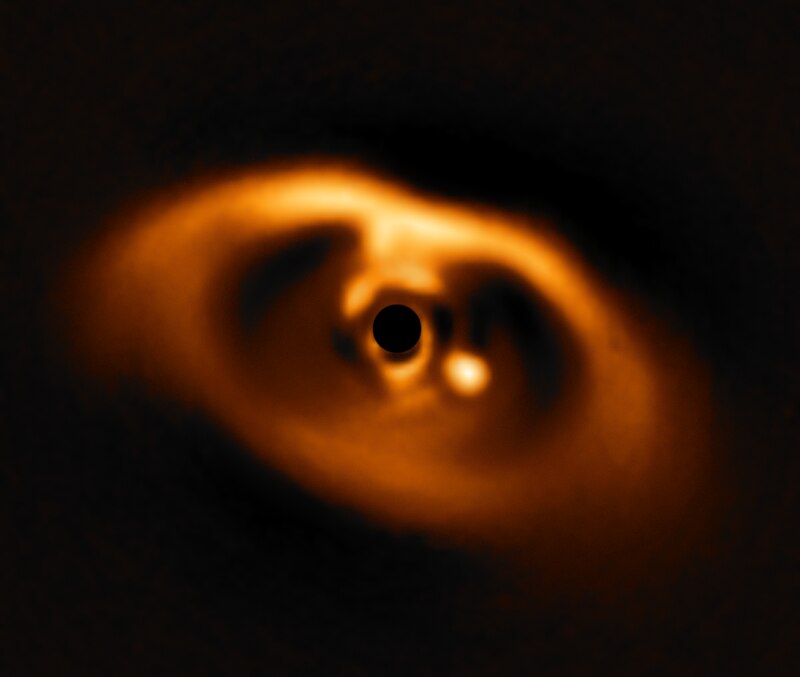
The most compelling confirmation of this interpretation came from observations of PDS 70, a young star approximately 113 parsecs away in the Centaurus constellation. Near-infrared imaging with the SPHERE instrument on the Very Large Telescope and subsequent ALMA observations revealed a wide gap in the disk extending from roughly 20 to 65 au, within which two accreting protoplanets — PDS 70b and PDS 70c — were directly detected.19, 20 PDS 70b orbits at approximately 22 au and has an estimated mass of several Jupiter masses, while PDS 70c orbits near 34 au close to a 2:1 mean-motion resonance with its companion. Both planets exhibit excess emission indicative of circumplanetary material, possibly circumplanetary disks from which satellites may eventually form.20 The PDS 70 system provides the first unambiguous case of planets caught in the act of forming within a protoplanetary disk gap.
Not all gaps need be produced by planets, however. Alternative mechanisms including snow-line-induced changes in dust opacity, magnetohydrodynamic zonal flows, and sintering-driven fragmentation of dust aggregates can also produce ring-like structures in disks.7 Distinguishing planetary gaps from these alternative origins requires combining dust continuum imaging with gas kinematics: a massive planet perturbs the velocity field of the gas in a characteristic way that can be detected through deviations from Keplerian rotation in molecular line emission.13 Several candidates for such kinematic planet detections have been reported in recent ALMA data, though confirmation remains challenging.
Disk lifetimes and dispersal
Protoplanetary disks are transient structures. Surveys of young stellar clusters at near-infrared wavelengths, which detect the hot dust in the inner disk through its excess emission, have established that the fraction of stars retaining optically thick inner disks declines approximately exponentially with cluster age, with a characteristic half-life of roughly 2 to 3 million years.14 By an age of approximately 5 to 6 million years, fewer than 10 percent of solar-type stars retain detectable inner disks, and by 10 million years the fraction is essentially zero.14 These disk lifetimes set a fundamental timescale for planet formation: gas giant planets must complete their assembly within this window or forfeit access to the nebular gas required to build massive envelopes.
Disk fraction versus cluster age14
Disk dispersal proceeds through several mechanisms operating on overlapping timescales. Viscous accretion drains mass inward onto the star, driven by angular momentum transport within the disk through turbulence, magnetorotational instability, or disk winds. Photoevaporation removes gas from the disk surface through heating by ultraviolet and X-ray radiation from the central star (internal photoevaporation) or from nearby massive stars in the cluster environment (external photoevaporation).15, 16 When the photoevaporation rate exceeds the viscous accretion rate at some radius, typically a few au, the disk is starved of resupply from the outer regions and the inner disk drains rapidly onto the star, creating a growing inner hole — a transition disk. The outer disk then disperses from the inside out on a timescale of roughly 105 years, producing the rapid final clearing observed in cluster disk-fraction surveys.16
External photoevaporation is particularly important in clustered star-forming environments. The proplyds observed by HST in the Orion Nebula are being actively eroded by the intense ultraviolet radiation field of the massive Trapezium stars, and their estimated mass-loss rates suggest that many of these disks may be stripped of their gas reservoirs on timescales shorter than the few million years typically available for planet formation.4, 15 Whether giant planets can form in such hostile environments remains an open question with implications for the frequency of planetary systems in the galaxy, since a significant fraction of stars form in clustered regions near massive stars.
Debris disks
After the primordial gas and fine dust of the protoplanetary disk have dispersed, many stars retain a tenuous disk of dust produced by ongoing collisions among residual planetesimals — a debris disk. Unlike protoplanetary disks, debris disks are gas-poor and optically thin, and their dust is continually replenished by the grinding of larger bodies rather than being a remnant of the original nebula.17 The archetypal debris disk surrounds Beta Pictoris, a 20-million-year-old A-type star whose edge-on dust disk was first imaged in 1984 and has since been shown to harbour at least two giant planets whose gravitational influence sculpts the disk's warps and asymmetries.
.jpg)
.jpg)
Debris disks are detected around roughly 20 percent of nearby main-sequence stars through their far-infrared excess emission, with detection rates depending on stellar age, spectral type, and survey sensitivity.17 Their dust distributions often exhibit rings, gaps, warps, and clumps that serve as indirect tracers of unseen planets. The Kuiper Belt in the solar system is the local analogue of a debris disk, and its structure — including the resonant populations sculpted by Neptune's migration — provides a ground-truth comparison for interpreting the morphologies of extrasolar debris disks.17, 23 Debris disks thus bridge the gap between the planet-forming epoch and the architectures of mature planetary systems, offering a window into the late stages of dynamical evolution that shape the final orbital configurations of planets and small bodies.
Constraints on solar system formation
Observations of protoplanetary disks in other stellar systems have profoundly informed models of how the solar system itself formed. The minimum-mass solar nebula model, originally derived by augmenting the present-day planets with enough hydrogen and helium to restore solar composition and spreading the resulting mass into a smooth disk, yields a surface density profile that can be directly compared against the mass distributions measured in real disks by ALMA.18, 21 These comparisons reveal that the classical minimum-mass solar nebula underestimates the mass of typical disks, suggesting that the solar nebula was not unusually massive or compact by the standards of observed protoplanetary disks.21
The prevalence of gaps and rings in ALMA-observed disks at radii comparable to those of the giant planets supports the hypothesis that Jupiter and Saturn opened gaps in the solar nebula early in its history, consistent with the Grand Tack and Nice models of solar system dynamical evolution.7, 23 The existence of wide gaps in transition disks, some extending to tens of au, provides observational analogues for the clearing that Jupiter's growth would have produced, potentially isolating the inner and outer solar system and explaining the compositional dichotomy between the terrestrial and giant planet regions.13, 23
The measured disk lifetimes of 1 to 10 million years are consistent with cosmochemical constraints from meteorites, which indicate that calcium-aluminium-rich inclusions (the oldest dated solids in the solar system) formed within the first few hundred thousand years of disk evolution, while chondrule formation and planetesimal accretion continued for the next 2 to 4 million years.8, 14 The concordance between astronomical disk lifetimes and meteoritic chronologies provides strong evidence that the processes observed in extrasolar disks are directly applicable to reconstructing the history of the solar nebula. As ALMA, the James Webb Space Telescope, and future extremely large telescopes continue to resolve finer structures and detect fainter planets within protoplanetary disks, the connection between disk observations and solar system formation models will only grow more precise.7, 23
References
The Disk Substructures at High Angular Resolution Project (DSHARP). I. Motivation, sample, calibration, and overview
Toward a deterministic model of planetary formation. I. A desert in the mass and semimajor axis distributions of extrasolar planets
Discovery of a planetary-mass companion within the gap of the transition disk around PDS 70