Overview
- The Sun’s core produces electron neutrinos at calculable rates through the proton–proton chain and CNO cycle; John Bahcall’s Standard Solar Model predicted a specific flux, but Ray Davis’s Homestake experiment, beginning in 1968, detected only about one-third of that number—a discrepancy that became known as the solar neutrino problem and persisted for more than thirty years.
- The resolution came not from errors in the solar model or the detector, but from neutrino physics: neutrinos have a small but nonzero mass, which allows them to oscillate between flavor states in transit, converting electron neutrinos into muon and tau neutrinos that earlier detectors were blind to.
- The Sudbury Neutrino Observatory confirmed the resolution in 2001–2002 by measuring both the electron-neutrino flux and the total flux of all flavors, finding the total in precise agreement with Bahcall’s prediction; the episode earned Nobel Prizes for Davis and Masatoshi Koshiba in 2002, and for Takaaki Kajita and Arthur McDonald in 2015.
A star’s hidden fire
The Sun radiates 3.828 × 1026 watts, an output sustained not by chemical combustion or gravitational contraction but by nuclear fusion in its core. At temperatures exceeding 15 million kelvins and densities around 150 grams per cubic centimetre, hydrogen nuclei overcome electrostatic repulsion and fuse, releasing energy that ultimately reaches the surface after a diffusive journey lasting hundreds of thousands of years.22 Every nuclear reaction in the core also produces neutrinos—electrically neutral, nearly massless particles that interact so weakly with matter that they escape the solar interior in roughly two seconds, streaming outward at close to the speed of light. About 65 billion solar neutrinos pass through every square centimetre of Earth’s surface every second.22 These particles carry direct, nearly unmodified information about the nuclear processes 150 million kilometres away at the heart of our star.

The story of how physicists attempted to detect these neutrinos, found far fewer than predicted, spent three decades unable to explain the discrepancy, and finally resolved it through a fundamental revision of particle physics is one of the most instructive episodes in the history of science. The solar neutrino problem was not a problem with the Sun. It was a problem with how physicists understood the neutrino itself.22
Bahcall’s prediction: the Standard Solar Model
By the early 1960s, the broad outlines of solar energy production were established. The dominant pathway in a star of the Sun’s mass is the proton–proton (pp) chain, a sequence of reactions beginning with the fusion of two protons to form deuterium, then helium-3, and ultimately helium-4.22 A secondary pathway, the CNO cycle, converts hydrogen to helium using carbon, nitrogen, and oxygen as catalysts; it contributes roughly 1 percent of the Sun’s energy but becomes dominant in more massive, hotter stars. Every branch of both chains produces electron neutrinos (νe) at well-defined energies, providing a characteristic spectrum that reflects the specific nuclear reactions occurring in the core.
In 1964, astrophysicist John Bahcall published the first detailed theoretical calculation of the solar neutrino flux, predicting the rate at which a suitably designed detector on Earth should register interactions.1 His approach—the Standard Solar Model (SSM)—combined known nuclear reaction rates, the observed solar luminosity, helioseismic constraints on the interior sound speed, and the chemical composition of the Sun to compute neutrino production as a function of depth in the solar core. The model was not a rough estimate but a precise, quantitative prediction that became more refined with every decade of refinement to solar physics.5, 6 Bahcall devoted much of his career to this calculation, producing successively more accurate versions as nuclear cross sections were measured in the laboratory and helioseismology placed tight constraints on the solar interior. By the 1990s, the SSM predicted the total 8B neutrino flux—the high-energy component most accessible to real-time detectors—to within roughly 15 percent uncertainty.
The most energetic solar neutrinos come from the decay of boron-8, a rare side branch of the pp chain. Though 8B neutrinos represent only a tiny fraction of the total flux, their energies reach up to 14.9 MeV, making them detectable by radiochemical and water-Cherenkov experiments that are blind to the much more numerous but lower-energy pp neutrinos. It was these high-energy neutrinos that the first experiments were designed to catch.21
The Homestake experiment and the deficit
Simultaneously with Bahcall’s theoretical paper, Ray Davis Jr. published a companion experimental proposal.2 Davis, a radiochemist at Brookhaven National Laboratory, designed a detector based on the reaction of solar neutrinos with chlorine-37: a sufficiently energetic neutrino could convert a chlorine nucleus into radioactive argon-37, which could then be chemically extracted and counted. The reaction has a threshold of 0.814 MeV, making it sensitive primarily to the 8B neutrinos Bahcall had calculated, along with contributions from the 7Be and pep branches.
The Homestake experiment, located 1,478 metres underground in a South Dakota gold mine to shield against cosmic-ray backgrounds, used 615 tonnes of perchloroethylene—a common dry-cleaning fluid—as both target and solvent.3 Every few weeks, helium gas was bubbled through the tank to carry out the few dozen argon-37 atoms produced by neutrino interactions. These atoms were counted in small proportional counters as they decayed. The experimental technique was extraordinarily demanding: Davis was seeking to detect fewer than one atom of argon produced per day in 615 tonnes of fluid.
When Davis reported the first results in 1968, the answer was unambiguous: the detector was seeing neutrinos, but only about one-third of the number Bahcall’s model predicted.3 Subsequent decades of operation refined this figure. The final analysis of the full Homestake dataset confirmed a capture rate of 2.56 ± 0.23 solar neutrino units (SNU) against a prediction of 7.7 ± 1.2 SNU—a deficit of roughly two-thirds.4 The solar neutrino problem had arrived.
Thirty years of doubt
The discrepancy between Bahcall’s prediction and Davis’s measurement generated decades of controversy. Three broad categories of explanation were debated. First, perhaps the Standard Solar Model was wrong: the Sun’s core temperature might be slightly lower than assumed, reducing the production of temperature-sensitive 8B neutrinos. Second, perhaps the Homestake experiment was wrong: the argon extraction efficiency might have been overestimated, or some systematic error might have corrupted the measurement. Third, perhaps there was something wrong with the neutrino itself—it might not travel from the Sun to Earth unchanged.5, 22
Each possibility was investigated with care. Helioseismology provided the most powerful test of the solar model.22 By measuring the frequencies of acoustic oscillations propagating through the solar interior—essentially treating the Sun as a resonating cavity—helioseismologists could reconstruct the interior sound speed profile to better than 0.1 percent throughout most of the solar volume. The agreement between the measured sound speed profile and the SSM prediction was spectacular: the Sun’s core temperature, density, and composition matched the model to high precision. Whatever was missing, it was not the solar model. By the early 1990s, helioseismology had effectively eliminated the astrophysical solution.
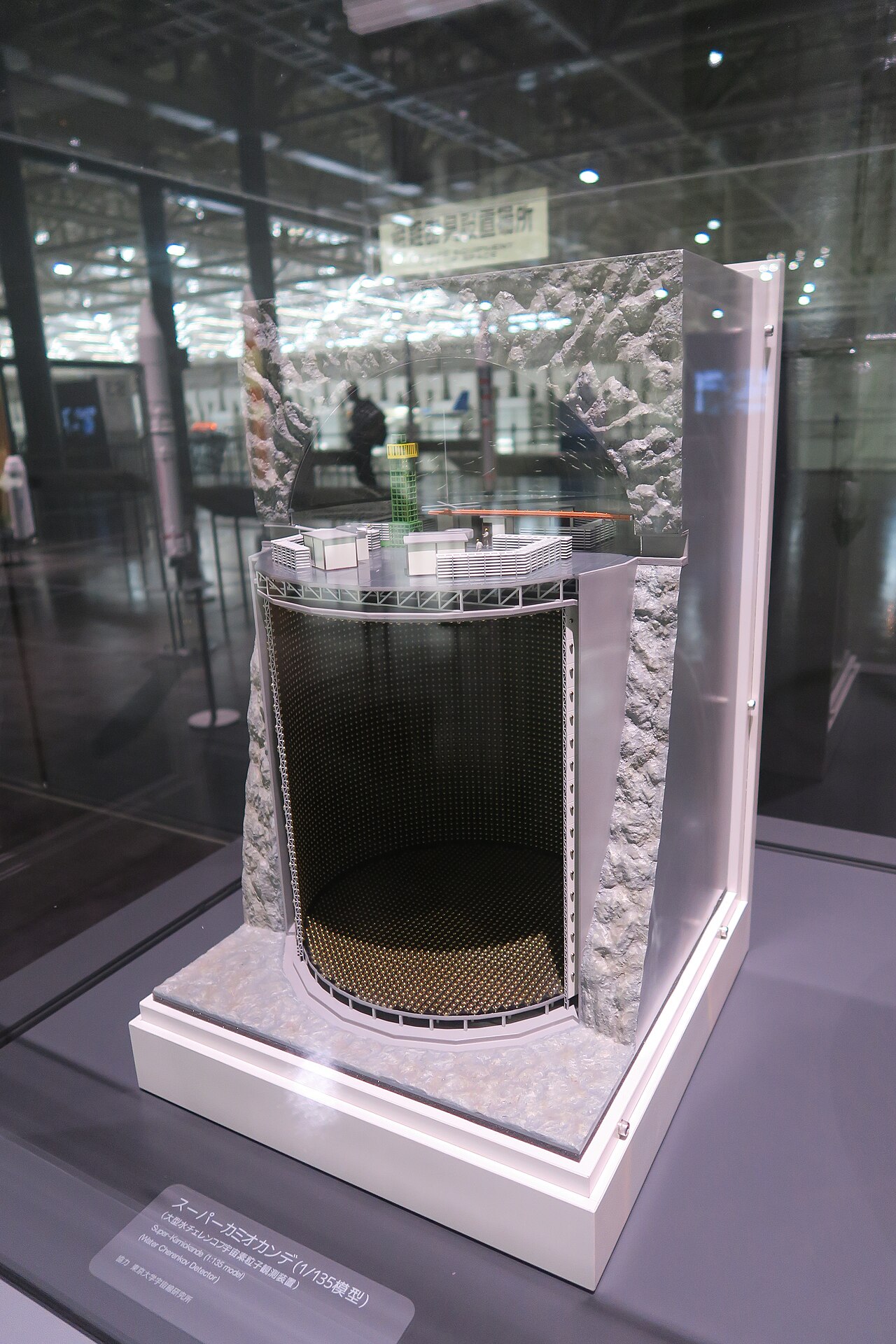
New experiments were built to cross-check Davis’s result. The Kamiokande water-Cherenkov detector in Japan, originally designed to search for proton decay, was modified to detect solar neutrinos in real time by observing the faint cone of Cherenkov radiation produced when an energetic electron was scattered by a neutrino.7 Unlike Homestake, Kamiokande could measure the direction of the incoming neutrino, directly confirming that the signal came from the Sun. It too found a deficit—roughly half the expected 8B flux—and confirmed that the missing neutrinos were genuine solar neutrinos, not experimental artifacts.7
Two radiochemical experiments sensitive to lower-energy neutrinos—SAGE in the Baksan Underground Scintillation Telescope in Russia and GALLEX at the Gran Sasso laboratory in Italy—used gallium-71 as a target, with a threshold of only 0.233 MeV that opened sensitivity to the primary pp neutrinos.17, 18 These were the most abundant solar neutrinos and, critically, their flux was almost entirely determined by the solar luminosity itself—largely independent of the uncertain nuclear physics of the 8B branch. SAGE reported its first results in 1991 and GALLEX in 1992, both finding approximately 60 percent of the predicted rate.17, 18, 19 The problem was not confined to the chlorine experiment or to the 8B component. It pervaded every solar neutrino measurement at every energy scale. This made an astrophysical explanation essentially impossible: no single modification to the solar model could simultaneously suppress the 8B neutrinos by two-thirds while also suppressing the pp neutrinos by forty percent.
The oscillation hypothesis
The particle-physics explanation had been available since before Davis published his first results. Bruno Pontecorvo suggested in 1957, and elaborated in 1968, that neutrinos might oscillate between different flavor states—analogous to the oscillation between particle and antiparticle already known in the kaon system.13 If neutrinos have mass, even a tiny mass, then the quantum-mechanical mass eigenstates need not coincide with the flavor eigenstates (electron neutrino, muon neutrino, tau neutrino). A neutrino produced as an electron neutrino in the Sun’s core would be a superposition of mass eigenstates; as it propagated through space, the components of this superposition would evolve at slightly different rates, causing the flavor composition to oscillate periodically. Ziro Maki, Masami Nakagawa, and Shoichi Sakata had provided the mathematical framework for this mixing in 1962, introducing what is now called the Pontecorvo–Maki–Nakagawa–Sakata (PMNS) mixing matrix.14
A crucial refinement came from Lincoln Wolfenstein in 1978 and Stanislav Mikheyev and Alexei Smirnov in 1985, who showed that neutrinos propagating through matter experience an effective potential that modifies their oscillation behavior.15, 16 In sufficiently dense material—such as the solar interior—the MSW effect (Mikheyev–Smirnov–Wolfenstein) can resonantly amplify the conversion of electron neutrinos into other flavors, even for very small mixing angles in vacuum. The solar matter density creates exactly the conditions for this resonant conversion in the relevant neutrino energy range. The MSW effect meant that solar neutrinos might be almost entirely converted to muon or tau flavor by the time they left the Sun, not merely partially converted during the eight-minute transit to Earth. Chlorine, gallium, and water-Cherenkov detectors were sensitive only to electron neutrinos; the muon and tau neutrinos that had once been electron neutrinos simply passed through undetected.
The oscillation hypothesis was compelling but not proven. What was needed was a detector that could measure the total flux of all neutrino flavors simultaneously—a way to see the neutrinos that had oscillated away, not just the ones that remained as electron flavor.
SNO: the resolution
The Sudbury Neutrino Observatory (SNO), located 2,092 metres underground in a nickel mine in Sudbury, Ontario, Canada, was designed from the outset to resolve the solar neutrino problem. Its crucial innovation was the use of 1,000 tonnes of heavy water (D2O) as the detection medium rather than ordinary water.10 Deuterium provides two distinct detection channels. The charged-current (CC) reaction—νe + d → p + p + e−—responds only to electron neutrinos, just like earlier experiments. But the neutral-current (NC) reaction—ν + d → p + n + ν—has equal sensitivity to all three neutrino flavors; it measures the total neutrino flux regardless of which flavor the neutrino has become. By comparing the CC and NC rates, SNO could directly test whether electron neutrinos were transforming into other flavors during transit.
SNO’s first results, published in 2001, measured the charged-current rate from 8B solar neutrinos and confirmed the same deficit as previous experiments.10 The electron-neutrino flux was 35 percent of the Bahcall SSM prediction—consistent with Homestake, Kamiokande, Super-Kamiokande, SAGE, and GALLEX. But the critical measurement came in 2002 when SNO published its neutral-current result.12 The total flux of neutrinos of all flavors, measured through the NC reaction, was 5.09 × 106 cm−2 s−1—in precise agreement with Bahcall’s SSM prediction of 5.05 × 106 cm−2 s−1. The Sun was producing exactly as many neutrinos as the model predicted. They were simply arriving at Earth as a mixture of flavors rather than as pure electron neutrinos. The solar neutrino problem was solved.
The SNO measurement provided the first direct, model-independent evidence that solar electron neutrinos were transforming into other active neutrino flavors in transit—a result that simultaneously confirmed the Standard Solar Model and demonstrated that the Standard Model of particle physics was incomplete.11, 12 Super-Kamiokande had already published compelling evidence for atmospheric neutrino oscillations in 1998, and its solar neutrino data lent further support; the SNO neutral-current measurement closed the case.8, 9
Implications for particle physics and beyond
Neutrino oscillations require neutrinos to have mass. This is a direct contradiction of the original Standard Model, in which neutrinos were assumed to be strictly massless. A massless particle travels at the speed of light and cannot have distinct mass eigenstates; oscillation is impossible. The measured oscillation parameters constrain the differences in squared masses between neutrino mass eigenstates: the solar oscillation solution (the large-mixing-angle MSW solution) requires Δm221 ≈ 7.5 × 10⁻⁵ eV2 with a large mixing angle θ12 ≈ 33°.22 The absolute mass scale remains unmeasured but is known to be very small—at least one neutrino mass eigenstate must have a mass above approximately 8.6 meV. Cosmological bounds from the cosmic neutrino background and large-scale structure currently place the sum of neutrino masses below roughly 0.12 eV.
The mechanism by which neutrinos acquire mass is an open question. The most theoretically attractive proposal, the seesaw mechanism, postulates the existence of very heavy right-handed neutrinos whose large mass pushes the observed light neutrinos to tiny masses through a coupling in the mass matrix.20 If neutrinos are Majorana particles—their own antiparticles—neutrinoless double-beta decay would be possible, a process actively searched for in several experiments. The mass hierarchy of the three neutrino mass eigenstates (normal or inverted ordering) remains undetermined. These questions place neutrino physics at the frontier of research extending beyond the Standard Model, with connections to the matter–antimatter asymmetry of the universe and the physics of core-collapse supernovae, where neutrinos carry away 99 percent of the released gravitational energy.
For solar and stellar physics, the resolution of the solar neutrino problem was an equally significant vindication. The Standard Solar Model had been correct all along; what had seemed like a crisis in astrophysics turned out to be a discovery in fundamental physics. The Sun’s core temperature, density, and nuclear reaction rates were as Bahcall had calculated. Helioseismology and solar neutrino observations now jointly constrain the solar interior with extraordinary precision, including the recent measurement of pp and CNO neutrino fluxes that probe the Sun’s core composition directly. The CNO neutrino flux, first measured by the Borexino experiment, provides a window onto the metallicity of the solar core—directly relevant to the ongoing solar abundance problem, a tension between spectroscopic surface abundances and helioseismic interior constraints that remains an active area of research.22
Nobel recognition
The solar neutrino problem and its resolution were recognized by the Nobel Committee on two occasions separated by thirteen years. In 2002, Raymond Davis Jr. and Masatoshi Koshiba (leader of the Kamiokande experiment) shared the Nobel Prize in Physics for their pioneering contributions to astrophysics, specifically for the detection of cosmic neutrinos—a category that included both solar neutrinos and the neutrino burst from Supernova 1987A detected by Kamiokande. John Bahcall, who had provided the theoretical foundation for the entire enterprise, was not included in the prize; his exclusion was widely noted as one of the more conspicuous omissions in the history of the Nobel. Bahcall died in 2005.22
In 2015, the Nobel Prize in Physics was awarded to Takaaki Kajita of Super-Kamiokande and Arthur B. McDonald of SNO for the discovery of neutrino oscillations, which showed that neutrinos have mass. The citation recognized that their experiments had established, through complementary approaches, that neutrinos change identity: Super-Kamiokande by demonstrating the oscillation of atmospheric muon neutrinos in 1998, and SNO by demonstrating that solar electron neutrinos transform into other active flavors in 2001–2002. The two Nobel prizes bookend the experimental story that began in a South Dakota mine in 1968 with a tank of dry-cleaning fluid and a deficit that took the world thirty years to explain.
The episode illustrates a recurring pattern in science: an anomaly that appears to challenge a successful theory, scrutinized for decades by competing explanations, ultimately resolved not by retracting the successful theory but by discovering that nature is richer than previously understood. The Sun was doing exactly what the models said. The neutrinos were doing something no one had expected. Both things were true.6, 12
References
Measurement of the rate of νe + d → p + p + e− interactions produced by 8B solar neutrinos at the Sudbury Neutrino Observatory
Measurement of day and night neutrino energy spectra at the Sudbury Neutrino Observatory
Direct evidence for neutrino flavor transformation from neutral-current interactions in the Sudbury Neutrino Observatory