Overview
- Comparative genomics uses whole-genome sequence alignments to reconstruct evolutionary relationships, revealing that organisms sharing recent common ancestry possess large blocks of genes in the same order (conserved synteny), shared regulatory elements, and similar genome architectures.
- Genome comparisons have uncovered the history of whole-genome duplications, large-scale chromosomal rearrangements, and transposable element expansions that have shaped genome evolution across all domains of life, from the two rounds of genome duplication in early vertebrates to the polyploidy events that characterise plant lineages.
- Ultraconserved noncoding elements — sequences preserved with near-perfect identity across hundreds of millions of years of divergence — highlight the critical role of regulatory DNA in genome evolution and demonstrate that natural selection acts on noncoding sequences with an intensity that sometimes exceeds that on protein-coding genes.
Comparative genomics is the field of biology that analyses the structure, function, and evolutionary history of genomes by aligning and comparing the complete DNA sequences of different organisms. Since the publication of the first complete bacterial genomes in 1995 and the human genome in 2001, the number of sequenced genomes has grown exponentially, enabling increasingly powerful comparisons across species, genera, families, and entire kingdoms of life.1, 13 These comparisons have revealed that genomes are not static blueprints but dynamic entities shaped by mutation, recombination, duplication, transposition, and natural selection operating over billions of years of evolutionary history.18
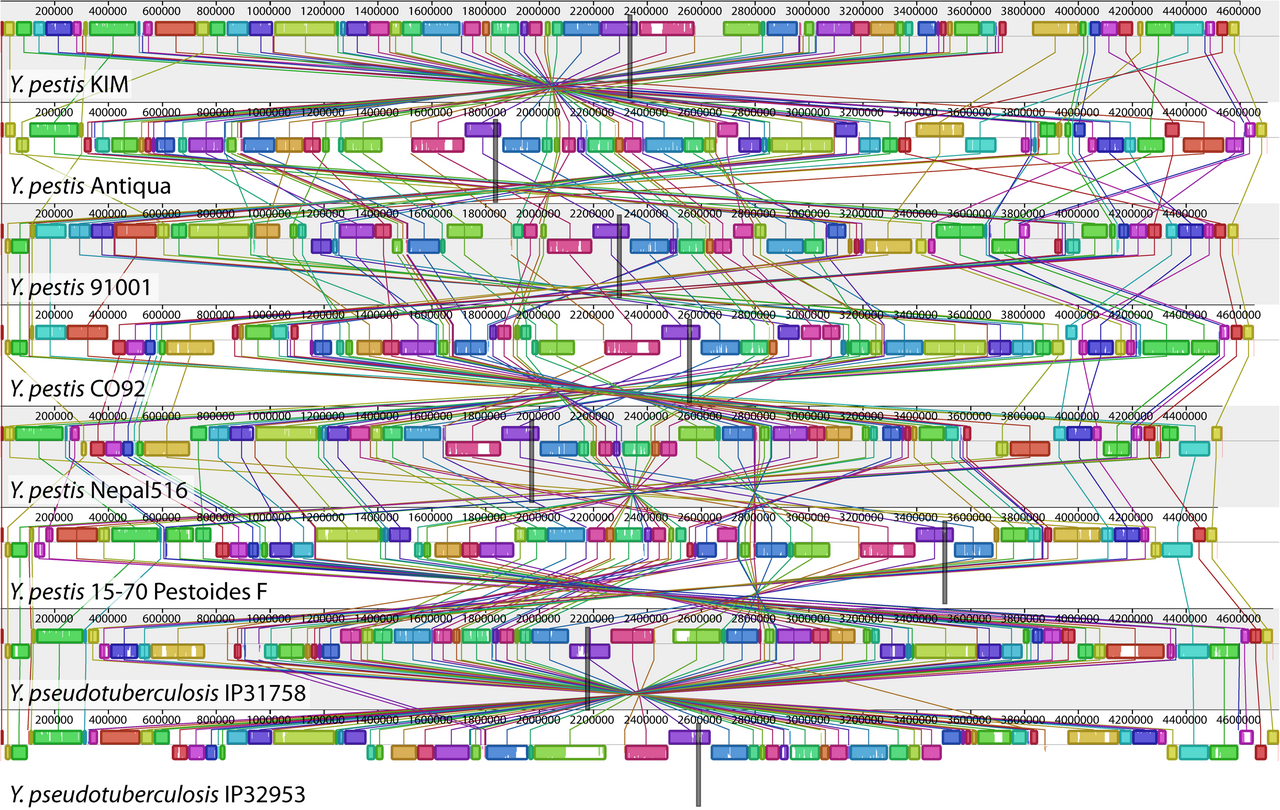

The fundamental logic of comparative genomics rests on a simple principle: sequences that are functionally important evolve more slowly than sequences that are not, because deleterious mutations in functional regions are removed by purifying selection. By comparing aligned genome sequences from multiple species, researchers can identify regions under evolutionary constraint — and thereby infer function — without any prior knowledge of what those regions do.4, 18 This approach has proven transformative for understanding the regulatory architecture of genomes, the history of genome duplication events, and the molecular basis of phenotypic differences between species.
Conserved synteny
One of the most striking findings of comparative genomics is that large blocks of genes remain in the same relative order on chromosomes across species that diverged hundreds of millions of years ago, a pattern called conserved synteny. The human and mouse genomes, for example, can be decomposed into approximately 342 syntenic blocks within which gene order is largely preserved, despite the two lineages having diverged roughly 90 million years ago.9 By reconstructing the pattern of chromosomal rearrangements that converted one genome arrangement into the other, researchers can infer the karyotype of the common ancestor and trace the history of inversions, translocations, fusions, and fissions that occurred along each lineage.9, 3
Synteny conservation extends well beyond mammals. Comparisons between the human genome and the genomes of teleost fishes, which diverged from the tetrapod lineage approximately 450 million years ago, reveal extensive syntenic correspondence, particularly when the two extra Hox clusters and other duplicated segments in teleosts are accounted for.3 In plants, synteny between rice, maize, sorghum, and other grass genomes has enabled the identification of orthologous gene pairs across species with dramatically different genome sizes, facilitating gene discovery and crop improvement.12 The persistence of synteny over deep evolutionary time suggests that gene order is not random but is maintained, at least in part, by functional constraints such as shared regulatory elements that control the expression of neighbouring genes.
Whole-genome duplications
Comparative genomics has provided definitive evidence that whole-genome duplication (WGD) events have played a major role in the evolution of eukaryotic genomes. The two rounds of WGD that occurred early in vertebrate evolution (the 2R hypothesis) were confirmed by the analysis of paralogous gene quartets distributed across four chromosomal regions in the human genome, a pattern consistent with two successive tetraploidisation events followed by rediploidisation and extensive gene loss.7 These duplications provided raw material for evolutionary innovation by creating redundant gene copies that were free to diverge in function, a process that has been linked to the elaboration of the vertebrate immune system, the expansion of the Hox gene clusters, and the increased complexity of vertebrate signalling pathways.7, 3
Teleost fishes experienced an additional, third round of WGD approximately 320 to 350 million years ago, as demonstrated by the comparison of teleost and tetrapod genomes, which revealed extensive duplicated syntenic blocks in fishes that have single-copy counterparts in tetrapods.3 In plants, WGD events are even more pervasive: the genome of Arabidopsis thaliana, despite its small size, carries the signatures of at least two ancient polyploidy events, and many crop species are recent polyploids.12 In fungi, the yeast Saccharomyces cerevisiae descends from a WGD that occurred approximately 100 million years ago, and comparison with pre-duplication yeast species has illuminated how duplicated genomes are restructured through reciprocal gene loss, a process called diploidisation.10
Conserved noncoding elements
Perhaps the most surprising revelation of comparative genomics has been the extent of evolutionary conservation in noncoding DNA. The human genome is approximately 98.5 percent noncoding, yet a substantial fraction of its noncoding sequence is under stronger purifying selection than many protein-coding genes.4, 16 Bejerano and colleagues identified 481 ultraconserved elements (UCEs) of 200 base pairs or longer that are perfectly conserved between the human, mouse, and rat genomes — a degree of sequence identity that far exceeds what would be expected under neutral evolution, given the approximately 90 million years of divergence between these lineages.5 Many of these UCEs also show extraordinary conservation in more distant vertebrates such as chickens and pufferfish, despite the absence of any protein-coding potential.5
The functional significance of these conserved noncoding elements has been a major focus of research. Many have been shown to function as transcriptional enhancers that drive gene expression in specific tissues during embryonic development, particularly in the brain, nervous system, and developing limbs.5, 16 The ENCODE project, which systematically mapped functional elements in the human genome, found that a large proportion of conserved noncoding sequences overlap with sites of transcription factor binding, histone modification, and other chromatin features indicative of regulatory activity.16 These findings have reinforced the conclusion from evo-devo research that the evolution of animal form is driven primarily by changes in gene regulation rather than changes in protein-coding sequences, and that the regulatory architecture of the genome is a major target of natural selection.18
Primate genome comparisons
Comparative genomics among primates has provided detailed insights into recent human evolution. The chimpanzee genome, published in 2005, confirmed that humans and chimpanzees share approximately 98.8 percent nucleotide identity in aligned sequences, with the remaining differences comprising single-nucleotide substitutions, insertions, deletions, and structural rearrangements.2 The gorilla genome, published in 2012, revealed a more complex picture: while the majority of the human genome is most closely related to the chimpanzee genome, approximately 15 percent of the gorilla genome is closer to either the human or chimpanzee genome than those two are to each other, a pattern expected from incomplete lineage sorting in the ancestral population.11
Human-chimpanzee genome comparisons have identified several categories of genomic change that may underlie the phenotypic differences between the two species. Genes involved in immunity, reproduction, and sensory perception show elevated rates of amino acid substitution, suggesting adaptation by positive selection.2 Human-specific gene duplications, deletions of conserved regulatory elements, and the expansion of particular gene families have also been identified as candidates for driving human-specific traits.2, 11 At the population level, the 1000 Genomes Project catalogued human genetic variation across global populations, providing a baseline for understanding the selective pressures that have shaped the human genome in the time since the divergence from our last common ancestor with chimpanzees.14, 17
Multi-species comparisons and model organisms
The comparative genomics of model organisms has yielded broad insights into genome evolution. The twelve-species Drosophila genome project, which sequenced the genomes of fruit fly species spanning approximately 40 million years of divergence, provided a high-resolution view of genome evolution within a single genus. The project revealed that protein-coding genes comprise only a small fraction of the evolutionarily constrained sequence; a substantial portion of the functionally important genome consists of noncoding regulatory elements, many of which are conserved across all twelve species.8 Rates of gene gain, loss, and rearrangement were quantified across the phylogeny, revealing that gene family size evolution is highly dynamic, with lineage-specific expansions and contractions occurring frequently and often correlating with ecological adaptations.8
Comparisons among bacterial genomes have been equally informative. Even closely related bacterial species can differ by 20 to 30 percent of their gene content due to horizontal gene transfer, gene loss, and the acquisition of mobile genetic elements, a finding that led to the concept of the pan-genome: the total gene repertoire of a species, comprising a core genome shared by all strains and an accessory genome of genes present in only some strains.6, 13 This discovery has had important implications for understanding bacterial pathogenesis, antibiotic resistance, and the fluidity of prokaryotic genomes.
Structural variation and genome architecture
Beyond single-nucleotide changes, comparative genomics has revealed that structural variation — including insertions, deletions, duplications, inversions, and translocations of DNA segments ranging from a few kilobases to megabases — is a major source of genomic divergence between species and between individuals within a species.14 Segmental duplications, defined as blocks of sequence greater than one kilobase with more than 90 percent identity to another genomic location, are particularly abundant in primate genomes and have been hotspots for gene innovation. Many human-specific gene duplications map to segmental duplication regions and have given rise to novel gene functions involved in brain development and cognitive capacity.2, 11
Transposable elements have also played a major role in shaping genome architecture across eukaryotes. Approximately 45 percent of the human genome consists of recognisable transposable element sequences, predominantly LINE and SINE retrotransposons.1 While most of these elements are now inactive, their historical activity has contributed to genome expansion, gene duplication, exon shuffling, and the creation of new regulatory elements. Comparative genomics has shown that transposable element content varies enormously across lineages: some organisms, such as the bdelloid rotifer Adineta vaga, have evolved mechanisms that limit transposon accumulation, resulting in unusually compact genomes, while others, such as maize, have genomes that are predominantly transposon-derived.15, 12
Significance for evolutionary biology
Comparative genomics has fundamentally changed the study of evolution by making the entire genome — not just individual genes — the unit of comparison. It has revealed that gene content is remarkably conserved across animals (humans and flies share roughly two-thirds of their genes), that the differences between organisms lie predominantly in regulatory DNA, and that genome-scale events such as whole-genome duplications and transposon expansions have been major drivers of evolutionary change.1, 7, 18 By enabling the identification of functionally constrained sequences without prior knowledge of function, comparative genomics has become an indispensable tool for annotating genomes, discovering regulatory elements, and reconstructing the evolutionary history of life at the most fundamental level of biological organisation.4, 13
References
Comparison of the genomes of two Xanthomonas pathogens with differing host specificities
The Arabidopsis genome initiative: analysis of the genome sequence of the flowering plant Arabidopsis thaliana
Identification and analysis of functional elements in 1% of the human genome by the ENCODE pilot project
Rates of molecular evolution suggest natural history of life history traits and a post-K-Pg nocturnal bottleneck of placentals