Overview
- Ecological character displacement is the evolutionary divergence of competing species' traits when they occur in sympatry (together) compared to when they occur in allopatry (apart), driven by natural selection against individuals whose resource use overlaps most with the competing species — a process that reduces interspecific competition and facilitates stable coexistence.
- Darwin's finches on the Galapagos Islands provide the most thoroughly documented example: the medium ground finch (Geospiza fortis) has a significantly smaller beak on islands where it co-occurs with the large ground finch (G. magnirostris) than on islands where it lives alone, and the Grants' long-term field studies have directly observed selection driving this divergence during drought years.
- Demonstrating character displacement requires distinguishing it from alternative explanations such as ecological sorting (where species with pre-existing differences preferentially colonise the same area) and differential extinction, and the six criteria established by Schluter and McPhail — including evidence for competition and the direction of selection — have become the standard framework for rigorous tests.
Ecological character displacement is the process by which natural selection drives the evolutionary divergence of traits between competing species where they co-occur (in sympatry), resulting in greater differences between species in sympatry than in allopatry (where they occur apart). The term was coined by William L. Brown and Edward O. Wilson in 1956 to describe a pattern they noticed across many animal groups: species that are similar in morphology and ecology tend to be more different from each other where their ranges overlap than where they do not.1 The mechanism underlying this pattern is straightforward: when two species compete for the same resources, individuals of each species whose traits overlap most with the competitor suffer reduced fitness because of intensified competition, while individuals whose traits are more distinct from the competitor's experience less competition and higher fitness. Over generations, this selective pressure pushes the two species apart in the traits most relevant to resource use.2, 3

Theory and criteria for demonstration
The theoretical basis for ecological character displacement is rooted in competition theory and the concept of the ecological niche. When two species overlap substantially in their resource use, interspecific competition reduces the fitness of both. If heritable variation exists in traits that determine resource use, natural selection will favour individuals in each species that use resources less exploited by the competitor, driving phenotypic divergence. This process is predicted to be strongest when competition is most intense — that is, when the two species are most similar and when resources are limiting — and weakest or absent when the species are already sufficiently different that competition is negligible.2, 4
Demonstrating that an observed pattern of greater divergence in sympatry than allopatry is the result of character displacement rather than alternative processes requires careful evidence. Schluter and McPhail established six criteria that have become the standard framework for rigorous tests. First, the pattern (greater divergence in sympatry) must be documented. Second, the pattern must not be attributable to chance (statistical significance). Third, the morphological differences must have functional consequences for resource use. Fourth, there must be evidence that the species actually compete. Fifth, the differences must have evolved in situ (in sympatry) rather than arising before the species came into contact. Sixth, there must be evidence that natural selection, rather than drift or other processes, is responsible for the divergence.10 Meeting all six criteria is challenging, which is why relatively few cases have been documented with full rigour, though the number has grown substantially since the 1990s.5, 15
Darwin's finches
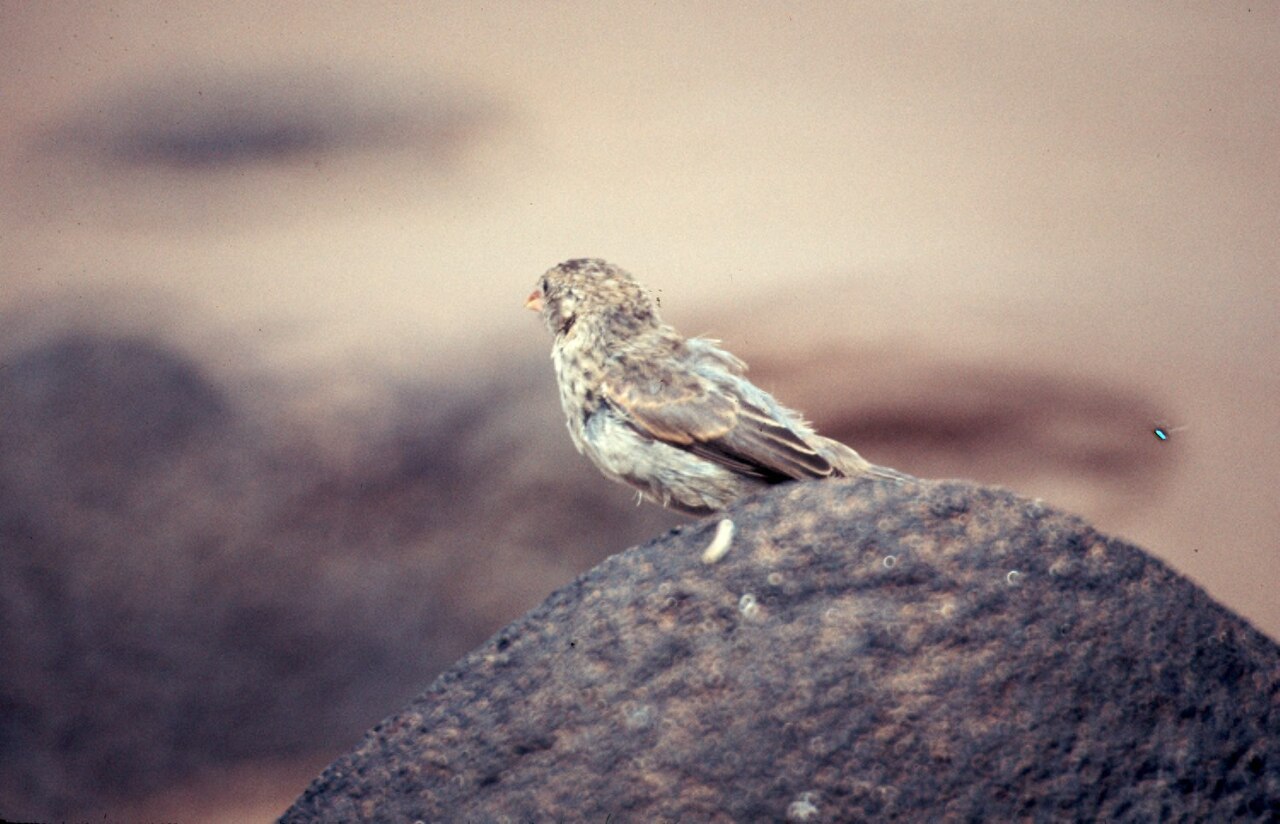
The most thoroughly studied case of ecological character displacement involves the ground finches of the Galapagos Islands. Peter and Rosemary Grant's multi-decade field studies on the island of Daphne Major have documented character displacement in real time between the medium ground finch (Geospiza fortis) and the large ground finch (G. magnirostris). Prior to the colonisation of Daphne Major by G. magnirostris in 1982, G. fortis exhibited substantial variation in beak size. Following the establishment of a breeding population of G. magnirostris, the two species competed directly for the large, hard seeds of Tribulus cistoides, which the large-beaked G. magnirostris is more efficient at processing.7, 8
During the severe drought of 2003–2004, food became scarce and competition intensified. Natural selection on G. fortis during this period strongly favoured individuals with smaller beaks, which were more efficient at feeding on the small seeds that G. magnirostris ignored. The mean beak size of G. fortis declined measurably in the post-drought population, representing a directly observed episode of character displacement driven by competition with a sympatric congener.8 Broader comparisons across the Galapagos archipelago confirm the pattern: on islands where G. fortis co-occurs with G. magnirostris, its beak is significantly smaller than on islands where G. fortis occurs alone, and on islands where G. fortis co-occurs with the smaller G. fuliginosa, its beak is significantly larger.9
Stickleback fish
Threespine stickleback fish (Gasterosteus aculeatus) in the postglacial lakes of British Columbia provide another well-documented case. In several small lakes on islands in the Strait of Georgia, sticklebacks have diversified into two ecologically distinct forms: a large-bodied, deep-headed benthic form that feeds on invertebrates in the littoral zone and a smaller, slender-bodied limnetic form that feeds on zooplankton in the open water.6 These species pairs have evolved independently in each lake from marine ancestors, representing replicated natural experiments in character displacement.11, 12
Schluter demonstrated experimentally that competition between the two forms drives divergent selection: when benthic and limnetic sticklebacks are placed together in experimental enclosures, each form's growth rate is reduced relative to when it occurs alone, and the reduction is greatest for individuals whose morphology is intermediate between the two forms.6 In lakes that contain only a single stickleback population (without a sympatric congener), the solitary population is morphologically intermediate between the benthic and limnetic forms found in the species-pair lakes, consistent with the prediction that divergence in sympatry is driven by competition rather than reflecting pre-existing differences.2
Anolis lizards and additional examples
Caribbean Anolis lizards offer a large-scale example of character displacement operating within adaptive radiations. On each of the four large islands of the Greater Antilles, anoles have independently evolved a set of ecomorphs — trunk-crown, trunk-ground, twig, and grass-bush specialists — that differ in body size, limb length, toepad size, and perch diameter. Losos and colleagues showed that the repeated, convergent evolution of the same ecomorph set on independent islands is driven by interspecific competition for perch space and food: species that co-occur on the same island partition habitat along the same axes on each island, with morphological divergence tightly correlated with ecological divergence.13, 14
Character displacement has been documented in many other systems. Pfennig and Murphy demonstrated ecological character displacement in spadefoot toads (Spea multiplicata and S. bombifrons), where tadpole morphology diverges in sympatric ponds: S. multiplicata tadpoles develop a smaller, more omnivore-like jaw morphology in ponds shared with S. bombifrons than in ponds where they occur alone, reducing overlap in the shrimp prey upon which S. bombifrons specialises.16 Reviews by Dayan and Simberloff and by Pfennig and Pfennig have compiled evidence for character displacement across mammals, birds, fish, amphibians, and invertebrates, establishing it as a widespread and taxonomically general phenomenon.5, 15
Significance for diversification
Ecological character displacement is significant beyond its role in reducing competition between co-occurring species. By driving phenotypic divergence between populations, it can contribute to the evolution of reproductive isolation, thereby linking competition directly to speciation. If the traits subject to character displacement also influence mate recognition — as beak size does in Darwin's finches, where females preferentially mate with males whose song (which is correlated with beak size) matches their own — then divergent selection on ecological traits can generate assortative mating as a by-product, promoting the evolution of prezygotic isolation between sympatric populations.2, 8
Character displacement may also be a major driver of the species diversity patterns observed in adaptive radiations. As new species arise and come into secondary contact, competition drives each pair to diverge, progressively filling the available ecological space with morphologically and ecologically distinct species. In this view, the diversity generated by character displacement is not merely a consequence of species coexistence but a cause of further diversification, creating a positive feedback loop between competition, divergence, and speciation that is central to the generation of biological diversity.3, 4, 17
References
Character displacement: ecological and reproductive responses to a common evolutionary problem
Experimental evidence that competition and habitat use shape the individual fitness surface