Overview
- Body size is one of the most consequential traits in biology, influencing metabolic rate, life history, ecological interactions, and extinction risk, and its evolution is governed by a set of macroecological patterns including Cope's rule (phylogenetic trends toward larger size), Bergmann's rule (larger body size in colder climates), and the island rule (gigantism in small species and dwarfism in large species on islands).
- Allometric scaling laws describe how physiological and life history traits change predictably with body mass across species, with metabolic rate scaling as mass to the three-quarter power, and these relationships constrain the range of viable body plans while explaining why the largest terrestrial animals have been limited to roughly 100 tonnes.
- The fossil record reveals repeated episodes of both gigantism and miniaturisation driven by oxygen availability, thermoregulation, predation pressure, and resource competition, with body size playing a significant role in extinction selectivity during mass extinction events.
Body size is among the most ecologically and evolutionarily consequential traits of any organism. It correlates with metabolic rate, generation time, population density, home range size, diet, locomotor capacity, and extinction risk, and its evolution has been shaped by physical constraints, physiological tradeoffs, ecological interactions, and climatic conditions over the entire history of life.5, 17 Several macroecological patterns describe regularities in body size evolution across taxa and environments: Cope's rule describes a tendency for lineages to evolve toward larger body size over geological time; Bergmann's rule describes the tendency for organisms to be larger in colder climates; and the island rule describes opposite size shifts in small and large species on islands.1, 2, 3 The fossil record reveals episodes of extreme gigantism in insects during the Carboniferous, sauropod dinosaurs during the Mesozoic, and cetaceans during the Cenozoic, each driven by distinct ecological and physiological factors, as well as repeated instances of miniaturisation that have produced some of the smallest vertebrates and invertebrates known.7, 8, 13, 14
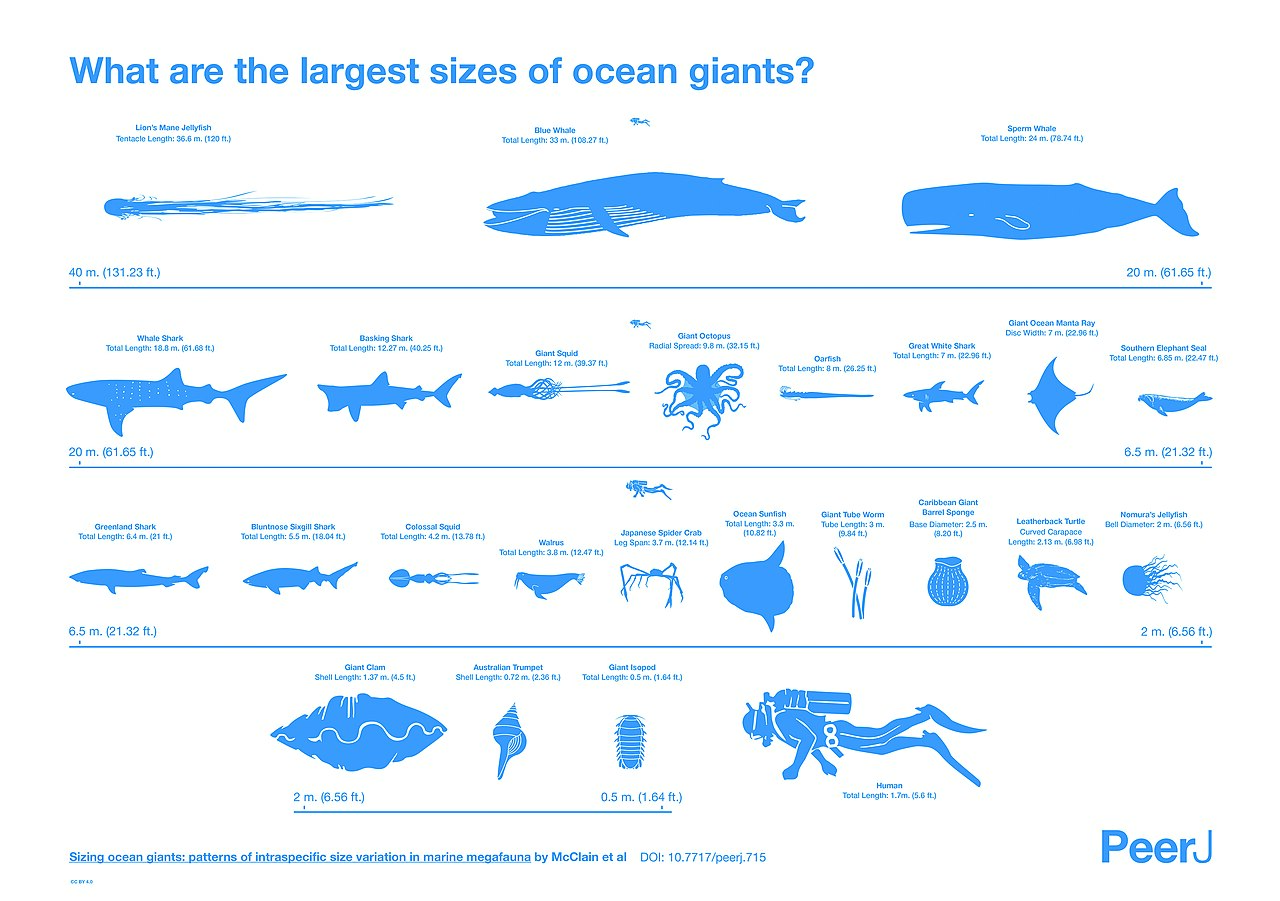

Cope's rule
Cope's rule, named after the nineteenth-century American palaeontologist Edward Drinker Cope, is the observation that many animal lineages exhibit a trend toward increasing body size over evolutionary time. The pattern has been documented in groups as diverse as mammals, dinosaurs, brachiopods, foraminifera, and horses, and it appears in both the mean and the maximum body size of clades through the fossil record.12
Several mechanisms have been proposed to explain Cope's rule. The most straightforward is directional selection for larger body size, which could arise if larger individuals enjoy fitness advantages such as increased competitive ability, reduced predation risk, greater mating success, improved thermoregulation, or access to a wider range of food resources.15 An alternative explanation is that lineages tend to originate at small body sizes and diversify in both directions, but because there is a hard lower boundary on body size (imposed by physiological constraints such as minimum viable organ sizes), the net effect over time is a shift in the mean toward larger sizes, a pattern that can arise without any directional selection at all. This is Stanley's "passive diffusion" model, which posits that Cope's rule is a statistical artefact of bounded diversification rather than evidence for a selective advantage of large size.12
Alroy tested these hypotheses using a large dataset of body masses in North American fossil mammals spanning 65 million years. He found that the pattern was more complex than either simple directional selection or passive diffusion would predict. Within individual lineages, there was a slight but consistent bias toward size increase, supporting a weak version of Cope's rule driven by within-lineage selection. However, the overall increase in average body size across the entire mammalian fauna was also driven by differential origination and extinction: larger-bodied lineages did not go extinct more frequently, and new lineages tended to originate at larger sizes than expected by chance.1
The advantages of large body size are numerous and well documented. Larger animals typically experience lower mass-specific predation rates, enjoy greater success in intraspecific competition for mates and resources, have better thermoregulatory capacity (particularly in cold environments, as described by Bergmann's rule), and can access food resources unavailable to smaller species. However, large body size also carries significant disadvantages: larger species require more absolute energy intake, have lower population densities, longer generation times, and slower evolutionary response to environmental change. Blanckenhorn synthesised these opposing pressures and argued that the optimal body size for any species represents a balance between the selective advantages of being large and the ecological and physiological costs, and that this balance shifts predictably with environmental conditions such as resource availability, predation intensity, and climate.15
Cope's rule is not universal. Many lineages, including certain insect groups, birds, and lizards, show no consistent trend toward larger size, and some show trends toward smaller size. The rule is best understood as a statistical tendency rather than an evolutionary law, one that applies unevenly across taxa and time periods and whose strength depends on the specific ecological and physiological pressures faced by each group.1, 15
Bergmann's rule
Bergmann's rule, formulated by the German biologist Carl Bergmann in 1847, states that within a broadly distributed taxon, populations and species in colder climates tend to be larger than those in warmer climates. The original explanation was thermoregulatory: larger bodies have a lower surface-area-to-volume ratio, which reduces heat loss in cold environments and provides an advantage for endotherms seeking to maintain body temperature in low ambient temperatures.2
Ashton, Tracy, and de Queiroz conducted a meta-analysis of body size variation in North American mammals and found broad support for Bergmann's rule: the majority of species showed a significant positive correlation between body size and latitude (a proxy for cold climate). The pattern was strongest in species with broad geographic ranges that span substantial temperature gradients and weaker or absent in species with narrow ranges.2
However, the thermoregulatory explanation has been challenged. Bergmann's rule also holds, to varying degrees, in ectotherms such as amphibians, reptiles, and insects, where the surface-area-to-volume argument is less obviously applicable because these organisms do not maintain a constant body temperature through metabolic heat production.15 Alternative explanations include the starvation resistance hypothesis (larger animals have greater energy reserves relative to metabolic rate and can survive longer periods of food scarcity, which are more common in seasonal or cold environments), the heat conservation during fasting hypothesis, and the productivity hypothesis (colder environments at higher latitudes may actually support larger body sizes through higher seasonal productivity or reduced competition). The relative importance of these mechanisms remains debated, and it is likely that Bergmann's rule reflects the combined action of multiple selective pressures rather than a single thermoregulatory mechanism.2, 15
The island rule
The island rule is the macroecological pattern in which small mainland species tend to evolve toward larger body size on islands (island gigantism) while large mainland species tend to evolve toward smaller body size (island dwarfism). Classic examples of island gigantism include the giant tortoises of the Galápagos and Aldabra, the giant rats of Flores, and the enormous flightless birds such as the dodo and the elephant bird. Classic examples of island dwarfism include the dwarf elephants of Mediterranean islands, the dwarf mammoths of the Channel Islands off California, and the controversial Homo floresiensis of Flores.3
Lomolino proposed that the island rule reflects a convergence toward an intermediate optimal body size that is determined by the balance between the advantages and disadvantages of large size in the ecologically simplified conditions of islands. On islands, the reduced diversity of competitors and predators relaxes the selective pressures that maintain small body size in small species (such as the need to reproduce quickly and hide from predators) and the pressures that maintain large body size in large species (such as the need for large body size to compete with other large herbivores or to deter predators). In the absence of these pressures, both small and large species converge toward a body size of roughly one kilogram, which Lomolino identified as an energetic optimum that balances metabolic efficiency, reproductive output, and survival.3
Meiri, Dayan, and Simberloff challenged the generality of the island rule, arguing that the pattern is strong for mammals but weak or inconsistent for other vertebrate groups such as birds, reptiles, and amphibians. They found that when analyses were restricted to well-sampled island populations with adequate mainland comparisons, the island rule held for some taxa but not others, and that the strength and direction of size change depended on island area, isolation, latitude, and the specific ecological context of each island population.10
Classic examples of the island rule3
| Species | Island | Direction | Mainland relative size |
|---|---|---|---|
| Dwarf elephant (Palaeoloxodon falconeri) | Sicily | Dwarfism | ~2% of mainland ancestor |
| Channel Islands mammoth (Mammuthus exilis) | Santa Rosa, California | Dwarfism | ~12% of mainland ancestor |
| Galápagos tortoise (Chelonoidis spp.) | Galápagos | Gigantism | Several times mainland relatives |
| Flores giant rat (Papagomys armandvillei) | Flores | Gigantism | ~5× mainland relatives |
| Dodo (Raphus cucullatus) | Mauritius | Gigantism | ~10× pigeon ancestors |
Allometric scaling and metabolic constraints
The relationship between body size and nearly every aspect of organismal biology is described by allometric scaling laws, power-law relationships of the form Y = Y0Mb, where Y is a biological variable, M is body mass, Y0 is a normalisation constant, and b is the scaling exponent. The most celebrated scaling relationship is Kleiber's law, which states that basal metabolic rate scales as body mass to the three-quarter power (M0.75) across mammals and birds spanning five orders of magnitude in body size.4, 17
Schmidt-Nielsen documented how allometric scaling pervades biology. Heart rate scales as M−0.25, lifespan as M0.25, stride frequency as M−0.17, and population density as M−0.75. The consistency of these quarter-power exponents across diverse taxa and biological variables suggested an underlying physical constraint. West, Brown, and Enquist proposed that the constraint arises from the fractal-like branching geometry of internal resource-distribution networks (such as circulatory and respiratory systems), which must service every cell in the body efficiently. Their model predicts three-quarter-power metabolic scaling as a necessary consequence of the physics of nutrient delivery through branching networks that fill three-dimensional space.4
These scaling laws impose fundamental constraints on body size evolution. As organisms increase in size, their mass-specific metabolic rate decreases, meaning that large organisms require less energy per unit mass but more total energy. This creates a tradeoff: larger organisms can exploit food resources more efficiently on a per-gram basis but require larger home ranges and greater absolute food intake, which limits population density and increases vulnerability to resource fluctuations.5, 17 The maximum size of terrestrial mammals appears to have been constrained to roughly 10 to 20 tonnes throughout the Cenozoic (with the exception of the largest indricotheres at approximately 15–20 tonnes), reflecting the ecological ceiling imposed by the productivity of terrestrial ecosystems and the energetic demands of maintaining a large endothermic body.9
Gigantism: insects, dinosaurs, and whales
The largest organisms in Earth's history illustrate how physical, physiological, and ecological factors interact to set the upper limits of body size in different lineages and eras.
Carboniferous insect gigantism. During the late Carboniferous period (approximately 300 million years ago), atmospheric oxygen concentrations reached approximately 35 percent, compared to the present-day 21 percent. This oxygen-rich atmosphere is widely regarded as the primary driver of insect gigantism during this interval, which produced dragonfly-like griffinflies (Meganeura) with wingspans exceeding 70 centimetres and millipede-like arthropods (Arthropleura) over two metres long. Insects deliver oxygen to their tissues through a system of tracheal tubes that rely on passive diffusion, a mechanism that becomes less efficient as body size increases because the diffusion distance grows. Higher atmospheric oxygen concentrations would have increased the efficiency of tracheal gas exchange, relaxing the constraint on maximum body size and permitting the evolution of giants.6, 7
Sauropod dinosaur gigantism. The sauropod dinosaurs of the Mesozoic era were the largest terrestrial animals that have ever lived, with the largest species (Argentinosaurus, Patagotitan) estimated to have weighed 70 to 100 tonnes. Sander and colleagues identified a suite of features that enabled sauropod gigantism: a bird-like respiratory system with air sacs that provided more efficient gas exchange than the mammalian lung; the absence of mastication (food was swallowed whole, eliminating the need for a massive jaw apparatus and allowing a small head on a long neck); high basal metabolic rates facilitated by their large size; and an oviparous reproductive strategy that produced many small offspring, allowing rapid population recovery and reducing the demographic risks associated with low population densities.8 Unlike mammals, sauropods did not need to nurse their young, which may have relaxed a key constraint on maximum body size in terrestrial endotherms.8, 18
Cetacean gigantism. The largest animals that have ever existed are the baleen whales, with the blue whale (Balaenoptera musculus) reaching approximately 30 metres and 150 tonnes. Slater and colleagues showed that extreme gigantism in baleen whales is geologically recent, evolving only within the last 4.5 million years, coinciding with the onset of Pleistocene glacial cycles. They proposed that the development of seasonal upwelling zones and dense patches of prey (krill and small fish) in cold, nutrient-rich waters provided the energetic conditions necessary for lunge-feeding at very large body sizes. The aquatic medium itself also removes the skeletal and locomotor constraints that limit terrestrial body size: water provides buoyancy that supports enormous mass, and the hydrodynamics of lunge-feeding favour larger body size because the volume of water (and prey) engulfed per lunge increases with body size more rapidly than the energetic cost of the lunge.13
Miniaturisation
While much attention has been devoted to gigantism, the evolution of extremely small body size, miniaturisation, is equally important and poses its own set of evolutionary and physiological challenges. Miniaturised organisms must maintain functional organ systems at dramatically reduced scales, often requiring fundamental reorganisation of anatomy. Hanken and Wake documented how miniaturisation in salamanders leads to the loss of bones, simplification of the skull, and reduction in the number of presacral vertebrae, and argued that miniaturisation has been a major driver of morphological novelty in amphibians by forcing developmental systems to produce novel solutions to the engineering challenges of extreme small size.14
Among vertebrates, the smallest known species include the frog Paedophryne amauensis from Papua New Guinea (approximately 7.7 millimetres in length), several species of miniature fish in the genus Paedocypris (approximately 8 millimetres), and the Etruscan shrew Suncus etruscus (approximately 1.8 grams). These organisms approach the lower limits of vertebrate body size, constrained by the minimum number of cells required to form functional sense organs, a brain capable of processing sensory information and generating motor commands, and a circulatory system capable of delivering oxygen to tissues.14, 17
Miniaturisation has ecological consequences that mirror those of gigantism. Very small organisms have extremely high mass-specific metabolic rates (a consequence of allometric scaling), requiring almost continuous feeding to avoid starvation. The Etruscan shrew, for example, must consume approximately 1.5 to 2 times its body weight in food each day and has a heart rate of over 1,200 beats per minute.17 These energetic demands constrain miniaturised organisms to habitats with reliably abundant food supplies and equable temperatures, and make them vulnerable to even brief periods of food scarcity or thermal stress.
Miniaturisation in invertebrates reaches even more extreme scales. The parasitic wasp Dicopomorpha echmepterygis has males approximately 139 micrometres in length, smaller than many single-celled organisms. At these scales, the nervous system must function with far fewer neurons than in larger relatives, raising questions about how minimum circuit complexity constrains behaviour and perception. Miniaturisation has also been extensively studied in frogs of the Old and New World tropics, where repeated independent origins of tiny body sizes (under 12 millimetres snout-vent length) are associated with reduced numbers of digits, simplified cranial morphology, and loss of the middle ear apparatus, demonstrating that the anatomical consequences of miniaturisation are convergent and predictable across independent lineages.14
The ecological advantages of small body size include access to microhabitats unavailable to larger organisms, reduced absolute food requirements, shorter generation times that permit rapid population growth, and the ability to sustain large population sizes that buffer against extinction. These advantages help explain why small-bodied species vastly outnumber large-bodied species in virtually every major taxonomic group, a pattern first noted by Hutchinson and MacArthur and subsequently confirmed across mammals, birds, insects, and marine invertebrates. The right-skewed body size distribution, with many small species and few large ones, is one of the most consistent macroecological patterns in biology and reflects the combined effects of higher speciation rates in small lineages, higher extinction rates in large lineages, and the energetic and ecological constraints that limit the number of viable large-bodied species in any given ecosystem.12, 15
Body size and extinction selectivity
Body size is one of the strongest predictors of extinction risk across a wide range of taxa and time periods. The relationship between body size and extinction, however, is not simple: large body size can be either a risk factor or a protective factor depending on the nature of the extinction event and the ecological context.11
During background extinction (the normal, ongoing rate of species loss outside of mass extinction events), large body size is generally associated with elevated extinction risk. Large species have smaller population sizes, lower reproductive rates, longer generation times, and larger home range requirements, all of which make them more vulnerable to environmental perturbations such as habitat loss, resource depletion, and human hunting. The late Quaternary megafaunal extinctions, in which most large-bodied mammals (mammoths, ground sloths, sabre-toothed cats) went extinct on every continent except Africa, illustrate this pattern dramatically.9, 16
During mass extinction events, the relationship between body size and extinction is more complex. Jablonski's analysis of selectivity during the end-Cretaceous mass extinction found that body size was a weaker predictor of survival than geographic range: widespread species survived preferentially regardless of body size. However, in the recovery phase following mass extinctions, small-bodied species tend to diversify more rapidly, presumably because their shorter generation times, higher reproductive rates, and lower resource requirements allow faster population growth and adaptation to post-extinction environments.11
Smith and colleagues documented the evolutionary trajectory of maximum mammalian body size following the end-Cretaceous extinction. After the extinction of the non-avian dinosaurs, mammals underwent a dramatic increase in body size over the first 25 million years of the Cenozoic, eventually reaching maximum sizes of 10 to 20 tonnes (in taxa such as the indricotheres and the proboscideans). The trajectory of body size increase was remarkably similar on different continents despite independent faunal compositions, suggesting that the upper limit was determined by ecological or physiological constraints rather than by the phylogenetic identity of the lineages involved.9
Significance and ongoing research
The evolution of body size sits at the intersection of ecology, physiology, palaeontology, and evolutionary biology. Body size determines the pace of life, the scale of ecological interactions, and the vulnerability of species to environmental change, making it one of the most integrative traits in all of biology.5, 17 Current research continues to refine the mechanisms underlying the major macroecological patterns. Phylogenetic comparative methods are being applied to test whether Cope's rule, Bergmann's rule, and the island rule hold after accounting for shared ancestry, and whether the apparent patterns reflect directional selection, constraint, or statistical artefacts of bounded diversification.1, 10
The fossil record also reveals that body size distributions are reshaped during and after mass extinctions in consistent ways. The "Lilliput effect," documented in the aftermath of several major extinction events, describes a transient reduction in body size across surviving lineages immediately following the extinction, possibly reflecting the selective advantage of small body size during periods of ecological crisis when resources are scarce and environmental conditions are harsh. The Lilliput effect has been documented after the end-Permian, end-Triassic, and end-Cretaceous mass extinctions, suggesting that it is a general feature of post-extinction recovery rather than a phenomenon specific to any single event.11, 12
In the context of contemporary biodiversity loss, body size patterns are directly relevant to conservation. The "size-selective" nature of modern extinctions, in which large-bodied species are disproportionately threatened by habitat destruction, hunting, and climate change, is reshaping the body size distribution of entire faunal communities in ways that have cascading effects on ecosystem function, nutrient cycling, and seed dispersal.9, 16 Understanding how body size has evolved in the past, and why it matters so profoundly for ecological and evolutionary dynamics, remains essential for predicting and mitigating the impacts of ongoing environmental change on the structure, function, and long-term evolutionary trajectory of biological communities worldwide.9
References
Atmospheric oxygen, giant Paleozoic insects and the evolution of aerial locomotor performance
Body mass and extinction risk in Australian marsupials: the 'critical weight range' revisited