Overview
- The evolution of cooperation poses a fundamental challenge to evolutionary theory: if natural selection favours traits that maximise individual fitness, how can behaviours that benefit others at a cost to the actor evolve and persist? Five major mechanisms have been identified — kin selection, direct reciprocity, indirect reciprocity, network reciprocity, and group selection — each specifying conditions under which cooperators can resist invasion by defectors.
- Evolutionary game theory, particularly the iterated Prisoner's Dilemma, has shown that simple conditional strategies such as Tit-for-Tat can sustain cooperation among self-interested agents, and that the spatial and social structure of populations profoundly affects whether cooperation or defection prevails.
- Cooperation is not restricted to complex animals: microbial systems including quorum-sensing bacteria and social amoebae exhibit sophisticated cooperative behaviours maintained by mechanisms ranging from kin discrimination to policing, while the major transitions in evolution — from replicators to cells to multicellular organisms to eusocial colonies — each represent the stabilisation of cooperation at a new level of biological organisation.
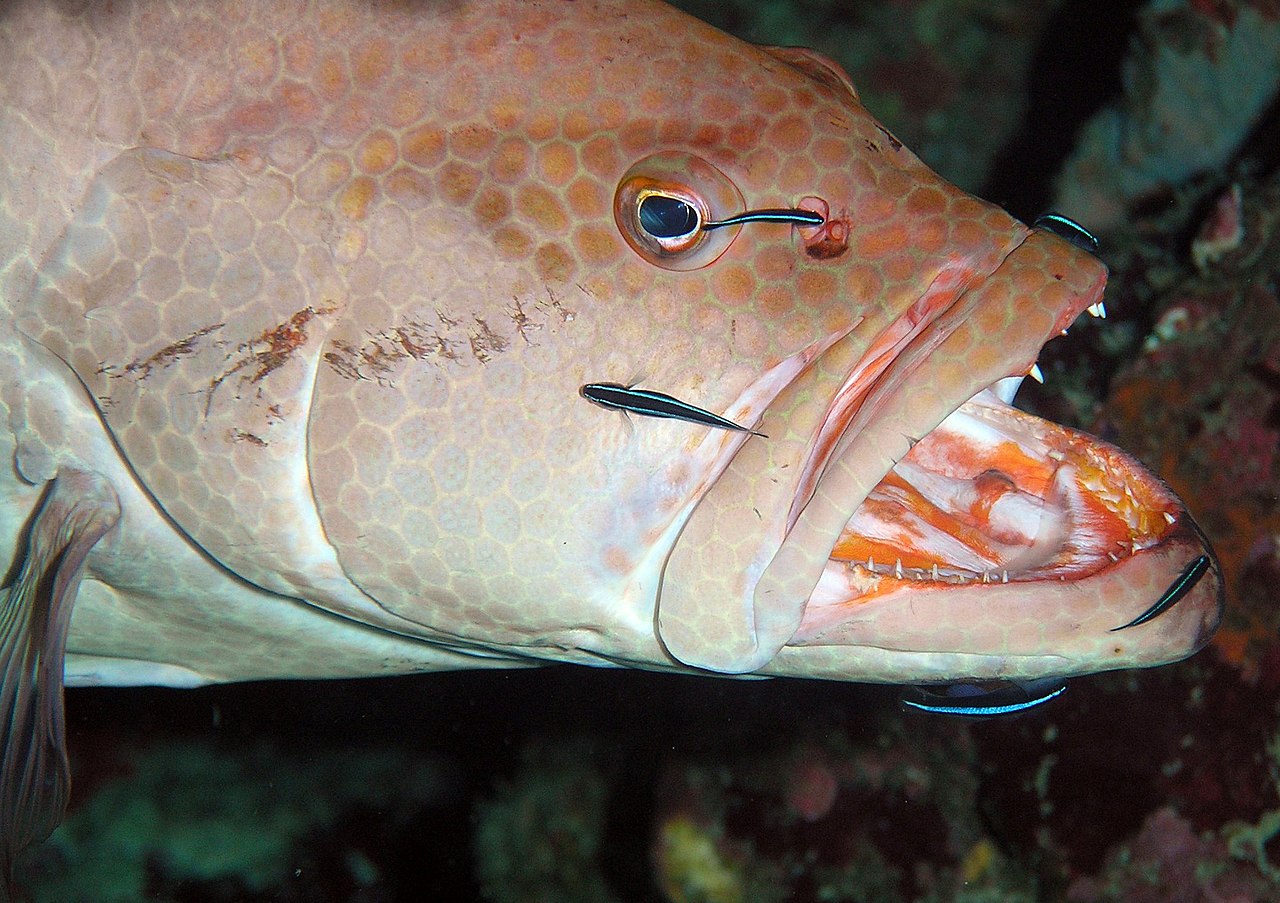
Cooperation — behaviour that provides a fitness benefit to another individual, often at some cost to the actor — is ubiquitous in the living world. Cells cooperate to build multicellular organisms. Worker insects forgo reproduction to serve their colony. Cleaner fish remove parasites from larger fish that could easily eat them. Humans build institutions, share knowledge, and coordinate action on scales unmatched by any other species. Yet the evolution of cooperation poses a fundamental challenge: if [natural selection](/evolution/natural-selection) favours traits that maximise individual fitness, how can costly cooperative behaviours evolve and persist in the face of exploitation by selfish defectors?4, 5 The resolution of this paradox has been one of the central achievements of twentieth- and twenty-first-century evolutionary biology, drawing on kin selection theory, game theory, population genetics, and microbiology to identify the mechanisms that sustain cooperation across all levels of biological organisation.1, 3, 9

Kin selection and Hamilton's rule
The first and most general mechanism for the evolution of cooperation is [kin selection](/evolution/kin-selection-and-altruism), formalised by W. D. Hamilton in 1964. Hamilton showed that a gene causing its bearer to help others can increase in frequency if the recipients are sufficiently likely to carry copies of the same gene by virtue of common descent. His famous rule, rB > C, states that an altruistic act is favoured when the fitness benefit to the recipient (B), weighted by the genetic relatedness between actor and recipient (r), exceeds the fitness cost to the actor (C). Under this framework, cooperation among relatives is not truly selfless but is a form of gene-level self-interest: by helping a relative reproduce, the actor indirectly propagates its own genes.1
Kin selection provides the primary explanation for the evolution of eusociality — the most extreme form of cooperation, in which individuals permanently forgo their own reproduction. In the Hymenoptera (ants, bees, wasps), sterile workers devote their lives to raising the queen's offspring, a behaviour that makes evolutionary sense because the haplodiploid sex-determination system of these insects results in unusually high relatedness among sisters. Although haplodiploidy is neither necessary nor sufficient for eusociality (termites and naked mole-rats are eusocial but diploid), high within-colony relatedness remains a consistent correlate of the evolutionary transition to eusociality across taxa.1, 10
Hamilton's framework is powerful because it applies whenever interacting individuals share genes, regardless of whether the interaction involves dramatic self-sacrifice or mild preferential treatment. Even slight biases in helping behaviour toward relatives — alarm calling when kin are nearby, sharing food with siblings, tolerating relatives in feeding territories — are interpretable as kin-selected cooperation if they satisfy Hamilton's rule.1, 5
Direct and indirect reciprocity
Cooperation among unrelated individuals requires mechanisms other than kin selection. Robert Trivers introduced direct reciprocity (reciprocal altruism) in 1971, proposing that cooperation can evolve between non-relatives if the same individuals interact repeatedly and can adjust their behaviour based on a partner's previous actions. A cooperator who helps a partner today may receive help from that partner tomorrow, and the long-term benefit of mutual cooperation can exceed the short-term temptation to defect — provided that interactions are sufficiently frequent and that individuals can recognise and punish defectors.2
The logic of direct reciprocity was formalised through the Prisoner's Dilemma, a game-theory model in which two players simultaneously choose to cooperate or defect. In a single round, defection always yields a higher payoff regardless of the opponent's choice, making mutual defection the only Nash equilibrium. But in the iterated Prisoner's Dilemma, where the same players meet repeatedly with a sufficiently high probability of future interaction, cooperative strategies can invade and resist exploitation by defectors. Axelrod and Hamilton's celebrated 1981 analysis showed that the simple strategy Tit-for-Tat — cooperate on the first move, then copy the opponent's previous move — won a computer tournament against far more complex strategies, demonstrating that cooperation could emerge among self-interested agents without central authority or prior agreement.3, 7
Subsequent work explored the conditions under which reciprocity can sustain cooperation. Nowak and Sigmund showed that in noisy environments where players occasionally misperceive their partner's actions, Tit-for-Tat is vulnerable to retaliatory spirals, and more generous strategies (which occasionally cooperate even after a defection) perform better. The general condition for direct reciprocity to favour cooperation is that the probability of future interaction (w) must exceed the cost-to-benefit ratio: w > C/B.4, 8
Indirect reciprocity extends the logic of reciprocity to cases where the same two individuals may never meet again, but where information about an individual's cooperative history circulates through the population. Under indirect reciprocity, cooperators benefit not from the direct return of favours but from the reputational consequences of their actions: those who are seen to cooperate acquire a good reputation and are more likely to receive cooperation from others in the future. Nowak and Sigmund showed that indirect reciprocity can sustain cooperation when individuals have access to reliable information about others' past behaviour, making it particularly relevant to human societies where language enables the rapid transmission of reputational information.4, 12
Spatial structure and network reciprocity
The structure of the population in which interactions occur profoundly affects the evolution of cooperation. In well-mixed populations where any individual is equally likely to interact with any other, defectors can exploit cooperators efficiently and cooperation is difficult to maintain. But in spatially structured populations — where individuals interact primarily with their neighbours on a lattice, network, or geographic landscape — cooperators can form clusters that preferentially interact with one another, reducing their exposure to exploitation by defectors.4, 13
Nowak and May demonstrated this principle in 1992 using a spatial Prisoner's Dilemma on a two-dimensional grid. When individuals play only against their immediate neighbours and adopt the strategy of their most successful neighbour, cooperators and defectors coexist in dynamic spatial patterns — clusters of cooperators that expand at their edges while being eroded from within by defectors that arise through mutation or invasion. The key insight is that cooperators on the interior of a cluster interact primarily with other cooperators and achieve high payoffs, while defectors can only exploit cooperators at the cluster boundary. If the benefit of cooperation is sufficiently high relative to its cost, cooperator clusters expand faster than they are eroded, and cooperation persists.13
This mechanism, which Nowak termed network reciprocity, applies to any population structured by a graph of interactions, not only spatial lattices. The condition for cooperation to be favoured under network reciprocity is B/C > k, where k is the average number of connections per individual in the network. Sparse networks (low k) favour cooperation because cooperators interact with fewer partners and are therefore less exposed to exploitation, while dense networks approach the well-mixed limit where defectors thrive.4
Group selection and multilevel selection
The role of group selection in the evolution of cooperation has been among the most contentious topics in evolutionary biology. The basic group-selection argument is straightforward: groups composed primarily of cooperators outperform groups of defectors, and if groups compete against one another, natural selection at the group level can favour cooperation even though within-group selection favours defection. The outcome depends on the relative strength of between-group and within-group selection.4, 5
V. C. Wynne-Edwards proposed in 1962 that animals voluntarily restrain their reproduction for the good of the group, but this idea was roundly criticised by George Williams and others who argued that within-group selection would quickly eliminate self-restraining individuals in favour of selfish ones. Hamilton's kin selection theory and Dawkins's gene-centred view largely displaced group selection as the preferred explanation for cooperation during the 1970s and 1980s. However, the concept was rehabilitated in modified form as [multilevel selection](/evolution/multilevel-selection), which recognises that selection operates simultaneously at multiple levels and that group-level effects can be important when between-group variation is maintained — for instance, through limited dispersal, cultural differences, or punishment of within-group defectors.5, 10
Nowak identified group selection as the fifth major rule for the evolution of cooperation, applicable when populations are subdivided into groups that compete with one another. The condition is that B/C > 1 + (n/m), where n is the maximum group size and m is the number of groups: cooperation is favoured when there are many small groups, maximising between-group variation.4 West, Griffin, and Gardner argued that multilevel selection and kin selection are mathematically equivalent frameworks — different accounting methods for the same underlying evolutionary process — and that the apparent disagreement between proponents of the two approaches often reflects semantic differences rather than substantive biological disputes.5, 17
Microbial cooperation
The study of cooperation in microorganisms has emerged as one of the most productive frontiers in social evolution, providing experimentally tractable systems for testing predictions that are difficult to examine in complex animal societies. Bacteria, yeasts, and social amoebae engage in a wide range of cooperative behaviours, including the secretion of public goods (enzymes, siderophores, and signalling molecules that benefit all nearby cells), coordinated virulence through quorum sensing, and the formation of multicellular structures such as biofilms and fruiting bodies.11
These microbial systems have provided critical tests of cooperation theory. In the social amoeba Dictyostelium discoideum, individual amoebae aggregate under starvation to form a multicellular slug that differentiates into a fruiting body. Cells in the stalk die to support the spore-bearing structure, an apparently altruistic sacrifice. Strassmann, Zhu, and Queller showed that when genetically distinct strains are mixed, cheater strains that preferentially occupy the spore (surviving) position can invade, demonstrating that the cooperation inherent in fruiting-body formation is vulnerable to exploitation. However, high genetic relatedness within natural aggregations (maintained by kin discrimination) limits cheating and stabilises cooperation, consistent with Hamilton's rule.16
In Pseudomonas aeruginosa, bacteria secrete iron-scavenging siderophores that are costly to produce but benefit all nearby cells. Mutant non-producers (cheaters) can exploit the siderophores produced by cooperators. West and colleagues demonstrated that the frequency of cheaters is higher when relatedness is low (cells are well-mixed) and lower when relatedness is high (cells grow in structured environments where cooperators interact primarily with clone-mates), again matching the predictions of kin selection theory.11
Punishment, institutions, and human cooperation
Punishment of defectors is a mechanism that can stabilise cooperation even in large groups of unrelated individuals. Costly punishment — in which cooperators pay a personal cost to impose a fitness reduction on defectors — can deter defection and maintain cooperation, although the evolution of punishment itself poses a second-order cooperation problem: why should any individual bear the cost of punishing when all cooperators benefit from the deterrent effect?14
Several solutions have been proposed. Indirect reciprocity can reward punishers with enhanced reputations. Spatial structure can allow punishment to evolve alongside cooperation through the same clustering mechanisms that favour cooperators. In human societies, punishment is often institutionalised through formal legal systems, social norms, and third-party enforcement, reducing the cost of punishment to any single individual and greatly expanding the scale at which cooperation can be sustained.14, 15
Human cooperation is distinguished by its scale, flexibility, and reliance on cultural transmission. Humans cooperate in groups of thousands or millions of genetically unrelated individuals, far exceeding the scale predicted by kin selection or direct reciprocity alone. This extraordinary cooperativeness appears to depend on a suite of uniquely human cognitive and cultural capacities: language (enabling indirect reciprocity through gossip and reputation), social norms (specifying expected cooperative behaviour and sanctioning violations), institutions (formalising and enforcing cooperative arrangements), and cultural group selection (in which groups with more effective cooperative norms outcompete groups with less effective ones).12, 15
Cooperation and the major transitions
The most consequential instances of cooperation in the history of life are the major evolutionary transitions identified by Maynard Smith and Szathmáry. Each transition involved the integration of formerly independent biological entities into a new, higher-level cooperative unit: independent replicators into chromosomes, prokaryotic cells into eukaryotic cells (via [endosymbiosis](/evolution/endosymbiosis)), single cells into multicellular organisms, and solitary organisms into eusocial colonies. In each case, the transition required the suppression of within-unit conflict (lower-level selfishness) and the alignment of lower-level interests with the reproductive success of the higher-level unit.9
The mechanisms that stabilise cooperation at each level mirror those identified in the broader study of cooperation. High relatedness (clonality in multicellular organisms, haplodiploidy and monogamy in eusocial insects) reduces the genetic incentive for within-group defection. Policing mechanisms (the immune system destroying rogue cells, worker bees killing eggs laid by other workers) suppress selfish behaviour at the lower level. Mutual dependence (mitochondria unable to survive outside their host, differentiated cells unable to reproduce independently) locks partners into cooperation by making defection self-destructive.9, 17
The evolution of cooperation thus emerges not as a peripheral topic in evolutionary biology but as central to the history of life itself. Every major increase in biological complexity has involved a new form of cooperation, stabilised by some combination of kinship, reciprocity, punishment, and mutual dependence. Understanding the conditions under which cooperation evolves, persists, and breaks down remains one of the most active and consequential research programmes in modern evolutionary science.4, 9
References
Social semantics: altruism, cooperation, mutualism, strong reciprocity and group selection