Overview
- Mimicry is a product of natural selection in which one organism evolves to resemble another organism or object, gaining a fitness advantage by deceiving a third party such as a predator, prey, or pollinator, and it encompasses a spectrum of strategies from Batesian mimicry of dangerous models by harmless species to Mullerian convergence among co-defended species.
- The genetic architecture of mimicry has been revealed in exceptional detail in Heliconius butterflies, where a small number of major-effect loci including optix, cortex, and WntA control wing pattern variation, and in Papilio swallowtails, where the single gene doublesex acts as a mimicry supergene maintained by chromosomal inversions that suppress recombination.
- Mimicry extends beyond visual resemblance to include chemical mimicry in sexually deceptive orchids, molecular mimicry by pathogens that imitate host proteins to evade immune detection, and aggressive mimicry by predators that exploit the signals of harmless species to lure prey.
Mimicry is the evolved resemblance of one organism (the mimic) to another organism or object (the model), where the resemblance deceives a third party (the signal receiver) and confers a fitness advantage on the mimic. First recognized as an evolutionary phenomenon by the Victorian naturalist Henry Walter Bates during his eleven-year expedition to the Amazon basin, mimicry has become one of the most thoroughly studied products of natural selection and a touchstone for understanding how complex adaptations arise.1 The phenomenon extends far beyond the butterflies that first drew Bates's attention. Mimicry encompasses harmless snakes that resemble deadly coral snakes, orchids that deceive male bees by imitating the scent and appearance of female insects, predatory fish that impersonate harmless cleaner species, and viral proteins that imitate host molecules to evade immune detection.3, 14

What unites these diverse cases is a shared evolutionary logic: in each, natural selection has favoured individuals that more closely resemble a model because that resemblance alters the behaviour of a signal receiver in a way that benefits the mimic. The receiver may be a predator that avoids the mimic, a prey item that approaches the mimic, or a pollinator that attempts to mate with it. The study of mimicry has illuminated fundamental questions about the power of natural selection, the genetics of adaptation, and the coevolutionary dynamics that arise when the interests of mimics, models, and signal receivers diverge.3, 4
Historical foundations
The scientific study of mimicry began with Henry Walter Bates, a self-taught English naturalist who spent eleven years (1848–1859) collecting insects in the Amazon rainforest alongside Alfred Russel Wallace. During his fieldwork, Bates amassed an enormous collection of butterflies and was struck by a recurring pattern: certain edible butterfly species bore an uncanny resemblance to unrelated, distasteful species that predators avoided. In 1862, Bates presented his explanation to the Linnean Society of London, proposing that natural selection had shaped the appearance of the palatable species to resemble their toxic counterparts, because individuals that more closely matched the warning coloration of the distasteful model were less likely to be attacked by predators. This mechanism, now called Batesian mimicry, was among the earliest and most compelling demonstrations of natural selection operating in the wild, and Darwin himself praised the work as providing "a beautiful proof of natural selection."1
Seventeen years later, the German-Brazilian naturalist Fritz Muller identified a second, fundamentally different form of mimicry. Studying butterflies of the genera Ituna and Thyridia in southern Brazil, Muller observed that two or more species, all of which were genuinely unpalatable, had converged on the same warning pattern. He reasoned that because predators must learn to avoid warning signals through costly trial-and-error encounters with defended prey, any two unpalatable species sharing the same pattern would benefit mutually: the cost of educating predators would be spread across both species' populations, reducing per-capita mortality for each. Muller provided one of the first mathematical models in evolutionary biology to support his hypothesis, demonstrating that the benefit of convergence increases as the number of individuals sharing the signal grows.2, 4 This form of mimicry, now called Mullerian mimicry, differs from Batesian mimicry in a crucial respect: it is a mutualism in which all participants benefit, rather than a parasitic relationship in which the mimic exploits the model's reputation.
Wolfgang Wickler's comprehensive 1968 monograph Mimicry in Plants and Animals expanded the concept further, documenting mimicry in virtually every major group of organisms and establishing criteria for distinguishing true mimicry from coincidental resemblance. Wickler emphasized that mimicry is not limited to visual appearance but encompasses acoustic, chemical, tactile, and behavioural signals, and that it operates in aggressive as well as defensive contexts.14 This broadened framework revealed mimicry to be one of the most pervasive adaptations in nature.
Batesian mimicry
Batesian mimicry is the form in which a palatable or harmless species (the mimic) evolves to resemble an unpalatable, toxic, or otherwise dangerous species (the model), gaining protection from predators that have learned to avoid the model. The system involves three parties: the model, the mimic, and the signal receiver (typically a visually oriented predator such as a bird). The mimic gains a fitness advantage because predators that have had unpleasant experiences with the model generalise their avoidance to any organism bearing similar appearance.1, 3
A critical feature of Batesian mimicry is that it is inherently frequency-dependent. The protective value of the mimetic resemblance depends on the ratio of mimics to models in the local population. If mimics become too common relative to models, predators encounter palatable prey bearing the warning pattern with increasing frequency, learn that the pattern does not reliably predict unpalatability, and begin attacking both mimics and models. This negative frequency-dependent selection constrains the mimic population and can also impose a cost on the model, creating selective pressure on the model to evolve away from the shared appearance.3, 7 Pfennig, Harcombe, and Pfennig demonstrated this frequency dependence experimentally by deploying artificial snake replicas across a geographic gradient in the southeastern United States. They showed that replicas resembling the venomous coral snake (Micrurus fulvius) experienced significantly lower predation rates in areas where the model was present, but received no protection in areas beyond the coral snake's range, confirming that Batesian mimicry requires the local presence of the model to be effective.7
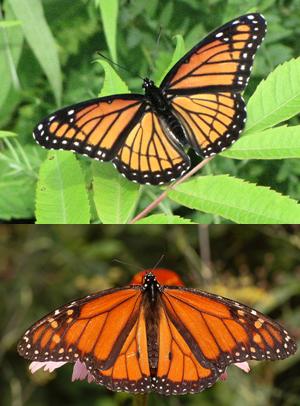
The classic textbook example of Batesian mimicry — the viceroy butterfly (Limenitis archippus) mimicking the toxic monarch butterfly (Danaus plexippus) — was one of the first mimicry systems to be experimentally tested. Jane Van Zandt Brower's pioneering 1958 feeding experiments demonstrated that birds learned to avoid monarchs after experiencing their emetic cardiac glycosides and subsequently refused to eat viceroys that resembled them.5 However, the viceroy-monarch system proved more complex than originally assumed. In 1991, Ritland and Brower showed that viceroys are themselves unpalatable, at least in Florida populations, where they proved as distasteful to predators as monarchs and significantly more unpalatable than the queen butterfly (Danaus gilippus). This finding reclassified the viceroy-monarch relationship from pure Batesian mimicry to Mullerian mimicry, or at least to a system that varies geographically along a continuum between the two.6 The reclassification of this celebrated example illustrates a broader point: the boundary between Batesian and Mullerian mimicry is not always sharp, and many natural systems fall on a spectrum between purely parasitic and purely mutualistic mimicry.
Mullerian mimicry
Mullerian mimicry occurs when two or more genuinely defended species converge on a shared warning signal, so that predators need fewer total encounters to learn avoidance of the common pattern. Unlike Batesian mimicry, in which the mimic parasitises the model's reputation, Mullerian mimicry is a mutualism: every species participating in the mimicry ring benefits from the shared signal because the per-capita cost of predator education is distributed across a larger pool of defended individuals.2, 4
The most extensively studied Mullerian mimicry systems involve the Neotropical butterflies of the genus Heliconius. Across Central and South America, multiple Heliconius species that are distasteful due to cyanogenic glycosides in their tissues have converged on shared wing patterns in local mimicry rings. In any given locality, several species from different clades within the genus may be virtually indistinguishable in wing coloration and pattern, yet the same species may display a completely different pattern in a different geographic region, where it participates in a different mimicry ring. This geographic mosaic of mimicry — in which the same species looks dramatically different in different places, always matching its local co-mimics — provides compelling evidence that natural selection drives convergence on locally advantageous warning signals.4, 9
Muller's original mathematical model predicted that the selective advantage of convergence should be asymmetric: the rarer species benefits more from resembling the commoner one, because it experiences a proportionally greater reduction in the per-capita mortality needed to educate predators. This asymmetry suggests that in many Mullerian mimicry rings, the rarer species has converged toward the pattern of the commoner one, rather than both species meeting at an intermediate phenotype. Sherratt's 2008 review of the evolution of Mullerian mimicry confirmed that this prediction is broadly supported, though the dynamics are complicated by factors including variation in the toxicity of different species, the cognitive abilities of predators, and the spatial structure of populations.4
Coral snakes provide another striking example of Mullerian mimicry. Venomous coral snakes of the genus Micrurus in the Americas display vivid banding patterns of red, yellow (or white), and black rings. Where multiple Micrurus species co-occur, their banding patterns tend to be more similar than where species ranges do not overlap, consistent with Mullerian convergence driven by shared predation pressure.8 A large assemblage of non-venomous and mildly venomous snake species also mimic the coral snake pattern to varying degrees of fidelity, creating a complex system in which Mullerian mimicry among genuinely dangerous coral snakes grades into Batesian mimicry by harmless imitators.7, 8
Aggressive mimicry and reproductive deception
In Batesian and Mullerian mimicry, the mimic gains protection from predators. In aggressive mimicry, the relationship is inverted: a predator or parasite mimics a harmless or beneficial organism to gain access to its victims. The concept was first systematically treated by Wolfgang Wickler, who documented cases across the animal and plant kingdoms in which the signal receiver is deceived not to its benefit but to its detriment.14
One of the best-known examples of aggressive mimicry involves the sabre-toothed blenny (Aspidontus taeniatus), a small marine fish that mimics the bluestreak cleaner wrasse (Labroides dimidiatus) in body shape, coloration, and swimming behaviour. Cleaner wrasses perform a mutualistic service, removing parasites from the skin and gills of larger client fish, which present themselves willingly. The blenny exploits this relationship by approaching unsuspecting client fish under the guise of the cleaner's appearance and behaviour, then biting off pieces of scales, mucus, or fin tissue and fleeing before the victim can retaliate.14 Like Batesian mimicry, aggressive mimicry is frequency-dependent: if blennies become too common relative to genuine cleaner wrasses, client fish learn to avoid anything resembling a cleaner, undermining the mutualism for the real cleaners and reducing the blenny's success.
Among the most remarkable forms of aggressive mimicry is the sexual deception practised by orchids of the genus Ophrys. These plants produce flowers that mimic the visual appearance, tactile properties, and, most crucially, the chemical sex pheromones of female bees or wasps. Male insects are attracted to the flowers and attempt to copulate with them — a behaviour termed pseudocopulation — during which they inadvertently collect or deposit pollinia. Schiestl and colleagues demonstrated in 1999 that Ophrys sphegodes produces the same alkene hydrocarbons, and in the same relative proportions, as the sex pheromone of its pollinator, the solitary bee Andrena nigroaenea.13 The chemical mimicry is so precise that male bees cannot distinguish between the orchid and a real female, and the mimicry is reinforced by selection because more accurate chemical mimics achieve greater pollination success. Approximately one-third of all orchid species employ some form of pollination by deception, making the Orchidaceae the largest family of plants exploiting mimicry for reproduction.13, 14
Self-mimicry and eyespots
Self-mimicry, sometimes called automimicry, refers to cases in which an organism mimics a different part of its own body or mimics a more dangerous version of itself. The most familiar examples involve the conspicuous eyespots found on the wings of many butterfly and moth species. These circular markings, often featuring concentric rings of contrasting colour that resemble the eye of a large vertebrate, have been studied extensively as antipredator devices.15
Martin Stevens's 2005 review of eyespot function in the Lepidoptera distinguished two principal hypotheses for how eyespots deter predators. The intimidation hypothesis proposes that large, centrally placed eyespots on the wings startle or intimidate predators by mimicking the eyes of the predator's own enemies, such as owls or hawks. The peacock butterfly (Aglais io), which displays four large eyespots when it suddenly opens its wings, triggers measurable fright responses in naive birds, consistent with the intimidation explanation. The deflection hypothesis proposes that small, peripherally placed eyespots on the wing margins redirect predator strikes away from the body toward expendable wing tissue, allowing the butterfly to escape with only minor wing damage.15 Experimental studies on the butterfly Bicyclus anynana have demonstrated that ventral hindwing eyespots draw attacks from invertebrate predators such as mantids, and that butterflies with larger eyespots survive these encounters more often than those with smaller ones.
A different form of self-mimicry occurs when the tail or posterior end of an animal mimics its head, potentially confusing predators about which direction the animal will flee. Several butterfly species have tails on their hindwings and markings at the posterior wing margin that form a "false head," complete with eyespot-like markings and antenna-like tail filaments. When a predator strikes at the false head, the butterfly escapes in the unexpected direction.3, 15 This form of mimicry is notable because the mimic and the model are parts of the same organism, and the deception is directed at exploiting a predator's cognitive shortcut of targeting the head of fleeing prey.
Molecular mimicry
Mimicry is not limited to macroscopic organisms deceiving visually oriented predators. At the molecular scale, many pathogens have evolved proteins or surface molecules that closely resemble the molecular structures of their hosts, a phenomenon termed molecular mimicry. By presenting molecules that the host's immune system recognises as self, these pathogens reduce the probability of immune detection and attack.16
Hurford and Day's 2013 evolutionary analysis modelled the selective pressures shaping molecular mimicry in parasites and identified two key constraints that limit its evolution. The costly autoimmunity hypothesis predicts that molecular mimics may trigger autoimmune responses in which the host's immune system, primed to recognise the mimic, begins attacking its own tissues bearing similar molecular signatures. If autoimmune disease reduces the host's ability to transmit the pathogen, molecular mimicry becomes self-defeating. The mimicry trade-off hypothesis proposes that the structural changes needed to make a parasite's proteins resemble host proteins may compromise the functional efficiency of those proteins, reducing the parasite's within-host replication rate.16 The balance between these costs and the benefit of immune evasion determines whether molecular mimicry evolves in any given host-pathogen system.
Molecular mimicry has been documented in a wide range of pathogenic organisms. Viruses in the Herpesviridae and Poxviridae families show particularly high levels of linear molecular mimicry, producing proteins that mimic host molecules involved in cell replication and inflammation. Bacteria such as Legionella pneumophila secrete effector proteins that structurally imitate eukaryotic regulatory proteins, manipulating host cellular machinery to create a favourable intracellular environment.16 The evolutionary logic is identical to that of classical mimicry: the pathogen benefits from resembling something that the signal receiver (the immune system) has been selected to tolerate. Unlike Batesian mimicry, however, the "model" in molecular mimicry is not another organism but the host's own molecules, and the deception operates at the biochemical rather than the perceptual level.
Genetics of mimicry
One of the most productive areas of modern mimicry research concerns the genetic architecture underlying mimetic wing patterns, particularly in butterflies of the genera Heliconius and Papilio. These systems have revealed that the extraordinary diversity of mimetic phenotypes is controlled by a surprisingly small number of major-effect loci, and that the same genes are recruited repeatedly in independent evolutionary origins of similar patterns.9, 10
In Heliconius butterflies, three major-effect genes control the principal elements of wing pattern variation. The transcription factor optix controls the distribution of red and orange pigmentation; WntA, a signalling molecule in the Wnt pathway, determines the shape and position of melanin-based pattern elements; and cortex, a cell-cycle regulator, influences the switch between yellow and melanic scales. Reed and colleagues demonstrated in 2011 that optix drives the repeated convergent evolution of red wing pattern mimicry across distantly related Heliconius species, showing that cis-regulatory changes in the same transcription factor independently produce similar patterns in the H. melpomene and H. erato lineages, which diverged approximately 12 million years ago.9 This finding blurred the boundary between convergence and homology: the phenotypic convergence was underpinned by regulatory changes at a homologous locus.
The concept of the supergene — a cluster of tightly linked loci that segregate as a single unit and control a complex, multi-component phenotype — has been central to understanding mimicry genetics since the mid-twentieth century. In Heliconius numata, a single supergene locus (designated P) controls the butterfly's wing pattern, allowing multiple distinct mimicry morphs to coexist in the same population. Joron and colleagues showed in 2011 that the different morphs of H. numata are associated with different chromosomal inversions at the P locus, which suppress recombination over a 400-kilobase interval containing at least 18 genes. By preventing recombination, these inversions ensure that the combinations of alleles producing each complete, functional mimicry pattern are inherited together, avoiding the production of intermediate, non-mimetic recombinants that would be selected against by predators.10
In swallowtail butterflies of the genus Papilio, an even more dramatic genetic architecture has been revealed. Kunte and colleagues demonstrated in 2014 that in Papilio polytes, a species in which only females are mimetic and display multiple distinct mimicry morphs resembling different toxic model species, the entire mimicry phenotype is controlled by a single gene: doublesex. This gene, a well-known component of the insect sex-determination pathway, has been co-opted to regulate wing pattern differences between mimetic and non-mimetic female morphs. Alternative alleles of doublesex, maintained by chromosomal inversions, produce different wing patterns that each mimic a different toxic model species.12 The discovery that a single gene can function as a mimicry supergene overturned the long-held assumption that supergenes necessarily involve multiple tightly linked loci with distinct functions.
Major-effect genes controlling mimicry in butterflies9, 10, 11, 12
| Gene | Function | Species | Pattern element controlled |
|---|---|---|---|
| optix | Transcription factor | Heliconius spp. | Red and orange wing coloration |
| WntA | Wnt signalling ligand | Heliconius spp. | Melanin pattern shape and position |
| cortex | Cell-cycle regulator | Heliconius spp. | Yellow vs. melanic scale identity |
| doublesex | Sex-determination transcription factor | Papilio polytes | Entire female mimicry morph |
| Supergene P locus | Multiple genes in chromosomal inversion | Heliconius numata | Complete wing pattern morph |
Adaptive introgression and the spread of mimicry alleles
Genomic studies of Heliconius butterflies have revealed a mechanism for the origin and spread of mimicry patterns that was entirely unexpected: adaptive introgression, the transfer of beneficial alleles between species through hybridisation. The sequencing of the Heliconius melpomene genome by the Heliconius Genome Consortium, published in 2012, demonstrated that wing-pattern alleles have been exchanged among species through interspecific hybridisation, and that these alleles were selectively retained because they conferred advantageous mimicry phenotypes.11
The Consortium's analysis compared the genomes of H. melpomene, H. timareta, and H. elevatus — three species that are co-mimics sharing similar warning patterns in the regions where they overlap. Genomic resequencing revealed that the wing-pattern loci, particularly the chromosomal regions containing optix and other pattern genes, showed strikingly low differentiation between co-mimetic species, consistent with recent gene flow at these specific loci despite substantial divergence across the rest of the genome. The pattern was most parsimoniously explained by adaptive introgression: hybridisation events had transferred wing-pattern alleles from one species to another, and these alleles had swept to high frequency because they produced locally advantageous mimicry phenotypes.11
This discovery has profound implications for the understanding of mimicry evolution. Rather than requiring each species to independently evolve the same complex wing pattern through de novo mutation and selection — a process that might take many generations — adaptive introgression provides a shortcut by which a fully formed, already tested mimicry allele can be transferred between species in a single hybridisation event. The finding also challenges the conventional view that hybridisation between species is always disadvantageous, demonstrating instead that interspecific gene flow can be a source of adaptive innovation. In the Heliconius system, the "promiscuous exchange" of mimicry alleles appears to have accelerated the formation of mimicry rings by allowing species to rapidly adopt locally favoured wing patterns that had already been refined by selection in a co-occurring species.11
Evolutionary dynamics and the spectrum of mimicry
Modern research has increasingly recognised that mimicry is not a set of discrete categories but a continuum of ecological relationships shaped by the relative toxicity of the interacting species, the cognitive abilities of the signal receivers, and the spatial and temporal context in which the interactions occur. The reclassification of the viceroy-monarch system from Batesian to Mullerian mimicry is emblematic of this shift: many real-world mimicry systems do not fit neatly into either Bates's or Muller's framework but instead occupy intermediate positions on what has been termed the mimicry spectrum.3, 6
Several factors complicate the clean dichotomy between Batesian and Mullerian mimicry. First, the palatability of prey species is not binary but varies continuously, and a mildly defended mimic may impose some cost on predators while still being more palatable than its more toxic co-mimic. Such species are sometimes termed quasi-Batesian mimics, occupying a position where they benefit from the shared warning signal but dilute its protective value relative to a fully Mullerian arrangement. Second, the palatability of a given species may vary across its geographic range depending on the availability of host plants that provide defensive chemicals. Monarch butterflies, for example, vary substantially in their cardenolide content depending on which milkweed species their larvae consumed, and in some populations the level of chemical defence may be too low to deter experienced predators.5, 6
The cognitive abilities of predators also shape the dynamics of mimicry. Kikuchi and Pfennig demonstrated that predator cognition permits imperfect mimicry to succeed: in the coral snake mimicry system, scarlet kingsnakes (Lampropeltis elapsoides) that resemble the coral snake (Micrurus fulvius) in general appearance but differ in the specific order of coloured rings still receive protection, because predators use a generalised "red-and-banded" avoidance rule rather than scrutinising ring sequence.8 This finding helps explain why many natural mimics are imperfect copies of their models — a long-standing puzzle in mimicry research. If predator cognition is coarse-grained, there is little additional selective advantage to perfecting fine details of resemblance, and mimicry can be maintained at a level of accuracy that is "good enough" rather than pixel-perfect.
The spectrum of mimicry types1, 2, 3, 14
The study of mimicry continues to reveal new dimensions of the phenomenon. Research on the genetics of butterfly wing patterns has demonstrated that a handful of major-effect genes can produce an extraordinary diversity of mimetic phenotypes, and that these genes are repeatedly recruited across independent evolutionary origins of similar patterns.9, 12 Genomic studies have shown that mimicry alleles can spread between species through adaptive introgression, accelerating the formation of mimicry rings and challenging the notion that beneficial traits must always arise through de novo mutation within a lineage.11 And the expansion of mimicry research to encompass molecular, chemical, and acoustic mimicry alongside the classical visual examples has revealed that the evolutionary logic first identified by Bates and Muller in nineteenth-century Amazonia operates at every scale of biological organisation, from the molecular interactions between pathogen proteins and immune receptors to the elaborate courtship deceptions of orchids and their insect pollinators.13, 16
References
Experimental studies of mimicry in some North American butterflies: Part I. The monarch, Danaus plexippus, and viceroy, Limenitis archippus archippus
Chromosomal rearrangements maintain a polymorphic supergene controlling butterfly mimicry
The role of eyespots as anti-predator mechanisms, principally demonstrated in the Lepidoptera