Overview
- Carbon isotope excursions are rapid, large-magnitude shifts in the ratio of carbon-13 to carbon-12 recorded in marine carbonates and organic matter, reflecting major perturbations to the global carbon cycle caused by massive releases of isotopically light carbon from volcanic degassing, methane hydrate dissociation, or organic carbon oxidation.
- The most prominent excursions — including the end-Permian negative shift, the Toarcian oceanic anoxic event, and the Paleocene-Eocene thermal maximum — coincide with mass extinctions, ocean acidification, widespread anoxia, and rapid global warming, making them critical markers for understanding the Earth system's response to carbon cycle disruption.
- Carbon isotope stratigraphy serves as a global correlation tool because the ocean-atmosphere carbon reservoir mixes on timescales of approximately 1,000 years, ensuring that isotopic perturbations are recorded nearly synchronously in marine sediments worldwide.
Carbon isotope excursions are abrupt, large-magnitude shifts in the ratio of the stable isotopes carbon-13 (13C) and carbon-12 (12C) preserved in marine carbonate sediments and organic matter, recording major perturbations to the global carbon cycle. The carbon isotopic composition of seawater dissolved inorganic carbon (expressed as δ13C in per mille notation) reflects the balance between inputs of carbon to the ocean-atmosphere system — from volcanism, weathering, and organic carbon oxidation — and outputs through carbonate burial and organic carbon burial.12 A negative excursion (a decrease in δ13C) indicates the rapid addition of isotopically light carbon, which is enriched in 12C relative to 13C, to the ocean-atmosphere reservoir. Sources of such light carbon include volcanic CO2, thermogenic methane from contact metamorphism of organic-rich sediments, biogenic methane from gas hydrate dissociation, and the oxidation of large organic carbon reservoirs such as peat or permafrost soils.4, 7, 11
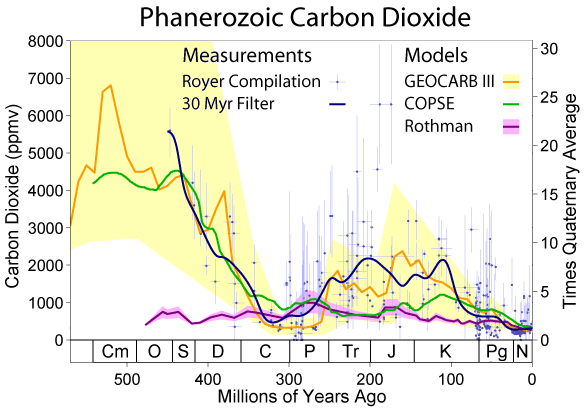

The Paleocene-Eocene thermal maximum
The Paleocene-Eocene thermal maximum (PETM), approximately 56 million years ago, is the best-studied carbon isotope excursion of the Cenozoic era. Marine and terrestrial sedimentary records from around the world document a negative δ13C excursion of 3–4 per mille in marine carbonates (and 5–8 per mille in terrestrial organic matter and soil carbonates), occurring over a geologically brief interval estimated at 5,000–20,000 years.5, 11 This excursion coincided with global warming of 5–8 degrees Celsius, shoaling of the carbonate compensation depth by more than two kilometres (indicating severe ocean acidification), shifts in ocean circulation, and widespread biotic turnover including the rapid diversification of modern mammalian orders on land and a major benthic foraminiferal extinction in the deep sea.5, 6, 15
The source of the isotopically light carbon responsible for the PETM excursion remains debated. Gerald Dickens and colleagues originally proposed that warming-induced dissociation of methane hydrates on continental margins released a massive pulse of isotopically depleted methane (δ13C approximately −60 per mille), which would oxidize to CO2 in the atmosphere and ocean.4 Subsequent estimates of the total carbon mass required — at least 2,000–4,500 gigatonnes of carbon, depending on the source isotopic composition — have suggested that methane hydrates alone may be insufficient and that additional sources, including volcanic carbon from the North Atlantic igneous province, thermogenic methane from contact metamorphism, and oxidation of terrestrial organic carbon, likely contributed.7, 11 The recovery of the PETM, marked by the return of δ13C to pre-excursion values over approximately 150,000–200,000 years, reflects the slow drawdown of excess atmospheric CO2 through enhanced silicate weathering and organic carbon burial.6, 11
The end-Permian carbon isotope crisis
The largest negative carbon isotope excursion of the Phanerozoic is associated with the end-Permian mass extinction, approximately 252 million years ago, which eliminated more than 90 percent of marine species and approximately 70 percent of terrestrial vertebrate families. Marine carbonate sections worldwide record a negative δ13C shift of 4–7 per mille occurring in two or more pulses around the Permian-Triassic boundary, with the carbon cycle remaining disturbed for several million years into the Early Triassic.1, 13 The timing of this excursion is closely linked to the eruption of the Siberian Traps, one of the largest igneous provinces in Earth history, which emplaced approximately 3–4 million cubic kilometres of basalt and released enormous quantities of CO2, SO2, and halogen gases into the atmosphere.3, 17
High-precision uranium-lead dating of the Siberian Traps and the extinction horizon has demonstrated that the main phase of volcanism and the mass extinction are essentially synchronous, both occurring within a window of approximately 60,000 years centred near 251.9 million years ago.17 The mechanism linking volcanism to the carbon isotope excursion likely involved both direct volcanic CO2 emissions and, critically, the thermal metamorphism of Siberian sedimentary basin rocks — including coal, petroleum source rocks, and evaporites — by magmatic intrusions (sills), which released vast quantities of thermogenic methane and other light carbon gases.3 The environmental consequences included global warming, ocean acidification, ocean anoxia and euxinia (hydrogen sulphide-rich conditions), and ozone depletion, creating a cascade of killing mechanisms that together account for the severity of the extinction.2, 16
The Toarcian oceanic anoxic event
The Early Jurassic Toarcian oceanic anoxic event (T-OAE), approximately 183 million years ago, provides another well-documented example of a carbon isotope excursion linked to large igneous province volcanism. A negative δ13C excursion of 6–7 per mille recorded in belemnite calcite and organic matter coincides with the eruption of the Karoo-Ferrar flood basalt province in southern Gondwana, widespread deposition of organic-rich black shales in epicontinental seas, and a significant marine extinction event that particularly affected benthic organisms.8, 9, 10 The magnitude of the negative excursion led Stephen Hesselbo and colleagues to propose methane hydrate dissociation, triggered by warming from volcanic CO2, as the immediate source of the light carbon — an interpretation supported by the rapid onset and large amplitude of the isotopic shift, which is difficult to explain by volcanic CO2 alone given its relatively modest δ13C value of approximately −5 per mille.9
Carbon isotope stratigraphy as a correlation tool
Beyond their significance for understanding Earth system perturbations, carbon isotope excursions serve as powerful tools for global stratigraphic correlation. Because the ocean-atmosphere carbon reservoir is well mixed on timescales of approximately 1,000 years, a perturbation to δ13C propagates essentially synchronously throughout the global ocean, and marine carbonates deposited anywhere in the world during the excursion will record the same isotopic signature.12 This makes carbon isotope stratigraphy particularly valuable for correlating sequences that lack biostratigraphic index fossils or that span facies boundaries where different fossil groups are preserved. The technique has been applied from the Precambrian through the Cenozoic, with major excursions now serving as formal or informal markers for stage boundaries in the geologic time scale.12, 14
The study of past carbon isotope excursions has acquired particular urgency in the context of modern anthropogenic carbon emissions. The PETM is frequently cited as the closest geological analogue to current fossil fuel burning, yet current rates of carbon release are estimated to be at least an order of magnitude faster than during the PETM, suggesting that the magnitude of environmental disruption may exceed that of even the most severe ancient excursions on short timescales.11, 6 The geological record demonstrates that the Earth system requires tens to hundreds of thousands of years to recover from major carbon cycle perturbations through silicate weathering feedbacks, underscoring the long-term consequences of rapid carbon release regardless of the source.6, 11
References
Global carbon cycle perturbation and ocean acidification linked to the end-Permian mass extinction
A volcanically triggered regime shift in the carbon cycle associated with the end-Permian mass extinction
Dissociation of oceanic methane hydrate as a cause of the carbon isotope excursion at the end of the Paleocene
A transient rise in tropical sea surface temperature during the Paleocene-Eocene thermal maximum
Toarcian oceanic anoxic event: an assessment of global causes using belemnite C isotope records