Overview
- The Paleocene-Eocene Thermal Maximum (PETM) was a geologically abrupt global warming event approximately 56 million years ago in which average surface temperatures rose by 5 to 8°C over roughly 20,000 years, driven by the release of thousands of gigatons of carbon into the atmosphere and oceans.
- The PETM triggered ocean acidification, a global carbon isotope excursion, the largest deep-sea benthic foraminifera extinction of the Cenozoic, and widespread dwarfing in mammalian lineages—yet it also coincided with the first appearances and rapid dispersal of several modern mammalian orders including primates, artiodactyls, and perissodactyls.
- As the closest deep-time analogue to modern anthropogenic carbon release, the PETM demonstrates that Earth’s climate system can respond rapidly and dramatically to large carbon inputs, with consequences that persist for tens to hundreds of thousands of years even after emissions cease.
The Paleocene-Eocene Thermal Maximum, universally abbreviated as PETM, was the most abrupt and dramatic global warming event of the Cenozoic Era. Approximately 56 million years ago, at the boundary between the Paleocene and Eocene epochs, Earth's average surface temperature rose by 5 to 8 degrees Celsius over a geologically brief interval of roughly 20,000 years—a rate of warming that dwarfed any climate shift in the preceding 65 million years and that would not be approached again until the anthropogenic carbon emissions of the industrial age.1, 3, 12 The event was triggered by a massive injection of isotopically light carbon into the ocean-atmosphere system, on the order of several thousand gigatons, which left its fingerprint in one of the most recognizable geochemical signals in the geological record: a sharp negative carbon isotope excursion (CIE) recorded in marine carbonates, terrestrial soils, and the teeth and bones of land animals worldwide.5, 7, 19 The warming persisted for approximately 150,000 to 200,000 years before the Earth system gradually restored equilibrium through enhanced silicate weathering and organic carbon burial.3, 15
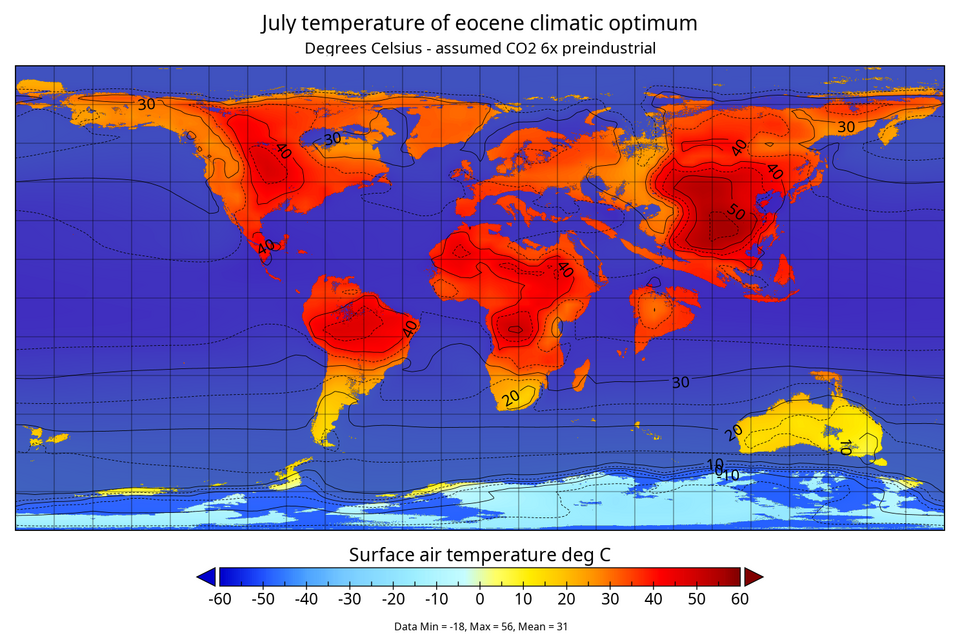

The PETM occupies a unique position in the study of climate change. It is the closest geological analogue to the carbon perturbation currently being driven by the burning of fossil fuels, and it demonstrates that the Earth's climate system can respond rapidly and severely to large injections of greenhouse gases. At the same time, the event is deeply embedded in the history of life: it coincides with major turnovers and dispersals in the mammalian radiation, the largest extinction of deep-sea benthic foraminifera in the Cenozoic, and profound reorganizations of terrestrial and marine ecosystems. Understanding the PETM is therefore essential both for interpreting the fossil record and for anticipating the long-term consequences of modern climate forcing.7, 13
Discovery and dating
The PETM was first recognized through the work of James Kennett and Lowell Stott, who in 1991 reported a dramatic negative shift in oxygen and carbon isotope ratios in foraminifera from Ocean Drilling Program (ODP) Site 690 on Maud Rise in the Southern Ocean. Their data revealed that deep-sea temperatures had spiked by several degrees Celsius at the Paleocene-Eocene boundary, accompanied by a sharp decrease in carbon-13 values and a mass extinction of benthic foraminifera—findings that pointed to a sudden and severe environmental perturbation in the deep ocean.17 In the years that followed, the same isotopic signal was identified in marine sediment cores from across the global ocean and in terrestrial paleosol carbonate sequences, confirming that the event was planetary in scope rather than a regional anomaly.7, 19
Precise dating of the PETM has been accomplished through a combination of magnetostratigraphy, cyclostratigraphy, and radiometric calibration. The onset of the carbon isotope excursion falls within magnetic polarity chron C24r, and orbital tuning of sedimentary cycles tied to Milankovitch cycles places the event at approximately 55.8 to 56.0 million years ago, with the most widely cited age being approximately 56 million years before present.15, 24 Cyclostratigraphic analyses of expanded marine sections, particularly from ODP Site 690 and sites in the North Atlantic, indicate that the total duration of the carbon isotope excursion—from onset through recovery to pre-event baseline values—was approximately 150,000 to 200,000 years, although the main body of the event (the interval of peak warmth and isotopic depletion) lasted roughly 70,000 to 100,000 years.15
The carbon isotope excursion
The defining geochemical signature of the PETM is a negative carbon isotope excursion of 2.5 to 6 per mil in the ratio of carbon-13 to carbon-12, recorded in virtually every carbon-bearing substrate that spans the Paleocene-Eocene boundary. In marine carbonates, the excursion is typically 2.5 to 4 per mil; in terrestrial paleosol carbonates and mammalian tooth enamel, where isotopic fractionation effects differ, the shift is larger, on the order of 5 to 6 per mil.5, 7, 19 The global consistency and magnitude of this signal provide powerful constraints on the source and quantity of carbon released.
The negative excursion demands a source of carbon that was strongly depleted in carbon-13 relative to the ambient ocean-atmosphere pool. Volcanic carbon dioxide, for example, has a carbon-13 signature of approximately −5 per mil, while biogenic methane and organic carbon in sediments are depleted to −25 to −60 per mil. The magnitude of the observed excursion therefore depends on the isotopic composition of the source: a thermogenic or volcanic source would require the release of roughly 6,000 to 12,000 gigatons of carbon to produce the observed shift, whereas a methane source would require approximately 2,000 to 4,000 gigatons.5, 7 In either scenario, the quantity of carbon involved is enormous—comparable to the total amount of carbon in the modern atmosphere and substantially greater than all known conventional fossil fuel reserves.3
The onset of the CIE was remarkably rapid. High-resolution studies of expanded marine sections suggest that the bulk of the isotopic shift occurred within fewer than 10,000 years, and some analyses place the onset interval at as little as a few thousand years.15 This rapidity constrains the mechanism of carbon release, ruling out slow, steady-state processes and favoring scenarios involving threshold behavior or positive feedback loops that could mobilize large quantities of carbon on millennial timescales.7
Temperature rise and climate response
The PETM produced one of the most extreme warm intervals in the Cenozoic, superimposed on an already warm background climate. The late Paleocene was significantly warmer than today, with no permanent polar ice sheets and global average temperatures roughly 10 degrees Celsius above modern values.12 Against this already warm baseline, PETM warming pushed the Earth's climate into a state with essentially no modern analogue.
Tropical sea surface temperatures, estimated from magnesium-to-calcium ratios and oxygen isotope ratios in well-preserved planktonic foraminifera, rose by approximately 4 to 5 degrees Celsius during the PETM, reaching peak values on the order of 36 to 38 degrees Celsius in some tropical regions—temperatures at or near the upper physiological limits for many marine organisms.1 At higher latitudes, the warming was amplified. Arctic Ocean surface temperatures, reconstructed from organic biomarker proxies (TEX86) in cores recovered by the Integrated Ocean Drilling Program Arctic Coring Expedition (ACEX), reached subtropical values of approximately 23 degrees Celsius during the peak of the PETM, compared to near-freezing temperatures today.11 This polar amplification of warming—a pattern also predicted by climate models for future anthropogenic warming—was a defining feature of the PETM climate state.3, 11
On land, paleobotanical evidence records the northward migration of subtropical and tropical floras into previously temperate regions. In the Bighorn Basin of Wyoming, one of the most intensively studied terrestrial PETM sections, leaf margin analysis and the composition of megafloral assemblages indicate a rise in mean annual temperature of approximately 5 degrees Celsius, accompanied by a dramatic shift in plant community composition toward species with entire-margined leaves characteristic of warmer, wetter climates.18 Crocodilians, palms, and other frost-intolerant organisms appeared at high paleolatitudes during the PETM, consistent with the elimination of below-freezing temperatures from most of the planet's surface.7
Ocean acidification and the carbonate dissolution horizon
The injection of massive quantities of carbon dioxide into the atmosphere during the PETM drove a profound acidification of the global ocean—one of the most clearly documented episodes of ocean acidification in the geological record, and a key reason the event is studied as a precedent for modern ocean chemistry changes.2, 16 When carbon dioxide dissolves in seawater, it reacts to form carbonic acid, which lowers pH and reduces the saturation state of calcium carbonate minerals. If the ocean becomes sufficiently undersaturated, carbonate minerals begin to dissolve rather than accumulate.
The sedimentary record of the PETM reveals this process with striking clarity. In deep-sea cores from the Atlantic and Pacific oceans, the Paleocene-Eocene boundary is marked by a distinctive clay layer from which calcium carbonate has been almost entirely dissolved, sandwiched between carbonate-rich sediments above and below. This dissolution horizon represents the shoaling of the calcite compensation depth (CCD)—the depth below which calcium carbonate dissolves faster than it accumulates on the seafloor—by an estimated 2,000 meters or more during the peak of carbon input.2 In some deep Atlantic sites, carbonate content drops from 90 percent to less than 10 percent across an interval of just a few centimeters of sediment, representing the near-complete dissolution of calcareous microfossils and the chemical erasure of the normal carbonate record.2, 16
Estimates of the pH change during the PETM range from 0.25 to 0.45 units, depending on assumptions about the rate and isotopic composition of carbon input.16 For comparison, the pH of the modern surface ocean has already declined by approximately 0.1 units since the onset of industrialization, and projections for the end of the twenty-first century under high-emission scenarios range from 0.3 to 0.4 units—values that approach or overlap with the PETM range, but achieved over centuries rather than millennia.16, 20
Biotic response
The environmental upheaval of the PETM drove biological responses that ranged from catastrophic extinction in the deep sea to rapid diversification on land. These contrasting outcomes illustrate both the vulnerability and the adaptability of life in the face of rapid climate perturbation.
Deep-sea extinction
The most severe biotic consequence of the PETM was the extinction of 35 to 50 percent of deep-sea benthic foraminifera species, the largest such extinction in the Cenozoic Era and one of the defining biostratigraphic markers of the Paleocene-Eocene boundary.13, 17 These single-celled organisms, which inhabit the ocean floor and construct shells of calcium carbonate, were devastated by the combined effects of deep-water warming, reduced dissolved oxygen concentrations, and carbonate undersaturation. The extinction was geologically instantaneous, occurring within the same thin stratigraphic interval as the onset of the carbon isotope excursion, and the deep-sea benthic foraminiferal community that reestablished itself after the PETM was taxonomically and ecologically distinct from its predecessor.13 By contrast, planktonic foraminifera and calcareous nannoplankton in the surface ocean experienced significant turnover and geographic range shifts but did not suffer comparable levels of extinction, suggesting that the deep ocean bore the brunt of the environmental stress.7, 13
Mammalian dispersal and diversification
On land, the PETM coincided with one of the most important intervals in the evolutionary history of mammals. The fossil record of the Bighorn Basin, continental Europe, and East Asia documents the abrupt first appearances of several modern mammalian orders at or immediately following the onset of the PETM, including the Perissodactyla (horses, tapirs, and rhinoceroses), Artiodactyla (even-toed ungulates such as deer, cattle, and pigs), and the earliest members of the order Primates with modern-grade dental and skeletal morphology.7, 8 These groups appear simultaneously on multiple continents, implying rapid intercontinental dispersal rather than in-situ evolution.8
The mechanism of this dispersal was likely the PETM warming itself. During the late Paleocene, high-latitude land bridges connected North America to Europe via Greenland and to Asia via Beringia. Under normal Paleocene climatic conditions, these northern routes may have been too cold for subtropical-adapted mammalian lineages to traverse, but PETM warming raised high-latitude temperatures sufficiently to open dispersal corridors through which warm-adapted taxa could spread rapidly between continents.7, 8 The result was a dramatic homogenization of previously distinct continental faunas and the establishment of mammalian lineages that would dominate terrestrial ecosystems for the remainder of the Cenozoic. The PETM mammalian dispersal is thus a key chapter in the broader story of the rise of mammals and the mammalian adaptive radiation that shaped the modern world.8
Dwarfing
One of the most striking biotic responses to PETM warming was a widespread reduction in body size among mammalian lineages—a phenomenon known as dwarfing. In the Bighorn Basin fossil record, the early Eocene horse Sifrhippus sandrae, already small by modern equid standards, decreased in estimated body mass by approximately 30 percent during the peak of the PETM before gradually recovering as temperatures returned to pre-event levels.10 Similar patterns of body size reduction have been documented in other mammalian lineages across the PETM interval, as well as in soil fauna including insects and other invertebrates whose burrow diameters shrank significantly during the warming event.9, 23
The causes of PETM dwarfing remain debated. Bergmann's rule—the biogeographic pattern in which individuals of a species tend to be smaller in warmer environments—provides one potential explanation, potentially driven by thermoregulatory constraints that favor smaller body sizes in hotter climates. Alternatively, nutrient limitation may have played a role: elevated atmospheric carbon dioxide can reduce the nutritional quality of plant tissues by decreasing their nitrogen content, and smaller body size may have been an adaptive response to lower-quality food resources.10, 23 A 2017 study by D'Ambrosia and colleagues documented dwarfing in a second, smaller hyperthermal event (ETM-2) approximately 2 million years after the PETM, finding that the magnitude of body size reduction correlated with the magnitude of warming—strengthening the case for a direct causal link between temperature and body size.23
Floral reorganization
Terrestrial plant communities were profoundly reorganized during the PETM. In the Bighorn Basin, the proportion of leguminous and other tropical plant taxa increased dramatically during the warming interval, while taxa adapted to cooler, more seasonal climates declined or disappeared from the local record. Leaf size increased and the proportion of species with entire (smooth) leaf margins—a reliable proxy for mean annual temperature—rose sharply, consistent with the establishment of a warmer, more humid climate regime.18 These floral changes were reversible: as temperatures declined during the recovery phase, the pre-PETM plant community composition gradually reasserted itself, though not to an exact replica of the pre-event state.7, 18
Proposed causes of carbon release
The source of the massive carbon injection that drove the PETM has been one of the most intensely debated questions in Cenozoic paleoclimatology. Any viable hypothesis must account for several observations simultaneously: the release of thousands of gigatons of isotopically light carbon, the geologically rapid onset (thousands to tens of thousands of years), and the coincidence with independent evidence for volcanic activity and tectonic reorganization. Two principal hypotheses have dominated the discussion, and current understanding increasingly favors a model in which both operated in concert.
Volcanic carbon dioxide from the North Atlantic Igneous Province
The PETM coincides precisely with the opening of the Northeast Atlantic Ocean and the eruption of the North Atlantic Igneous Province (NAIP), one of the largest flood basalt events of the Cenozoic. Radiometric dating of volcanic ash layers and sill intrusions in East Greenland, the Faroe-Shetland Basin, and the Vøring Plateau confirms that the peak of NAIP magmatic activity overlaps with the onset of the CIE within the resolution of available dating methods.4 The eruption of basaltic lavas would have released carbon dioxide directly into the atmosphere, but the total quantity of CO2 from basalt degassing alone is generally considered insufficient to explain the full magnitude of the carbon isotope excursion.7
A more potent mechanism was proposed by Svensen and colleagues in 2004, who documented the presence of hundreds of hydrothermal vent complexes on the Norwegian continental margin, formed when NAIP magma intruded into carbon-rich sedimentary basins. When sills of hot basalt (at temperatures exceeding 1,000 degrees Celsius) intruded into organic-rich shales and coal deposits, the heat would have generated enormous quantities of thermogenic methane and carbon dioxide through contact metamorphism. Svensen and colleagues estimated that this process could have released 1,500 to 3,000 gigatons of carbon in a geologically brief pulse, consistent with the required carbon input.6 A 2017 study by Gutjahr and colleagues provided additional support, using boron isotope pH reconstructions to demonstrate that the pattern of ocean acidification during the PETM is best explained by a carbon source with an isotopic signature intermediate between pure volcanic CO2 and biogenic methane—consistent with thermogenic carbon from contact metamorphism of organic sediments.22
Methane clathrate destabilization
The methane clathrate hypothesis, first articulated by Gerald Dickens and colleagues in 1995, proposes that the PETM carbon release originated from the dissociation of methane hydrates—ice-like crystalline structures in which methane molecules are trapped within a lattice of water molecules under conditions of high pressure and low temperature on continental margins and in permafrost regions.5 These deposits contain enormous quantities of carbon, and they are thermodynamically sensitive to changes in temperature and pressure. A modest warming of deep-ocean waters, whether triggered by volcanic activity, shifts in ocean circulation, or orbital forcing, could have destabilized clathrate deposits on continental slopes, releasing methane into the water column and ultimately the atmosphere. Because methane is approximately 80 times more potent as a greenhouse gas than carbon dioxide over a 20-year timescale, even a relatively modest initial release could have triggered a positive feedback loop: warming destabilizes clathrates, releasing methane, which causes further warming, which destabilizes more clathrates.5, 7
The strongly negative carbon-13 signature of biogenic methane (approximately −60 per mil) means that a methane source would require the smallest total mass of carbon to explain the observed isotope excursion. However, questions remain about whether the volume of Paleocene methane hydrate reservoirs was sufficient to produce the required amount, and the relationship between clathrate stability and the independently documented volcanic trigger remains an active area of modeling and geochemical research.5, 7
An integrated model
Current understanding of the PETM carbon cycle increasingly favors a multi-stage scenario in which volcanic activity served as the initial trigger and methane hydrate destabilization amplified the perturbation through positive feedback. In this model, the eruption of the NAIP and the intrusion of magma into carbon-rich sedimentary basins released a first pulse of carbon (both CO2 and thermogenic methane) that was sufficient to raise global temperatures by 1 to 2 degrees Celsius. This initial warming then destabilized methane clathrates on continental margins, releasing a second, larger pulse of isotopically light carbon that drove the full magnitude of the CIE and the peak of global warming.6, 7, 22 Orbital forcing, specifically precession and eccentricity cycles that modulated high-latitude insolation, may have preconditioned the climate system for instability by warming deep waters prior to the volcanic trigger.24 The integrated model is consistent with the geochemical evidence, the volcanic chronology, the isotopic constraints, and the rapidity of the onset, and it illustrates a critical principle of Earth system behavior: that relatively modest initial perturbations can trigger disproportionately large responses when they push the climate system past thresholds that activate positive feedbacks.3, 7
Recovery
The Earth system's recovery from the PETM carbon perturbation took approximately 150,000 to 200,000 years, as measured by the return of the carbon isotope ratio to pre-excursion values.3, 15 This timescale is broadly consistent with the theoretical response time of the long-term carbon cycle, which is governed by the rate of silicate weathering—the chemical breakdown of silicate rocks by carbonic acid, which converts atmospheric CO2 into dissolved bicarbonate ions that are ultimately delivered to the ocean and precipitated as carbonate sediments.14
The PETM warming itself accelerated this recovery process through a negative feedback loop. Higher temperatures and increased atmospheric CO2 intensified the hydrological cycle, increasing rainfall and accelerating the chemical weathering of continental silicate rocks. The resulting flux of calcium and magnesium ions to the ocean raised carbonate saturation, allowing the CCD to deepen back toward pre-event levels and enabling renewed carbonate accumulation on the deep seafloor. Enhanced burial of organic carbon in productive marine and terrestrial environments likely contributed as well.3, 14 The recovery was not monotonic: the isotopic and temperature records show structure within the recovery interval, including possible stepwise decreases in temperature and secondary oscillations that may reflect continued pulsed carbon release or internal variability in the ocean-atmosphere system.15
The 150,000-to-200,000-year recovery timescale carries a sobering implication for the modern carbon cycle. It represents the minimum time required for the Earth's natural thermostat—silicate weathering—to remove excess carbon dioxide from the atmosphere after a large carbon injection. Because modern anthropogenic emissions are delivering carbon to the atmosphere at a rate at least an order of magnitude faster than the PETM input, the perturbation to the climate system will persist for an equivalent or longer interval even after emissions cease.20, 21
The PETM as a modern analogue
The PETM has become the primary deep-time case study for understanding the potential long-term consequences of anthropogenic climate change. The parallels between the PETM and the modern situation are substantive: both involve the injection of massive quantities of isotopically light carbon into the atmosphere, both produce global warming with polar amplification, and both drive ocean acidification and biotic disruption. However, the differences are equally instructive and in several respects make the modern perturbation more concerning than its Paleocene analogue.7, 20
A 2016 analysis by Zeebe, Ridgwell, and Zachos calculated that the rate of carbon release during the PETM was on the order of 0.6 to 1.1 gigatons of carbon per year, sustained over several thousand years. Modern anthropogenic carbon emissions, by contrast, exceed 10 gigatons of carbon per year—roughly ten times faster than the maximum PETM rate. This difference in rate matters because the ability of ocean chemistry to buffer carbon input depends critically on the timescale of release: the faster the input, the less effectively the ocean can absorb and neutralize the excess carbon, and the more severe the resulting acidification and atmospheric CO2 accumulation.20 The modern rate of carbon release is, to the best of current geological knowledge, unprecedented in at least the past 66 million years and possibly in the entire Cenozoic.20
The PETM also provides a sobering lesson about the inertia of the climate system. Even though the total duration of carbon release during the PETM may have been only 5,000 to 20,000 years, the full recovery of the ocean-atmosphere carbon cycle required 150,000 to 200,000 years. The lesson for the modern world is that the consequences of rapid carbon release are not reversible on human timescales: even an immediate and complete cessation of anthropogenic emissions would leave the climate system perturbed for tens of thousands of years, as the slow machinery of silicate weathering gradually draws down excess CO2.3, 21
At the same time, the PETM record offers a measure of reassurance: the event did not trigger a runaway greenhouse or a permanent reorganization of the climate system. The Earth recovered. Ecosystems were disrupted but not destroyed. Mammals, in particular, emerged from the PETM more diverse and more widely distributed than they had been before it. The critical difference is that the PETM occurred against a background of an already warm world with no ice sheets, giving the climate system and its inhabitants more thermal headroom than exists today. Modern ecosystems, adapted to a cooler world with extensive polar and montane ice, may be considerably less resilient to a comparable perturbation.7, 12 The PETM does not predict the future, but it provides the most informative single data point the geological record offers about how the Earth system responds when large quantities of carbon are released quickly—and it makes clear that the answer is: consequentially, severely, and for a very long time.3, 20
References
A transient rise in tropical sea surface temperature during the Paleocene-Eocene Thermal Maximum
Dissociation of oceanic methane hydrate as a cause of the carbon isotope excursion at the end of the Paleocene
The Paleocene-Eocene Thermal Maximum: a perturbation of carbon cycle, climate, and biosphere with implications for the future
New carbon isotope excursion data from Paleocene-Eocene sections: an expanded carbon cycle model
Time-dependent climate sensitivity and the legacy of anthropogenic greenhouse gas emissions