Overview
- The geologic time scale is a hierarchical framework dividing Earth's 4.54-billion-year history into eons, eras, periods, epochs, and ages, each defined by characteristic rock sequences and fossil assemblages.
- The timescale was assembled in the 19th century by correlating rock strata across continents using the principle of faunal succession, then calibrated to absolute dates in the 20th century through radiometric dating.
- Boundaries between time units are formally defined by Global Boundary Stratotype Sections and Points — physical locations in rock exposures worldwide where a precise stratigraphic marker fixes the start of each division.
The geologic time scale is the standard framework by which Earth scientists organize the 4.54-billion-year history of the planet into discrete, named intervals of time. It functions as both a calendar and a map of deep history: each unit corresponds not only to a span of years but also to a characteristic body of rock, a distinctive suite of fossils, and a set of physical and chemical conditions that prevailed when those rocks were deposited. The timescale is maintained and periodically revised by the International Commission on Stratigraphy (ICS), which publishes the International Chronostratigraphic Chart — the universally accepted reference for all geochronological work.1, 2
The construction of this framework was a century-long collective achievement. Geologists working in Europe during the late 18th and early 19th centuries discovered that rock strata could be correlated across vast distances by the fossils they contained, and that the sequence of those fossils was always the same no matter where one looked. This principle allowed the major divisions of the timescale to be identified and named long before anyone knew their absolute ages. The calibration of those named divisions to specific numbers of years was only accomplished in the 20th century, once radiometric dating had been developed and refined to the precision required to assign dates to boundaries separated by hundreds of millions of years.1, 3
The pioneers of stratigraphy


The intellectual foundations of the geologic time scale rest on work done in the late 17th century by the Danish anatomist and natural philosopher Nicolaus Steno. Working in Tuscany in the 1660s, Steno articulated what would become the core axioms of stratigraphy. In his 1669 treatise De solido intra solidum naturaliter contento dissertationis prodromus, he proposed that sedimentary rock layers are deposited horizontally, one upon another, with younger layers always forming on top of older ones. He also argued that any layer extending laterally must originally have been continuous, and that if rock layers are now found tilted or folded, some force must have displaced them after their deposition.5 These three principles — original horizontality, superposition, and lateral continuity — remain the starting axioms of all stratigraphic reasoning.
The next decisive step came from the English surveyor and canal engineer William Smith (1769–1839). While mapping canal routes across England in the 1790s, Smith made an observation that transformed the discipline: different rock strata consistently contained different assemblages of fossils, and the fossil assemblages appeared in the same vertical order wherever he observed them. He described this pattern, which he called the principle of faunal succession, in his 1816 work Strata Identified by Organised Fossils.3 The implication was profound — if strata could be identified by their fossils, then rocks from distant locations could be matched to one another even without physical contact. Smith used this insight to produce the first large-scale geological map of England, Wales, and part of Scotland in 1815, an achievement that earned him recognition as the founder of English geology. His map demonstrated that stratigraphy could be a quantitative, predictive science rather than merely descriptive.
Working in France at roughly the same time, the naturalist Georges Cuvier and the geologist Alexandre Brongniart applied the same principle of faunal succession to the sedimentary basins around Paris. By the 1820s, geologists across Europe were competing to name and describe the major rock sequences they recognized, and the outlines of the modern time scale were taking shape through coordination and, frequently, acrimonious debate over priority and nomenclature.4
How the periods were named
The names given to the major divisions of geological time reflect the places where the characteristic rocks of each period were first studied, or the dominant characteristics of those rocks. The Cambrian Period takes its name from Cambria, the Latin name for Wales, where the geologist Adam Sedgwick described its characteristic rock sequence in the 1830s.6 The Ordovician and Silurian, which follow it, are both named after ancient Celtic tribes that inhabited Wales and the Welsh Borderlands — the Ordovices and the Silures — in recognition of the fact that their characteristic rocks were defined there by Sedgwick and Roderick Murchison respectively.21 The Devonian takes its name from Devonshire in southwest England, where Murchison and Sedgwick recognized a distinct rock sequence in the late 1830s.7
Moving into the Mesozoic, the Jurassic Period is named for the Jura Mountains on the border between France and Switzerland, where the Swiss naturalist Alexander von Humboldt first described its characteristic limestones in 1795, and where later researchers including Leopold von Buch carried out detailed stratigraphic work.8 The Cretaceous takes its name from the Latin creta, meaning chalk, because the most visually distinctive rock of this period in western Europe is the white chalk that forms cliffs at Dover and across northern France.1 The Carboniferous, covering the preceding interval of vast coal-forming forests, derives its name from the Latin for carbon-bearing, a direct reference to the economically important coal seams contained in its strata.1
Some period names have a more abstract origin. The Permian is named for the Perm region of Russia, where the geologist Murchison traveled in 1841 to describe what he recognized as a distinct stratigraphic unit above the Carboniferous.1 The Triassic takes its name from the German Trias, referring to the three-part division of its characteristic rocks in Germany into a lower red sandstone, a middle limestone, and an upper shale.1 In each case the name, once internationally accepted, became permanently attached to the time interval itself, not merely the rocks in its type region.
The hierarchical structure of the timescale
The geologic time scale is organized into a nested hierarchy of five formal ranks, each defined both in terms of time (chronostratigraphy) and in terms of the rock record (lithostratigraphy). The largest unit is the eon. Earth history is divided into four eons: the Hadean, the Archean, the Proterozoic, and the Phanerozoic. The first three are collectively called the Precambrian, a term of convenience rather than a formal rank, since they account for approximately 88 percent of Earth's total history but contain a comparatively sparse fossil record.1, 2
Eons are subdivided into eras. The Phanerozoic Eon, which spans the interval from approximately 538.8 million years ago to the present, contains three eras: the Paleozoic ("ancient life"), the Mesozoic ("middle life"), and the Cenozoic ("recent life"), reflecting the broad changes in dominant life forms across these intervals.1 The Archean and Proterozoic eons are each divided into four eras. Eras are in turn divided into periods, of which there are twelve in the Phanerozoic and several more in the Proterozoic. Periods are subdivided into epochs, epochs into ages, and ages into chronozones, with each finer subdivision representing a progressively shorter and more precisely defined span of time.2
Major divisions of the geologic time scale with approximate dates and defining events1, 2
| Eon | Era | Period / Interval | Start (Ma) | Key events |
|---|---|---|---|---|
| Hadean | — | — | 4,540 | Earth accretes; Moon-forming impact; magma ocean; oldest zircons (~4,374 Ma) |
| Archean | Eoarchean–Neoarchean | — | 4,000 | First continental crust; oldest confirmed microbial fossils; banded iron formations |
| Proterozoic | Paleoproterozoic | — | 2,500 | Great Oxidation Event (~2,400 Ma); rise of eukaryotes |
| Proterozoic | Mesoproterozoic | — | 1,600 | Supercontinent Columbia/Nuna; first sexual reproduction inferred |
| Proterozoic | Neoproterozoic | Cryogenian / Ediacaran | 1,000 | Snowball Earth glaciations; Ediacaran macrofossils; animal origins |
| Phanerozoic | Paleozoic | Cambrian | 538.8 | Cambrian explosion: rapid diversification of animal body plans |
| Phanerozoic | Paleozoic | Ordovician | 485.4 | Ordovician biodiversification event; first vertebrates; end-Ordovician mass extinction |
| Phanerozoic | Paleozoic | Silurian | 443.8 | First vascular land plants; jawed fishes diversify |
| Phanerozoic | Paleozoic | Devonian | 419.2 | "Age of Fishes"; first forests; tetrapod emergence; Late Devonian extinction |
| Phanerozoic | Paleozoic | Carboniferous | 358.9 | Vast coal swamps; first reptiles; atmospheric O₂ peaks |
| Phanerozoic | Paleozoic | Permian | 298.9 | Supercontinent Pangaea; largest mass extinction (~252 Ma, ~90% marine species lost) |
| Phanerozoic | Mesozoic | Triassic | 251.9 | Recovery from P–T extinction; first dinosaurs; first mammals |
| Phanerozoic | Mesozoic | Jurassic | 201.4 | Dinosaur dominance; first birds; breakup of Pangaea begins |
| Phanerozoic | Mesozoic | Cretaceous | 145.0 | Flowering plants; peak dinosaur diversity; K–Pg impact extinction (~66 Ma) |
| Phanerozoic | Cenozoic | Paleogene | 66.0 | Mammal radiation; Eocene warming; Oligocene glaciation begins |
| Phanerozoic | Cenozoic | Neogene | 23.0 | Grasslands spread; hominid origins; Antarctic ice sheet stabilizes |
| Phanerozoic | Cenozoic | Quaternary | 2.58 | Pleistocene glacial cycles; megafauna; Homo sapiens emerges and spreads globally |
The Precambrian: Hadean to Proterozoic
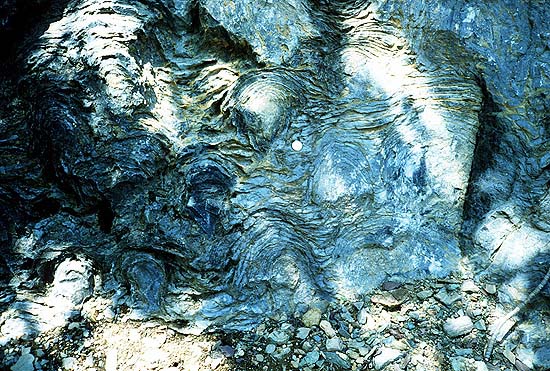

The Hadean Eon spans the interval from Earth's formation at approximately 4,540 million years ago to 4,000 million years ago. The name is derived from Hades, the Greek underworld, and reflects early assumptions that the young Earth was entirely molten and hostile to any form of solid geology. Modern geochemistry has revised this picture considerably. Detrital zircon crystals from the Jack Hills of Western Australia, dated by uranium-lead methods to 4,374 million years ago, provide evidence that at least some solid continental crust existed within 170 million years of Earth's formation, and that liquid water was likely present at or near the surface by that time.11 The Hadean has no formally defined lower boundary at a GSSP — by definition it begins at Earth's accretion — and its upper boundary with the Archean is set at 4,000 million years ago, though this boundary is also not currently defined by a GSSP, reflecting the scarcity of intact rock from this interval.10
The Archean Eon, extending from 4,000 to 2,500 million years ago, records the development of the first stable continental cratons, the large rigid blocks of ancient crust that persist to the present as the cores of modern continents. The rock record of the Archean, though fragmentary by comparison with younger intervals, preserves clear evidence of microbial life in the form of stromatolites — layered sedimentary structures built by mats of photosynthesizing microbes — with the oldest convincing examples dating to approximately 3,500 million years ago.12 The vast banded iron formations that characterize Archean and early Proterozoic sedimentary sequences record the progressive oxygenation of ocean water as photosynthesizing microbes released molecular oxygen into an atmosphere that was initially anoxic.
The Proterozoic Eon, spanning from 2,500 to 538.8 million years ago, encompasses more than two billion years of Earth history and is itself divided into three eras: the Paleoproterozoic, Mesoproterozoic, and Neoproterozoic. The most consequential event of the Paleoproterozoic was the Great Oxidation Event, which began approximately 2,400 million years ago, when atmospheric oxygen concentrations rose dramatically — probably as a result of cyanobacterial photosynthesis — transforming surface chemistry across the globe and enabling the evolution of aerobic metabolisms.14 The Neoproterozoic saw at least two, and possibly more, global glaciation events during the Cryogenian Period (720–635 million years ago), in which ice sheets may have extended to equatorial latitudes — the so-called Snowball Earth hypothesis. These glaciations were followed by the Ediacaran Period (635–538.8 million years ago), during which the first large, complex, multicellular organisms appear in the fossil record.13
The Phanerozoic Eon
.jpg)
_2_(15262901845).jpg)
The Phanerozoic Eon, whose name derives from the Greek for "visible life," begins at 538.8 million years ago and extends to the present. Its opening coincides with the Cambrian explosion, an interval of roughly 20–25 million years during which the major animal phyla — the fundamental body plans that still characterize the animal kingdom today — appear in the fossil record with remarkable rapidity.15 Radiometric dating of volcanic ash beds intercalated within Cambrian strata has allowed the duration of this diversification event to be constrained with considerable precision, confirming that it was geologically sudden rather than gradual.15
The Paleozoic Era, extending from 538.8 to 251.9 million years ago, encompasses six periods and records the colonization of the land by vascular plants and vertebrate animals, the diversification of fish and amphibians, the evolution of the first reptiles and early synapsids, and, at its close, the most severe mass extinction in Earth's history. The end-Permian extinction, which defines the boundary between the Paleozoic and Mesozoic, eliminated an estimated 90 to 96 percent of marine species and approximately 70 percent of terrestrial vertebrate species over a geologically brief interval, probably driven by the eruption of the Siberian Traps large igneous province and associated environmental perturbations including global warming, ocean acidification, and anoxia.16
The Mesozoic Era, from 251.9 to 66.0 million years ago, is the interval colloquially known as the Age of Reptiles and encompasses the Triassic, Jurassic, and Cretaceous periods. Dinosaurs diversified from relatively small Triassic forms into the dominant large vertebrates of the Jurassic and Cretaceous, while mammals radiated into a diverse range of small ecological roles alongside them. The Mesozoic also records the origin of flowering plants (angiosperms) in the Cretaceous, a development that transformed terrestrial ecosystems worldwide. The Mesozoic ended at the Cretaceous–Paleogene boundary, 66.0 million years ago, when a large bolide impact at Chicxulub on the Yucatan Peninsula of Mexico triggered a global environmental catastrophe that wiped out all non-avian dinosaurs along with approximately 75 percent of all species.17
The Cenozoic Era, from 66.0 million years ago to the present, is divided into the Paleogene, Neogene, and Quaternary periods. It records the diversification of mammals into the ecological roles vacated by the non-avian dinosaurs, the gradual cooling of global climate through the Eocene and Oligocene, the spread of grasslands in the Miocene, and the onset of the Pleistocene glacial cycles approximately 2.58 million years ago — the beginning of the Quaternary Period.22 Within the Quaternary, the genus Homo evolved in Africa and ultimately dispersed across the globe, a set of events that now define the youngest epoch of the Cenozoic, the Holocene, which began with the end of the last glacial maximum approximately 11,700 years ago.
GSSPs and the International Commission on Stratigraphy
For the geologic time scale to function as a global communication standard, each boundary between time units must be defined with sufficient precision and reproducibility that geologists anywhere in the world can identify the same moment in Earth history in their own rock sequences. The mechanism for achieving this is the Global Boundary Stratotype Section and Point, abbreviated GSSP and colloquially known as a "golden spike." A GSSP is a precisely located physical point in a specific rock exposure anywhere in the world — a particular centimeter of outcrop or core — at which a primary marker (typically the first occurrence of a specific fossil taxon, a geochemical anomaly, or a magnetic reversal) defines the base of a stratigraphic stage or series.9
The selection of a GSSP is a formal process managed by the International Commission on Stratigraphy, a constituent body of the International Union of Geological Sciences. Proposals are evaluated by specialist subcommissions for each period of the timescale. A candidate GSSP must meet strict criteria: the boundary marker must be globally recognizable and correlatable, the section must be well-exposed and protected from destruction, and auxiliary markers — isotopic excursions, microfossil events, magnetostratigraphy — must be documented to permit correlation in sections where the primary marker is absent.9, 23 After approval by the subcommission and the full ICS, the boundary is ratified by the International Union of Geological Sciences and becomes internationally binding.
The ICS publishes and regularly updates the International Chronostratigraphic Chart, which displays all formally ratified boundaries, their associated GSSPs, and their calibrated numerical ages. The current version of the chart, updated in 2023, reflects decades of collaborative work by hundreds of stratigraphers worldwide and represents the official international standard for all geochronological reference.2 Not all boundaries on the timescale have yet been formally defined by a GSSP — some, particularly in the Precambrian, are defined only by numerical age (Global Standard Stratigraphic Age, or GSSA) because the rock record is too fragmentary or the correlation tools too imprecise to anchor a physical stratotype.1
Radiometric calibration of the timescale
The relative sequence of geologic periods had been established by stratigraphic correlation before the end of the 19th century, but the conversion of that relative sequence into absolute dates — specific numbers of millions of years before the present — required the development of radiometric dating in the 20th century. The discovery of radioactivity by Henri Becquerel in 1896 and its subsequent theoretical elaboration by Ernest Rutherford and Frederick Soddy provided the physical mechanism: radioactive isotopes decay to stable daughter products at constant, measurable rates characterized by their half-lives, so the ratio of parent to daughter isotope in a mineral grain encodes the time elapsed since the mineral crystallized.20
The most important geochronometers for calibrating the Phanerozoic timescale are uranium-lead (U-Pb) dating of zircon and other accessory minerals in volcanic ash beds (bentonites) intercalated within fossiliferous sedimentary sequences. Volcanic ash is particularly valuable because it provides a contemporaneous date — the moment of eruption — rather than an inherited age, and zircon is chemically robust enough to preserve its original isotopic composition through hundreds of millions of years of burial and diagenesis.20 By dating bentonites immediately above and below a GSSP horizon, geochronologists can assign a numerical age to that boundary with uncertainties that have, in recent decades, been reduced to as little as a few hundred thousand years for Phanerozoic boundaries.
For the Precambrian, where volcanic ash beds are rare and the rock record is fragmentary, the timescale is calibrated primarily through U-Pb dating of igneous and metamorphic rocks, supplemented by rhenium-osmium (Re-Os) and samarium-neodymium (Sm-Nd) methods for specific rock types.1 The temporal resolution achievable in the Precambrian is generally lower than in the Phanerozoic, but key events such as the Great Oxidation Event and the Snowball Earth glaciations have been dated with sufficient precision to anchor the broad outlines of Proterozoic and Archean history.14
The numerical calibration of the timescale is an ongoing process. As new U-Pb dates are published and analytical techniques improve, some boundary ages are revised. The timescale published by the ICS in 2023 incorporates radiometric data that were not available to the compilers of earlier versions, and several boundary ages have been shifted by a few hundred thousand to a few million years relative to the 2012 edition.2 These revisions reflect the normal operation of a living scientific framework rather than fundamental uncertainty about the age of Earth or the sequence of events it records.
The Anthropocene debate
Since the early 2000s, the question of whether human activities have produced a stratigraphically recognizable change in Earth's rock record sufficient to warrant the designation of a new epoch — the Anthropocene — has been the subject of sustained scientific debate. The term was popularized by the atmospheric chemist Paul Crutzen and the ecologist Eugene Stoermer in 2000, who argued that human influence on atmospheric composition, land cover, sediment flux, and biogeochemical cycles was now globally dominant and geologically significant.19
The Anthropocene Working Group, established by the ICS Subcommission on Quaternary Stratigraphy, evaluated candidate GSSPs for a formal Anthropocene epoch. Their recommendation, published in 2023 and subsequently subject to ICS review, proposed a GSSP in sediment cores from Crawford Lake in Ontario, Canada, anchored to the first peak of plutonium fallout from nuclear weapons testing in the early 1950s as the primary stratigraphic marker.19 This marker reflects the global deposition of artificial radionuclides that began with above-ground nuclear testing and constitutes a globally synchronous signal reproducible in lake sediments, ice cores, and coral archives worldwide.
The proposal has, however, been controversial within the stratigraphic community. Critics have argued that a formal epoch of only approximately 70 years duration is inconsistent with the temporal scales of existing epochs, that the proposed start date of the mid-20th century excludes much of the most consequential phase of anthropogenic environmental change (including deforestation, agriculture, and early industrialization), and that the stratigraphic evidence, while real, does not meet the threshold required for a formal chronostratigraphic unit.18 In 2024, the ICS voted to reject the Anthropocene Working Group's proposal for a formal epoch, though the term continues to be widely used informally in the earth sciences to refer to the current interval of dominant human influence on Earth systems.18 The debate itself illustrates the rigorous standards that govern the geologic time scale: formal additions require not merely scientific consensus that something significant has happened, but a technically defensible stratigraphic definition that meets the criteria applied to every other division in the scale.
References
Global Boundary Stratotype Sections and Points (GSSPs) of the Geologic Period Boundaries
Evidence from detrital zircons for the existence of continental crust and oceans on the Earth 4.4 Gyr ago
End-Permian mass extinction in the oceans: an ancient analog for the twenty-first century?
The Chicxulub asteroid impact and mass extinction at the Cretaceous-Paleogene boundary