Overview
- Stromatolites are layered sedimentary structures formed by microbial communities, primarily cyanobacteria, and represent some of the oldest macroscopic evidence of life on Earth, with the most widely accepted examples dating to approximately 3.43 billion years ago in Western Australia.
- Cyanobacterial mats within ancient stromatolites were among the first organisms to produce oxygen through photosynthesis, contributing to the Great Oxidation Event around 2.4 billion years ago that fundamentally transformed Earth's atmosphere and enabled the evolution of aerobic life.
- Stromatolites dominated shallow marine environments for over two billion years during the Proterozoic but declined sharply in the late Neoproterozoic, likely due to the rise of grazing metazoans, and today persist only in restricted environments such as Shark Bay, Australia, and the Exuma Cays, Bahamas.
Stromatolites are layered sedimentary structures produced by the growth and metabolic activity of microbial communities, most commonly dominated by photosynthetic cyanobacteria. They form through cycles in which sticky mats of microorganisms trap and bind fine sediment particles or induce the precipitation of carbonate minerals, building up successive laminae over time.1, 6 Found in the geological record from the Archean eon onward, stromatolites constitute some of the oldest macroscopic evidence of life on Earth, with widely accepted biological examples dating to approximately 3.43 billion years ago in the Pilbara region of Western Australia.2 Their study lies at the intersection of paleontology, microbiology, and sedimentary geology, and they remain central to scientific efforts to understand when and how life first emerged on this planet.
For more than two billion years, stromatolites were among the most conspicuous features of shallow marine environments worldwide, and the photosynthetic organisms that built them played a pivotal role in oxygenating Earth's atmosphere.10, 14 Today, living stromatolites persist in only a handful of restricted settings, offering a rare window into the microbial ecosystems that dominated the planet for most of its history.
Definition and formation
The term stromatolite, derived from the Greek stroma (bed or layer) and lithos (stone), was introduced by the German geologist Ernst Kalkowsky in 1908 to describe laminated carbonate structures he observed in Mesoproterozoic rocks of northern Germany. The definition has been debated extensively over the following century, but most modern usage defines stromatolites as attached, lithified sedimentary growth structures that accrete away from an initial surface and exhibit lamination produced or influenced by microbial communities.1, 9
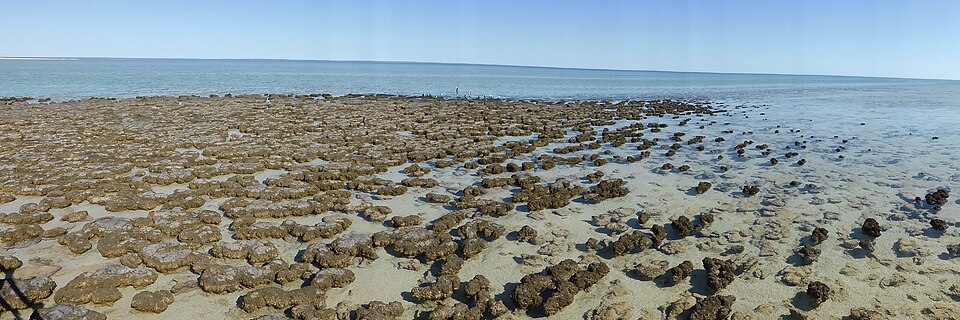

Stromatolite formation begins with a microbial mat, a thin, cohesive layer of microorganisms — principally filamentous and coccoid cyanobacteria — that colonises a submerged surface in shallow water. The microorganisms secrete extracellular polymeric substances (EPS), a sticky organic matrix that traps fine-grained sediment particles such as carbonate sand and silt carried by waves and currents. Additionally, the photosynthetic metabolism of cyanobacteria raises the pH and carbonate saturation of the surrounding water, promoting the in situ precipitation of calcium carbonate within and atop the mat.6, 7 As sediment accumulates on the mat surface, the phototactic microorganisms migrate upward to maintain access to sunlight, abandoning their EPS sheaths and establishing a new living layer on top. This repeated cycle of mat growth, sediment trapping, carbonate precipitation, and upward migration produces the characteristic fine lamination that defines stromatolites.7
The relative importance of sediment trapping versus in situ mineral precipitation has varied through geological time. Grotzinger and Knoll demonstrated that the oldest known stromatolites, from the Archean and early Proterozoic, formed predominantly through in situ precipitation of carbonate laminae in seas that were supersaturated with calcium carbonate, whereas younger Proterozoic stromatolites grew increasingly through the physical trapping and binding of detrital sediment by microbial mats.1 This shift reflected the progressive decline in oceanic carbonate supersaturation as Earth's ocean chemistry evolved.
Morphology and classification
Stromatolites exhibit a wide range of external forms, from flat, laterally continuous sheets (stratiform stromatolites) to domed, columnar, branching, and conical structures. The pioneering classification system established by Walter grouped stromatolites into morphological categories based on their gross shape and internal laminar geometry, including stratiform (flat-layered), domal (convex hemispherical mounds), columnar (discrete upright pillars, sometimes branching), and conical (pointed, often assigned to the form-genus Conophyton).9 Some columnar stromatolites branch into smaller columns as they grow, producing complex arborescent structures.
The morphology of a given stromatolite reflects the interplay of biological and environmental factors. The species composition and growth rate of the microbial community, the energy of the depositional environment (wave action, tidal currents), the rate of sedimentation, and the chemistry of the ambient water all influence the shape of the resulting structure.1, 12 In the approximately 3,430-million-year-old Strelley Pool Formation of Western Australia, Allwood and colleagues identified at least seven distinct stromatolite morphotypes distributed across a peritidal carbonate platform, with each morphotype corresponding to a particular sub-environment — from subtidal to intertidal to supratidal settings — demonstrating that even in the Early Archean, stromatolite form was sensitive to local environmental conditions.2, 12
The internal microstructure of stromatolites is equally varied. Laminae may be smooth and continuous, wrinkled and undulating, or broken into distinct clots and clusters of carbonate (the latter producing structures sometimes classified separately as thrombolites, which lack regular lamination and instead display a clotted internal fabric).6 In well-preserved Proterozoic examples, filamentous microfossils and preserved organic matter can sometimes be found within the laminae, providing direct evidence of the microbial communities that constructed the structure.11
The oldest stromatolites and the biogenicity debate
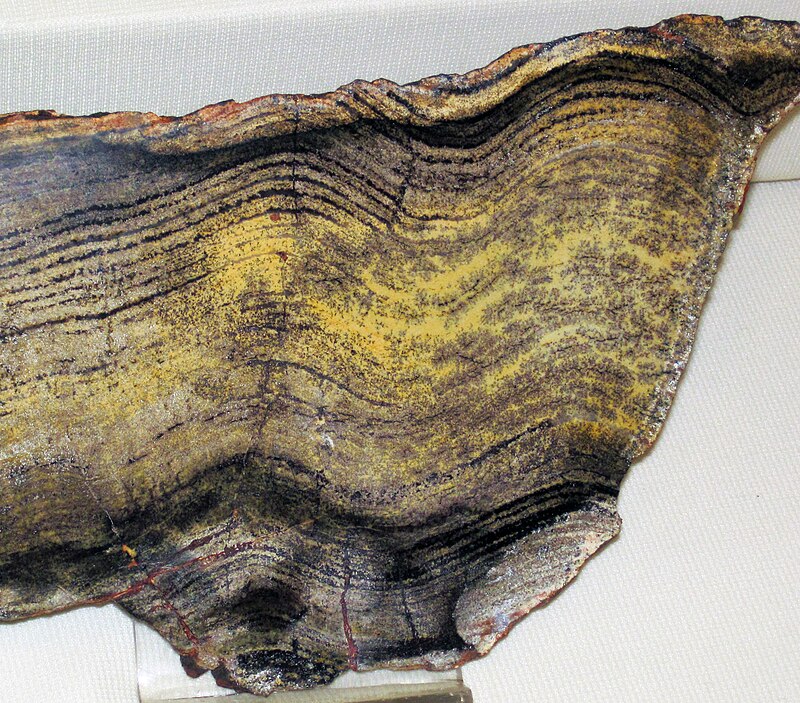
The identification of the oldest stromatolites on Earth is one of the most contested questions in paleontology and astrobiology. The difficulty arises because the simple laminated morphology of stromatolites can, in principle, be produced by purely abiotic processes — such as the evaporitic precipitation of minerals from supersaturated solutions or the deformation of soft sediment — without any biological involvement.4, 16 Distinguishing biogenic stromatolites from abiotic look-alikes in rocks that have endured billions of years of metamorphism and deformation is therefore a formidable challenge.
_1_(17346619166).jpg)
The most widely accepted ancient stromatolites occur in the approximately 3,430-million-year-old Strelley Pool Formation (formerly called the Strelley Pool Chert) of the Pilbara Craton, Western Australia. Allwood and colleagues documented a diverse assemblage of stromatolite morphotypes within a laterally extensive carbonate platform and argued that the diversity of forms, their systematic environmental distribution, and their association with sedimentary structures indicative of shallow marine conditions collectively favoured a biological origin.2, 13 Subsequent nano-scale analysis of these structures revealed carbonaceous matter and textures consistent with microbial activity, further strengthening the case for biogenicity.13
In 2016, Nutman and colleagues reported the discovery of putative stromatolites in the approximately 3,700-million-year-old Isua Supracrustal Belt of southwestern Greenland, which, if confirmed as biological, would extend the record of life on Earth by roughly 270 million years.3 However, these structures have been met with significant scepticism. The Isua rocks have experienced intense metamorphism and deformation, and some researchers have argued that the observed laminated features could have been produced by tectonic processes rather than microbial activity.20 The biogenicity of the Isua structures remains an active area of debate.
The challenge of distinguishing biogenic from abiogenic laminated structures was articulated forcefully by Lowe, who argued in 1994 that all described stromatolites older than 3.2 billion years could plausibly be explained by abiotic mechanisms, including evaporitic precipitation and soft-sediment deformation.4 Grotzinger and Rothman further demonstrated through mathematical modelling that certain stromatolite-like morphologies could arise from purely chemical precipitation in the absence of biology.16 These critiques have not invalidated the biological interpretation of the Strelley Pool structures, which rest on multiple independent lines of evidence, but they have sharpened the criteria that must be met before an ancient laminated structure can be confidently attributed to life.2, 12
Key stromatolite localities through geological time1, 2, 3, 7, 8
| Locality | Age | Formation / Setting | Biogenicity status |
|---|---|---|---|
| Isua, Greenland | ~3,700 Ma | Isua Supracrustal Belt | Disputed |
| Pilbara, Western Australia | ~3,430 Ma | Strelley Pool Formation | Widely accepted |
| Barberton, South Africa | ~3,416 Ma | Buck Reef Chert | Strong evidence |
| Great Slave Lake, Canada | ~1,900 Ma | Pethei Group | Accepted |
| Shark Bay, Australia | Modern | Hamelin Pool | Living stromatolites |
| Exuma Cays, Bahamas | Modern | Open marine | Living stromatolites |
Stromatolites in the Archean eon
Although the earliest putative stromatolites remain debated, there is broad agreement that by approximately 3.4 billion years ago, microbial communities were constructing recognisable stromatolite structures in shallow marine environments. The Strelley Pool Formation preserves a carbonate platform extending over at least 30 kilometres of strike length, containing a range of stromatolite morphotypes — from small domical forms in intertidal settings to larger columnar structures in subtidal environments — that collectively indicate a productive and ecologically differentiated microbial ecosystem.2, 12
In the Barberton Greenstone Belt of South Africa, Tice and Lowe documented photosynthetic microbial mats in the 3,416-million-year-old Buck Reef Chert. Geochemical and petrographic analysis demonstrated that carbonaceous matter in these rocks was produced by photosynthetic organisms living within the euphotic zone of a stratified ocean, providing some of the earliest direct evidence for photosynthesis on Earth.5 These mats, while not classical columnar stromatolites, represent the same fundamental process of microbial mat growth and sediment interaction.
Archean stromatolites are preserved almost exclusively in chert (microcrystalline silica) and carbonate rocks that have undergone varying degrees of metamorphism. The original organic matter and cellular structures of the mat-building organisms are rarely preserved, and where microfossils have been reported in Archean rocks, their biological origin has often been questioned.11, 20 The difficulty of interpreting Archean microfossils was highlighted by the controversy surrounding the purported 3,465-million-year-old microfossils of the Apex Chert, also in the Pilbara, which were initially described as filamentous cyanobacteria but were later reinterpreted by some workers as abiotic mineral artefacts.20
The Proterozoic peak and decline
Stromatolites reached their greatest abundance and morphological diversity during the Proterozoic eon (2,500 to 541 million years ago). Through the Paleoproterozoic and Mesoproterozoic, stromatolites were ubiquitous features of shallow marine carbonate platforms worldwide, forming extensive reef-like buildups in settings ranging from tidal flats to subtidal shelves.1, 15 Taxonomic surveys of stromatolite form-genera have documented a peak in morphological diversity between approximately 1,350 and 1,000 million years ago, during the late Mesoproterozoic.15
After this peak, stromatolite diversity and abundance declined substantially through the Neoproterozoic (1,000 to 541 million years ago). The causes of this decline have been debated for decades. One influential hypothesis attributes the decline to the evolution and diversification of grazing organisms — first protists and then early metazoans — that consumed the microbial mats before they could lithify into permanent structures.15 The temporal correlation between the decline of stromatolites and the appearance of the first complex multicellular organisms, including the Ediacaran biota, supports this interpretation. However, the relationship is not straightforward: changes in ocean chemistry, particularly declining carbonate supersaturation and shifts in the calcium-to-magnesium ratio of seawater, may have played an equally important role by reducing the rate of in situ carbonate precipitation that had sustained Archean and early Proterozoic stromatolite growth.1
The decline of stromatolites continued into the Phanerozoic eon, though they did not disappear entirely. Stromatolites experienced brief resurgences following mass extinction events, when the removal of grazing and competing organisms temporarily allowed microbial communities to recolonise vacated ecological niches. The aftermath of the end-Permian mass extinction, for example, saw a proliferation of microbial carbonates including stromatolites in the Early Triassic, before more complex ecosystems re-established themselves.6
Stromatolite morphological diversity through time1, 15
Stromatolites and the oxygenation of the atmosphere
The microorganisms that built stromatolites played one of the most consequential roles in Earth history: the production of free oxygen through oxygenic photosynthesis. Cyanobacteria use water as an electron donor in photosynthesis, splitting H2O molecules and releasing O2 as a byproduct — a metabolic innovation that, over geological time, transformed Earth's atmosphere from an anoxic, reducing environment to the oxygen-rich state that supports aerobic life today.10, 14
The precise timing of the origin of oxygenic photosynthesis remains uncertain. Molecular clock estimates and phylogenetic analyses of cyanobacterial lineages suggest that oxygenic photosynthesis may have evolved as early as 3.0 to 2.7 billion years ago, well before its geochemical signature became globally apparent.14 For hundreds of millions of years, the oxygen produced by cyanobacterial mats and stromatolites was consumed by reactions with reduced substances in the ocean and atmosphere — dissolved ferrous iron, volcanic gases, and reduced minerals on the seafloor — preventing its accumulation to significant levels. The massive banded iron formations (BIFs) of the late Archean and early Proterozoic are interpreted as a record of this oxygen buffering, in which biologically produced oxygen oxidised dissolved iron in seawater, precipitating it as iron oxides on the seafloor.10, 18
The Great Oxidation Event (GOE), beginning approximately 2.4 billion years ago, marks the point at which oxygen production finally overwhelmed the available sinks and free oxygen began to accumulate permanently in the atmosphere.10, 21 The GOE was not a single, abrupt transition but a protracted process spanning hundreds of millions of years, with atmospheric oxygen levels fluctuating considerably before stabilising. The geochemical evidence for the GOE includes the disappearance of mass-independent fractionation of sulfur isotopes (MIF-S) from the sedimentary record after approximately 2.4 billion years ago, which is diagnostic of an atmosphere containing more than trace levels of O2.10 Stromatolite-building cyanobacteria were almost certainly the primary biological agents responsible for this transformation, making stromatolites not merely passive geological curiosities but active agents of planetary-scale environmental change.14, 21
Modern living stromatolites
Although stromatolites were once globally abundant, living examples today are confined to a small number of environments where conditions discourage the grazing organisms that would otherwise consume or disrupt the delicate microbial mats. The two most celebrated localities are Hamelin Pool in Shark Bay, Western Australia, and the Exuma Cays in the Bahamas.7, 8
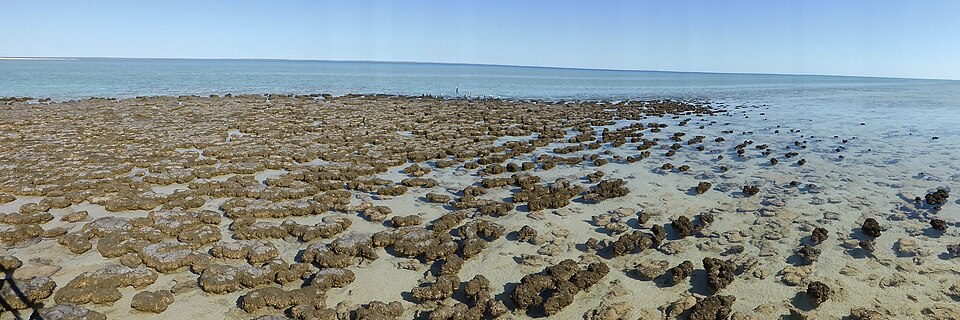
Hamelin Pool is a shallow, hypersaline embayment within Shark Bay, a UNESCO World Heritage Site on the coast of Western Australia. The elevated salinity of the pool — roughly twice that of normal seawater — excludes most grazing invertebrates, allowing cyanobacterial mats to grow undisturbed. Approximately 135 kilometres of shoreline within Hamelin Pool are fringed with stromatolites and microbial mats, forming the world's most extensive and morphologically diverse system of living marine stromatolites.8, 19 The stromatolites of Hamelin Pool exhibit a range of forms, from flat, pustular mats in the intertidal zone to large domed and columnar structures in the shallow subtidal, some reaching heights of more than half a metre.17, 19 Molecular studies of the microbial communities within these stromatolites have revealed a diverse consortium of organisms, including cyanobacteria from the genera Microcoleus, Leptolyngbya, and Synechococcus, as well as sulfate-reducing bacteria, heterotrophic bacteria, and archaea that collectively mediate the complex biogeochemical processes of mat growth and lithification.8, 17
The stromatolites of the Exuma Cays represent the only known example of actively forming stromatolites in open marine conditions of normal salinity. Reid and colleagues demonstrated that these structures grow through a repeating cycle of three distinct microbial community types: a pioneering mat of filamentous cyanobacteria that traps and binds carbonate sand, a biofilm of coccoid cyanobacteria and heterotrophic bacteria that fuses the grains together through precipitation of a thin micritic crust, and a final community of endolithic (rock-boring) cyanobacteria that colonises the lithified surface before the cycle repeats.7 This three-stage accretion model provided the first detailed mechanistic explanation for how modern stromatolites grow and demonstrated that lamination arises from the temporal succession of distinct microbial communities rather than from the activity of a single organism.7
Living stromatolites have also been documented in other restricted settings, including hypersaline lakes in the Bahamas, alkaline lakes in British Columbia and Mexico, and hot springs in Yellowstone National Park. These modern examples serve as invaluable natural laboratories for understanding the biological and environmental processes that produced the ancient stromatolites preserved in the geological record.6, 9
Broader significance
Stromatolites occupy a unique position at the intersection of geology, biology, and planetary science. As the oldest widely accepted macroscopic evidence of life, they anchor one end of the fossil record and provide the most tangible connection to Earth's earliest biosphere.1, 2 Their role in the oxygenation of the atmosphere places them among the most consequential biological structures in Earth history — without the cumulative oxygen output of cyanobacterial stromatolites over billions of years, the aerobic metabolisms that support complex multicellular life, including all animals, could not have evolved.10, 14
Stromatolites also figure prominently in the search for evidence of past life on Mars. The layered carbonate and chert deposits that preserve ancient stromatolites on Earth bear structural similarities to sedimentary formations observed in Martian terrains that may once have hosted liquid water, and the criteria developed to assess biogenicity in terrestrial stromatolites are being adapted for the analysis of Martian rock samples returned by current and future missions.13 If layered structures resembling stromatolites are ever found on Mars, the long and rigorous debate over biogenicity in Earth's own ancient record will have provided the intellectual framework for evaluating whether they represent evidence of extraterrestrial life.
The study of modern living stromatolites continues to illuminate the microbial processes underlying carbonate sedimentation, nutrient cycling, and ecosystem function in extreme environments. As understanding of these processes deepens, stromatolites are likely to remain central to scientific efforts to reconstruct the earliest chapters of life on Earth and to assess the habitability of other worlds.7, 8, 19
References
Stromatolites in Precambrian carbonates: evolutionary mileposts or environmental dipsticks?
Rapid emergence of life shown by discovery of 3,700-million-year-old microbial structures
Microbial carbonates: the geological record of calcified bacterial–algal mats and biofilms
The role of microbes in accretion, lamination and early lithification of modern marine stromatolites
Microbial diversity of extant stromatolites in the hypersaline marine environment of Shark Bay, Australia
Stromatolites in the ~3400 Ma Strelley Pool Formation, Western Australia: examining biogenicity from the macro- to the nano-scale
Composition and structure of microbial communities from stromatolites of Hamelin Pool in Shark Bay, Western Australia