Overview
- Earth's magnetic field is generated by convective motions of liquid iron in the outer core through a self-sustaining dynamo mechanism, and paleomagnetic evidence from rocks shows the field has existed for at least 3.5 billion years, making it one of the most enduring features of the planet.
- The geomagnetic field has reversed polarity hundreds of times throughout Earth's history, with the most recent reversal (the Brunhes-Matuyama transition) occurring approximately 780,000 years ago, and the pattern of reversals recorded in ocean-floor basalts provided critical evidence for seafloor spreading and plate tectonics.
- The magnetic field shields the Earth from solar wind and cosmic radiation, protecting the atmosphere from erosion and the surface from harmful particle bombardment, and comparison with Mars, which lost its global field early in its history, illustrates the field's importance for planetary habitability.
Earth's magnetic field is a largely dipolar field generated deep within the planet by the motion of electrically conducting liquid iron in the outer core. This self-sustaining geodynamo has operated for at least 3.5 billion years, shielding the planet's atmosphere from erosion by the solar wind and providing a navigational reference recorded in the magnetisation of rocks worldwide.7 The study of the magnetic field spans disciplines from geophysics and geochronology to space science and planetary habitability, and the pattern of geomagnetic reversals preserved in ocean-floor basalts was instrumental in establishing the theory of plate tectonics.

The geodynamo
Earth's magnetic field originates in the outer core, a shell of liquid iron-nickel alloy extending from approximately 2,890 to 5,150 kilometres depth. The inner core, a solid iron sphere roughly 1,220 kilometres in radius, grows slowly as the outer core crystallises, releasing latent heat and light elements (such as silicon, oxygen, and sulfur) that drive compositional convection in the overlying liquid. This convection, combined with thermal convection from the hot core-mantle boundary, sustains vigorous fluid motions that, through the Coriolis effect imposed by Earth's rotation, organise into columnar flow patterns aligned roughly parallel to the rotation axis.14
These organised fluid motions generate and maintain the magnetic field through electromagnetic induction, a process described by magnetohydrodynamic theory. Moving conducting fluid stretches, amplifies, and regenerates magnetic field lines, compensating for the continuous decay that would otherwise dissipate the field through ohmic diffusion on a timescale of roughly 20,000 years. Numerical simulations by Glatzmaier and Roberts in 1995 produced the first three-dimensional self-consistent models of the geodynamo, successfully reproducing both the predominantly dipolar field structure and spontaneous polarity reversals.3 Subsequent systematic parameter studies have mapped the conditions under which dipole-dominated dynamos arise, showing that rapid rotation and strong buoyancy forcing produce Earth-like field morphologies across a wide range of model parameters.2
History of the field
Paleomagnetic measurements from ancient rocks provide a record of the geomagnetic field extending back billions of years. When igneous rocks cool through their Curie temperature or when sedimentary grains settle in water, magnetic minerals align with the ambient field and preserve a record of its direction and intensity. The oldest reliable paleomagnetic signals come from single zircon crystals in the Jack Hills of Western Australia, indicating that a geomagnetic field existed as early as 4.2 billion years ago, potentially within a few hundred million years of Earth's formation.7 Additional paleomagnetic evidence from Neoarchean gabbro intrusions in Botswana confirms that a stable geodynamo was operating by at least 3.4 billion years ago, with field intensities comparable to those of the present day.8
The energy source for the early geodynamo remains debated. Before the inner core began crystallising (estimated at 0.5 to 1.5 billion years ago), the dynamo must have been powered entirely by thermal convection rather than compositional buoyancy. Some models suggest that radioactive potassium dissolved in the core, or higher initial core temperatures, provided sufficient heat flow to sustain convection during this early period. The onset of inner core growth would have provided a dramatic boost to dynamo power, and some researchers have proposed that a sharp increase in paleomagnetic field intensity in the Proterozoic may mark this transition.9, 15
Polarity reversals
One of the most remarkable features of Earth's magnetic field is its tendency to reverse polarity at irregular intervals, with the north and south magnetic poles exchanging positions over a transition period of a few thousand years. The current normal polarity epoch, the Brunhes chron, has persisted for approximately 780,000 years. The preceding reversed epoch, the Matuyama chron, lasted from approximately 2.6 million to 780,000 years ago. The reversal record, calibrated against radiometric dating and seafloor magnetic anomalies, forms the geomagnetic polarity timescale, a fundamental tool for geochronology.6
During a reversal, the dipole field weakens substantially (to perhaps 10 to 20 percent of its normal strength), the field geometry becomes complex and multipolar, and the virtual magnetic poles wander across low latitudes before re-establishing a stable dipole with opposite polarity. Sedimentary and volcanic records of transitional fields suggest that reversals proceed through rapid directional changes punctuated by brief periods of stability, with the entire transition lasting 2,000 to 12,000 years.4 The frequency of reversals has varied through geological time, from superchrons lasting tens of millions of years without reversal (such as the Cretaceous Normal Superchron, approximately 121 to 83 million years ago) to periods of frequent reversals every few hundred thousand years.6
Seafloor spreading evidence
The magnetic field's role in establishing plate tectonics was pivotal. In 1963, Fred Vine and Drummond Matthews proposed that the symmetric pattern of normal and reversed magnetic anomalies flanking mid-ocean ridges resulted from seafloor spreading: new oceanic crust forming at the ridge crest records the ambient field polarity, then moves laterally as new crust forms behind it, producing a magnetic barcode-like pattern that mirrors the reversal timescale.5
This Vine-Matthews-Morley hypothesis, confirmed independently by Lawrence Morley, provided one of the most compelling pieces of evidence for continental drift and plate tectonics, transforming the Earth sciences. The magnetic anomaly patterns allowed calculation of spreading rates at ridges worldwide and demonstrated that ocean floors are geologically young, with the oldest oceanic crust dating to approximately 200 million years ago.
Secular variation
On shorter timescales (years to millennia), the magnetic field undergoes continuous changes in direction and intensity known as secular variation. The present dipole field is tilted approximately 11 degrees from the rotation axis, and the non-dipole components of the field drift westward at approximately 0.2 degrees per year. The total dipole moment has decreased by roughly 9 percent since systematic measurements began in 1840, leading to periodic speculation about an impending reversal.16
The South Atlantic Anomaly (SAA), a region of anomalously weak field intensity centred over Brazil and the South Atlantic, has deepened and expanded over recent centuries. Some researchers have suggested that the SAA may represent the early stages of a reversal or excursion, though the current rate of field decay is not unprecedented in the paleomagnetic record and periods of comparable decline have not always led to reversals.11 Archaeomagnetic data from fired clay and pottery provide higher-resolution records of field behaviour over the past several thousand years, revealing rapid intensity fluctuations (geomagnetic jerks and spikes) that complicate simple interpretations of modern field trends.12
Magnetosphere and habitability
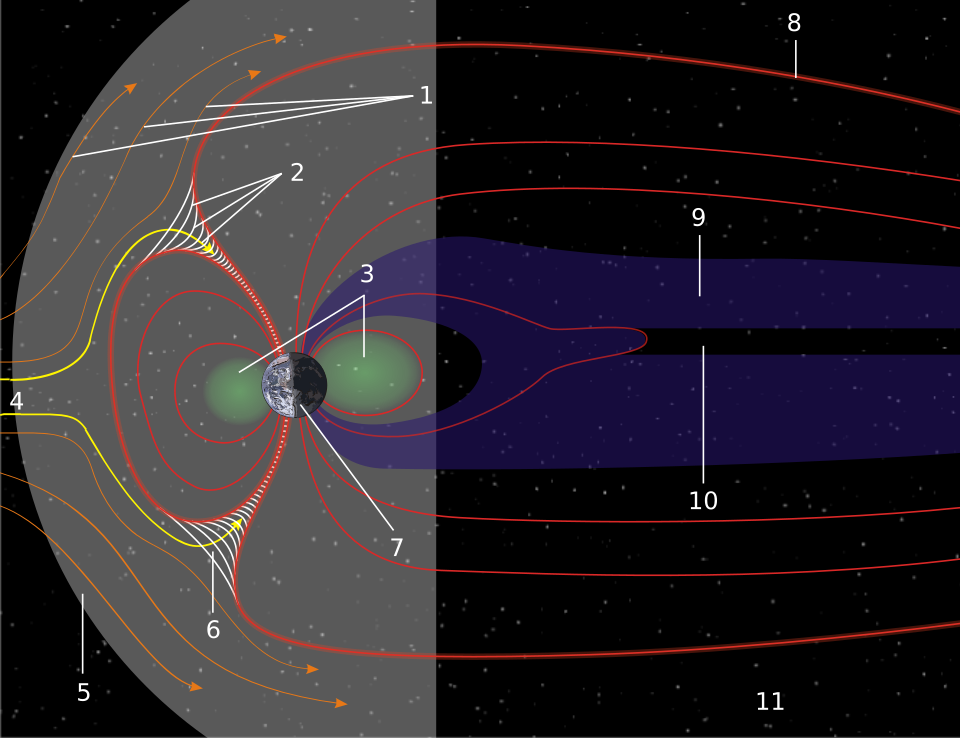
The geomagnetic field extends far beyond the solid Earth, forming the magnetosphere, a tear-drop-shaped cavity in the solar wind that deflects the continuous stream of charged particles emitted by the Sun. The magnetopause, the outer boundary of the magnetosphere, stands off the solar wind at approximately 10 Earth radii on the dayside and stretches into a long magnetotail on the nightside. Within the magnetosphere, the Van Allen radiation belts trap energetic protons and electrons in toroidal regions around the Earth.13
The magnetosphere's shielding effect is essential for atmospheric retention and surface habitability. Without a global magnetic field, the solar wind would directly interact with the upper atmosphere, sputtering away light gases and gradually stripping the atmosphere over geological time. Mars provides a natural comparison: MAVEN mission data show that Mars lost its global magnetic field approximately 4 billion years ago, after which solar wind erosion stripped most of its atmosphere, transforming it from a potentially habitable world with liquid surface water into the cold, thin-atmosphere planet observed today.10 Earth's sustained geodynamo has thus been a critical factor in maintaining the atmospheric conditions necessary for life over billions of years.
Paleomagnetism as a geological tool
Beyond its role in geochronology, paleomagnetism serves as a tool for reconstructing ancient continental positions (apparent polar wander paths), constraining the thermal history of rocks, and dating archaeological materials. The principle of remanent magnetisation — that rocks and fired materials record the ambient field at the time of their formation or last heating — underpins paleomagnetic studies across all geological timescales.1
Apparent polar wander paths, constructed by plotting the sequential positions of magnetic poles recorded in rocks of different ages from a single continent, provided early evidence that continents had moved through time. When the polar wander paths of different continents converge at particular times in the past, they indicate that those continents were joined. This paleomagnetic evidence was instrumental in reconstructing supercontinent configurations such as Pangaea, Rodinia, and Columbia, complementing geological and paleontological evidence for ancient continental connections.1
References
A three-dimensional self-consistent computer simulation of a geomagnetic field reversal
Secular variation of the Earth's magnetic field: from nanoseconds to millions of years