Overview
- Geothermal systems are regions where Earth’s internal heat is concentrated near the surface through magmatic intrusions, tectonic fracturing, or anomalously high heat flow, producing thermal gradients far exceeding the global average of approximately 25–30 °C per kilometre and giving rise to surface manifestations including hot springs, geysers, fumaroles, and mud pots.
- Systems are classified as magmatic or non-magmatic depending on whether a shallow intrusion provides the heat source, with magmatic systems — exemplified by Yellowstone and Iceland — capable of sustaining reservoir temperatures above 200 °C and powering high-enthalpy electricity generation, while non-magmatic systems rely on deep circulation through regions of elevated crustal heat flow.
- Geothermal energy exploitation has expanded from traditional direct-use applications (bathing, heating, agriculture) to electricity generation at more than 600 power plants in 29 countries, with global installed capacity exceeding 16 GW as of 2023, and emerging enhanced geothermal systems (EGS) technology promises to extend viable geothermal resources far beyond naturally permeable volcanic terrains.
Geothermal systems are regions of Earth’s crust where internal heat is transferred toward the surface at rates significantly exceeding the planetary average, producing elevated temperatures in subsurface rocks and fluids that often manifest at the surface as hot springs, geysers, fumaroles, and steaming ground. The global average geothermal gradient — the rate at which temperature increases with depth — is approximately 25 to 30 °C per kilometre, corresponding to a mean continental surface heat flow of about 65 milliwatts per square metre.2, 15 In geothermal systems, this gradient may be several times higher, reaching 100 °C per kilometre or more in volcanically active regions, so that exploitable temperatures are found at depths of only one to three kilometres rather than the five to ten kilometres that would be necessary under normal conditions.1, 3
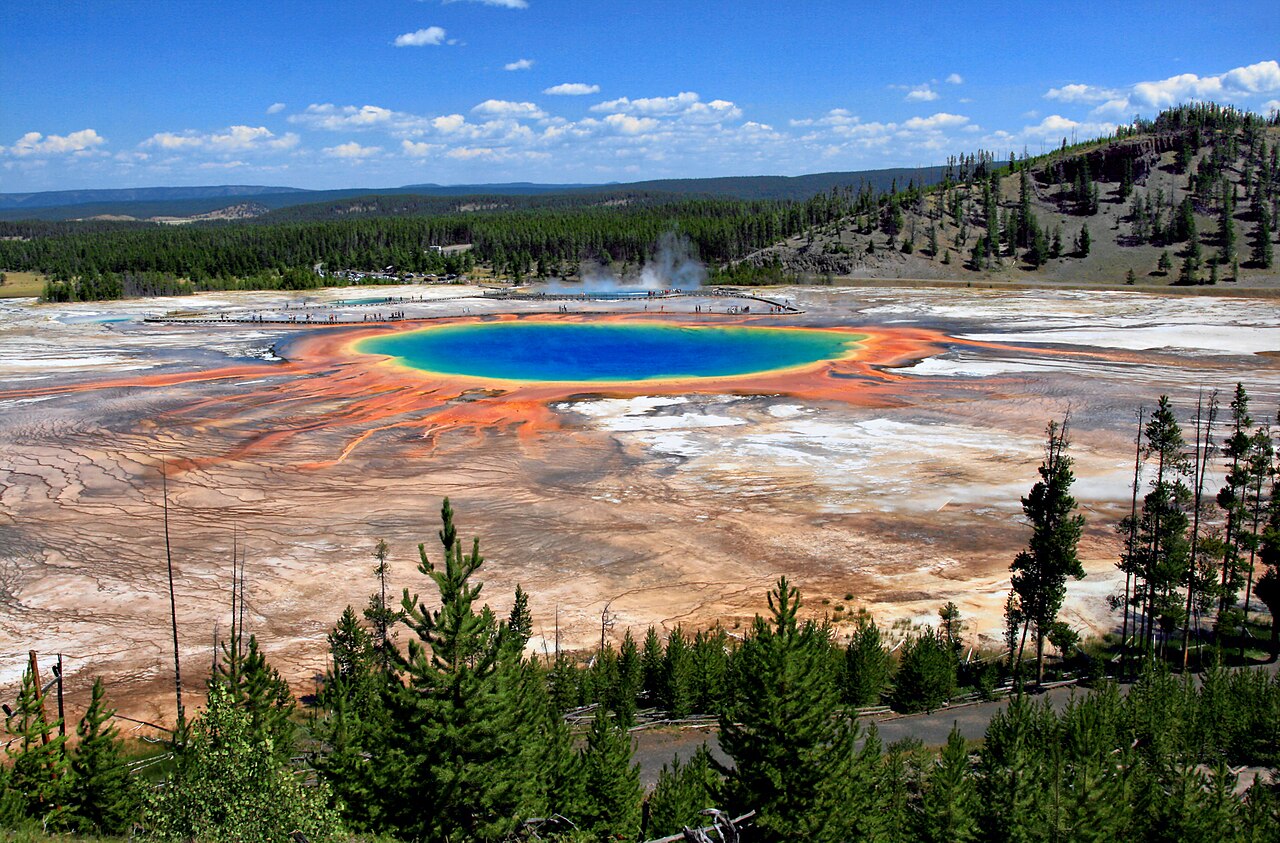

The fundamental requirement for a geothermal system is a concentrated heat source, a permeable reservoir through which fluid can circulate, and a supply of water to serve as the heat-transfer medium. Where these three elements coincide — most commonly at volcanic centres, along tectonic plate boundaries, and above mantle plumes — thermal energy from Earth’s interior becomes accessible for both natural surface expression and human exploitation.1, 3
Earth’s internal heat and geothermal gradients
The heat that drives geothermal systems originates from two principal sources. Approximately 40 to 50 percent of the total terrestrial heat flow is primordial heat retained from Earth’s accretion and core formation some 4.5 billion years ago, when gravitational energy was converted to thermal energy during the coalescence of planetesimals and the subsequent segregation of the iron core. The remaining 50 to 60 percent is generated continuously by the radioactive decay of long-lived isotopes — principally uranium-238, uranium-235, thorium-232, and potassium-40 — distributed throughout the mantle and concentrated in the continental crust.2 Together, these sources produce a total heat output from the solid Earth of approximately 44 terawatts, of which roughly 30 terawatts passes through the ocean floor and 14 terawatts through the continents.15
The geothermal gradient is not uniform. In stable continental interiors where the lithosphere is thick and old, heat flow is relatively low (40 to 60 mW/m²) and the gradient correspondingly gentle. In tectonically active regions — mid-ocean ridges, volcanic arcs, rift zones — heat flow may exceed 100 to 200 mW/m², driven by the proximity of magma or anomalously hot mantle to the surface.2, 15 The global heat flow database maintained by the International Heat Flow Commission contains more than 70,000 measurements from boreholes and ocean-floor probes, revealing a clear correlation between heat flow, tectonic setting, and the age of the crust: young oceanic crust at mid-ocean ridges has the highest heat flow, while Precambrian cratons have the lowest.15
These regional variations in thermal gradient determine where geothermal systems develop. Wherever heat flow is sufficiently elevated and permeability allows fluid circulation, water that infiltrates from the surface or is present in the pore spaces of rock becomes heated, decreases in density, and rises buoyantly toward the surface, establishing a convective circulation cell that transfers thermal energy far more efficiently than conduction alone.1, 3
Magmatic geothermal systems
Magmatic geothermal systems are those in which the heat source is a shallow intrusion of molten or partially molten rock, typically at depths of two to ten kilometres beneath the surface. These systems are the most thermally vigorous and economically productive, capable of sustaining reservoir temperatures above 200 °C and sometimes exceeding 350 °C.1, 3 They occur at three principal tectonic settings: convergent plate boundaries where subduction-related volcanism creates chains of stratovolcanoes with shallow magma chambers, divergent boundaries where rifting thins the crust and brings magma close to the surface, and intraplate hotspots where mantle plumes impinge on the base of the lithosphere.12
The Yellowstone geothermal system in Wyoming is the most extensively studied magmatic system on Earth. The Yellowstone Plateau sits above a mantle plume that has been active for at least 16 million years, producing a track of progressively older calderas extending to the southwest across the Snake River Plain. The most recent caldera-forming eruption occurred approximately 640,000 years ago, and seismic tomography has revealed a large body of partially molten rock extending from the upper mantle through the lower crust to a shallow magma reservoir centred at approximately 8 kilometres depth, with a smaller, more crystalline body at 4 to 5 kilometres.4 This enormous heat source drives one of the world’s most spectacular geothermal fields. Yellowstone contains more than 10,000 thermal features, including approximately 500 geysers — more than half the world’s total — along with thousands of hot springs, mud pots, and fumaroles. The total convective heat discharge from the Yellowstone system is estimated at 4,500 to 6,000 megawatts, equivalent to the output of several large power plants, all dissipated naturally into the atmosphere.11, 6
Iceland provides the definitive example of a magmatic geothermal system at a divergent plate boundary. The island straddles the Mid-Atlantic Ridge and also sits above a mantle plume, a combination that produces exceptionally high heat flow and widespread volcanism.13 Eruptions occur on average every four to five years, and geothermal manifestations are ubiquitous. The Iceland Deep Drilling Project (IDDP) drilled into supercritical conditions at approximately 4.5 kilometres depth in the Reykjanes geothermal field, encountering fluid at temperatures above 427 °C and pressures exceeding 340 bar — conditions where water exists as a supercritical fluid with properties intermediate between liquid and steam, carrying vastly more enthalpy per unit mass than conventional geothermal fluids.5 A single well tapping supercritical resources could potentially generate five to ten times the power of a conventional geothermal well, a possibility that has driven continued research into deep, high-temperature drilling technology.5
Non-magmatic geothermal systems
Not all geothermal systems require a magmatic heat source. Non-magmatic systems derive their thermal energy from the normal radiogenic heat production of the crust, amplified by favourable geological conditions that concentrate heat flow or allow deep circulation of water into regions of elevated temperature. These systems typically operate at lower temperatures than their magmatic counterparts — generally 50 to 150 °C — and are important primarily for direct-use applications such as district heating, greenhouse agriculture, and aquaculture, though some produce enough heat for binary-cycle electricity generation.1, 8
Several geological settings produce non-magmatic geothermal anomalies. Regions of anomalously high crustal heat production, such as granitic batholiths enriched in uranium and thorium, can generate thermal gradients sufficient to produce hot water at modest depths. The Cooper Basin in central Australia, where buried granites with heat production rates three to five times the crustal average produce temperatures of 250 °C at 4.5 kilometres depth, is the most studied example of this type.10 Extensional tectonic settings, such as the Basin and Range province of the western United States, produce high heat flow through crustal thinning and deep faulting that allows meteoric water to circulate to depths where it is heated by the normal geothermal gradient before rising along fault zones to feed hot springs. The Great Basin of Nevada and Utah contains hundreds of such fault-controlled hot springs, many of which now support small geothermal power plants.12
Deep sedimentary basins also host non-magmatic geothermal resources. In the Paris Basin, warm water at 60 to 85 °C is produced from Jurassic limestone aquifers at depths of 1.5 to 2 kilometres and used for district heating serving more than 200,000 housing units — one of the largest geothermal direct-use projects in Europe.8 The key requirement in all non-magmatic systems is adequate permeability to allow fluid circulation. Where natural permeability is insufficient, enhanced geothermal systems technology aims to create artificial reservoirs by hydraulic stimulation of hot but impermeable rock.10, 16
Hot springs, geysers, and fumaroles
The surface manifestations of geothermal systems are determined by the temperature, chemistry, and flow rate of the ascending fluid, as well as the depth of the water table and the permeability of the near-surface rocks. Hot springs are the most common expression, occurring wherever heated groundwater reaches the surface at temperatures above the ambient air temperature. Hot spring temperatures range from barely warm to boiling, and their chemistry reflects the rocks through which the water has circulated: silica-rich waters indicate interaction with volcanic or granitic rocks at high temperature, while carbonate-rich waters suggest passage through limestone or marble.6, 11
Geysers represent a special case of hot spring behaviour in which eruptions of boiling water and steam occur at periodic or quasi-periodic intervals. The mechanism, first elucidated in detail by Susan Kieffer in 1984, requires a specific plumbing geometry: a narrow, constricted conduit filled with water heated to near-boiling temperatures at depth, where the hydrostatic pressure of the overlying water column maintains the water in the liquid phase despite temperatures exceeding the surface boiling point. When a small perturbation — a bubble, a slight pressure drop — initiates boiling at some point in the conduit, the resulting expansion of steam reduces the pressure on the water below, triggering a cascading chain of flash boiling that propels a column of water and steam explosively out of the vent.7 Old Faithful in Yellowstone, the world’s most famous geyser, erupts approximately every 90 minutes, ejecting 14,000 to 32,000 litres of boiling water to heights of 30 to 55 metres in eruptions lasting two to five minutes.7, 11 The relative rarity of geysers — fewer than 1,000 exist worldwide, concentrated overwhelmingly in Yellowstone, Kamchatka, Iceland, and the Taupo Volcanic Zone of New Zealand — reflects the stringent requirements of the necessary plumbing geometry, which is easily disrupted by mineral deposition, earthquake activity, or groundwater changes.6
Fumaroles are vents that emit volcanic gases and steam without significant liquid water, occurring where the water table lies below the surface or where temperatures are high enough to boil all ascending water before it reaches the vent. The emitted gases are predominantly steam, with varying proportions of carbon dioxide, hydrogen sulfide, sulfur dioxide, and trace amounts of hydrogen, methane, and other volatiles. The hydrogen sulfide is often oxidised by bacteria near the surface to produce native sulfur deposits and sulfuric acid, which attacks surrounding rocks to create the bleached, altered ground and bubbling mud pots characteristic of acid-sulfate geothermal areas.6, 11 Sinter terraces — broad, stepped platforms of amorphous silica (opaline sinter) or calcium carbonate (travertine) deposited by cooling geothermal waters — are among the most visually striking products of hot spring activity. The Mammoth Hot Springs travertine terraces at Yellowstone deposit calcium carbonate at rates of up to several centimetres per year, building an actively growing geological structure in real time.11
Hydrothermal convection and mineral deposits
The circulation of heated water through permeable rock — hydrothermal convection — is the fundamental process linking geothermal systems to ore formation and to the chemical evolution of the crust. As water circulates through hot rock, it dissolves metals, silica, and other elements, transporting them in solution until changes in temperature, pressure, or chemical environment cause precipitation. This process is responsible for the formation of many economically important mineral deposits, including epithermal gold and silver deposits, porphyry copper deposits, and volcanogenic massive sulfide deposits on the seafloor.3, 12
In continental geothermal systems, hydrothermal alteration of the host rock produces distinctive mineral assemblages that geologists use to map the thermal structure of both active and fossil systems. At high temperatures (above 200 °C), alteration minerals include epidote, chlorite, and adularia; at moderate temperatures (100 to 200 °C), clay minerals such as illite and mixed-layer clays dominate; and at low temperatures (below 100 °C), smectite, zeolites, and calcite are typical.3 These alteration zones can be preserved in ancient rocks long after the geothermal system has ceased to operate, providing a fossil record of past hydrothermal activity. The study of such fossil systems — epithermal ore deposits, for example — informs both economic geology and the understanding of modern geothermal processes.3, 12
Submarine geothermal systems at mid-ocean ridges operate on a grander scale, cycling the entire volume of the world’s oceans through the oceanic crust every 10 to 20 million years. This hydrothermal circulation profoundly influences ocean chemistry, representing a major sink for magnesium and sulfate and a major source of iron, manganese, lithium, and other elements. The chemical fluxes from submarine hydrothermal systems are comparable in magnitude to the riverine inputs from the continents for many dissolved species, making hydrothermal circulation a first-order control on the geochemical balance of the oceans over geological time.3
Geothermal energy exploitation
Human use of geothermal heat extends back thousands of years — Paleolithic peoples used hot springs for bathing, and the Romans built elaborate bathhouses at geothermally heated sites across the empire — but the systematic exploitation of geothermal energy for electricity generation began in 1904, when Prince Piero Ginori Conti operated a small dynamo powered by natural steam at Larderello in Tuscany, Italy. The first commercial geothermal power plant opened at the same site in 1913, and Larderello remained the world’s only geothermal electricity facility for more than four decades.1, 9
As of 2023, global installed geothermal electricity capacity exceeds 16 gigawatts, distributed across more than 600 power plants in 29 countries. The leading producers are the United States (approximately 3.7 GW, concentrated at The Geysers in California and in Nevada, Utah, and Hawaii), Indonesia (approximately 2.4 GW), the Philippines (approximately 1.9 GW), Turkey, and New Zealand.9, 17 Iceland generates approximately 25 to 30 percent of its electricity from geothermal sources and supplies more than 90 percent of its building heating demand through direct-use geothermal district heating systems — the most geothermally dependent economy in the world.13, 8
Three principal technologies are used for geothermal electricity generation. Dry steam plants, such as those at Larderello and The Geysers, use naturally occurring steam directly to drive turbines. Flash steam plants, the most common type, bring high-temperature water (above 180 °C) to the surface under pressure and then allow it to flash to steam in a low-pressure separator. Binary cycle plants use moderate-temperature water (100 to 180 °C) to heat a secondary working fluid with a lower boiling point — typically an organic compound such as isobutane or isopentane — which vaporises and drives the turbine. Binary plants have extended the economic viability of geothermal electricity to lower-temperature resources and now represent the majority of new installations worldwide.1, 9
The most significant emerging technology is the enhanced geothermal system (EGS), which aims to create artificial geothermal reservoirs in hot but impermeable rock by drilling deep wells and using hydraulic stimulation to open or enlarge fractures, thereby creating the permeability needed for fluid circulation. The landmark MIT-led assessment of 2006 concluded that the accessible EGS resource base in the United States alone exceeds 100,000 exajoules of thermal energy — roughly 1,000 times the country’s annual primary energy consumption — though the economic and technical challenges of drilling to the necessary depths (3 to 10 kilometres), creating sustained fracture permeability, and managing induced seismicity remain substantial.10, 16 Pilot EGS projects have been conducted at Soultz-sous-Forêts in France, Habanero in Australia, and Newberry in Oregon, with results demonstrating the technical feasibility of the concept while highlighting the engineering difficulties of sustaining commercial flow rates over the lifetime of a power plant.16
References
The Iceland deep drilling project: a search for deep unconventional geothermal resources
The future of geothermal energy: impact of enhanced geothermal systems (EGS) on the United States in the 21st century
Volcanism in Iceland in historical time: volcano types, eruption styles and eruptive history
Enhanced geothermal systems: a review of research, development, and demonstration projects