Overview
- Impact cratering is a fundamental geological process in which a hypervelocity projectile strikes a planetary surface, generating shock waves that excavate a bowl-shaped cavity through distinct stages of contact, compression, excavation, and modification — producing craters that range from simple bowl-shaped depressions under ~2–4 km in diameter to complex multi-ring basins hundreds of kilometres across.
- Shock metamorphism provides the definitive criteria for confirming impact origin, including shatter cones, planar deformation features in quartz, and the formation of high-pressure silica polymorphs such as coesite and stishovite at pressures far exceeding those produced by any endogenic geological process.
- Earth preserves roughly 200 confirmed impact structures, including the Vredefort (~300 km, ~2.02 Ga), Sudbury (~250 km, ~1.85 Ga), and Chicxulub (~180 km, ~66 Ma) craters, which collectively demonstrate that impact events have driven mass extinctions, generated economically significant ore deposits, and shaped the geological and biological trajectory of the planet.
Impact cratering is one of the most fundamental geological processes operating on solid bodies throughout the solar system. On Earth, the recognition that hypervelocity collisions between extraterrestrial projectiles and the planetary surface produce distinctive geological structures was a hard-won insight of twentieth-century science, resisted for decades by a geological establishment accustomed to uniformitarian explanations for all surface features.2 Today, approximately 200 confirmed impact structures have been identified on Earth, and the study of impact cratering integrates shock physics, petrology, geochemistry, remote sensing, and planetary science into a unified discipline that has profoundly reshaped understanding of Earth history.15

Crater formation mechanics
The formation of an impact crater unfolds through a sequence of stages that together last only seconds to minutes, even for the largest events, yet rearrange enormous volumes of target rock. These stages are conventionally divided into contact and compression, excavation, and modification.1, 20
During the contact and compression stage, the projectile strikes the target surface at velocities typically between 11 and 72 km/s for asteroidal and cometary impactors in the inner solar system. Upon contact, intense shock waves propagate both forward into the target and rearward through the projectile. The pressures generated at the point of impact routinely exceed 100 GPa — far beyond the yield strength of any terrestrial rock — and the projectile is completely destroyed within a fraction of a second, either vaporised or melted depending on impact velocity and composition.20 The shock wave radiates hemispherically outward into the target, decaying in intensity with distance from the point of impact.
The excavation stage begins as the shock wave and its trailing rarefaction wave set the target material into motion, opening a transient cavity. Material near the surface is ejected ballistically, forming an ejecta curtain that deposits an annular blanket of debris around the growing crater. Deeper material flows downward and outward along the walls of the expanding cavity. The transient cavity reaches its maximum dimensions within seconds for even very large impacts. At this stage, its depth-to-diameter ratio is roughly 1:3 regardless of crater size — a consequence of the physics of shock-wave propagation through a uniform medium.1, 20
The modification stage follows immediately. Gravity causes the steep, unstable walls of the transient cavity to collapse inward, and in larger craters, the compressed floor of the cavity rebounds upward to form a central uplift. The final crater is therefore wider and shallower than the transient cavity that preceded it. In very large impacts, the central uplift itself may collapse outward, producing a peak ring or multiple concentric rings.18 The entire formation process, from initial contact to the cessation of significant ground motion, typically concludes in under ten minutes for even the largest terrestrial impact events.1
Simple and complex craters
Impact craters are classified into two principal morphological types — simple and complex — with a transitional diameter that depends on the target body’s surface gravity and rock properties.18
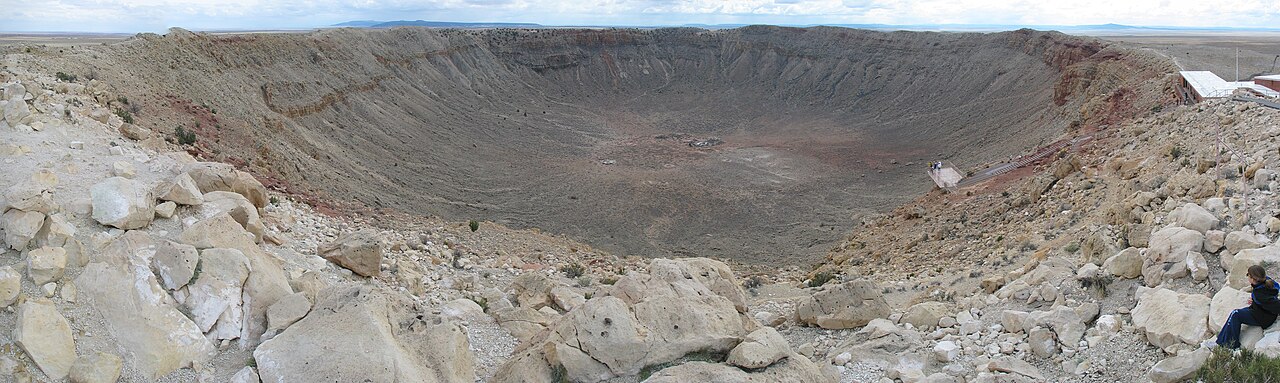
Simple craters are bowl-shaped depressions with smooth, raised rims and relatively uniform interior slopes. On Earth, simple craters form when the final rim diameter is less than approximately 2–4 km in sedimentary targets or up to about 4 km in crystalline rock. The classic example is Barringer Crater (Meteor Crater) in Arizona, a 1.2 km diameter structure formed roughly 50,000 years ago by the impact of an iron meteorite. Its well-preserved bowl shape, overturned rim strata, and surrounding ejecta blanket make it perhaps the most studied simple impact crater on Earth.14
Complex craters develop above the simple-to-complex transition diameter and are characterised by a structurally uplifted central peak or peak ring, terraced rim walls formed by slumping, and a broad, relatively flat floor underlain by impact melt rock and breccia.18 The transition from simple to complex morphology reflects the point at which gravitational forces during the modification stage overcome the mechanical strength of the target rock, triggering wholesale collapse of the transient cavity walls and rebound of the crater floor. On the Moon, where surface gravity is roughly one-sixth that of Earth, the simple-to-complex transition occurs at approximately 15–20 km, illustrating the gravitational control on crater morphology.20 The largest impact structures, such as the Chicxulub crater, exhibit multi-ring basin morphology with concentric structural rings extending well beyond the central peak ring.9
Shock metamorphism
The most reliable diagnostic criteria for confirming an impact origin are the products of shock metamorphism — permanent deformations and phase transformations in minerals that record the passage of shock waves at pressures unattainable by normal tectonic or volcanic processes.2, 4
Shatter cones are distinctively striated, conical fracture surfaces that form at relatively low shock pressures of approximately 2–30 GPa. They are typically the first macroscopic indicator of impact encountered in the field and can occur in rock volumes extending kilometres from the point of impact. Their characteristic horse-tail pattern of radiating striations distinguishes them from any fracture type produced by tectonic deformation.3 Despite being widely recognised as impact indicators, the precise mechanism of shatter cone formation remains an active area of research, with competing models invoking tensile failure in the rarefaction wave behind the shock front.3
Planar deformation features (PDFs) in quartz are sets of narrow, parallel, closely spaced lamellae that form at shock pressures of roughly 10–35 GPa. They represent amorphous planes along specific crystallographic orientations and are considered among the most unambiguous indicators of impact because no known endogenic process produces them. The crystallographic orientations of PDFs are diagnostic: at lower pressures they form along {10-13} planes, while at higher pressures orientations such as {10-12} and the basal plane {0001} become progressively more common.4 The systematic measurement of PDF orientations using a universal stage microscope has become a standard technique in impact crater verification.
At pressures exceeding approximately 12–15 GPa, the silica polymorph coesite forms, and at pressures above roughly 12–45 GPa, the even denser polymorph stishovite is produced.5, 6 The discovery of coesite at Barringer Crater and the Ries crater in Germany by Edward Chao and colleagues in the early 1960s provided some of the most compelling early evidence that these structures were of impact origin rather than volcanic. Stishovite, with a rutile-type crystal structure and a density of approximately 4.3 g/cm³ compared to quartz’s 2.65 g/cm³, is particularly diagnostic because it has never been confirmed to form by any endogenic terrestrial process.2
At the highest shock pressures — above roughly 50–60 GPa — minerals are completely transformed into diaplectic glass (retaining the original crystal’s external form but with an amorphous internal structure) or, at still higher pressures, into normal glass through actual melting. Where shock pressures are sufficient to melt or vaporise substantial volumes of target rock, the resulting impact melt may form coherent sheets, dykes, or dispersed glasses within breccia deposits.17
Major terrestrial impact structures
Earth’s confirmed impact structures span a wide range of sizes and ages, though the terrestrial record is heavily biased toward younger and larger structures owing to the continuous erasure of the geological record by plate tectonics, erosion, and sedimentation.15
The Vredefort structure in South Africa is the largest confirmed impact structure on Earth, with an estimated original diameter of approximately 250–300 km. Dated to roughly 2.02 billion years ago, it has been deeply eroded and only the central uplift region — the Vredefort Dome — remains exposed. The structure preserves abundant shatter cones, PDFs in quartz, and pseudotachylitic breccia veins that together confirm its impact origin.7
The Sudbury structure in Ontario, Canada, originally approximately 200–250 km in diameter and dated to roughly 1.85 billion years ago, has been significantly deformed by subsequent tectonic events into its present elliptical shape. Its most notable feature is the Sudbury Igneous Complex (SIC), a differentiated impact melt sheet several kilometres thick that hosts one of the world’s most economically important concentrations of nickel, copper, and platinum-group elements.8, 16
The Chicxulub structure, buried beneath Cretaceous–Paleogene sediments on the Yucatan Peninsula of Mexico, is approximately 180 km in diameter and was formed 66 million years ago. It is the only impact structure definitively linked to a mass extinction — the end-Cretaceous event that eliminated roughly 76% of all species, including all non-avian dinosaurs. The Chicxulub impact was first inferred from a global iridium anomaly at the Cretaceous–Paleogene boundary identified by Luis and Walter Alvarez and colleagues in 1980.10 Subsequent work confirmed the crater’s existence through gravity and magnetic anomalies, shocked quartz in boundary deposits worldwide, and drilling into the structure itself.9
Barringer Crater in Arizona, though modest at 1.2 km in diameter, holds outsized historical significance as the structure that proved the reality of impact cratering on Earth. Daniel Barringer’s early twentieth-century hypothesis that the crater was formed by a meteorite impact was initially rejected by most geologists, who favoured a volcanic steam-explosion origin. The discovery of high-pressure silica polymorphs and metallic meteorite fragments in the 1950s and 1960s finally settled the debate.14
Crater identification and verification
Confirming that a circular geological structure is of impact origin requires the identification of shock-metamorphic effects, since circular features can also result from volcanism, salt diapirism, dissolution collapse, and other endogenic processes.2 The Earth Impact Database, maintained by the Planetary and Space Science Centre at the University of New Brunswick, applies strict criteria: a structure must exhibit at least one unambiguous indicator of shock metamorphism — PDFs in quartz, high-pressure mineral polymorphs, shatter cones, or the presence of meteoritic material — to be listed as confirmed.15
Geophysical surveys play a critical supporting role. Impact structures often exhibit distinctive circular gravity and magnetic anomalies because impact brecciation reduces rock density relative to undeformed target rock, while impact melt sheets may produce magnetic contrasts. Seismic reflection profiling has proven especially valuable for buried craters such as Chicxulub, where surface expressions have been erased by subsequent sedimentation.13 Remote sensing and digital elevation models can reveal circular topographic features, annular drainage patterns, and concentric structural elements that warrant further investigation. However, none of these morphological or geophysical indicators alone constitutes proof of impact — only shock metamorphism does.2
Tektites and impact ejecta
Large impacts eject material far beyond the crater rim, distributing characteristic products across regional to global scales. Tektites are natural glasses formed from terrestrial surface material that was melted, ejected ballistically on suborbital trajectories, and quenched during atmospheric re-entry. They occur in four well-established strewn fields: the North American (associated with the Chesapeake Bay impact, ~35.5 Ma), Central European (Ries crater, ~14.8 Ma), Ivory Coast (Bosumtwi crater, ~1.07 Ma), and Australasian (~0.79 Ma, source crater unconfirmed).12 Tektites are chemically homogeneous, virtually anhydrous, and aerodynamically shaped, distinguishing them from volcanic glass.
Microtektites and impact spherules — sub-millimetre glassy or crystalline beads formed by condensation from the impact vapour plume — have been identified in deep-sea sediment cores at stratigraphic levels corresponding to known impact events. The global distribution of iridium-enriched impact spherules at the Cretaceous–Paleogene boundary was instrumental in confirming the extraterrestrial origin of the end-Cretaceous mass extinction.10
Impactites is the general term for all rocks produced or modified by impact processes, encompassing impact melt rocks, suevites (polymict breccias containing glass fragments and shocked mineral clasts), lithic breccias, and shocked but unmelted target rocks. The classification of impactites follows a scheme based on the degree of shock metamorphism, the proportion of melt, and the setting within or around the crater.17
The Late Heavy Bombardment
Lunar samples returned by the Apollo missions revealed a clustering of radiometric ages for impact melt rocks at approximately 3.8–4.1 billion years ago, leading to the hypothesis of a Late Heavy Bombardment (LHB) — a proposed spike in the impact flux affecting the inner solar system well after the main phase of planetary accretion had concluded.11 The Nice model, proposed by Gomes, Levison, Tsiganis, and Morbidelli, attributed the LHB to a late dynamical instability among the giant planets that scattered objects from the primordial Kuiper Belt and asteroid belt into planet-crossing orbits.11
However, the LHB hypothesis has been increasingly questioned. Some researchers argue that the apparent clustering of ages reflects sampling bias toward the Imbrium basin’s ejecta blanket rather than a genuine bombardment spike, and that the decline in impact flux may have been monotonic rather than punctuated.19 Whether the inner solar system experienced a discrete cataclysmic bombardment or a more gradual decline from initially high impact rates remains one of the most actively debated questions in planetary science. What is not debated is that the impact flux in the first billion years of solar system history was orders of magnitude higher than at present, with profound consequences for the habitability and geological evolution of the early Earth.19
Economic deposits in impact structures
Impact structures host some of the world’s most economically significant mineral deposits. The mechanisms by which impacts concentrate resources include the differentiation of large impact melt sheets, the creation of structural traps for hydrocarbons, and the hydrothermal circulation driven by the thermal energy of the impact event.15
The Sudbury Igneous Complex is the premier example: the differentiation of a massive impact melt sheet concentrated immiscible sulfide liquids enriched in nickel, copper, and platinum-group elements at its base and along embayments in the crater floor, producing ore deposits that have been mined continuously for over a century.16 The Vredefort impact structure in South Africa is spatially associated with the Witwatersrand gold deposits, the world’s largest gold province, though the precise relationship between the impact event and gold concentration remains debated.7
Impact-generated porosity and fracturing also create reservoir rocks for hydrocarbons. Several North American impact structures, including the Ames structure in Oklahoma and the Red Wing Creek structure in North Dakota, produce oil and gas from impact-brecciated and fractured rocks that serve as effective reservoirs.15 The Popigai impact structure in Siberia contains vast deposits of impact diamonds formed by the shock transformation of graphite in the target rocks, though their industrial exploitation has been limited.1
Planetary cratering comparisons
Comparative planetology has demonstrated that impact cratering is the most widespread surface-modifying process in the solar system. The heavily cratered surfaces of the Moon, Mercury, and the southern highlands of Mars record billions of years of bombardment with minimal erasure, providing a cratering record far more complete than Earth’s. Crater counting on these bodies serves as the principal method for estimating surface ages where radiometric dating is unavailable, calibrated against the lunar chronology established from Apollo samples.20
On Earth, by contrast, fewer than 200 confirmed impact structures survive, a stark deficit attributable to the continuous destruction of the geological record by plate tectonics, weathering and erosion, and sedimentary burial. The ocean floors, which constitute roughly 60% of Earth’s surface, preserve almost no impact record because oceanic crust is recycled at subduction zones on timescales of less than 200 million years.15 Venus, imaged by the Magellan radar mission, preserves roughly 1,000 craters distributed nearly uniformly across its surface, suggesting a global volcanic resurfacing event approximately 300–600 million years ago that erased the prior cratering record.20
The icy satellites of the outer solar system — including Europa, Ganymede, and Enceladus — display cratering records modified by viscous relaxation of ice, cryovolcanism, and tidal resurfacing, producing crater morphologies distinct from those on rocky bodies. These variations in crater preservation and morphology across different planetary bodies provide a powerful comparative framework for understanding both impact processes and the geological histories of worlds beyond Earth.1, 20
References
Traces of Catastrophe: A Handbook of Shock-Metamorphic Effects in Terrestrial Meteorite Impact Structures
The Vredefort impact structure: a review with discussion on the analytical methods used to establish its origin
The Chicxulub asteroid impact and mass extinction at the Cretaceous–Paleogene boundary