Overview
- Lake Suigetsu in Japan is a meromictic lake containing 73 metres of continuously laminated sediment, where each light-dark couplet (varve) represents one year of seasonal deposition — providing a direct, physically countable chronology spanning approximately 52,800 continuous years.
- Radiocarbon dating of terrestrial plant macrofossils embedded in the varves produced the first complete terrestrial radiocarbon calibration dataset, anchoring the international IntCal calibration curve and independently verifying the varve count.
- The record extends far beyond the timescales of young-earth models and has been confirmed by multiple independent research teams, making it one of the most robust annual layer chronologies in the Earth sciences.
Lake Suigetsu is a small meromictic lake located on the coast of the Sea of Japan in Fukui Prefecture, central Honshu, Japan. Its continuously laminated sediment record, extending to a depth of approximately 73 metres and spanning at least 150,000 years, constitutes one of the most important annual layer chronologies in the Earth sciences.2, 9 The lake's unique physical and chemical conditions have preserved an unbroken sequence of annual sediment couplets (varves) that can be individually counted under a microscope, providing a direct, physical record of elapsed time extending approximately 52,800 years into the past with annual resolution. This varve-counted chronology, combined with more than 800 radiocarbon measurements on terrestrial plant macrofossils embedded in the sediment, has been instrumental in calibrating the international radiocarbon calibration curve and provides one of the most direct empirical demonstrations of time extending far beyond the scales proposed by young-earth models.1, 4
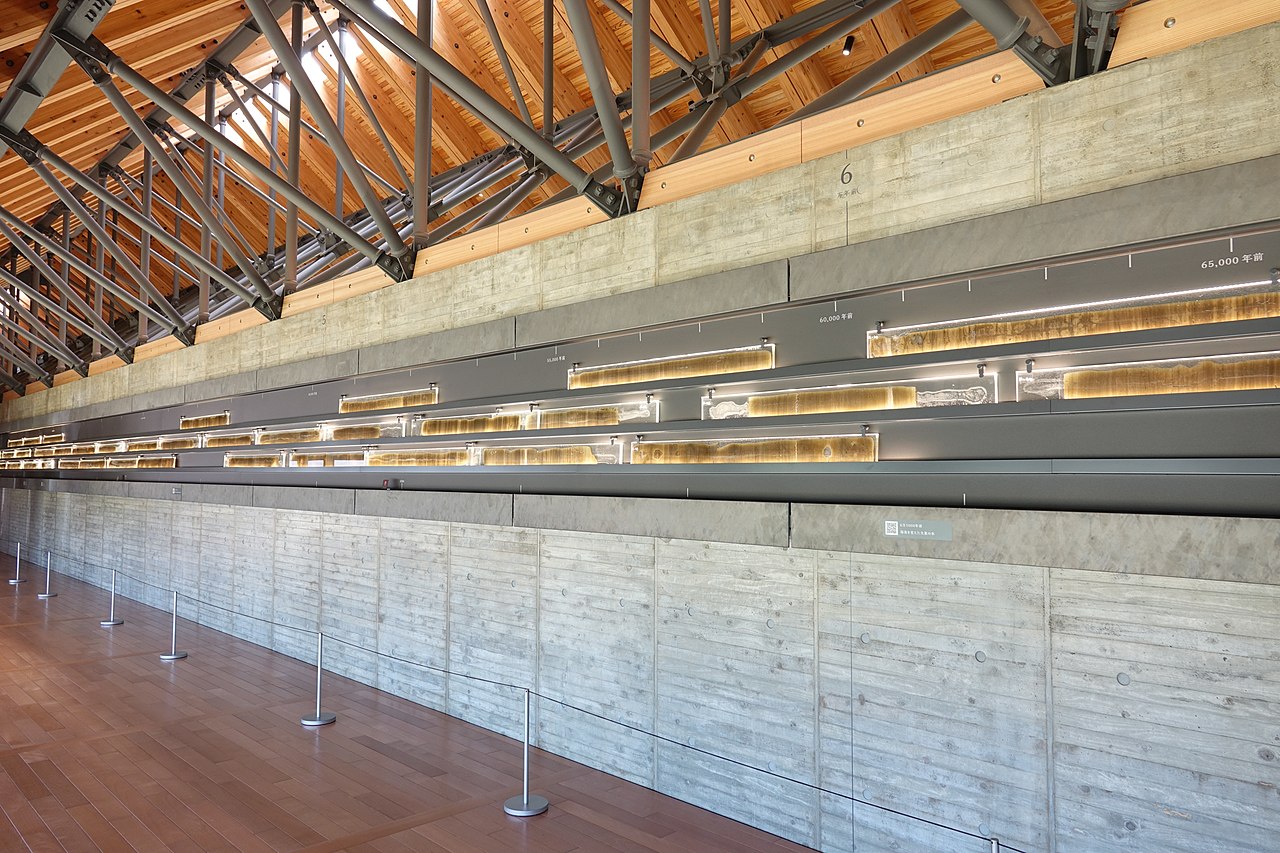

The lake and its preservation conditions
Lake Suigetsu is one of five interconnected lakes (the Mikata Five Lakes) situated behind a coastal sand barrier. The lake is approximately 2 kilometres long, 1 kilometre wide, and up to 34 metres deep. Critically, it is meromictic: its water column is permanently stratified into an oxygenated upper layer and an anoxic (oxygen-depleted) lower layer, separated by a chemocline at approximately 15 metres depth.2, 7 This permanent stratification arises because freshwater from rivers flows over denser, slightly brackish water that enters the lake through a connection to the Sea of Japan. The absence of seasonal overturn means the bottom waters never receive oxygen, and no benthic organisms can survive there to disturb the sediment. This anoxia is the key to the lake's extraordinary preservation: without bioturbation, each annual lamination remains intact and undisturbed for tens of thousands of years.7
The varves in Lake Suigetsu follow a characteristic seasonal pattern. During spring and summer, blooms of diatoms (microscopic siliceous algae) produce a light-coloured, silica-rich lamina. In autumn and winter, as biological productivity declines and fine-grained clay particles settle through the quiescent water column, a dark, clay-rich lamina is deposited.2, 7 Each light-dark couplet represents one year. The varves are typically 0.5 to 2 millimetres thick, though thickness varies with climate and lake conditions, and they are clearly visible under both optical and scanning electron microscopy.9
Coring campaigns and varve counting
The scientific significance of Lake Suigetsu was first recognized in the 1990s by Hiroyuki Kitagawa and Johannes van der Plicht, who recovered sediment cores and produced a preliminary radiocarbon chronology extending to approximately 45,000 years before present.5, 6 Their work demonstrated the potential of the site but was limited by core quality and incomplete varve preservation in some intervals.
A major international coring campaign in 2006, designated SG06 (Suigetsu 2006), recovered four parallel cores from the lake's deepest point using a hydraulic piston corer. The four cores were offset vertically so that gaps or disturbances in one core could be bridged by intact sections from another, producing a composite sedimentary profile with no missing intervals. The SG06 composite profile extends to 73.2 metres depth and encompasses approximately 150,000 years of continuous sedimentation.2, 9
The varves were counted by multiple researchers working independently, using high-resolution digital photographs and thin sections examined under microscopy. Schlolaut and colleagues established a recommended composite profile and varve chronology, documenting each counted varve and identifying event layers (such as flood deposits and volcanic ash layers) that interrupt the regular annual laminations.9, 13 The annually resolved portion of the chronology extends back approximately 52,800 years. Below this depth, the varves become less distinct and the chronology relies increasingly on interpolation and geochemical correlation, though laminated sediment continues to the base of the core.2, 8
Radiocarbon calibration
The Lake Suigetsu record's most important contribution to geochronology is its role in calibrating the radiocarbon timescale. Radiocarbon dating measures the decay of carbon-14, which has a half-life of approximately 5,730 years. However, the production rate of carbon-14 in the atmosphere has not been constant over time, varying with solar activity, geomagnetic field strength, and other factors. As a result, raw radiocarbon ages must be calibrated against an independent chronology to convert them to calendar years.10
For the period from the present to approximately 12,000 years ago, this calibration is provided by dendrochronology — tree-ring chronologies in which each ring is independently dated and can be radiocarbon-measured. Beyond the reach of tree rings, however, the calibration curve historically relied on less precise marine records affected by reservoir effects. Lake Suigetsu changed this situation fundamentally.1, 4
Bronk Ramsey and colleagues measured radiocarbon ages on more than 800 terrestrial plant macrofossils (leaves, twigs, and seeds blown into the lake from the surrounding land) extracted from precisely known positions in the varve-counted SG06 core.1 Because these macrofossils are terrestrial rather than aquatic, they faithfully record the atmospheric radiocarbon concentration at the time they fell into the lake, unaffected by the reservoir effects that complicate marine and lacustrine samples. Each macrofossil's position in the core corresponds to a specific varve year, providing a direct comparison between radiocarbon age and calendar age.1, 3
The resulting dataset produced the first complete terrestrial radiocarbon calibration record extending from 11,200 to 52,800 calendar years before present. It demonstrated that the radiocarbon calibration curve follows a smooth, predictable pattern consistent with known variations in atmospheric carbon-14 production, and it was incorporated into the IntCal20 international radiocarbon calibration standard.1, 4 The agreement between the varve-counted ages and the radiocarbon measurements across 40,000 years provides powerful mutual confirmation: the varve count is validated by the radiocarbon ages (which depend on entirely different physics), and the radiocarbon ages are validated by the varve count (which depends on no physics at all, only the ability to distinguish one year's sediment from the next).1
Cross-validation with other records
The Lake Suigetsu varve chronology does not stand in isolation. It agrees with other independent annual layer records wherever they overlap. The Greenland GICC05 ice-core chronology, which is based on counting annual layers in ice using chemical and isotopic markers, extends to approximately 60,000 years before present.11 In the interval where both records cover the same time period, the two independently counted chronologies agree on the timing and duration of abrupt climate events — including the rapid Dansgaard-Oeschger warming episodes and Heinrich cooling events of the last glacial period — within their stated uncertainties.1, 11
Volcanic tephra (ash) layers identified within the Lake Suigetsu sediments by their geochemical fingerprints provide additional tie points. Several tephra layers from known Japanese volcanic eruptions have been identified in the SG06 core, and their positions match the expected ages based on independent dating of the same eruptions by 40Ar/39Ar and other radiometric methods.13 The micro-XRF geochemical record of the SG06 core further provides continuous, high-resolution data on sediment composition that can be correlated with marine and ice-core records of climate change.8
Significance for deep time
The Lake Suigetsu record is significant precisely because it requires no sophisticated instrumentation to understand conceptually. Each varve is a physical layer of sediment deposited in one year. The layers can be seen, touched, and counted. A person with a microscope and sufficient patience could, in principle, count through the entire sequence and arrive at approximately 52,800 years. This directness makes the varve record resistant to objections about the assumptions underlying radiometric dating, because no radiometric assumptions are involved in counting varves — only the straightforward observation that lakes deposit one pair of seasonal layers per year.12
The Lake Suigetsu varve count of approximately 52,800 continuous annual layers is, by itself, incompatible with any chronological framework that places the origin of the Earth within the last 6,000 to 10,000 years. The varves are not ambiguous structures that might represent something other than annual layers: their seasonal composition (diatom-rich spring/summer layers alternating with clay-rich winter layers) has been confirmed by modern sediment-trap studies that directly observe the same pattern forming in the lake today.7 Furthermore, the record has been reproduced by multiple independent research teams working on different core sections, eliminating the possibility of counting errors or systematic bias by a single group.1, 3, 9
Taken together with the concordant radiocarbon ages, the agreement with the Greenland ice-core chronology, and the identification of independently dated volcanic marker horizons, the Lake Suigetsu record represents one of the most robust and accessible demonstrations that Earth's geological history extends into deep time. It stands as a physical archive in which the passage of tens of thousands of years is written in sediment, one layer at a time.1, 4, 12
Paleoclimate record
Beyond its geochronological significance, the Lake Suigetsu varve record preserves a detailed archive of regional and global climate change over the past 150,000 years. Variations in varve thickness, diatom species composition, and geochemical indicators such as titanium and iron content reflect changes in precipitation, temperature, and wind patterns that can be correlated with climate events recorded in ice cores and marine sediments.2, 8 The record captures the full last glacial cycle, including the Last Glacial Maximum (approximately 26,500 to 19,000 years ago), the rapid climate oscillations of the Younger Dryas (approximately 12,900 to 11,700 years ago), and the onset of the present Holocene interglacial. The annual resolution of the varve record enables the identification of abrupt climate transitions at sub-decadal precision, providing constraints on the speed of past climate shifts that are directly relevant to understanding the potential for rapid climate change in the future.1, 11
The identification of volcanic tephra layers within the sediment provides additional value: these geochemically fingerprinted event layers serve as isochronous markers that can be correlated across widely separated archives, linking the Lake Suigetsu record to marine cores, ice cores, and other terrestrial sequences in a unified chronostratigraphic framework.13 The combination of annual counting, radiocarbon calibration, and tephra correlation makes the Lake Suigetsu record one of the most precisely dated and widely connected paleoclimate archives in the world.
References
Atmospheric radiocarbon calibration to 45,000 yr B.P.: Late Glacial fluctuations and cosmogenic isotope production
Micro-XRF studies of sediment cores from Lake Suigetsu: a new continuous 150 kyr geochemical record
The SG06 Lake Suigetsu varved sediment core: the complete overview and recommended profile
Event stratigraphy of the Lake Suigetsu sediments: the identification and correlation of event layers in a long lacustrine record