Overview
- Varves are seasonally deposited sediment couplets — one light layer and one dark layer per year — preserved in anoxic lake and marine basins, allowing researchers to count annual increments directly back through time without relying on radiometric decay constants.
- The Green River Formation preserves more than six million annually laminated layers from Eocene lakes roughly 50 million years ago, while the Lake Suigetsu varve record spans 60,000+ years and has been cross-calibrated against radiocarbon measurements to anchor the international IntCal20 calibration curve.
- Varve chronologies converge with independent records from ice cores, tree rings, and radiocarbon dating wherever their intervals overlap, and isotopic, pollen, and microfossil evidence within the varves themselves distinguishes true annual couplets from event-deposited turbidites — directly refuting the claim that multiple layers form per year.
A varve is a pair of sedimentary laminae deposited in a single calendar year within a lake or restricted marine basin. The term was coined by the Swedish geologist Gerard De Geer in 1912, who recognized that glacial lake sediments in Scandinavia preserved an annual signal analogous to the growth rings of trees.7 Each couplet consists of a coarser, lighter-coloured layer formed during the productive spring and summer months, when meltwater delivers mineral grains and diatoms bloom near the surface, and a finer, darker layer formed during the quiet winter months, when clay particles and organic detritus settle slowly through a still, ice-covered water column.7, 9 Where the bottom waters of a lake are permanently anoxic — depleted of oxygen and therefore inhospitable to the burrowing organisms that would otherwise churn the sediment — these couplets accumulate undisturbed over thousands or even millions of years, providing a direct, countable record of elapsed time.
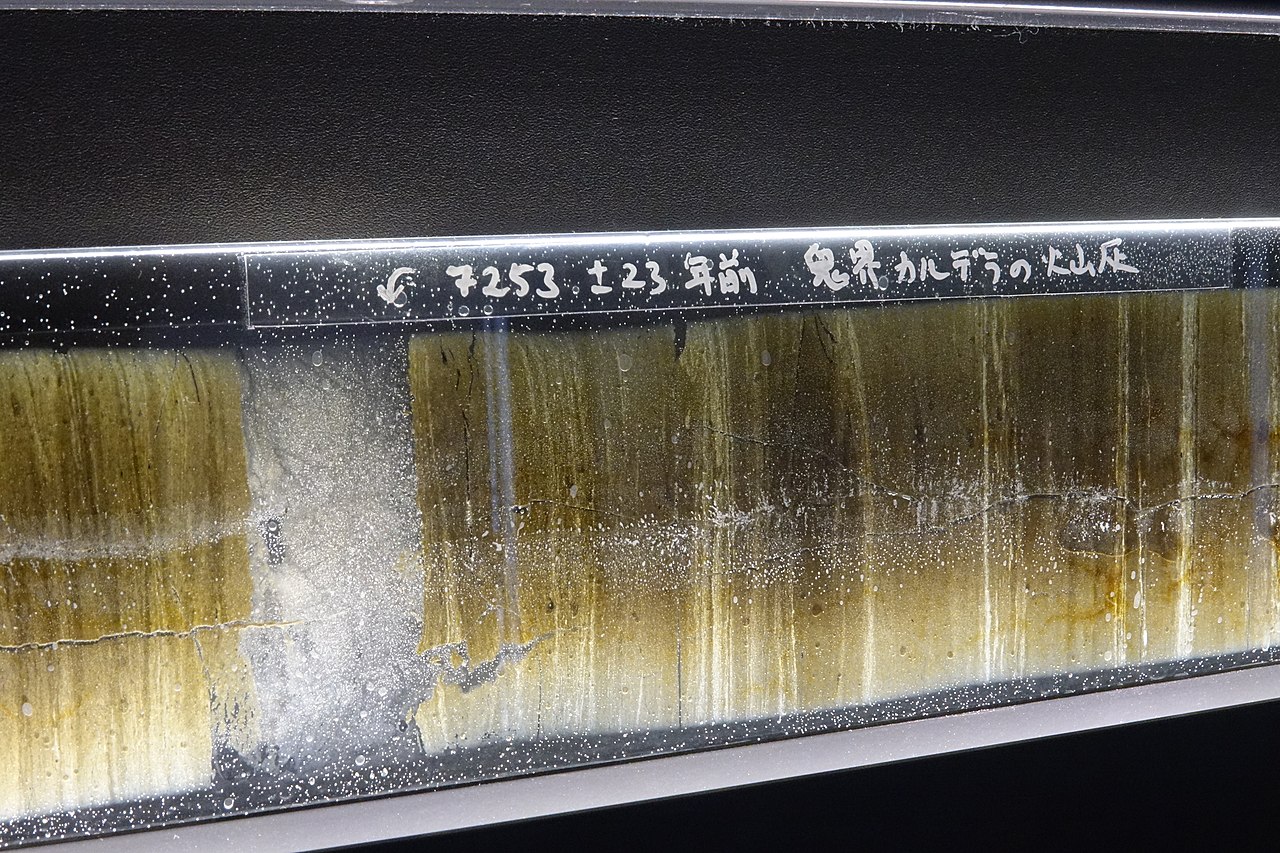

Varve chronology sits within the broader family of annual layer chronology methods, alongside ice cores, tree rings, and coral banding. Its particular value is the great antiquity it can achieve: while tree-ring records reach back roughly 12,000 to 14,000 years and ice-core annual layer counting extends to about 60,000 years before present, some lacustrine varve sequences preserve annually resolved records spanning millions of years.5, 11, 12 The Lake Suigetsu sequence in Japan has become the world’s most important varve record for Quaternary geochronology, while the ancient Green River Formation of the American West demonstrates that the annual lamination process operated faithfully across Eocene time. Together, these and dozens of other varved basins constitute one of the most direct lines of evidence for the antiquity of the Earth.
How varves form
The physical mechanism underlying varve formation is the seasonality of deposition. In high-latitude and alpine glacial lakes fed by snowmelt and glacial outwash, the spring thaw delivers a pulse of coarse silt and fine sand into the lake as meltwater rushes in. This material settles relatively quickly, forming the pale, mineral-rich summer layer.7, 13 As autumn approaches, meltwater input slows, the lake thermally stratifies, and biological productivity declines. The overlying waters then mix during autumnal overturn, carrying organic particles downward, and as ice forms across the lake surface in winter, even the finest clay particles settle in the absence of turbulence, draping a thin, dark lamina over the summer sediment. The result is a couplet: one pale layer and one dark layer, representing twelve months of deposition.9, 10
For varves to be preserved rather than destroyed, the lake bottom must remain anoxic throughout the year. In meromictic lakes — those whose deep waters never mix with oxygenated surface waters — the absence of dissolved oxygen prevents colonization by benthic worms, crustaceans, and other organisms whose burrowing activity (bioturbation) would homogenize the sediment and erase the annual signal.1, 16 Basin morphology reinforces this stability: lakes with steep sides, small surface areas relative to depth, and positions sheltered from wind-driven circulation are most likely to maintain permanent stratification. Marine basins with restricted bottom-water renewal, such as the Santa Barbara Basin off the California coast, produce analogous varved sequences for the same reasons.16
Varves also form in non-glacial settings wherever seasonal productivity cycles are pronounced. In lakes whose laminations are driven by biological rather than clastic input, the summer layer is rich in siliceous diatom frustules or carbonate precipitated from warm, productive surface waters, while the winter layer consists primarily of clay and fine organic matter.9, 18 This biological varve type is common in tropical and temperate lakes distant from glaciers, and it extends the geographic and temporal range of varve records well beyond the glacially dominated high latitudes where De Geer first described the phenomenon.
Lake Suigetsu and the radiocarbon calibration
Lake Suigetsu, a small meromictic lake on the Pacific coast of central Honshu, Japan, occupies a basin approximately 0.4 kilometres in diameter and 34 metres deep. Its permanently stratified, anoxic bottom waters have preserved a continuously laminated sediment sequence stretching more than 73 metres below the lake floor, representing over 150,000 years of annual deposition in its deepest sections, of which the most recent 60,000 years are well-characterized.1 The varves at Suigetsu alternate between light layers dominated by endogenic carbonate and diatom frustules and dark layers rich in clay and organic carbon, producing a visually distinct annual couplet throughout the cores.1, 4
The scientific significance of Suigetsu extends far beyond its impressive duration. Because the sediment preserves terrestrial plant macrofossils — leaf fragments, seeds, and wood delivered to the lake by wind and streams — it is possible to measure radiocarbon on organic material of known varve age. Terrestrial plant material incorporates atmospheric carbon directly, avoiding the reservoir effects that complicate radiocarbon dating of aquatic organisms and marine shells. Multiple research teams counted the Suigetsu varves independently, producing a robust floating chronology; that chronology was then anchored to the absolute calendar timescale using radiocarbon measurements on the macrofossils themselves.2, 4
The resulting dataset — more than 800 radiocarbon ages plotted against their independently counted varve positions — provided the first complete, continuous terrestrial calibration of the radiocarbon timescale from the present back to 52,800 years before present, the effective limit of the radiocarbon method.2 This record is now a primary pillar of the international IntCal20 calibration curve, the standard reference against which all radiocarbon dates are converted to calendar years.3 The practical implication is significant: every archaeologist, palaeoclimatologist, or palaeontologist who uses a radiocarbon date is relying, in part, on the annual layer count at Lake Suigetsu.
The Green River Formation: six million annual layers
The Green River Formation of Wyoming, Colorado, and Utah is one of the most extensively studied ancient lake deposits on Earth. Formed during the Eocene epoch, roughly 48 to 53 million years ago, it records the gradual rise, expansion, and eventual desiccation of a system of large shallow lakes that occupied the intermontane basins of the early Rocky Mountains.5, 6 Throughout much of its thickness, the formation consists of finely laminated oil shale — organic-rich mudstone — in which individual laminae are visible to the naked eye. These laminae have been interpreted as varves since the early twentieth century, and quantitative analyses of their geochemistry, microfossil content, and rhythmic bundling have repeatedly confirmed their annual character.5, 19
The evidence for annual periodicity in the Green River laminae is multistranded. The laminae alternate between organic-rich dark layers and carbonate-rich light layers consistent with the seasonal productivity cycle of a warm, stratified lake.19 Geochemical analysis of individual laminae reveals systematic variation in carbon and oxygen isotope ratios that tracks inferred seasonal temperature changes.19 Crucially, the laminae bundle into thicker cycles of approximately 20,000 and 40,000 laminae, matching the periodicities of orbital precession and obliquity in the Milankovitch cycle framework. Because orbital periods are independently calculated from celestial mechanics, this bundling provides a powerful external confirmation that the laminae are indeed annual: if each lamina represents one year, the bundles should contain roughly 20,000 and 40,000 of them, and they do.6
The total lamina count in the thickest sections of the Green River Formation exceeds six million.5 Even allowing for the possibility that a small fraction of laminae represent event deposits rather than true annual couplets, the sheer number places a firm minimum constraint on the duration of the formation: it cannot have been deposited in any timescale shorter than millions of years. This direct count constitutes some of the most visually compelling physical evidence for deep time available anywhere in the geological record.
Cross-validation with independent chronometers
The credibility of varve chronology rests not only on the internal consistency of any single sequence but on its agreement with completely independent dating methods that share no common assumptions. In the Quaternary interval covered by the Lake Suigetsu record, the convergence of varve counts, radiocarbon measurements, ice-core annual layer counts, and tree-ring chronologies is particularly well-documented.2, 3
The NGRIP Greenland ice core provides an independently counted annual layer record extending to approximately 60,000 years before present, closely matching the reach of the Suigetsu varve sequence.11 The two records — one counting winter-summer contrasts in glacial ice deposited in Greenland, the other counting seasonal sediment couplets in a Japanese lake — were produced by entirely different physical processes on opposite sides of the Northern Hemisphere. Yet where they overlap in age, they assign concordant calendar years to the same abrupt climate events visible in both archives, such as the rapid transitions between Greenland Stadials and Interstadials.2, 11 Agreement of this precision between uncorrelated archives provides strong evidence that both records are faithfully counting real years.
The overlap between the Suigetsu varve record and the European dendrochronological record is equally instructive. Tree-ring chronologies built from German oak and pine sequences extend continuously back to approximately 12,460 years before present.12 In the interval from roughly 10,000 to 12,500 years before present, both records have been used to measure radiocarbon on material of known age, and both produce the same radiocarbon calibration curve within measurement uncertainties.3 The probability that annual layer counts in lake sediment and tree rings, each subject to different error modes, would accidentally agree on the same calibration relationship by chance is negligible. The agreement instead confirms that both methods are accurately tracking calendar years.
Scandinavian varve chronologies, built from De Geer’s original observations and extended over a century of subsequent work, provide an additional independent check.13, 14 The Swedish Time Scale, based on varve counts in glacial lake sediments deposited as the Fennoscandian ice sheet retreated northward after the Last Glacial Maximum, has been correlated across hundreds of lake sites and independently dated by radiocarbon measurements on organic material within the varved sequences. The resulting deglaciation chronology aligns closely with ice-core and cosmogenic nuclide evidence for the timing of ice-sheet retreat, confirming that the counted varve years map onto real calendar time.14
Distinguishing varves from turbidites
The most persistent objection to varve chronology — associated principally with young-Earth creationist literature — is the claim that individual laminae need not represent annual deposits and that catastrophic flood events could produce multiple laminae per year, rendering the layer counts meaningless as chronometers. This objection conflates two sedimentological phenomena that geologists have distinguished rigorously since the mid-twentieth century: true varves and turbidites.8, 17
A turbidite is a graded deposit formed when a density current — a turbid mixture of sediment and water heavier than the surrounding lake water — cascades down a slope and settles rapidly.17 Turbidites can indeed form within hours of a triggering event such as an earthquake, a delta collapse, or a storm. They differ from varves in several diagnostically important ways. Turbidites typically display graded bedding, with coarser grains at the base and progressively finer grains upward within a single event layer; varve couplets, by contrast, show a seasonal transition between two compositionally and texturally distinct laminae without internal grading.8, 17 Turbidites are laterally discontinuous, thinning and pinching out within the basin; true varves can be traced laterally across an entire lake floor with consistent thickness.8 Turbidites are randomly distributed through time and do not show the systematic seasonal geochemical signal of varves.
Multiple independent lines of evidence within varved sequences confirm their annual character and rule out turbidite contamination. Pollen analysis at multiple levels within Swedish varved clay reveals an orderly succession of pollen types that tracks the well-established postglacial vegetation history of northern Europe, with each successional stage occupying the expected number of varve years.15 If multiple laminae formed per year, the pollen record would be compressed — entire vegetation eras would appear in only a few laminae — but no such compression is observed. Stable oxygen isotope measurements on successive laminae in Swedish and Finnish varve sequences show clear seasonal cyclicity consistent with summer-winter temperature contrasts, with each couplet recording one complete seasonal swing.10 Diatom assemblage analysis within individual Suigetsu varves reveals a systematic seasonal succession of species, with cold-water winter species in the dark laminae and warm-water summer assemblages in the light laminae — a pattern that would be obliterated if laminae were produced by rapid non-seasonal events.9
Professional sedimentological practice applies these criteria routinely, and the distinction between varves and turbidites is not a matter of interpretation but of measurable physical and chemical properties. The claim that all laminae could represent flood events fails additionally on stratigraphic grounds: a global or regional flood capable of depositing millions of laminae would require not one but millions of distinct events, each depositing exactly one lamina, in exactly the same basin, in an uninterrupted sequence with no erosional unconformities — a scenario that has no mechanism and no analogue in observed sedimentary processes.8, 17
Significance for Earth chronology
Varves hold a distinctive position within the broader edifice of geochronology because they provide a measure of time that is both direct and visually intuitive. Unlike radiometric dating, which infers age from the statistical behaviour of radioactive decay and requires knowledge of decay constants and initial isotope ratios, varve counting demands only that researchers identify and tally seasonal laminae — a process that any careful observer can evaluate independently.7 The counts are reproducible: multiple research teams working independently on the same cores from Lake Suigetsu produced varve chronologies that agree within the expected counting uncertainties, confirming that the layer identification is objective rather than subjective.4
The broader significance of varve chronology for establishing Earth’s age operates on two levels. At the level of the Quaternary, varve records at Lake Suigetsu and in Scandinavia demonstrate beyond reasonable doubt that tens of thousands of years elapsed during the period of lake sedimentation, directly contradicting any chronology that places the entire geological past within a few thousand years.1, 13 At the level of deep time, the Green River Formation presents a visual argument: more than six million individually visible annual layers, stacked in undisturbed sequence, each recording a single year’s worth of biological and chemical change in a Eocene lake.5, 6 No mechanism consistent with physics or chemistry can produce six million annually periodic, orbitally bundled laminae in less than six million years.
When varve chronologies are placed alongside ice-core records, the geological time scale, radiocarbon calibration, and radiometric ages from uranium-thorium and potassium-argon systems, the result is a web of mutually reinforcing constraints, each built from independent physical principles, all converging on the same deep chronology.2, 3, 11 The coherence of this convergence is not a property that could be manufactured by systematic error: ice cores accumulate by snowfall, varves by seasonal sedimentation, tree rings by biological growth, and uranium decays by quantum-mechanical processes. That all of these independent clocks read the same time is the strongest possible evidence that the time they record is real.20
References
- Schlolaut, G. et al. “The varved record of Lake Suigetsu, Japan, spanning the past 150,000 years.” Quaternary Science Reviews 36: 164–176, 2012. doi:10.1016/j.quascirev.2010.12.019
- Bronk Ramsey, C. et al. “A complete terrestrial radiocarbon record for 11.2 to 52.8 kyr B.P.” Science 338: 370–374, 2012. doi:10.1126/science.1226660
- Reimer, P. J. et al. “IntCal20 Northern Hemisphere radiocarbon age calibration curve (0–55 cal kBP).” Radiocarbon 62: 725–757, 2020. doi:10.1017/RDC.2020.41
- Marshall, M. H. et al. “An annually resolved chronology for the Lake Suigetsu sediments.” Nuclear Instruments and Methods in Physics Research B 294: 240–245, 2013. doi:10.1016/j.nimb.2012.01.016
- Pietras, J. T. & Carroll, A. R. “Eocene Green River Formation varves: a record of ancient lake-level oscillation.” Geology 34: 361–364, 2006. doi:10.1130/G22108.1
- Machlus, M. L. et al. “Orbital forcing of the Green River Formation since the early Eocene.” Earth and Planetary Science Letters 197: 51–69, 2002. doi:10.1016/S0012-821X(02)00451-X
- De Geer, G. “Varves, their nature and uses.” Geografiska Annaler 14: 123–148, 1912. doi:10.1080/20014422.1912.11880537
- Francus, P. et al. “Distinguishing varves from turbidites: sedimentological and geochemical criteria in Holocene lake sediments of New England.” Quaternary Science Reviews 27: 2191–2208, 2008. doi:10.1016/j.quascirev.2008.08.008
- Ojala, A. E. K. & Francus, P. “Seasonal diatom succession in a Swedish varved lake: implications for varve interpretation.” Journal of Paleolimnology 28: 99–113, 2002. doi:10.1023/A:1020326318443
- Jonsson, C. E. et al. “Oxygen-isotope seasonality recorded in Holocene lake varves, Sweden.” Quaternary Science Reviews 28: 1629–1638, 2009. doi:10.1016/j.quascirev.2009.01.025
- Svensson, A. et al. “Annual layer counting in the NGRIP ice core back to 60,000 yr b2k.” Climate of the Past 4: 47–57, 2008. doi:10.5194/cp-4-47-2008
- Friedrich, M. et al. “Constructing long tree-ring chronologies: establishing 12,460 years of dendrochronological data in central Europe.” The Holocene 14: 551–556, 2004. doi:10.1191/0959683604hl732rp
- Linden, M. et al. “Scandinavian varve chronology and the deglaciation of Fennoscandia.” Boreas 35: 610–625, 2006. doi:10.1080/03009480600942622
- Stroeven, A. P. et al. “Swedish Time Scale — varve-based deglaciation chronology for Scandinavia.” Quaternary Science Reviews 175: 3–107, 2016. doi:10.1016/j.quascirev.2021.107075
- Berglund, B. E. “Pollen analysis of Swedish varved clay and its significance for late-glacial chronology.” Boreas 8: 1–37, 1979. doi:10.1111/j.1502-3885.1979.tb00373.x
- Hagadorn, J. W. et al. “Marine varved sediments from the Santa Barbara Basin: verification of an annually resolved record.” Paleoceanography 10: 605–622, 1995. doi:10.1029/95PA01158
- Mulder, T. & Alexander, J. “Turbidites vs. varves: a conceptual framework for lacustrine event stratigraphy.” Sedimentology 48: 269–299, 2001. doi:10.1046/j.1365-3091.2001.00359.x
- Fritz, S. C. et al. “Millennial-scale variability during the last glacial period in the tropical Andes.” Quaternary Science Reviews 29: 2861–2878, 2010. doi:10.1016/j.quascirev.2010.06.028
- Boyer, B. W. “Geochemical evidence for annual resolution in Green River Formation oil shale.” Geological Society of America Bulletin 94: 1271–1280, 1982. doi:10.1130/0016-7606(1982)94<1271>
- PAGES 2k Consortium. “Climate of the Past 2000 Years: the SV2k database.” Scientific Data 4: 170088, 2017. doi:10.1038/sdata.2017.88
References
Distinguishing varves from turbidites: sedimentological and geochemical criteria in Holocene lake sediments of New England
Seasonal diatom succession in a Swedish varved lake: implications for varve interpretation
Constructing long tree-ring chronologies: establishing 12,460 years of dendrochronological data in central Europe
Pollen analysis of Swedish varved clay and its significance for late-glacial chronology
Marine varved sediments from the Santa Barbara Basin: verification of an annually resolved record