Overview
- Hypervelocity impacts by asteroids and comets have shaped Earth's geology, biology, and surface chemistry across all of geological time, producing diagnostic features including shatter cones, planar deformation features in quartz, and anomalous concentrations of siderophile elements such as iridium that allow ancient impact structures to be identified even after billions of years of erosion.
- The five largest confirmed impact structures on Earth — Vredefort (~2.02 Ga), Sudbury (~1.85 Ga), Chicxulub (~66 Ma), Manicouagan (~215 Ma), and Popigai (~35.7 Ma) — range from economically important ore deposits to the only well-established direct trigger of a mass extinction in the geological record.
- Modern events such as the 1908 Tunguska airburst and the 2013 Chelyabinsk bolide demonstrate that the impact hazard is ongoing, and NASA's DART mission in 2022 proved for the first time that a spacecraft can measurably alter the orbit of a near-Earth asteroid.
Asteroid and comet impacts have been a defining force in the geological and biological evolution of Earth from the planet's earliest days to the present. During planetary accretion, collisions between planetesimals were the very mechanism by which the Earth grew, and the single largest impact in Earth's history — the giant impact that formed the Moon — reset the thermal and chemical state of the proto-Earth entirely.18 Long after accretion slowed, bolides of varying sizes continued to strike the surface, excavating craters now preserved as some of the most geologically distinctive structures on the planet, delivering economically important metal concentrations, and, in at least one documented case, triggering a mass extinction that fundamentally restructured the biosphere.9, 23
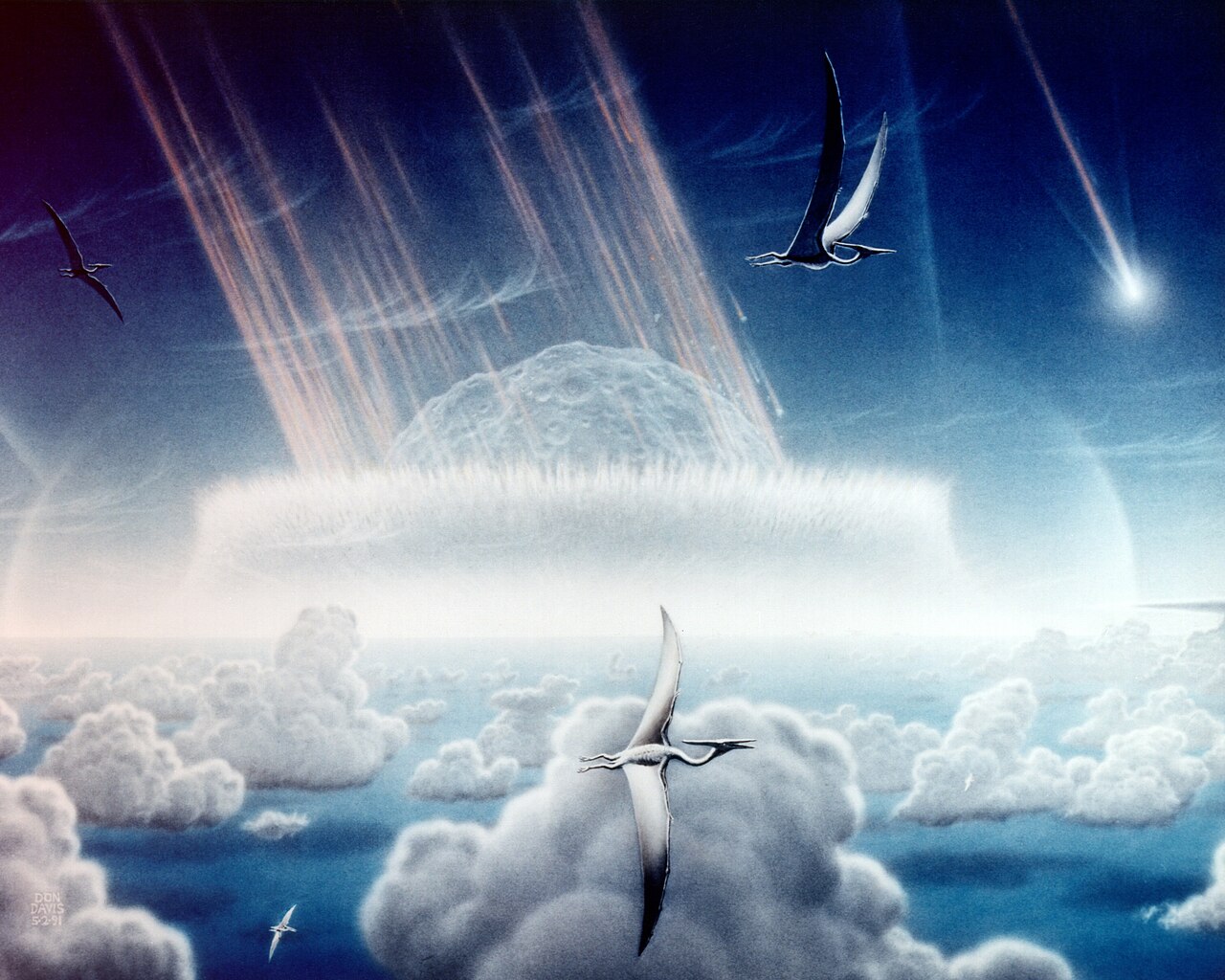

The study of impact cratering draws on petrology, geochemistry, remote sensing, planetary science, and stratigraphy. Each discipline contributes independent lines of evidence that together establish both the reality of individual impact events and their broader significance for Earth history. Modern planetary defense programmes, spacecraft missions, and real-time observations of bolides entering the atmosphere have transformed what was once a largely retrospective discipline into one with direct implications for contemporary risk assessment and mitigation.17
Impact mechanics and cratering physics
When an asteroid or comet strikes a planetary surface at typical solar system encounter velocities — ranging from roughly 11 kilometres per second at the low end to over 70 kilometres per second for long-period comets — the kinetic energy is vastly greater than any explosive force achievable by chemical means.19 The impacting body decelerates within milliseconds of contact, generating a shock wave that propagates into both the target rocks and back through the projectile itself. Pressures in the contact and compression stage routinely exceed one million atmospheres (100 gigapascals), temperatures reach tens of thousands of degrees, and both the projectile and a substantial volume of the nearest target material are vaporised almost instantaneously. The projectile itself is essentially destroyed in this process, leaving behind only minute chemical traces.22
As the shock wave expands into the target, it excavates a transient cavity many times the diameter of the impactor. For a stony asteroid impacting at 20 kilometres per second, the transient crater diameter is typically ten to twenty times the projectile diameter. The excavation flow ejects material upward and outward, depositing an ejecta blanket around the crater whose thickness decreases with distance and whose composition samples progressively deeper target lithologies with increasing proximity to the rim.19
Crater morphology changes systematically with increasing diameter in a manner controlled by target rock strength and gravitational collapse of the transient cavity. Simple craters, which form at relatively small sizes — generally below about 2 kilometres on Earth — are bowl-shaped depressions with a raised rim and a breccia lens at the base, geometrically similar to the transient cavity. Complex craters, which dominate at diameters above roughly 4 kilometres on Earth (the precise threshold varies with target properties and gravity), undergo gravitational modification: the steep walls slump inward, the floor rebounds upward to form a central peak or peak ring, and the final structure is substantially shallower relative to its diameter than the transient cavity. At the largest scales, multi-ring basins develop, characterised by multiple concentric ridges and basin rings produced by the collapse of extremely large transient cavities; these are well-documented on the Moon, Mercury, and other bodies but are represented on Earth only by structures so ancient and eroded that their original multi-ring geometries must be largely inferred.19
Shock metamorphism and diagnostic signatures
The pressures and temperatures generated by hypervelocity impact produce a suite of mineralogical and textural changes collectively termed shock metamorphism, which have no analogue in endogenic geological processes such as volcanism, regional metamorphism, or tectonic deformation. These shock indicators are the primary tools by which geologists confirm the impact origin of suspected structures, particularly when the original crater morphology has been obliterated by billions of years of erosion and tectonism.22
Shatter cones are striated, conical fracture surfaces that form in fine-grained rocks subjected to shock pressures between roughly 2 and 30 gigapascals. Their apices point toward the impact point, and their distinctive horsetail-like striation patterns — produced by interference between the shock wave and heterogeneities in the target rock — are not reproducible by any known tectonic or volcanic process. Shatter cones are macroscopic features, often tens of centimetres in length, and their presence alone is widely accepted as unambiguous evidence of impact.3
Planar deformation features (PDFs) are microscopic sets of parallel amorphous lamellae within quartz grains, formed at shock pressures above approximately 5 to 10 gigapascals. PDFs occur along specific crystallographic planes characteristic of impact shock and are distinct from the planar fractures produced by tectonic processes. Their identification by optical or transmission electron microscopy in separated quartz grains provides strong microstructural evidence for impact.4
At still higher pressures, silica transforms into its high-pressure polymorphs. Coesite, which requires pressures above approximately 2 gigapascals and was first synthesised in the laboratory in 1953, was discovered in natural rocks at the Barringer (Meteor) Crater in Arizona in 1960, providing the first mineralogical proof of hypervelocity impact on Earth.5 Stishovite, stable above approximately 10 gigapascals, is an even more extreme indicator of impact; its rutile-type crystal structure, with silicon in six-fold oxygen coordination, is completely alien to any magmatic or metamorphic silica. Both phases are metastably preserved in impact glasses and shocked quartz grains at impact structures worldwide.4, 22
The geochemical hallmark of impact at the stratigraphic scale is an iridium anomaly. Iridium is a platinum-group siderophile element that, because of its affinity for iron, largely partitioned into Earth's core during planetary differentiation, leaving the crust depleted in iridium by roughly five orders of magnitude relative to chondritic meteorites. An impacting asteroid or comet carries near-chondritic iridium abundances; its vaporisation at impact and subsequent global dispersal as fine aerosol deposits a thin iridium-enriched layer in contemporaneous sediments worldwide. The discovery by Alvarez and colleagues in 1980 of precisely such a global iridium anomaly at the Cretaceous–Paleogene boundary was the original evidence for a major impact at the end of the Cretaceous, subsequently confirmed by the discovery of the Chicxulub structure.6
Major impact structures on Earth
The Earth Impact Database currently lists over 190 confirmed impact structures on Earth, with the number continuing to grow as geophysical surveys and remote sensing improve.23 The geological record is strongly biased toward younger and continental structures because oceanic crust is subducted on timescales of hundreds of millions of years, erasing the ocean-floor record entirely, and because ancient continental structures have been subjected to extensive erosion and tectonic overprinting. Of the surviving record, five structures stand out for their exceptional size or significance.
The Vredefort structure of South Africa, with an estimated original diameter of approximately 250 to 300 kilometres, is the largest confirmed impact structure on Earth.7 Radiometric dating of pseudotachylitic breccia and impact melt rocks using uranium-lead methods on zircon yields an age of approximately 2.023 ± 0.004 billion years, placing the event in the Paleoproterozoic.7 The Vredefort Dome, which forms the exposed core of the structure, preserves a spectacular record of shock metamorphism including shatter cones, PDFs in quartz, coesite, and stishovite, as well as the deeply eroded roots of what was once the central uplift of a complex crater. The structure has been designated a UNESCO World Heritage Site.
The Sudbury structure of Ontario, Canada, originally approximately 200 to 250 kilometres in diameter and dated at approximately 1.849 ± 0.003 Ga, is renowned for having produced one of the world's great ore deposits.8 The impact melted a large volume of the target crust, generating a differentiated impact melt sheet, the Sudbury Igneous Complex, within which fractional crystallisation concentrated nickel, copper, and platinum-group elements in economically exploitable sulfide horizons at the base of the igneous body. The Sudbury mines have produced more nickel than any other district on Earth, an irony that makes an ancient catastrophe one of the foundations of modern industrial civilisation.
The Manicouagan structure of Quebec, Canada, approximately 100 kilometres in diameter, was formed at approximately 214 ± 1 Ma during the Late Triassic and is one of the best-preserved large impact structures on Earth.10 The circular reservoir that now occupies the structure's annular trough is visible from orbit and has made Manicouagan one of the most photographed impact structures in the world. The impact melt sheet is extensively exposed at the surface, and the structure has been intensively studied as a type locality for complex crater formation in crystalline shield rocks.
The Popigai structure of Siberia, Russia, approximately 100 kilometres in diameter and dated at 35.7 ± 0.2 Ma, formed near the Eocene–Oligocene boundary.11 The impactor struck graphite-bearing Archean gneisses, and the instantaneous shock transformation of graphite to diamond produced what may be the world's largest diamond deposit — not gem-quality stones but industrial-grade impact diamonds (lonsdaleite and cubic diamond polycrystalline aggregates) distributed throughout the impact melt and suevite. Soviet-era geological surveys estimated the diamond content in the hundreds of billions of carats, though the irregular distribution makes economic extraction problematic.
The Chicxulub structure of the Yucatan Peninsula, Mexico, approximately 180 to 200 kilometres in diameter, was formed at 66.052 ± 0.031 Ma, coincident with the Cretaceous–Paleogene (K–Pg) boundary and the end-Cretaceous mass extinction.9 Chicxulub is unique among Earth's impact structures in having been causally linked to a global extinction event, making it the most consequential impact in the last several hundred million years of Earth history. Its geological record, environmental effects, and biological consequences are treated separately in the articles on the Chicxulub impact and the end-Cretaceous extinction.
The Late Heavy Bombardment hypothesis
The Moon's surface is saturated with craters, and radiometric dating of impact melt rocks collected during the Apollo missions revealed a striking clustering of ages: a large number of lunar basin-forming events appeared to date to a narrow interval between approximately 3.85 and 4.1 billion years ago, several hundred million years after the formation of the Solar System.12 This observation gave rise to the hypothesis of a Late Heavy Bombardment (LHB) — also called the lunar cataclysm — a proposed spike in impact flux affecting the entire inner Solar System during the Hadean eon of Earth history.
The most influential dynamical explanation for such a cataclysm is the Nice model, in which a gravitational resonance crossing between Jupiter and Saturn destabilised the orbits of Uranus and Neptune, scattering vast numbers of outer Solar System objects onto inner-planet-crossing trajectories. Gomes and colleagues demonstrated in 2005 that such a planetary orbital instability could produce an impact pulse of the correct timing and approximate magnitude to account for the lunar cratering record, if the instability occurred several hundred million years after planetary accretion.12
The LHB hypothesis has been substantially revised and remains debated. Re-examination of the Apollo sample ages reveals that the apparent clustering may partly reflect sampling bias: most Apollo landing sites were close to or within the Imbrium and Nectaris basins, and their impact melt rocks dominate the sample collection. Zellner and others have argued that the Apollo sample ages therefore record the tail end of a steadily declining bombardment flux rather than a discrete cataclysm, with the concentration of ages near 3.9 Ga reflecting reset of older samples by these large, nearby events.13 The question of whether the late Hadean Earth experienced a cataclysmic bombardment spike or a more gradual decline in impact rate remains unresolved, though current opinion increasingly favours a monotonically declining flux with no sharp cataclysm.13 Either way, the bombarding flux during the first five hundred million years of Earth history was orders of magnitude higher than at present and would have profoundly influenced early surface environments and the origin of life.1
Impacts and mass extinctions
The hypothesis that bolide impacts can cause mass extinctions entered mainstream science with the publication by Alvarez and colleagues in 1980 of the global iridium anomaly at the K–Pg boundary.6 The subsequent discovery of Chicxulub, coincident in age with the boundary to within the precision of geochronological methods, and the documentation of shocked quartz, spherules, and impact ejecta in K–Pg boundary sections worldwide, established beyond reasonable doubt that a large impact occurred at the moment of extinction. Detailed environmental modelling indicates that the consequences of the Chicxulub impact — ejecta thermal pulse, sulfate aerosol injection from the vaporisation of anhydrite-bearing target rocks, soot from global wildfires, and prolonged impact winter reducing photosynthesis — were sufficient to drive the extinctions independently of coincident Deccan Traps volcanism.9, 20
Despite the success of the impact hypothesis at the K–Pg boundary, efforts to generalise it to other mass extinctions have not produced comparably strong evidence. The end-Permian, end-Triassic, and end-Ordovician extinctions — the other major Phanerozoic events — lack credible impact signatures at the level of the K–Pg boundary, and the current consensus is that Chicxulub is the only well-established impact-driven extinction in Earth history.23
The Popigai impact, occurring at approximately 35.7 Ma, is contemporaneous within uncertainty with the Eocene–Oligocene transition, which was accompanied by global cooling, Antarctic glaciation, and significant marine faunal turnover. Farley and colleagues reported an anomalous flux of extraterrestrial helium-3 in Eocene–Oligocene boundary sediments, suggesting an elevated impact flux during this interval that might contribute to the cooling.21 However, the Eocene–Oligocene transition is widely attributed primarily to the opening of the Drake Passage and associated oceanographic reorganisation, and the causal role of impact in the climatic changes of this boundary remains uncertain rather than established.21
Crater counting and planetary chronology
On planetary surfaces where the cratering history can be calibrated against radiometric ages — primarily the Moon, where Apollo and Luna missions returned datable samples from multiple terrains — the density of craters per unit area serves as a chronometer: older surfaces accumulate more craters, younger surfaces fewer.14 This technique, known as crater size-frequency distribution analysis or crater counting, is the primary method by which surface ages are estimated on planetary bodies where no samples have been collected, including Mars, Mercury, and the asteroids.
The lunar crater production function, derived from the spatial density and size distribution of craters on radiometrically dated terrain, has been refined through decades of orbital remote sensing and sample analysis. Applying this function to other solid Solar System bodies requires assumptions about how the impactor flux scaled across the inner Solar System and whether the bombardment history differed significantly between, for example, the Moon and Mars. These assumptions introduce uncertainties of hundreds of millions of years for ancient surfaces, but crater counting nonetheless provides the only chronological framework available for most of the Solar System's rocky bodies and is indispensable for reconstructing planetary evolutionary histories.14
On Earth, the erosion, sedimentation, and tectonic recycling that make the terrestrial record scientifically interesting also progressively destroy craters. The average preservation timescale for impact structures of moderate size on continents has been estimated at approximately a billion years for hard crystalline shield terrain, far less in sedimentary basins subject to rapid burial and uplift. The total number of impact events that have struck Earth over its history is consequently far greater than the roughly 190 confirmed structures; extrapolation from the lunar record and delivery rate estimates suggests Earth has been struck by impactors capable of making craters larger than 20 kilometres in diameter at least several thousand times since its formation.23
Modern reminders: Tunguska and Chelyabinsk
The theoretical and ancient geological record of impacts acquires a visceral character from two twentieth- and twenty-first-century events that demonstrated the ongoing reality of the bolide hazard.
On the morning of 30 June 1908, a bolide entered the atmosphere over the remote Podkamennaya Tunguska River region of central Siberia and exploded at an altitude estimated at 5 to 10 kilometres, releasing energy equivalent to approximately 10 to 15 megatons of TNT. The airburst flattened roughly 2,000 square kilometres of boreal forest, with trees knocked down radially from the point above which the explosion occurred. The absence of a crater, combined with the radial blowdown pattern and the lack of significant meteoritic fragments at the site, is consistent with the atmospheric disruption of a stony body estimated at 50 to 80 metres in diameter before it could reach the ground intact.15 Because the object exploded in the atmosphere rather than forming a crater, recognition that it was an extraterrestrial impactor took decades; the event was not seriously studied until 1927 when Leonid Kulik led the first scientific expedition to the site.
On 15 February 2013, a smaller body estimated at approximately 17 to 20 metres in diameter entered the atmosphere over the Chelyabinsk Oblast of Russia at a shallow angle and released approximately 500 kilotons of energy in an airburst at around 30 kilometres altitude. The resulting blast wave shattered windows across a wide area and injured approximately 1,500 people, mostly from broken glass. The Chelyabinsk event was recorded by hundreds of dashboard cameras and surveillance systems, providing an unprecedented scientific dataset for characterising the fragmentation, entry dynamics, and energy deposition of a natural bolide in the lower atmosphere.16 The object had approached from the direction of the Sun and was not detected before impact, highlighting a key limitation of current sky survey programmes: small, fast-moving objects on sun-approach trajectories may provide little to no warning time.
Planetary defense and the DART mission
The recognition that the impact hazard is both real and, unlike earthquakes or volcanic eruptions, physically preventable has motivated the development of organised planetary defense programmes. NASA's Center for Near Earth Object Studies (CNEOS) catalogues near-Earth objects (NEOs) and routinely calculates impact probabilities for known asteroids. As of 2024, no known asteroid poses a significant probability of impact within the next century for objects large enough to cause regional or global damage, though the catalogue of smaller objects remains incomplete.17
The most practically significant development in planetary defense was the Double Asteroid Redirection Test (DART) mission, which in September 2022 deliberately crashed a spacecraft into Dimorphos, the moon of the near-Earth asteroid Didymos, to test the kinetic impactor deflection concept. Observations by ground-based telescopes measured the orbital period of Dimorphos around Didymos before and after impact. Thomas and colleagues reported in 2023 that DART shortened the orbital period of Dimorphos by approximately 33 minutes, far exceeding the minimum success criterion of 73 seconds and demonstrating that the momentum transfer from a kinetic impactor is substantially amplified by the ejecta recoil.17 This result confirmed for the first time with a real asteroid that the kinetic impactor technique is a viable method for deflecting a potential Earth impactor, provided sufficient lead time — ideally decades — is available to execute the mission.
The history of impacts on Earth is thus simultaneously a record of catastrophes and a scientific foundation for protecting against future ones. From the Vredefort event that shook a young Earth to the Chicxulub impact that closed the Mesozoic, and from the Tunguska airburst to the DART demonstration over Dimorphos, the story of cosmic collisions encompasses deep time, extinction, economic geology, and the emerging discipline of planetary protection — a reminder that Earth does not exist in isolation but as a target embedded in a Solar System still populated by millions of potentially hazardous objects.
References
- Sleep, N. H. & Zahnle, K. · "Impacts and the early evolution of life" · Journal of Geophysical Research: Planets 103: 28529–28544, 1998. doi:10.1029/98JE01307
- Schultz, P. H. & Gault, D. E. · "Oblique impacts are surprisingly common" · Nature 349: 508–510, 1991. doi:10.1038/349508a0
- Osinski, G. R. & Ferriere, L. · "Shatter cones: (Imperfect) Recorders of cosmic collisions" · Science Advances 2: e1600616, 2016. doi:10.1126/sciadv.1600616
- Stöffler, D. & Langenhorst, F. · "Planar deformation features in quartz as indicators of large meteorite impacts" · Meteoritics 29: 155–181, 1994. doi:10.1111/j.1945-5100.1994.tb00656.x
- Coes, L. · "Coesite, a dense polymorph of silicon dioxide" · Science 118: 131–132, 1953. doi:10.1126/science.118.3057.131
- Alvarez, L. W., Alvarez, W., Asaro, F. & Michel, H. V. · "Extraterrestrial cause for the Cretaceous–Paleogene extinction" · Science 208: 1095–1108, 1980. doi:10.1126/science.208.4448.1095
- Gibson, R. L. & Reimold, W. U. · "The Vredefort impact structure: a review with discussion on the analytical methods used to establish its origin" · South African Journal of Geology 111: 1–51, 2008. doi:10.2113/gssajg.111.1.1
- Grieve, R. A. F., Stöffler, D. & Deutsch, A. · "The Sudbury structure: a review" · Journal of Geophysical Research: Planets 96: 22753–22764, 1991. doi:10.1029/91JE02547
- Schulte, P. et al. · "The Chicxulub asteroid impact and mass extinction at the Cretaceous–Paleogene boundary" · Science 327: 1214–1218, 2010. doi:10.1126/science.1177265
- Hodych, J. P. & Dunning, G. R. · "Manicouagan impact melt rock: a mid-Triassic age" · Geology 20: 705–708, 1992. doi:10.1130/0091-7613(1992)020
- Masaitis, V. L. · "Popigai impact structure and its diamond-bearing rocks" · Meteoritics & Planetary Science 33: 349–359, 1998. doi:10.1111/j.1945-5100.1998.tb01641.x
- Gomes, R., Levison, H. F., Tsiganis, K. & Morbidelli, A. · "Origin of the cataclysmic Late Heavy Bombardment period of the terrestrial planets" · Nature 435: 466–469, 2005. doi:10.1038/nature03676
- Zellner, N. E. B. · "Rethinking the Late Heavy Bombardment" · Geosciences 7: 77, 2017. doi:10.3390/geosciences7030077
- Neumann, G. A. et al. · "Crater counting and the lunar chronology" · Journal of Geophysical Research: Planets 118: 1804–1821, 2013. doi:10.1002/jgre.20118
- Longo, G., Serra, R., Cecchini, S. & Gallà, M. · "The Tunguska event: new views on the historic explosion from Sibiria" · Planetary and Space Science 42: 163–177, 1994. doi:10.1016/0032-0633(94)90163-5
- Popova, O. P. et al. · "Chelyabinsk airburst, damage assessment, meteorite recovery, and characterization" · Science 342: 1069–1073, 2013. doi:10.1126/science.1242642
- Thomas, C. A. et al. · "Successful kinetic impactor demonstration for planetary defense using DART" · Nature 616: 448–452, 2023. doi:10.1038/s41586-023-05805-2
- Canup, R. M. · "Collisions: The origin of the Moon and the evolution of the solar system" · Annual Review of Astronomy and Astrophysics 42: 441–475, 2004. doi:10.1146/annurev.astro.41.082201.113457
- Grieve, R. A. F. & Pilkington, M. · "Impact structures: what does crater form tell us about the impacting body?" · AGSO Journal of Australian Geology and Geophysics 16: 1–18, 1996. doi:10.4095/207483
- Vellekoop, J. et al. · "Global effects of the Chicxulub impact and the K/Pg boundary" · Proceedings of the National Academy of Sciences 111: 7537–7541, 2014. doi:10.1073/pnas.1316167111
- Farley, K. A., Montanari, A., Shoemaker, E. M. & Shoemaker, C. S. · "The role of impact events in the evolution of the Eocene–Oligocene transition" · Science 280: 1250–1253, 1998. doi:10.1126/science.280.5367.1250
- French, B. M. & Short, N. M. (eds.) · Shock metamorphism of natural materials · Mono Book Corporation, Baltimore, 1968. doi:10.4095/302039
- Grieve, R. A. F. · "A Billion Years of Impacting: Perspectives on the Terrestrial Cratering Record" · Annual Review of Earth and Planetary Sciences 35: 379–418, 2007. doi:10.1146/annurev.earth.35.092006.145302
References
The Vredefort impact structure: a review with discussion on the analytical methods used to establish its origin
The Chicxulub asteroid impact and mass extinction at the Cretaceous–Paleogene boundary