Overview
- The Oklo natural nuclear reactor in Gabon, Africa, operated as a self-sustaining fission chain reaction approximately 1.97 billion years ago — discovered in 1972 when French analysts detected anomalously depleted uranium-235 in ore from the Oklo mine.
- The isotope ratios preserved in the reactor zones match the predictions of nuclear physics using modern decay constants, providing direct physical evidence that nuclear decay rates have remained constant for nearly two billion years and independently confirming the reliability of radiometric dating.
- The Oklo reactor has also been used to place stringent constraints on possible variation in fundamental physical constants, including the fine-structure constant, over geological time.
The Oklo natural nuclear reactor is a series of sixteen fossilized nuclear fission reactor zones located within the Oklo and Okelobondo uranium deposits in southeastern Gabon, West Africa. Approximately 1.97 billion years ago, during the Paleoproterozoic Era, natural conditions within these ore bodies spontaneously initiated and sustained nuclear fission chain reactions that operated intermittently for several hundred thousand years.3, 5 The discovery of these natural reactors in 1972 was one of the most remarkable findings in nuclear science, and their preserved geochemistry has since provided direct physical evidence bearing on the constancy of nuclear decay rates, the behaviour of radioactive waste products over geological timescales, and the possible variation of fundamental physical constants.1, 7

Discovery
The existence of the Oklo natural reactor was discovered in June 1972 at the Pierrelatte uranium enrichment facility in France. A routine mass spectrometric analysis of uranium hexafluoride feed material, derived from ore mined at Oklo, revealed that the uranium-235 content was 0.7171 percent rather than the expected 0.7202 percent — a discrepancy far outside analytical uncertainty.6 The analyst, H. Bouzigues, flagged the anomaly. Subsequent investigation by the French Atomic Energy Commission (CEA) traced the depleted uranium to specific zones within the Oklo deposit and, after eliminating industrial contamination as a cause, concluded that the depletion was the result of ancient nuclear fission.6, 7 The physicist Francis Perrin formally announced the discovery in September 1972, and the implications immediately attracted worldwide scientific attention.
Uranium-235 is the only naturally occurring fissile isotope — capable of sustaining a chain reaction with thermal (slow) neutrons. Today it constitutes just 0.72 percent of natural uranium, with the remainder being the much more abundant but non-fissile uranium-238. However, because uranium-235 decays faster than uranium-238 (with a half-life of 704 million years versus 4.47 billion years), uranium was more enriched in U-235 in the geological past. At the time the Oklo reactors operated, approximately 1.97 billion years ago, the natural abundance of uranium-235 was roughly 3.1 percent — comparable to the enrichment level used in modern light-water nuclear reactors.7, 12
How the reactors operated
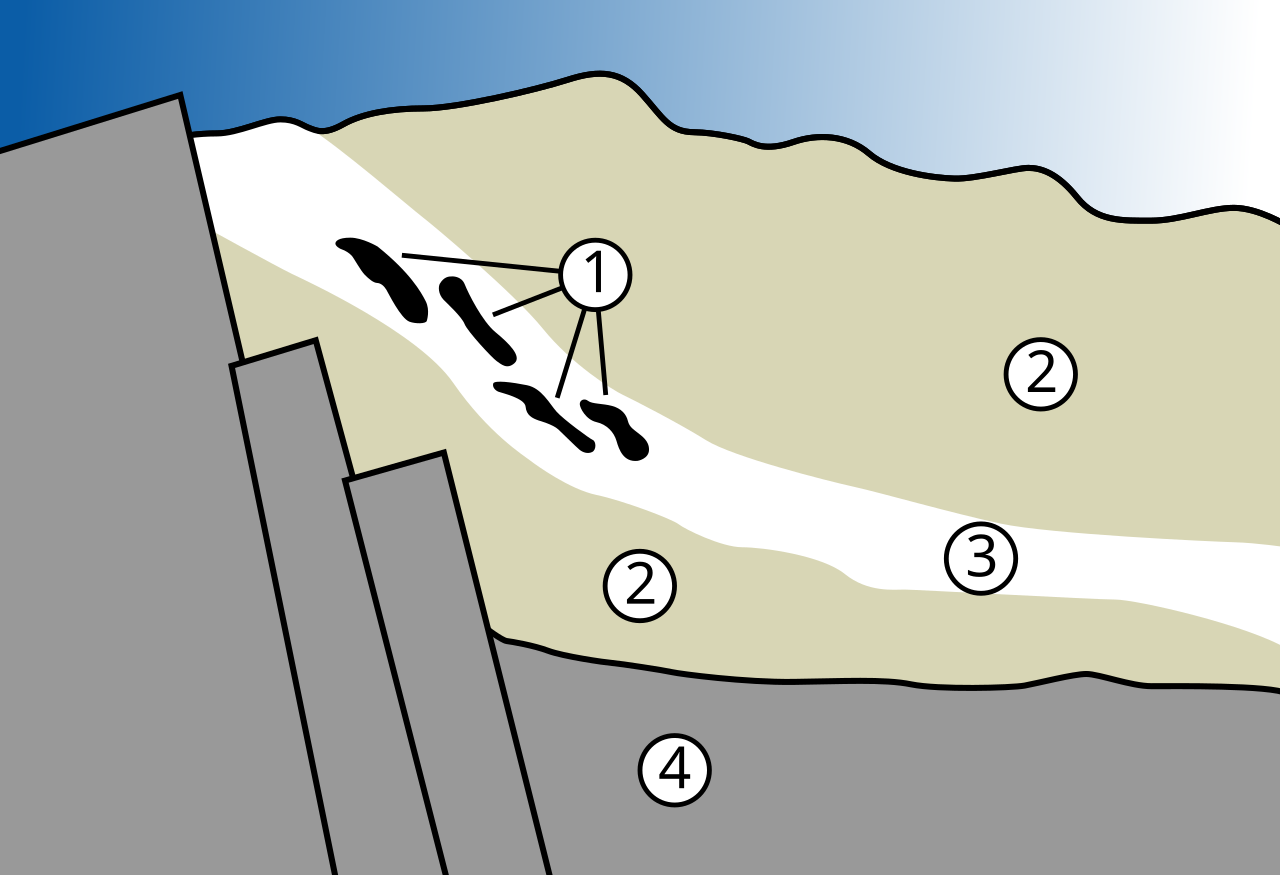
For a natural fission chain reaction to initiate and sustain itself, several conditions must be met simultaneously: a sufficient concentration of fissile material (uranium-235), a neutron moderator to slow fast neutrons to thermal energies (increasing the probability of fission), and the absence of excessive neutron-absorbing impurities. At Oklo, all of these conditions were satisfied. The uranium ore was unusually rich, with concentrations reaching 20–60 percent uranium oxide in the reactor zones. Groundwater percolating through the sandstone host rock served as the neutron moderator, performing the same function as the water in a modern pressurized-water reactor.5, 7
Remarkably, the Oklo reactors appear to have been self-regulating. Analysis of xenon isotopes trapped in aluminium phosphate minerals within the reactor zones has demonstrated that the reactors operated in a cyclic mode: fission heated the surrounding rock, boiling off the groundwater moderator and shutting down the reaction. Once the rock cooled and water seeped back in, criticality resumed.11 Meshik, Hohenberg, and Pravdivtseva estimated that the reactors operated in cycles of approximately 30 minutes of criticality followed by 2.5 hours of shutdown, a pattern that persisted over hundreds of thousands of years.11 The total energy output of the Oklo reactors has been estimated at roughly 15 gigawatt-years, and the reactions consumed approximately six tonnes of uranium-235 over their operational lifetime.2, 5
Isotopic evidence and decay rate constancy
The geochemistry of the Oklo reactor zones preserves a detailed record of nuclear processes that occurred nearly two billion years ago. The fission of uranium-235 produces a characteristic suite of daughter isotopes — including isotopes of neodymium, samarium, ruthenium, zirconium, and xenon — in proportions dictated by the physics of nuclear fission. These fission-product ratios can be predicted precisely using modern nuclear cross-sections and decay constants. If the fundamental constants governing radioactive decay or nuclear reactions had been different in the past, the predicted ratios would not match those observed in the Oklo rocks.1, 4
Detailed analyses of the Oklo reactor zones have shown that the observed isotopic ratios match the predictions of nuclear physics with remarkable precision.4, 5 The samarium-149 abundance is particularly diagnostic. Samarium-149 is produced by the beta decay of neodymium-149, a short-lived fission product, and is a strong neutron absorber. Its measured abundance in the Oklo zones is consistent with the known neutron capture cross-sections and decay rates, constraining any change in these parameters to less than a few percent over 1.97 billion years.1, 8 This finding provides direct physical evidence that nuclear decay constants have not varied significantly over nearly half the age of the Earth, independently corroborating the foundational assumption of radiometric dating.10, 12
Constraints on the fine-structure constant
Beyond confirming the stability of decay rates, the Oklo reactor has been used to place some of the most stringent geological constraints on possible variation in the fine-structure constant (α), the dimensionless constant that characterizes the strength of the electromagnetic interaction. Because neutron capture cross-sections depend sensitively on α, even a tiny change in the fine-structure constant over the past two billion years would have altered the isotopic ratios in the reactor zones in a measurable way. Damour and Dyson's pioneering 1996 analysis used the samarium-149 data from Oklo to constrain the fractional change in α to less than approximately 10−7 over 1.97 billion years.8 Subsequent analyses by Fujii and colleagues and by Petrov and colleagues have refined these bounds, though the precise constraint depends on nuclear physics modelling assumptions.1, 13
These constraints are significant because they are derived from a direct geophysical measurement rather than from astronomical observations of distant quasars, which probe variation at different redshifts and cosmological epochs. The Oklo data thus provide a complementary and independent line of evidence in the ongoing investigation of whether the fundamental constants of nature are truly constant or have evolved over cosmic time.1, 8
Natural analogue for nuclear waste disposal
The Oklo reactors are also of considerable practical interest as natural analogues for the geological disposal of radioactive waste. The fission reactions produced the same suite of radioactive daughter products that are generated in modern nuclear power plants — including isotopes of plutonium, cesium, strontium, and the rare earth elements. After two billion years, the behaviour of these fission products in the Oklo geological environment provides direct empirical data on the long-term migration and retention of nuclear waste in natural rock formations.9, 14
Studies of the Oklo reactor zones have shown that many of the fission products, including the rare earth elements and the platinum-group metals, were effectively retained within a few metres of the reactor cores over the entire two-billion-year interval. Some more mobile elements, such as cesium and rubidium, migrated further but were largely retained within the surrounding clay-rich formations.3, 9 These findings have been cited as empirical evidence supporting the feasibility of deep geological repositories for high-level nuclear waste, demonstrating that certain rock formations can immobilize radioactive materials over timescales far exceeding those required for the waste to decay to safe levels.14
Geological context and reactor zone geometry
The Oklo uranium deposit is hosted within the Francevillian Series, a sequence of Paleoproterozoic sedimentary rocks deposited approximately 2.1 billion years ago in a shallow marine to deltaic environment. The uranium was concentrated by secondary enrichment processes: oxidized, uranium-bearing groundwater migrated through the sandstone and encountered reducing conditions created by organic matter in the sediment, causing uranium to precipitate and accumulate in discrete ore lenses.15, 3 Sixteen distinct reactor zones have been identified within the Oklo and Okelobondo mines, each ranging from a few centimetres to several metres in thickness and covering areas of tens to hundreds of square metres. The reactor zones are distinguished by their anomalous uranium isotopic compositions and the presence of fission products not found in ordinary uranium ore.5, 15
The geometry of the reactor zones has been mapped in detail through mining operations and core drilling. Each zone is lens-shaped, bounded above and below by clay-rich layers that served as hydrological seals, confining the groundwater moderator within the reactive zone. The detailed spatial mapping of fission product distributions within and around the reactor zones has revealed that different elements migrated different distances from the core over the two-billion-year interval, providing a natural laboratory for studying radionuclide transport in geological media.15, 16 Jensen and Ewing's comprehensive review demonstrated that the uraninite matrix of the reactor zones retained the majority of actinides and fission products within the original ore body, with only the most mobile elements (cesium, barium, and some noble gases) showing significant migration beyond the immediate reactor environment.16
Significance for geochronology
The Oklo natural reactor occupies a unique position in the evidence for deep time. Young-earth creationist claims that radioactive decay rates may have been different in the past — dramatically faster during a supposed creation week or global flood — are directly contradicted by the Oklo data. If decay rates had been orders of magnitude higher at any point in the past two billion years, the isotopic ratios in the reactor zones would be grossly inconsistent with those predicted by modern nuclear physics. Instead, the ratios match the predictions precisely.1, 4, 10 The Oklo reactor thus provides a natural experiment, conducted two billion years ago and preserved in stone, that independently confirms the uniformity of nuclear physics across geological time and the reliability of the radiometric dating methods built upon it.12
References
The constraint on the variation of the fine-structure constant from the Oklo natural reactor
The natural nuclear reactor at Oklo: a unique analog for a radioactive waste repository
Record of cycling operation of the natural nuclear reactor in the Oklo/Okelobondo area in Gabon
The Oklo reactor and geologic disposal of nuclear waste: key findings and current status
Geochemistry and retention of spent nuclear fuel and high-level waste in the Oklo natural fission reactors