Overview
- Petrified wood forms through permineralization, a process in which dissolved silica (typically chalcedony or opal) carried by groundwater infiltrates buried wood and precipitates within cell walls, cell lumina, and intercellular spaces, replacing organic material molecule by molecule while preserving anatomical detail down to the cellular level.
- The Petrified Forest National Park in Arizona preserves one of the world's most spectacular concentrations of silicified wood, derived from Late Triassic conifers of the genus Araucarioxylon deposited in the Chinle Formation approximately 225–210 million years ago, with individual logs exceeding 60 metres in original length.
- Petrification requires specific geological conditions — rapid burial in sediment, anoxic pore waters to inhibit decomposition, and a sustained source of mineral-laden groundwater — and typically proceeds over timescales of thousands to millions of years, with laboratory and field evidence from volcanic environments demonstrating that initial mineral infiltration can begin within decades under favorable geochemistry.
Petrified wood is fossilized wood in which the original organic material has been wholly or partially replaced by minerals — most commonly silica in the form of chalcedony, microcrystalline quartz, or opal — while preserving the anatomical structure of the wood down to the cellular level.2 It is among the most visually striking products of the fossil record: cross-sections of petrified logs reveal growth rings, bark textures, insect borings, and individual cell walls in stone, often stained vivid reds, yellows, and purples by trace amounts of iron, manganese, and other transition metals. Petrified wood is found on every continent and spans nearly the entire history of land plants, from Devonian lycopsids to Cenozoic angiosperms, but the most celebrated deposits are Late Triassic in age, preserved in the Chinle Formation of the American Southwest and exposed most spectacularly in Arizona’s Petrified Forest National Park.5
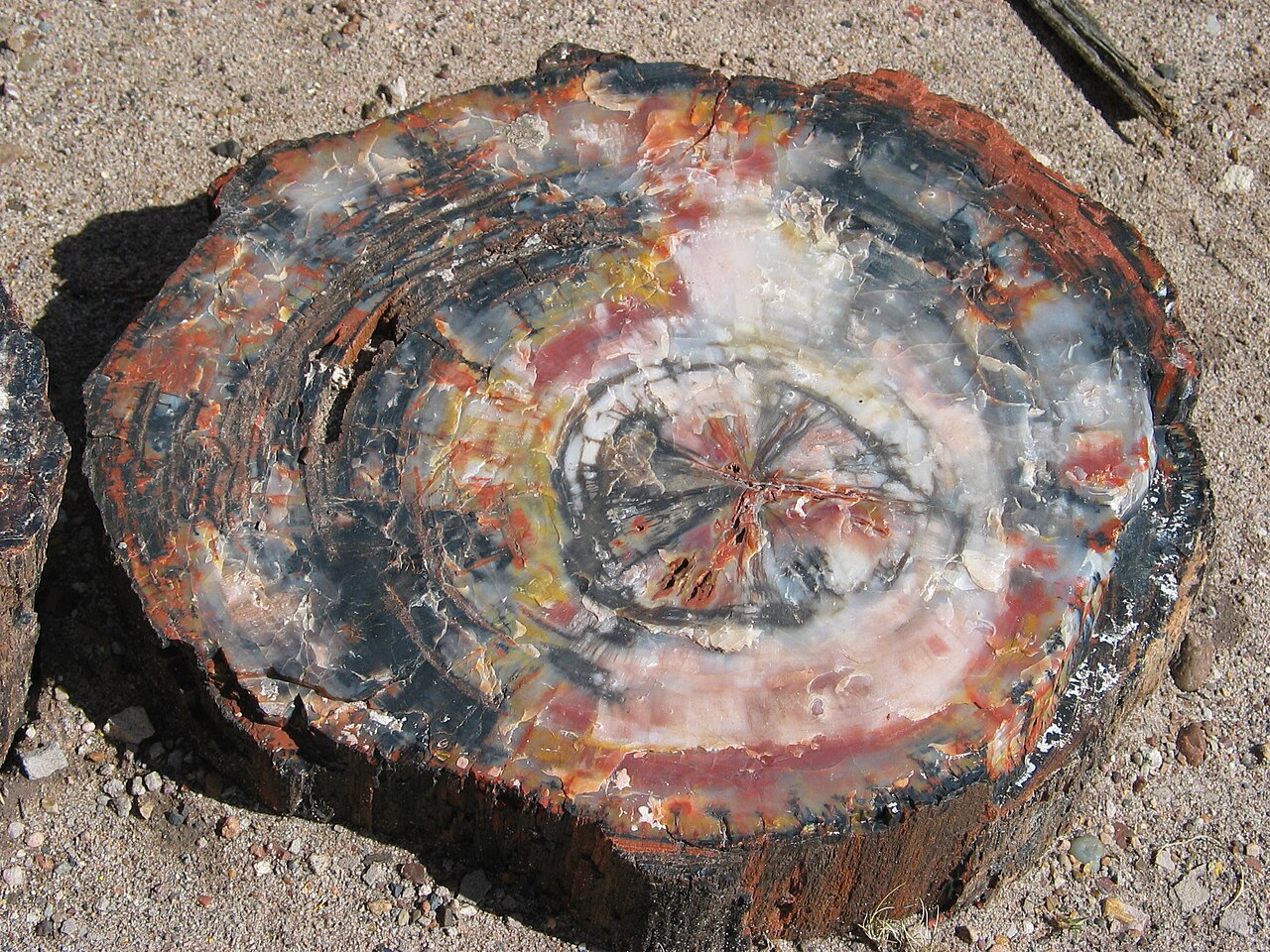

The permineralization process
The transformation of wood to stone proceeds through permineralization, a taphonomic process in which mineral-bearing groundwater percolates through buried plant tissue and deposits minerals within the pore spaces of the wood’s cellular structure.8 The process requires several conditions to be met simultaneously. The wood must be buried rapidly enough, and in sufficiently anoxic sediment, to retard bacterial and fungal decomposition that would otherwise destroy the tissue before mineralization can begin. A sustained source of dissolved minerals — most commonly silica derived from the dissolution of volcanic ash, siliceous sediment, or hydrothermal fluids — must be available in the pore water. And the geochemical environment must favour precipitation of those minerals within the wood rather than in the surrounding sediment.2, 8
In the most common form of petrification, dissolved silica (SiO2) enters the wood through the cell walls, which are permeable at the molecular scale, and precipitates first as amorphous opal-A or opal-CT within cell lumina (the interior cavities of cells) and along cell walls.1 As permineralization progresses, the original cellulose and lignin of the cell walls are gradually replaced by silica through a molecule-by-molecule substitution process in which the organic polymer degrades and silica precipitates in its place, preserving the three-dimensional geometry of the cell wall with extraordinary fidelity.2 Over geological time, the initially amorphous silica matures through a diagenetic sequence: opal-A converts to opal-CT (a disordered cristobalite-tridymite phase), which in turn recrystallizes to microcrystalline quartz (chalcedony) and eventually to megaquartz.2, 12 The degree of silica maturation varies within and between specimens and provides a rough indicator of the thermal and temporal history of the deposit.
The colours that make petrified wood so aesthetically prized are products of trace element chemistry. Iron oxides produce reds, oranges, and yellows (hematite and goethite); manganese oxides yield blacks and purples (pyrolusite and manganite); chromium compounds can produce greens; and pure silica produces white or translucent zones.2 These colours are not present in the original wood but are incorporated during or after permineralization as metallic ions coprecipitate with silica or fill microfractures in the mineralized tissue.
Petrified Forest National Park and the Chinle Formation
The Petrified Forest National Park in northeastern Arizona preserves the world’s densest and most extensively studied concentration of Triassic petrified wood. The fossilized logs are found within the Chinle Formation, a sequence of fluvial and lacustrine sedimentary rocks deposited during the Late Triassic, approximately 225–210 million years ago, in a broad floodplain traversed by rivers and studded with seasonal lakes.7 The Chinle Formation extends across much of the Colorado Plateau, and petrified wood is present throughout its extent, but the concentration within the park — where logs litter the surface of eroded badlands in extraordinary profusion — is unmatched.
The dominant tree in the Petrified Forest assemblage is Araucarioxylon arizonicum, a large conifer related to the living Araucaria (monkey puzzle) trees of the Southern Hemisphere, first described by F. H. Knowlton in 1889.14 Individual silicified trunks exceed 60 metres in estimated original length and 3 metres in diameter, indicating forest trees of impressive stature. The wood anatomy, visible in thin section under the petrifying silica, shows well-preserved tracheids, growth rings (often with asymmetric widths indicating seasonal climate variation), resin canals, and in some specimens fungal hyphae and insect borings that record biological interactions in the living forest.5 Other taxa identified from the park include Woodworthia and Schilderia, though Araucarioxylon overwhelmingly dominates the assemblage.13
The silicification of the Chinle logs is attributed to the dissolution of volcanic ash that was deposited abundantly across the Late Triassic landscape during episodes of explosive volcanism in what is now the southern and western United States and Mexico. The ash, rich in siliceous glass, dissolved readily in groundwater, producing silica-saturated pore fluids that infiltrated the buried wood.1 Sigleo’s geochemical analysis of Petrified Forest specimens showed that the silicifying fluids were chemically distinct from the sedimentary matrix, confirming that silica was transported in from an external source rather than derived from the enclosing sediment.1 The exceptional preservation at the Petrified Forest reflects the combination of rapid burial by floodplain sediment, an abundant supply of volcanic-derived silica in the groundwater system, and anoxic conditions in the saturated subsurface that retarded decomposition long enough for permineralization to proceed.
Other mineralization types
While silicification is by far the most common mode of wood petrification, other mineral types can replace or fill wood tissue under appropriate geochemical conditions. Pyritization, in which iron sulfide (FeS2) replaces organic material, occurs in anoxic, sulfide-rich marine or marginal-marine sediments where bacterial sulfate reduction produces abundant dissolved sulfide that reacts with iron in the pore water.10 Pyritized wood is typically less well preserved at the cellular level than silicified wood because the cubic crystal habit of pyrite is a poor template for replicating the curved cell walls of plant tissue, though exceptional specimens preserve tracheid detail. Pyritized plant fossils are best known from the London Clay Formation (Eocene) and from Cretaceous and Jurassic marine sediments in Europe.10
Calcification, in which calcium carbonate replaces wood, occurs in alkaline groundwater environments, particularly in limestone terrains and in association with travertine-depositing springs. Calcified wood is common in Cretaceous formations of the Gulf Coastal Plain of the United States, where specimens preserve wood anatomy in calcite and are often partially or wholly silicified as well, indicating successive mineralization events.11 More rarely, wood may be replaced by iron oxides (goethite or hematite), phosphate minerals, or even native copper, depending on the chemistry of the mineralizing fluid. Ballhaus and colleagues demonstrated experimentally that iron and manganese oxides can silicify wood tissue in laboratory settings, suggesting that transition metal chemistry plays an important catalytic role in natural silicification processes.4
The diversity of mineralization modes underscores the point that petrification is not a single chemical reaction but a family of related processes united by the common principle of mineral infiltration and replacement of organic tissue. The specific mineral that fills and replaces the wood is determined entirely by the geochemical environment of burial — the pH, Eh, temperature, and dissolved ion concentrations of the pore water — rather than by any property of the wood itself.2, 8
Timescales of petrification
The time required for complete petrification of wood has been a subject of both scientific investigation and public confusion. The geological evidence is unambiguous that most large deposits of petrified wood formed over timescales of thousands to millions of years, and the ages of the host sediments — determined by radiometric dating, biostratigraphy, and magnetostratigraphy — constrain the age of the petrification event to the geological period of burial.7, 13 The Chinle Formation logs at Petrified Forest National Park, for example, are unambiguously Late Triassic in age based on radiometric dates from interbedded ash layers, palynological (pollen and spore) evidence, and vertebrate biostratigraphy, placing their burial and silicification at approximately 225–210 million years ago.7, 13
However, the initial stages of permineralization — the infiltration of mineral-bearing fluid into cell spaces and the beginning of mineral precipitation — can proceed rapidly under geochemically favorable conditions. Akahane and colleagues demonstrated that wood submerged in silica-supersaturated hot spring water at Tateyama, Japan, developed thin opaline silica coatings on cell walls within months to years.9 Jahren and colleagues reported incipient silicification of wood in geothermal environments on timescales of years to decades.3 These observations demonstrate that the onset of permineralization is a function of fluid chemistry — particularly silica supersaturation, pH, and temperature — rather than time per se. In hot spring environments where silica concentrations are exceptionally high (hundreds of parts per million compared to typical groundwater concentrations of 5–60 ppm), the rate-limiting step is not mineral precipitation but the diffusion of dissolved silica into the wood tissue.12
Young-earth creationist literature has cited these observations as evidence that petrified wood can form in thousands of years rather than millions, and therefore that the geological timescale is unreliable. This claim conflates the onset of mineral infiltration with the completion of full petrification. The hot spring experiments produce wood with thin mineral coatings on some cell surfaces, not the complete replacement of all organic material by crystalline silica that characterizes mature petrified wood such as the Chinle specimens. The conversion from initial opal-A to the chalcedony and quartz that dominate ancient petrified wood is itself a slow diagenetic process that proceeds over hundreds of thousands to millions of years under normal geothermal gradients.2 Moreover, the age of the Chinle Formation and its contained wood is independently constrained by multiple radiometric systems, including U-Pb zircon dates from volcanic ash beds, which yield consistent ages of 225–210 Ma with uncertainties of less than one percent — a level of precision that leaves no room for orders-of-magnitude reinterpretation.7
Global distribution and scientific value
Petrified wood is globally distributed, and major deposits are known from every geological period in which woody plants existed. Devonian petrified forests in Gilboa, New York, preserve some of the earliest known tree-sized plants. Carboniferous and Permian petrified wood is widespread in both hemispheres, including spectacular specimens from the Chemnitz Petrified Forest in Germany, buried by a Permian volcanic eruption. Jurassic and Cretaceous silicified wood is common across western North America, South America, and Africa.15 Cenozoic petrified forests include those at Yellowstone National Park in Wyoming (Eocene), the Lesbos Petrified Forest in Greece (Miocene), and numerous occurrences in Patagonia, Egypt, and Indonesia.6, 15
The scientific value of petrified wood extends well beyond its aesthetic appeal. Because permineralization preserves wood anatomy at the cellular level, petrified specimens allow paleobotanists to identify the taxonomic affinities of ancient trees, reconstruct their growth patterns from preserved growth rings, and infer the climatic conditions under which they lived. Growth ring analysis (dendroclimatology) of petrified wood has been used to reconstruct Mesozoic and Paleozoic climate variability, seasonality, and latitude-dependent growth patterns that constrain paleogeographic reconstructions.5 The chemical composition of the petrifying minerals records the geochemistry of the diagenetic environment, providing information about paleohydrology, volcanic input, and groundwater flow systems that complement sedimentological and stratigraphic data.
Petrified wood also serves as a particularly accessible example of fossilization for public science education, because its preservation is so vivid and intuitive: a log that looks like wood but rings like stone. The Petrified Forest National Park alone receives nearly a million visitors per year, and petrified wood is among the most recognizable and widely collected geological specimens worldwide. Its formation illustrates principles of mineral chemistry, groundwater hydrology, taphonomy, and deep time in a single tangible object.
References
Silicified wood in the Morrison Formation and other Jurassic formations: evidence for rapid silicification