Overview
- Polystrate fossils — most famously upright tree trunks that penetrate multiple sedimentary layers — were documented by geologists decades before young-earth creationists adopted them as evidence of a global flood; the term itself is a creationist coinage with no standing in professional geology.
- Mainstream geology explains polystrate tree trunks as products of rapid local sedimentation events: volcanic lahars, river floods, delta progradation, and coastal swamp burial — processes that operate on timescales of days to centuries within an overall framework of deep time.
- The Joggins Formation of Nova Scotia, the premier polystrate fossil site and a UNESCO World Heritage Site, contains dozens of upright Carboniferous lycopod trunks embedded in repeated cycles of swamp, delta, and flood-plain deposits, and its stratigraphy is entirely consistent with an old-Earth model of repeated, episodic sedimentary events.
A polystrate fossil is a fossil that extends through more than one stratum of sedimentary rock — the term combining the Latin poly (many) with stratum (layer). The overwhelming majority of examples are the upright trunks of ancient trees, preserved in a vertical or near-vertical orientation that cuts across bedding planes representing what conventional stratigraphy interprets as distinct depositional episodes separated in time. Polystrate fossil trees are found on every continent and in rocks ranging in age from Carboniferous coal measures to Eocene volcanic sequences. The most celebrated localities include the Joggins Formation of Nova Scotia, the fossil forests of the Yellowstone region in Wyoming, and the coal measures of England, Belgium, and the Ruhr basin of Germany.1, 7, 16
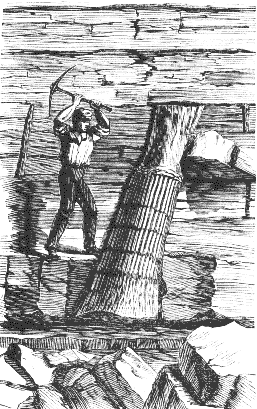

The term polystrate itself is not used in professional geology. It was introduced by creationist writers in the twentieth century as a polemical framing device and appears exclusively in young-earth creationist literature and the popular press influenced by it.15, 18 Professional geologists refer to the same phenomena using the vocabulary of event stratigraphy — upright trees buried by floods, lahars, or delta progradation — and have understood the mechanisms responsible for their preservation since the 1840s, long before young-earth creationism emerged as a modern movement.1, 2
Discovery and scientific history
The scientific documentation of upright fossil trees buried within sedimentary sequences predates the creationist adoption of the phenomenon by more than a century. Charles Lyell visited the Joggins coastal section in Nova Scotia in 1842 and reported finding numerous large Carboniferous lycopsid trunks standing erect in the cliffs, their bases embedded in the same seat earths (rootlet beds) from which they grew, with their upper portions penetrating several meters of overlying shale and sandstone.1 Lyell recognized immediately that the trees had not been transported but had grown in place: their in-situ roots, preserved in the underclay beneath each trunk, were diagnostic. He concluded that the trees had been overwhelmed by rapid local sedimentation — floods or delta advance — and buried before they could decay.1
John William Dawson, the pre-eminent Canadian geologist of the nineteenth century, conducted systematic excavations at Joggins beginning in the early 1850s. His work revealed not only the upright trees but also the remarkable fauna sheltering within their hollow trunks — including the earliest known reptile, Hylonomus lyelli, named in honor of Lyell’s earlier work at the site.2 Dawson documented the stratigraphic context of the standing trees in detail, recognizing that each upright trunk was associated with a rootlet bed below and a coarsening sequence of clastic sediment above, a pattern consistent with repeated episodes of forest growth and rapid burial over an extended period of geological time.2, 9
Similar upright trees buried in sedimentary sequences were described in the British coal measures throughout the nineteenth century. The Carboniferous coal fields of Yorkshire, Lancashire, and South Wales, as well as the Belgian and German Ruhr coalfields, were all found to contain lycopsid and cordaitalean trunks preserved in growth position, their bases rooted in seat earths (seat clays or underclays) and their shafts penetrating multiple coal and shale horizons.16 These observations were integrated seamlessly into the uniformitarian framework that had replaced diluvialism in European geology by the 1840s: rapid local burial by fluvial or deltaic sedimentation, not a global catastrophe, explained the preservation of the trees without contradiction.16, 13
The Joggins Formation, Nova Scotia
The Joggins Formation exposed along the shores of Chignecto Bay on the Cumberland Basin of Nova Scotia is the world’s most extensively studied polystrate fossil locality. Designated a UNESCO World Heritage Site in 2008 for its exceptional scientific value, the formation comprises approximately 15 kilometers of Pennsylvanian-age strata (approximately 307–310 million years old) exposed in sea cliffs up to 10 meters high along a 14.7-kilometer coastal section.3 The succession was deposited in an equatorial basin during the Carboniferous, when Nova Scotia lay near the equator and was covered by the dense lycopsid forests that gave rise to the major coal seams of the northern hemisphere.
The Joggins stratigraphy is a cyclically repetitive sequence of sedimentary rock types: at the base of each cycle lies a seat earth (rootlet bed) carrying the in-situ root systems of lycopsid trees; above it is a coal seam representing the compressed remains of the forest floor; above the coal is a succession of shales, siltstones, and sandstones representing flooding, abandonment of the swamp surface, and renewed clastic input from adjacent river systems.9, 12 The upright tree trunks, predominantly Sigillaria and Lepidodendron, stand within these clastic intervals, their bases rooted in the seat earths below and their trunks enclosed in sediment deposited after the forest was overwhelmed.
Critical evidence that the trees grew in place rather than being transported is unambiguous. Every upright trunk is associated with its own seat earth directly below it, demonstrating root attachment to the substrate at that location.9, 10 The root systems (stigmarian rootlets) fan outward and downward from the trunk base, as they would in a living tree. The trunks show no evidence of water transport — no abrasion, no removal of bark, no preferred directional alignment that would indicate current sorting. Many trunks retain their bark impressions (Sigillaria and Lepidodendron are identified almost exclusively by their bark surface patterns), which would not survive significant transport.10, 16
Detailed sedimentological analysis of the Joggins section has established that the repeated burial episodes reflect the dynamics of a Carboniferous alluvial-deltaic plain subject to frequent flooding.11 When river channels avulsed and spread sediment-laden water across the swamp surface, standing trees were buried to varying depths in hours to days. Trees buried below the photosynthetic threshold died where they stood; those buried only partially may have survived by producing adventitious roots from the trunk above the new sediment surface, a response observed in modern lycopsids subjected to sediment burial.11 The entire sequence represents not a single event but dozens of discrete burial episodes separated by periods of forest growth long enough for trees to reach heights of several meters to tens of meters.10, 3
Yellowstone fossil forests
The Eocene fossil forests of the Yellowstone region in Wyoming present one of the most instructive examples of polystrate preservation in volcanic terrains and have been a particular focus of creationist argument since the 1970s. The Absaroka Volcanic Supergroup, a thick sequence of Eocene volcanic deposits, contains numerous upright fossil trees — predominantly conifers, with broadleaf angiosperms and palms — preserved in multiple stratigraphic levels within volcanic tuffs, lahars, and debris flow deposits.7, 8
Early creationist writers, noting that the Yellowstone trees appeared at dozens of successive levels within the volcanic sequence, proposed that the entire stack of fossil forests had been deposited in a single cataclysmic flood that sorted and stacked floating log mats. This interpretation was advanced primarily on the basis of a superficial resemblance to the log mats observed floating on Spirit Lake following the 1980 eruption of Mount St. Helens, which reoriented logs and deposited upright stumps on the lake bottom when waterlogged.15
The Spirit Lake analogy, however, fails to account for the full range of evidence at Yellowstone. Detailed geological mapping by Fritz (1980) and Yuretich (1984) established that the successive forest levels are separated by well-developed paleosols — ancient soils — with the same diagnostic features as soils formed by weathering over centuries: clay mineral development, root mottling, Fe-Mn nodule formation, and gradational horizons.7, 8 A log mat deposited by a flood cannot produce a mature soil above it; only a period of subaerial stability long enough for vegetation to colonize the surface and for soil-forming processes to operate can produce such a feature. The presence of multiple mature paleosols throughout the Yellowstone sequence demonstrates that each fossil forest level records a genuine interval of terrestrial stability, separated from the next by a new volcanic episode — a process geologists estimate repeated at least 27 times over a period of roughly two million years during the Eocene.7, 8
The trees themselves further contradict the transport hypothesis. Many trunks retain attached root systems penetrating the underlying paleosol, demonstrating growth in place. The geochemistry of the trees’ silicified wood is consistent with slow permineralization within a fixed substrate, not deposition from suspension.7 The successive forests record a long ecological and volcanic history, not a single catastrophic depositional episode.
Mechanisms of polystrate preservation
Mainstream geology recognizes several distinct depositional mechanisms capable of burying standing trees rapidly enough to preserve them in growth position, each leaving a characteristic sedimentological signature.13
Volcanic lahars are debris flows generated when volcanic ash and pyroclastic material mix with water, either from rainfall, snowmelt, or crater lakes, producing a rapidly moving slurry of sediment. Lahars can travel at velocities of 20–40 kilometers per hour and deposit meters of sediment within minutes to hours over large areas, burying standing trees to depths that prevent toppling.14 The Yellowstone fossil forests and many Arctic Eocene fossil forests (including those of Axel Heiberg Island in the Canadian High Arctic) were preserved by repeated lahar burial of forest stands growing on the lower slopes of active volcanic complexes.4, 5, 7
River floods and avulsion are the dominant mechanism at non-volcanic sites such as Joggins. When a river channel avulses — abruptly switching its course across a floodplain — it can deposit meters of sand and silt across a swamp or forest within a single flood event. The Carboniferous fluvial systems responsible for the Joggins succession were large, sediment-laden rivers draining the uplifting Acadian highlands to the east, capable of delivering substantial clastic loads during major flood events.11, 17 The cyclical nature of the Joggins sequence, with its alternating swamp, flood, and marine-influenced horizons, reflects the dynamics of a mobile fluvial system on a low-gradient alluvial plain.9, 12
Delta progradation occurs when a river delta advances into a standing body of water, burying coastal forests under prograding sediment lobes. As the delta front advances, terrestrial sediments onlap and bury the coastal forest fringe, preserving trees in growth position within a shoreward-thickening wedge of sand and silt. This mechanism produces the characteristic coarsening-upward sequences seen in many polystrate fossil localities, where the trunk of an upright tree is embedded first in fine offshore muds and then in coarser nearshore sands deposited as the delta margin advanced over the site.13, 17
Peat compaction and differential subsidence can also create the appearance of polystrate preservation in coal-bearing sequences. As the peat layer beneath a standing forest compacts during burial, the forest floor subsides relative to the surrounding topography, drawing the tree trunks deeper into accumulating sediment without any single catastrophic depositional event. This mechanism may contribute to the preservation of trees that appear to penetrate thin coal seams while their bases remain in the underlying seat earth.12, 16
The creationist argument and its problems
The young-earth creationist argument from polystrate fossils takes the following form: if a tree trunk extends through multiple sedimentary layers, and if those layers were deposited slowly over thousands or millions of years as conventional geology maintains, then the tree trunk would have rotted long before the upper layers were deposited. Therefore, all the layers enclosing the trunk must have been deposited simultaneously in a single rapid event — the Genesis flood.15, 18
This argument rests on a caricature of how professional geologists interpret polystrate trees. No geologist — including Lyell and Dawson in the nineteenth century — has ever proposed that the sediment enclosing a polystrate tree was deposited slowly over millions of years while the tree stood undecayed. The geological explanation has always been rapid local deposition: the sediment enclosing any individual trunk was deposited quickly, in a single flood or lahar event, over hours to days.1, 2, 11 What requires millions of years is not the burial of any individual tree but the accumulation of the entire stratigraphic sequence — the dozens to hundreds of distinct burial events, separated by periods of forest growth, soil development, and ecological succession, that produced the thick successions in which polystrate trees are found.
The creationist argument therefore misidentifies what the geological timescale is applied to. Individual beds within a polystrate sequence are not claimed to take millions of years to form; they are recognized as event deposits formed rapidly. The millions of years are required by the number and character of the successive events: the repeated growth of forests to maturity, the development of soils, the accumulation of peat into coal, and the cycling of depositional environments that produced the cyclothemic sequences at Joggins and elsewhere.9, 10, 12
A related problem for the flood interpretation is that polystrate trees occur at dozens of distinct stratigraphic levels throughout thick sequences, each level associated with its own rootlet bed, its own soil horizon, and its own assemblage of associated organisms. A global flood cannot explain why each buried forest level has its own in-situ root system attached to the substrate at that level, why the rootlet beds show the same pedogenic features as modern soils, why different tree species dominate at different levels in a pattern consistent with ecological succession, and why the geochemical composition of paleosols between levels records distinct weathering histories incompatible with continuous submersion.10, 8
Finally, the global flood interpretation fails to account for the geographic specificity of polystrate occurrences. If all sedimentary sequences were deposited simultaneously by a single global flood, polystrate trees should be randomly distributed throughout the geological column in every sequence worldwide. Instead, polystrate trees occur in specific geological contexts — Carboniferous coal measures, Eocene volcanic sequences, Cretaceous deltaic deposits — that correspond precisely to the depositional environments geologists independently identify as prone to rapid local burial.6, 13 Their distribution is a predictable consequence of event stratigraphy, not evidence against it.
Event stratigraphy and deep time
Polystrate fossils are best understood within the framework of event stratigraphy, a subdiscipline of stratigraphy that focuses on the recognition and interpretation of discrete depositional events in the sedimentary record — storms, floods, volcanic eruptions, turbidity currents, and mass wasting events that produce beds on timescales of hours to years rather than the slow background sedimentation that accumulates over millennia.13 Event stratigraphy was developed to handle exactly the kind of evidence that polystrate fossils represent: rapid local deposition within a context of overall slow accumulation.
The coexistence of rapid local events and deep geological time is not paradoxical. A river floodplain may receive meters of new sediment during a major flood event lasting days, yet the same floodplain may accumulate only a few meters of net sediment per thousand years when averaged over its entire history, because most of the time sediment is being eroded or bypassed rather than deposited.13, 17 A volcanic lahar can bury a forest in hours; yet the volcanic field responsible for that lahar may be active for millions of years, producing dozens to hundreds of successive burial events separated by long quiescent intervals during which forests regenerate and soils develop. The geological timescale does not demand that every bed was deposited slowly — it demands only that the total succession of events be accommodated within the available time, and the evidence from radiometric dating, biostratigraphy, and magnetostratigraphy consistently places that succession in deep time.3, 13
The Joggins Formation illustrates this perfectly. Radiometric dates and biostratigraphic correlation place the entire Joggins succession within the Pennsylvanian sub-epoch, spanning roughly 3–5 million years of Carboniferous time.3, 9 Within that interval, the section records dozens of individual flood or deltaic burial events, each rapid, each separated from the next by a period of forest growth that can be estimated by the size and density of the preserved trees and by the thickness and maturity of the associated paleosols. The cumulative picture is of a dynamic alluvial-coastal plain repeatedly colonized by forests, repeatedly inundated by sediment, and repeatedly re-colonized — a system operating over millions of years by familiar processes observable in tropical river deltas today, not a single catastrophe incompatible with modern physical understanding.10, 11, 12
Other notable localities
Beyond Joggins and Yellowstone, polystrate fossil trees occur in several other well-documented geological contexts that further illustrate the diversity of preservation mechanisms.13
The Eocene fossil forests of Axel Heiberg Island in the Canadian High Arctic preserve some of the best-documented examples of lahar-burial polystrate trees outside the Yellowstone region. Multiple forest levels, dominated by large deciduous conifers including Metasequoia and Taxodium, are interbedded with volcanic ash and lahar deposits within an Eocene sedimentary basin.4, 5 Unlike the silicified Yellowstone trees, the Axel Heiberg specimens are preserved as mummified wood — actual organic tissue, not mineral replacement — because the burial was rapid and the subsequent conditions cold and dry enough to retard decay for approximately 45 million years. The mummified wood can be identified to species level and retains original cellulose and lignin. The successive forest levels, each with its own soil horizon, record a multi-million-year history of periodic volcanic disturbance in an otherwise climatically warm Eocene high-Arctic environment.4, 5
The Cretaceous–Paleogene boundary sequence of the Raton Basin in Colorado and New Mexico contains polystrate fossil logs within a succession documenting the aftermath of the Chicxulub impact event. Johnson and Ellis (2002) described in-situ root systems and upright stumps within impact-related sedimentary deposits, demonstrating rapid burial of Cretaceous rain forests by impact-generated sediment pulses.6 This example is particularly instructive because the burial mechanism — a catastrophic but geographically localized event — is documented independently by multiple lines of evidence including the iridium anomaly, shocked quartz, and the global mass extinction at the boundary. Rapid local deposition preserving upright trees is entirely consistent with the established geological context.6
The coal measures of northern England and continental Europe provided some of the earliest-described polystrate trees and remain among the most thoroughly documented. The Yorkshire, Lancashire, and South Wales coalfields, as well as the Ruhr basin of Germany and the Belgian Borinage, all contain upright lycopsid and cordaitalean trunks in growth position within cyclothemic sequences analogous to Joggins.16 The economic importance of these coal fields drove intensive geological investigation throughout the nineteenth and early twentieth centuries, producing a literature that thoroughly characterized the depositional environments responsible for polystrate preservation well before creationist writers discovered the phenomenon.16, 13
Significance and context
The scientific significance of polystrate fossil trees lies not in any challenge they pose to conventional geology — they pose none — but in what they reveal about the dynamics of ancient depositional systems. Upright trees in sedimentary sequences are direct records of catastrophic local events: they mark flood horizons, lahar deposits, and delta lobes with a precision that diffuse sedimentological signals alone cannot provide. For stratigraphers and sedimentologists, polystrate trees are valuable precisely because they constrain the rate of individual depositional events and allow the reconstruction of ancient landscape dynamics.13, 11
The creationist use of polystrate fossils exemplifies a broader rhetorical pattern: the adoption of phenomena documented and explained by mainstream science, stripped of their geological context, and reframed as anomalies that science cannot explain. The explanation for polystrate trees — rapid local burial within an old-Earth framework of repeated episodic events — was provided by geologists, including devout Christians such as Dawson, in the nineteenth century.2, 18 The creationist adoption of the term polystrate obscures this history by coining new vocabulary for a phenomenon that geology had already understood and named within its existing conceptual framework.
The Joggins Formation’s designation as a UNESCO World Heritage Site reflects the site’s genuine scientific importance as a window into Carboniferous terrestrial ecology and coal-forming environments. Its value lies in the completeness of the ecological picture it preserves — standing trees, root systems, coal seams, soils, aquatic environments, and a diverse fauna including the earliest reptiles — and in the clarity with which it demonstrates how repeated rapid local events, embedded within a deep-time geological succession, can produce a rich and precisely interpretable fossil record.3, 10 Nothing in that record requires a global flood; everything in it is consistent with the same alluvial, deltaic, and swamp processes that operate in tropical river systems today.
References
Burial of standing forests by volcanic activity in the Tertiary of Axel Heiberg Island, Canadian Arctic Archipelago
Fossil forests and climate change in the Eocene of Axel Heiberg Island, Canadian High Arctic
Yellowstone fossil forests: new evidence for multiple horizons of fossil trees in the Absaroka volcanic field
Depositional environments of Carboniferous coal measures containing polystrate fossils, Joggins, Nova Scotia
Pennsylvanian standing trees and vegetational change in a cyclothemic sequence, Joggins, Nova Scotia
Event stratigraphy and the recognition of high-resolution stratigraphic signals in the geological record
Sequence stratigraphy and depositional systems in the Carboniferous of Atlantic Canada