Overview
- Soil forms through pedogenesis, the slow transformation of rock and organic matter into layered profiles governed by five interdependent factors identified by Hans Jenny: climate, organisms, relief, parent material, and time.
- Biological activity is essential to soil development, as plant roots, fungi, bacteria, and burrowing animals accelerate mineral weathering, cycle nutrients, and generate the organic-rich horizons that distinguish soil from mere regolith.
- Paleosols preserved in the geological record serve as archives of ancient climates, atmospheric composition, and terrestrial ecosystems stretching back more than three billion years.
Soil is the thin, biologically active layer of weathered rock and organic matter that covers most of Earth's land surface. It forms through pedogenesis, the suite of physical, chemical, and biological processes that transform consolidated rock or loose sediment into a structured medium capable of supporting terrestrial life.1, 2 Despite its familiarity, soil is extraordinarily complex: a single handful may contain billions of bacteria, kilometres of fungal hyphae, and mineral grains spanning the full range of weathering stages from fresh rock fragments to nanometre-scale clay particles. The global soil mantle stores roughly 1,500 to 2,400 gigatonnes of organic carbon, more than twice the amount in the atmosphere and terrestrial vegetation combined, making it a critical reservoir in the global carbon cycle.9 Understanding how soil forms, how quickly it develops, and what it records about the past is fundamental to geology, ecology, agriculture, and climate science.
The five soil-forming factors
The modern framework for understanding soil formation was established by the Russian geologist Vasily Dokuchaev in the 1880s and formalised by Hans Jenny in his 1941 treatise Factors of Soil Formation. Jenny expressed soil properties as a function of five independent variables: climate, organisms, relief (topography), parent material, and time, often abbreviated as the clorpt equation: S = f(cl, o, r, p, t).1 No single factor operates in isolation; rather, the five interact to produce the remarkable diversity of soils found across the planet.
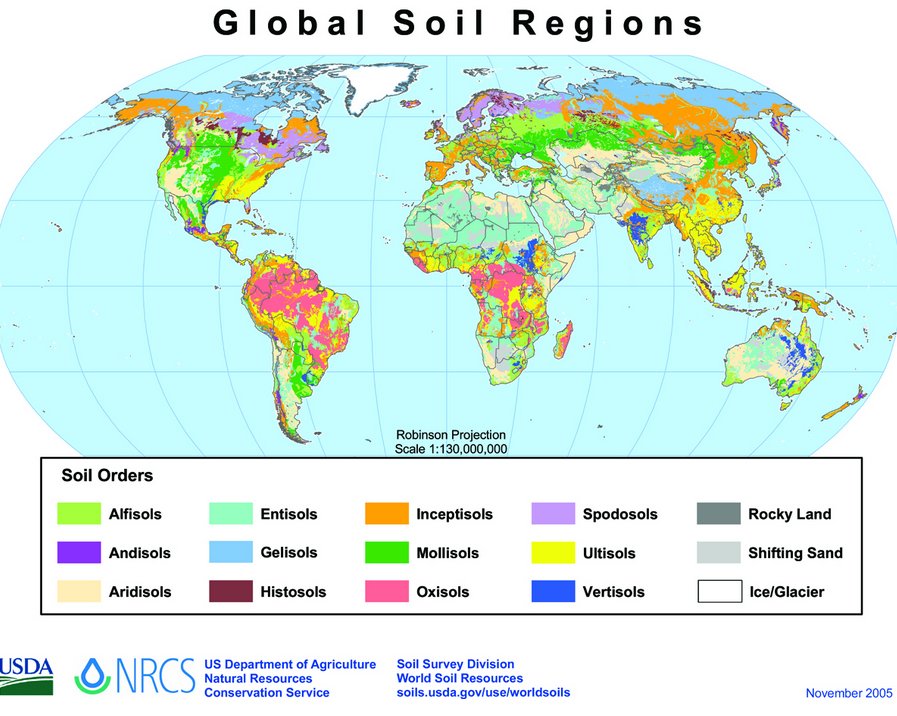

Climate exerts the strongest overall influence on pedogenesis. Temperature controls the rate of chemical reactions, roughly doubling for every 10 °C increase, while precipitation determines the volume of water available to dissolve minerals and transport solutes downward through the profile.2 Hot, humid tropical environments produce deeply weathered, iron- and aluminium-rich soils (Oxisols) in which nearly all primary silicate minerals have been destroyed, whereas arid climates produce thin, weakly developed profiles with accumulations of calcium carbonate or soluble salts near the surface.2, 6 Organisms include plants, animals, fungi, and microorganisms. Vegetation supplies organic matter to the soil surface and roots penetrate and physically disrupt rock, while mycorrhizal fungi dissolve minerals through the secretion of organic acids and facilitate nutrient transfer to their host plants.7 Burrowing animals, from earthworms to termites, mix soil horizons, create macropores that enhance water infiltration, and transport material between depths. Charles Darwin devoted his final book to the role of earthworms, estimating that they bring roughly 10 tonnes of soil per hectare per year to the surface in English pastures.8
Relief influences soil formation through its effects on drainage, erosion rate, and microclimate. Steep slopes shed water and sediment rapidly, producing thin, poorly developed soils, while level or concave positions accumulate water and material, promoting thicker, wetter profiles. The characteristic sequence of soils along a hillslope, from crest to footslope, is called a catena.6 Parent material is the geological substrate from which the soil forms. It may be solid bedrock weathering in place, or unconsolidated deposits such as glacial till, alluvium, loess, or volcanic ash. The mineralogy and texture of the parent material control the initial chemistry of the developing soil, the rate at which it weathers, and the types of clay minerals that form.2, 3 Quartz-rich granites weather slowly, while basalts and other mafic rocks weather rapidly because their ferromagnesian minerals are far from equilibrium at surface conditions.3, 4 Time determines how far pedogenesis has progressed. Young soils on recently deposited parent material may consist of little more than unaltered sediment with a thin organic layer, whereas soils that have been developing for hundreds of thousands of years on stable surfaces can be many metres deep with strongly differentiated horizons.6, 14
Weathering processes in soil development
Soil formation begins with the weathering of parent material. Physical (mechanical) weathering fragments rock without altering its chemical composition, increasing the surface area available for chemical attack. Frost wedging, thermal expansion and contraction, root growth, and bioturbation by soil fauna all contribute to physical disintegration.2 In periglacial environments, repeated freeze-thaw cycles drive cryoturbation, the churning and mixing of soil material that produces the distinctive patterned ground of arctic and alpine regions.18
Chemical weathering dissolves and transforms primary minerals inherited from the parent rock into secondary minerals stable at surface conditions. The principal reactions include hydrolysis (the reaction of silicate minerals with water and dissolved CO2 to produce clay minerals, dissolved silica, and cations), oxidation (the rusting of iron-bearing minerals to form iron oxides and hydroxides such as goethite and hematite), and dissolution (the direct dissolving of soluble minerals such as calcite and gypsum).3, 4 The rate of chemical weathering depends on temperature, water availability, the reactivity of the mineral, and the presence of organic acids produced by plant roots and soil microorganisms. Laboratory and field studies have established that mineral dissolution rates span many orders of magnitude, from the rapid weathering of olivine and volcanic glass to the extreme resistance of quartz and zircon.3, 4
Soil horizons and profiles
As pedogenesis proceeds, the developing soil differentiates into distinct horizontal layers called horizons, which together constitute the soil profile. The standard horizon nomenclature recognised in stratigraphy and pedology designates the uppermost organic layer as the O horizon, composed of leaf litter and partially decomposed plant material. Beneath it, the A horizon (topsoil) is a mineral layer enriched in organic matter by biological activity, typically dark in colour. The E horizon, where present, is a pale, leached layer from which clays, iron oxides, and organic compounds have been removed by downward-percolating water in a process called eluviation.2, 6
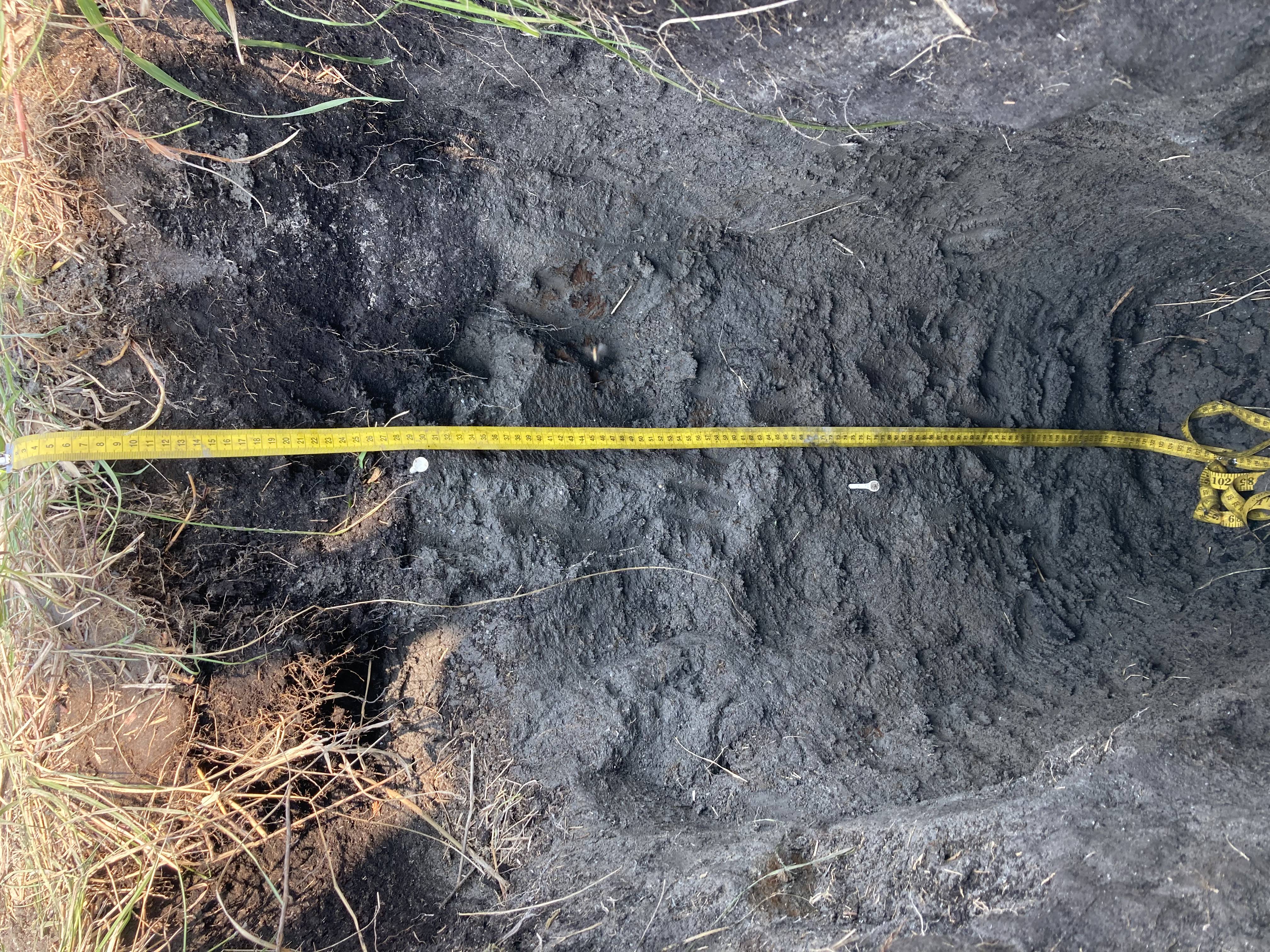

The B horizon (subsoil) is the zone of accumulation, or illuviation, where materials washed from above are deposited. Depending on the environment, the B horizon may be enriched in clay (Bt), iron oxides (Bs), calcium carbonate (Bk), or translocated organic matter (Bh).2 Below the B horizon lies the C horizon, consisting of partially weathered parent material that retains much of its original geological character, and beneath that the R horizon of unweathered bedrock. Not every soil contains all horizons; the specific combination present reflects the balance of the five soil-forming factors acting at that site.6
Typical soil horizon sequence and characteristics2, 6
| Horizon | Name | Key characteristics |
|---|---|---|
| O | Organic | Decomposing plant litter; high organic content |
| A | Topsoil | Mineral layer enriched in humus; dark colour; biologically active |
| E | Eluviated | Pale, leached zone; depleted of clays and iron oxides |
| B | Subsoil | Zone of accumulation; enriched in clay, iron, carbonates, or organic matter |
| C | Parent material | Partially weathered rock or sediment; little pedogenic alteration |
| R | Bedrock | Unweathered consolidated rock |
The role of biological activity
Life is not merely a passive inhabitant of soil but an active agent in its creation. The concept of the critical zone, the region extending from the top of the vegetation canopy to the base of groundwater, emphasises that biological, chemical, and physical processes are inseparable in the transformation of rock to soil.5 Plant roots exert mechanical forces that fracture rock along joints and grain boundaries, while the organic acids they exude accelerate the dissolution of minerals by orders of magnitude compared to pure water.4, 7 Mycorrhizal fungi, which form symbiotic associations with the roots of more than 80 percent of terrestrial plant species, are particularly effective mineral weatherers; their hyphae penetrate into rock along microfractures and dissolve minerals through targeted acid secretion, extracting phosphorus, potassium, and other nutrients that are then transferred to the host plant.7
Soil microorganisms, including bacteria and archaea, mediate virtually all of the biogeochemical transformations that occur in soil: nitrogen fixation, nitrification, denitrification, organic matter decomposition, and the cycling of sulfur, iron, and manganese.2 The organic matter they produce and decompose generates humic substances that bind mineral particles into stable aggregates, creating the porous structure essential for water retention and root growth. Without biological activity, the weathering mantle would remain a sterile regolith of fragmented rock, lacking the organic horizons, nutrient cycling, and structural organisation that define true soil.5
Soil classification systems
The enormous diversity of soils has prompted the development of formal classification systems analogous to biological taxonomy. The two most widely used frameworks are USDA Soil Taxonomy and the World Reference Base for Soil Resources (WRB). USDA Soil Taxonomy, maintained by the Natural Resources Conservation Service, classifies soils into 12 orders based on diagnostic horizons and measurable properties such as moisture regime, temperature regime, base saturation, and clay mineralogy. The orders range from Entisols (minimally developed soils with no diagnostic horizons) to Oxisols (deeply weathered tropical soils dominated by iron and aluminium oxides).10 The WRB, developed under the auspices of the International Union of Soil Sciences and the Food and Agriculture Organization, uses a system of 32 reference soil groups with qualifying prefixes and suffixes, providing a common international language for soil description and correlation.11
Paleosols as geological records
When ancient soils are buried by sediment, lava flows, or volcanic ash and preserved in the rock record, they become paleosols — fossil soils that serve as archives of past environmental conditions.
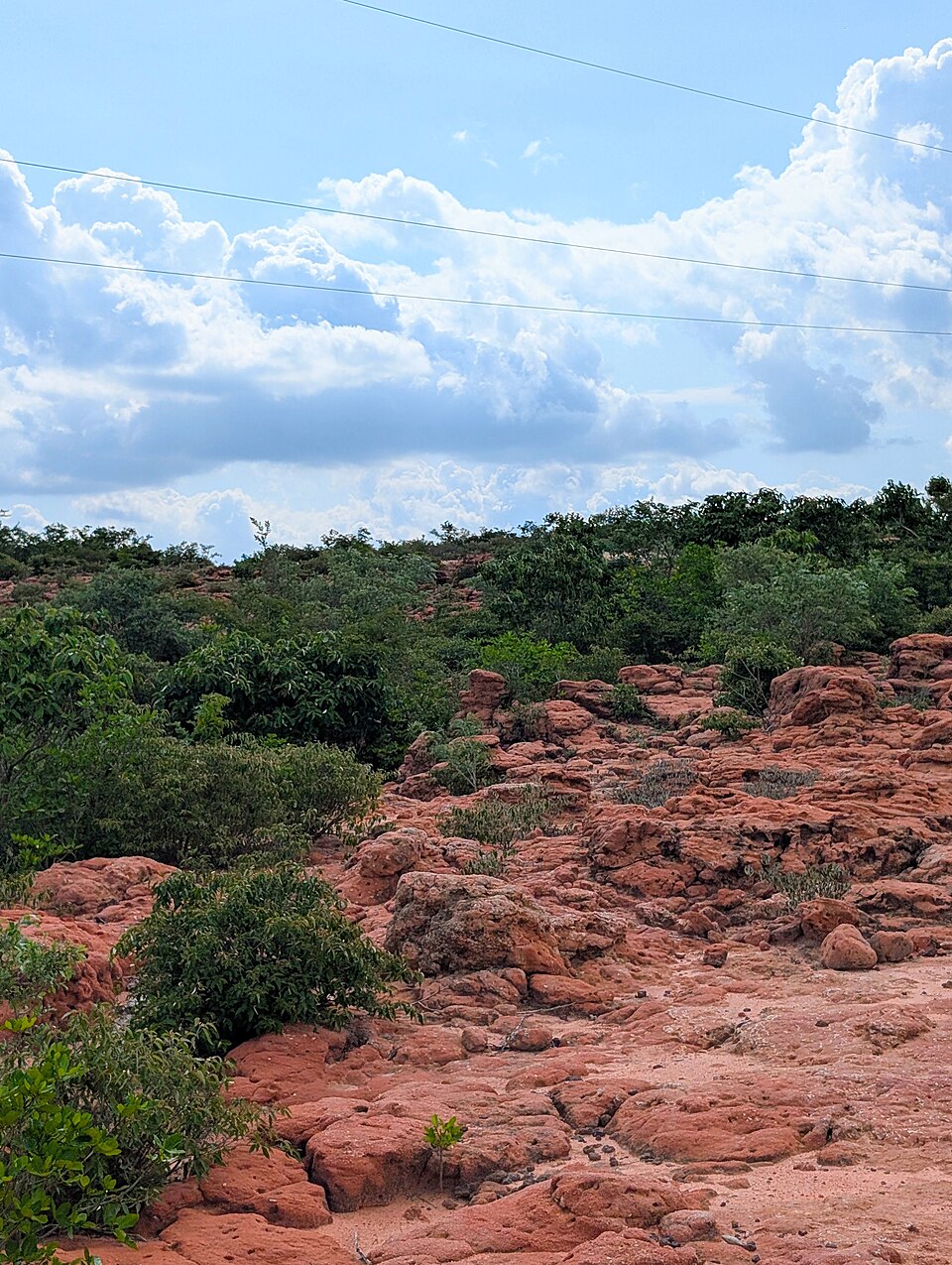

Precambrian paleosols are particularly valuable because they record conditions on the early Earth. The absence of iron depletion in paleosols older than about 2.4 billion years, combined with the presence of detrital pyrite and uraninite, provides independent evidence for an anoxic atmosphere before the Great Oxidation Event.12, 16 Some of the oldest reported paleosols, from the Isua Greenstone Belt in Greenland, may date to approximately 3.7 billion years ago, suggesting that weathering processes were active on Earth's surface within the first billion years of the planet's history.13
Timescales of soil development
Soil formation is geologically slow. Field studies using chronosequences, series of soils of known but different ages developed on the same parent material, indicate that the production of one centimetre of soil from hard rock typically requires 200 to 1,000 years, depending on climate, lithology, and biological activity.14 In alpine and periglacial environments where chemical weathering is sluggish, rates may be even slower, with soil production on silicate bedrock measured at as little as 10 to 50 millimetres per thousand years.15 On unconsolidated deposits such as glacial till or volcanic ash, initial horizon development can be detectable within decades, but the formation of mature, well-differentiated profiles with clay-enriched B horizons typically requires tens of thousands to hundreds of thousands of years.6, 14
These rates have profound practical implications. Modern agricultural soils that took millennia to develop can be eroded in decades by poor land management. Global soil erosion rates on conventionally tilled cropland average 10 to 100 times the rate of new soil formation, representing a net loss of a non-renewable resource on human timescales.17 The disparity between the rate at which soil is created and the rate at which it can be destroyed underscores the importance of understanding pedogenesis not only as a geological process but as a foundation for the sustainability of terrestrial ecosystems and agriculture.