Overview
- The geological column is the composite stratigraphic sequence compiled by overlapping rock sections from around the world, establishing a globally consistent order of fossil assemblages that was worked out by Christian geologists — William Smith, Georges Cuvier, and Alexandre Brongniart — in the early nineteenth century, before Darwin and before radiometric dating, using only the physical superposition of fossils in rock.
- The principle of faunal succession holds that fossil assemblages follow one another in the same vertical order everywhere on Earth, and this order has since been independently confirmed by radiometric dating, paleomagnetism, chemostratigraphy, and orbital cycle analysis, each of which produces consistent ages without reference to the fossil record.
- Flood geology’s claim that the column is a fiction, or that a global flood could produce its ordered sequence, fails on every physical test: no mixing of Cambrian marine fauna with Mesozoic dinosaurs, no Precambrian mammals, no flood mechanism capable of sorting microscopic pollen grains into their observed evolutionary sequence — and the column exists intact in more than two dozen deep drill cores.
The geological column is the composite, globally integrated sequence of rock strata and fossil assemblages that defines the known history of life on Earth. No single location exposes the entire column from Cambrian to Recent, but the sequence has been assembled from thousands of overlapping outcrop sections and drill cores whose fossil contents overlap sufficiently to establish an unambiguous vertical order. Every major geological period — Cambrian, Ordovician, Silurian, Devonian, Carboniferous, Permian, Triassic, Jurassic, Cretaceous, Paleogene, Neogene, Quaternary — is defined by a characteristic set of fossil taxa that succeeds the assemblage below it and precedes the assemblage above, with the same order reproduced on every continent where sedimentary rocks of those ages are preserved.5, 14
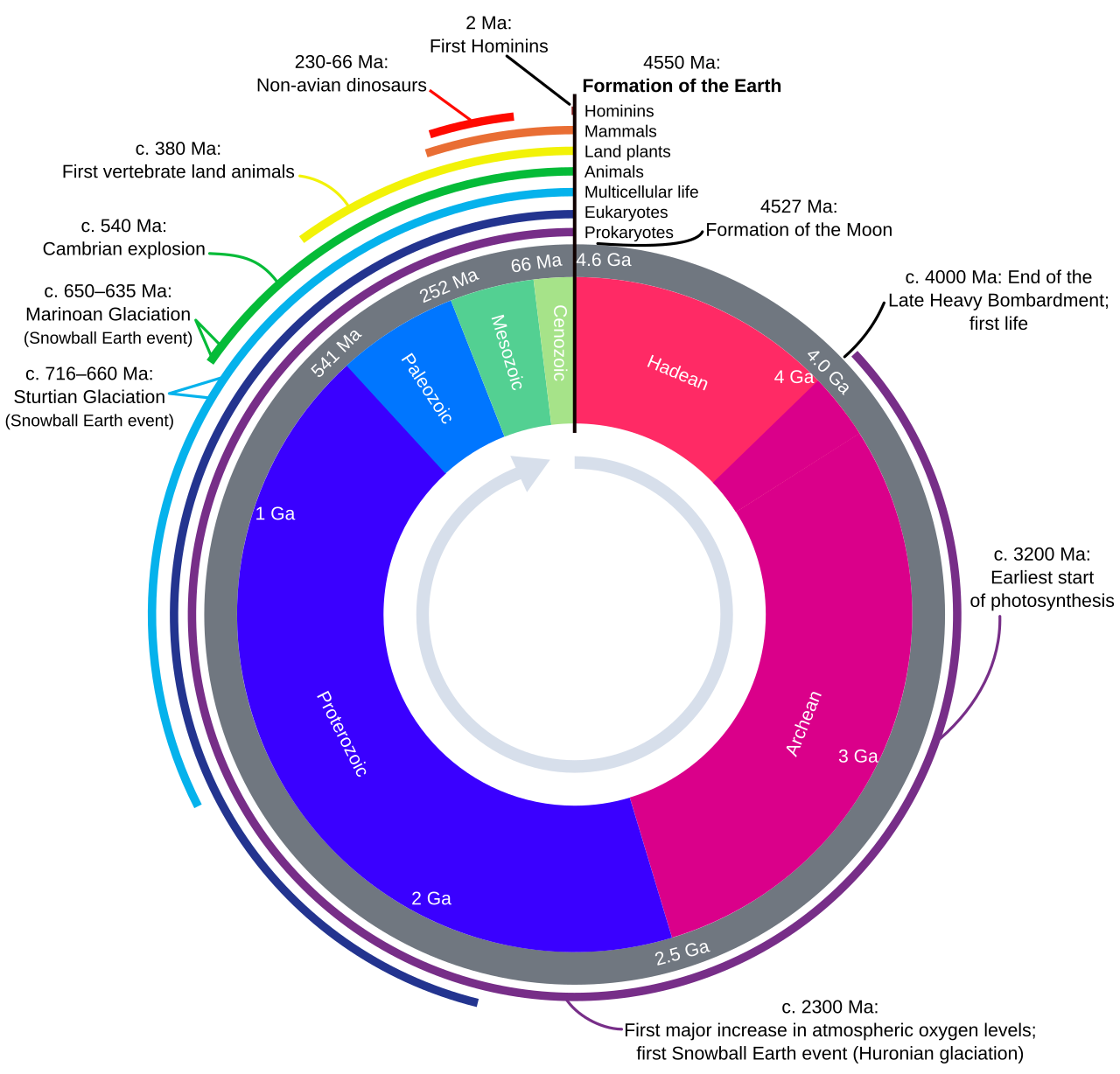

The column is not a theoretical construct imposed on ambiguous data. It is an empirical observation with the same status as any replicated experimental finding: observers in England, France, Germany, North America, China, and Australia working independently have all recovered the same ordered succession of fossil assemblages from their local rock sequences. This universal agreement on order was the central discovery of early nineteenth-century geology, and it was made before evolutionary theory provided an explanation for it, before radiometric dating provided numerical ages, and in many cases by men who were active members of the Christian clergy.4, 7
How the column was constructed
The recognition that rock layers contain a predictable and consistent succession of fossils is attributed principally to William Smith (1769–1839), a canal surveyor and self-trained geologist who spent decades traversing the English countryside mapping the rock formations exposed in canal cuts, quarry faces, and river banks. Smith observed that each distinct rock unit contained its own characteristic suite of fossils, that the same fossils recurred in the same unit wherever it was traced across the country, and that the units themselves always occurred in the same vertical order. He summarized his findings in the 1815 geological map of England and Wales — the most accurate and comprehensive geological map yet produced anywhere in the world — and in the accompanying memoir, which established the principle that strata could be identified and correlated by their fossil contents.1, 2
Working entirely independently in France, the anatomist Georges Cuvier and the mineralogist Alexandre Brongniart reached the same conclusions from their study of the Paris Basin. Their 1811 Essai sur la géographie minéralogique des environs de Paris documented the alternating marine and freshwater formations around Paris, each with a distinct fauna, and demonstrated that the faunas succeeded one another in a consistent stratigraphic order that could be correlated with formations of similar age in England.3 Cuvier was a devout Protestant and an opponent of transformism (the precursor to evolutionary theory). His stratigraphic work was motivated by a desire to document the history of life as revealed by the rocks, not to demonstrate biological change. The consistency of faunal succession was therefore an empirical finding, not a theoretical prediction derived from any theory of biological change.3, 9
By the 1820s and 1830s, English and continental geologists had collaboratively established the sequence of geological periods from the Cambrian (named by Adam Sedgwick) through the Carboniferous and Permian. The names Jurassic and Cretaceous came from French and German workers; Triassic from German sections; Devonian from a heated dispute resolved by Sedgwick and Roderick Murchison working on south-west England. Each period was defined by its distinctive fossil fauna, and the order of periods was consistent across all the European and North American sections examined.4, 14 Charles Darwin’s On the Origin of Species was not published until 1859 — two to three decades after the geological column had been assembled in its essential form. The column was built by observation, not by theory.17
The principle of faunal succession
The principle of faunal succession states that fossil assemblages succeed one another in a definite, recognizable, and reproducible order. This principle was formulated inductively from the data: geologists observed that wherever rocks from a given time interval were found, they contained the same suite of fossils, and that this suite was consistently above one set of assemblages and consistently below another. The inference was that the order of fossils reflects the order in which organisms lived and died, preserved in sequence by the process of burial and lithification.14, 6
The implications of the principle are testable and have been tested repeatedly. If faunal succession holds universally, then trilobites — which are characteristic of Paleozoic rocks — should never occur above the Permian-Triassic boundary in any section anywhere in the world. They do not. If the principle holds, Cretaceous ammonites should never be found above Cretaceous strata. They are not. If it holds, mammals with modern body plans should appear only in Cenozoic rocks. They do. In over two centuries of systematic collection from every continent, including Antarctica, not a single verified exception to the ordered succession of major fossil groups has been found.6, 18
The global consistency of faunal succession is especially striking because it holds across radically different depositional environments. Marine limestones in Kansas, coal-measure swamp deposits in Wales, desert red beds in Arizona, and deep-ocean sediments in the Pacific all yield fossil assemblages that fall in the same stratigraphic order. The organisms preserved in these environments were ecologically diverse, geographically separated, and preserved by entirely different sedimentary processes, yet their ordered succession is invariant. This universality is precisely what evolutionary theory predicts and what any alternative model of fossil ordering must explain.6, 10
Independent radiometric confirmation
The geological column was constructed entirely from physical superposition and fossil succession, without any knowledge of radioactive decay or absolute ages. When radiometric dating methods were developed in the early twentieth century and refined through the mid-century, they provided a completely independent test of the stratigraphic sequence: if the column was correctly assembled, the numerical ages assigned by radiometric methods should increase with depth in conformity with the established fossil order. They do, without exception.8, 15
The concordance between fossil order and radiometric age has been demonstrated using multiple decay systems — uranium-lead, potassium-argon, rubidium-strontium, samarium-neodymium, and rhenium-osmium — each based on different parent and daughter isotopes with different chemical properties and decay rates.8 Volcanic ash layers (bentonites and tephras) interbedded with fossil-bearing sedimentary sequences provide the primary tie points, since zircon crystals in volcanic ash can be dated with precision using uranium-lead methods and their stratigraphic position within the fossil sequence is directly observable. At every level tested, the radiometric ages are consistent with the fossil order: Cambrian rocks date to approximately 485–539 million years, Devonian rocks to approximately 359–419 million years, Cretaceous rocks to approximately 66–145 million years, and so on through the column.5, 8
This concordance is not circular. The fossil order was established before radiometric dating existed and without reference to numerical ages. The radiometric ages were then measured independently and found to match. That two completely different methods of ordering — one biological, one physical-chemical — agree with each other is a powerful verification of both. If either method were systematically wrong, the agreement would not be expected.8, 15 The column has since been further confirmed by a third independent method: astronomical tuning of cyclic sedimentary sequences to the calculated history of Earth’s orbital variations (Milankovitch cycles), which provides age control independent of both fossils and radiometric decay.5
The column in physical rock
A persistent creationist objection holds that the geological column does not exist as a physical reality — that it is merely a conceptual composite, assembled from scattered sections around the world, and that no single location shows the full Phanerozoic sequence from Cambrian to Recent. The first part of this objection is technically correct but misleading; the second part is false.6, 7
The column is assembled from overlapping sections in the same way that a reference genome is assembled from overlapping sequencing reads. No single read spans the full genome, but the overlaps are sufficient to establish the order unambiguously. In stratigraphy, the overlaps between local sections allow geologists to trace formations laterally and vertically until the complete sequence from oldest to youngest is documented. This is standard practice in every sedimentary basin on Earth and is the basis of the entire petroleum exploration industry, which locates hydrocarbon reservoirs by applying the column to subsurface drill data.14
The claim that the full column nowhere exists in one place is also simply incorrect. Deep drill cores recovered from stable cratonic basins — ancient, tectonically quiet areas of continental crust — commonly penetrate the full Phanerozoic sequence from Quaternary down to Cambrian without significant gaps. The Williston Basin of North Dakota contains a near-complete Phanerozoic record in its subsurface drill cores, with formations from every geological period stacked in their expected order from the Cambrian through the Cenozoic.13 The Michigan Basin, the Illinois Basin, the Amadeus Basin of central Australia, and numerous other cratonic depocenters preserve similarly complete sequences. Deep-sea sediment cores recovered by the Ocean Drilling Program and its successors contain complete Cenozoic and Mesozoic sequences from seafloor basalts upward, with the fossil order confirmed meter by meter through the cores.12 More than 25 locations worldwide have been identified where the stratigraphic column is complete or nearly complete through the full Phanerozoic eon.6
Why flood geology cannot produce the column
The primary creationist alternative to the standard geological column is the claim that the ordered fossil sequence was produced by a global flood: organisms living at different depths or ecological zones were buried successionally as flood waters rose, producing an apparent sequence from marine bottom-dwellers to high-elevation terrestrial forms. This hypothesis, advanced under the label of flood geology, makes specific, testable predictions about the fossil record and fails each of them.7, 9
The ecological zonation argument holds that trilobites and other marine invertebrates appear at the bottom of the column because they lived on the seafloor and were buried first, while dinosaurs and mammals appear higher because they were more mobile and could escape rising waters longer. This predicts that organisms sharing the same ecological zone should occur together in the column. They do not. Marine fish occur at every level from the Ordovician to the Recent, spanning over 450 million years of the column, not concentrated at the base. Marine reptiles (ichthyosaurs, plesiosaurs, mosasaurs) are restricted to Mesozoic rocks despite being marine animals in the same ecological zone as fish that persist through the column. If ecological zonation were the sorting mechanism, marine reptiles and marine fish should be mixed throughout the column. They are not.6, 7
The problem is acute for pollen. Pollen grains are microscopically small, lighter than virtually any other biological structure, and easily transported by water. Under any hydrodynamic sorting mechanism, pollen should be uniformly distributed throughout the flood deposit, or concentrated near the top. Instead, pollen shows a precise stratigraphic pattern: no angiosperm (flowering plant) pollen appears before the Cretaceous, no grass pollen before the Eocene, no spruce or fir pollen before the Cenozoic. The lightest and most water-mobile biological particles are restricted to the upper portions of the column not because they floated there, but because the plants that produced them had not yet evolved.6
The absence of expected mixtures is equally diagnostic. In the entire history of systematic fossil collecting, no verified trilobite has ever been found in the same stratum as a dinosaur. No verified mammal with a modern body plan has been found in Paleozoic rock. No Cambrian-age marine fauna has been found interbedded with Cenozoic terrestrial mammals. These absences are precisely what evolutionary theory and the standard column predict: these organisms did not coexist, so they could not be buried together. A global flood, scouring every environment simultaneously, would inevitably mix organisms from different ecological zones and different geographic regions. The column shows no such mixing, at any scale, anywhere on Earth.6, 10
An additional problem is the existence of features between strata that are incompatible with continuous submersion: mature paleosols with root traces and weathering horizons, desert dune cross-bedding with reptile trackways, evaporite sequences requiring prolonged subaerial desiccation, and in-place coral reef frameworks hundreds of meters thick. These features occur not at a single level that might be attributed to a pre-flood land surface, but at dozens of levels throughout the column, each separated by fully marine or lacustrine sediments. Each such feature independently requires an interval of non-submersion lasting from decades to millions of years, distributed throughout the sequence that flood geology attributes to a single year-long event.7, 11
The column as a falsification test
One of the most important features of the geological column as a scientific construct is its falsifiability. The evolutionary interpretation of the column makes a specific, unambiguous prediction: no organism with an advanced body plan should appear before the organisms from which it is supposed to have descended. A Precambrian rabbit — a mammal in rock layers predating the appearance of the first vertebrates — would overturn the entire framework. The British geneticist J. B. S. Haldane is reported to have offered exactly this as his criterion for falsifying evolution when challenged by a creationist: “fossil rabbits in the Precambrian.” No such fossil has ever been found.6
The standard is not merely rhetorical. Paleontologists actively look for anomalous occurrences. Every new fossil find is placed in stratigraphic context, and the geological community would be electrified by a genuine example of a derived organism in strata far older than its inferred origin. The history of paleontology includes revisions to the estimated first appearances of many groups — the known range of flowering plants, for instance, has been pushed back as older specimens are identified — but no such revision has ever placed a derived group below its ancestral groups in the stratigraphic sequence. Vertebrates always appear above invertebrates. Tetrapods always appear above fish. Amniotes always appear above amphibians. Mammals always appear above reptiles.18, 6
The repeated confirmation of this order across hundreds of thousands of fossil localities, collected by researchers with competing theoretical commitments, in rock of every type and age, constitutes one of the strongest sustained empirical tests in all of natural science. The geological column is not merely consistent with evolutionary theory; it would be utterly inexplicable without it. No alternative framework has ever been proposed that accounts for the globally consistent, non-mixed, hierarchically ordered fossil record without invoking the evolutionary origin and extinction of successive life forms over deep time.6, 10, 17
Significance and applications
The practical applications of the geological column extend far beyond academic geology. The entire global petroleum and natural gas industry is organized around it. Subsurface formations are identified by their biostratigraphic content — the characteristic index fossils they contain — and correlated between drill wells using the column as a reference framework. Formation tops, reservoir intervals, and source rock horizons are defined by their position in the column, which allows exploration geologists to predict the subsurface geology of undrilled areas from the surface outcrop pattern and the drill record of nearby wells.14 The column is similarly foundational to aquifer mapping, mining exploration, civil engineering site assessment, and natural hazard evaluation.
In evolutionary biology, the column provides the temporal scaffold on which the history of life is read. The timing of major evolutionary events — the Cambrian explosion of animal body plans, the colonization of land by vascular plants, the diversification of mammals following the end-Cretaceous extinction — is determined from the stratigraphic positions of the relevant fossils and the radiometric ages of the surrounding strata.16, 18 The column also provides the primary record of past mass extinctions, whose timing, geographic extent, and biological selectivity are read from the pattern of last occurrences in the fossil sequence. Without the column, there would be no way to establish the sequence of evolutionary events or to test hypotheses about the causes of biological change through Earth history.5, 18
The column was built by patient empirical work over more than two centuries, by geologists who were in many cases motivated by religious conviction and who would have had every reason to report anomalies had they found them. Its consistency, its independence from the theory it later came to support, and its confirmation by multiple independent dating methods make it one of the most thoroughly tested constructs in science. The order of the fossil record is not an assumption; it is an observation, replicated on every continent, in every ocean basin, and in thousands of drill cores reaching kilometers into the crust of the Earth.6, 7, 10
References
Memoir to the Map and Delineation of the Strata of England and Wales, with Part of Scotland
Stratigraphic completeness of the deep-sea sediment record and implications for paleoclimate
The complete Phanerozoic record at the Williston Basin, North Dakota: a deep-borehole stratigraphic study
Convergent evolution of similar phenotypes but different genomes in Cambrian-period fossils