Overview
- The Acheulean industry is defined by the production of large bifacially flaked tools — most iconically the handaxe — and represents the longest-lasting and most geographically widespread stone tool tradition in human prehistory, spanning from approximately 1.76 million years ago in East Africa to as recently as 250,000 years ago in parts of Europe and the Levant.
- Acheulean handaxes display a degree of bilateral symmetry, standardized form, and imposed design that far exceeds the cognitive demands of earlier Oldowan technology, with neuroimaging studies showing that handaxe manufacture activates prefrontal cortex and language-related brain regions not recruited during simpler flake production.
- The geographic distribution of the Acheulean has long been debated through the lens of the Movius Line, a boundary proposed in 1948 to separate handaxe-bearing assemblages in Africa, Europe, and western Asia from the supposedly handaxe-free industries of East and Southeast Asia — a dichotomy now recognized as considerably more complex than originally conceived.
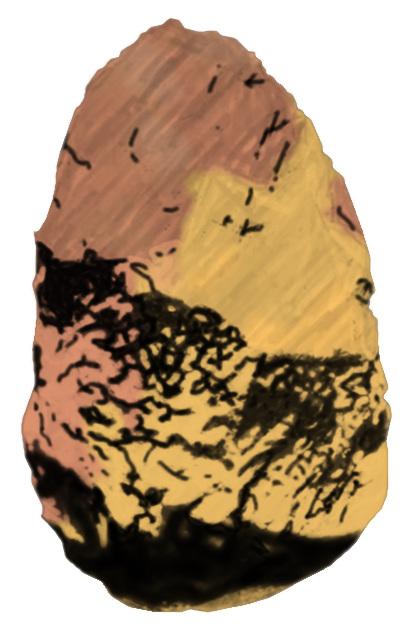
The Acheulean industry, named after the site of Saint-Acheul in the Somme Valley of northern France, represents one of the most remarkable phenomena in the entire human archaeological record: a stone tool tradition characterized by large, bifacially flaked tools — most notably the handaxe — that persisted with recognizable continuity for more than 1.5 million years across three continents.8, 1 First appearing in the West Turkana region of Kenya approximately 1.76 million years ago, the Acheulean spread throughout Africa, into the Levant, the Indian subcontinent, the Arabian Peninsula, and Europe, surviving in some regions until as recently as 250,000 to 200,000 years ago.1, 7 The Acheulean handaxe — a teardrop or oval-shaped stone tool flaked on both faces to produce a symmetrical, pointed implement — is arguably the most iconic artifact in all of prehistoric archaeology, and its production demanded cognitive, motor, and planning abilities that substantially exceeded those required for the earlier [Oldowan industry](/human-evolution/oldowan-industry).3, 6

Origins in East Africa
The earliest securely dated Acheulean artifacts come from the Kokiselei site complex in the Nachukui Formation, West Turkana, Kenya, where Lepre and colleagues recovered bifacially flaked handaxes and picks from sediments dated by paleomagnetic methods to approximately 1.76 million years ago.1 This date pushed the origin of the Acheulean back by several hundred thousand years from previous estimates and demonstrated that the transition from Oldowan to Acheulean technology occurred earlier than had been supposed. At Konso in southern Ethiopia, Beyene and colleagues documented a rich sequence of Acheulean assemblages spanning from 1.75 to 0.85 million years ago, providing an unparalleled record of technological change within the Acheulean tradition over nearly a million years at a single locality.2
The earliest Acheulean handaxes are relatively crude compared to later examples: they are thick, asymmetrical, and bear irregular flake scars that suggest the knappers were still developing the technical skills needed to impose a predetermined form on a stone blank.2, 8 Over the following million years, Acheulean handaxes became progressively thinner, more symmetrical, and more standardized in outline, a trajectory that has been interpreted as evidence for cumulative technological learning and, potentially, for the social transmission of knapping techniques from one generation to the next.9, 10 The transition from Oldowan to Acheulean was not abrupt: at many East African sites, Oldowan-style core-and-flake assemblages continued to be produced alongside early Acheulean bifaces, suggesting a period of technological overlap that may have lasted several hundred thousand years.8, 5
Bifacial technology and the handaxe form
The Acheulean is defined by the production of large cutting tools — handaxes, cleavers, and picks — that are shaped by removing flakes from both faces (bifacial flaking) of a large stone blank, which may be a cobble, a large flake struck from a boulder, or a slab of raw material.8, 5 The handaxe, the signature artifact of the tradition, is typically worked into a teardrop, ovate, or pointed planform with a roughly lenticular cross-section, producing a tool with a continuous cutting edge around much or all of its perimeter.3 Cleavers, which are more common in African than in European assemblages, have a broad, unretouched cutting edge at one end, formed by a single large flake removal, and are thought to have functioned as heavy-duty chopping and butchering tools.5
Sharon documented a widespread pattern of "giant core technology" in which Acheulean knappers first struck very large flakes — sometimes exceeding 30 centimetres in length — from boulder-sized cores and then shaped these large flake blanks into handaxes and cleavers through subsequent bifacial trimming.5 This technique, documented at sites across Africa, the Levant, and the Indian subcontinent, required the knapper to manage a two-stage reduction process: first producing a suitable blank through a carefully aimed blow on a massive core, then shaping the blank into a finished tool through a series of controlled removals.5 The cognitive demands of this process — mental rotation of three-dimensional forms, hierarchical planning across multiple reduction stages, and the maintenance of bilateral symmetry through dozens of individual flake removals — are substantially greater than those involved in Oldowan flake production.3, 6
Symmetry, aesthetics, and cognitive complexity
The bilateral symmetry of Acheulean handaxes has long fascinated archaeologists and cognitive scientists. Thomas Wynn argued that the imposition of symmetry on a stone tool requires the knapper to hold a mental template of the desired final form and to adjust each flake removal in relation to that template, a capacity he linked to the cognitive domain of spatial reasoning and, potentially, to an emerging aesthetic sensibility.3 Lycett and von Cramon-Taubadel applied multivariate statistical methods to handaxe shape data and demonstrated that Acheulean handaxes are significantly more standardized in form than would be expected from unconstrained flaking, supporting the hypothesis that knappers were working toward a culturally transmitted ideal shape rather than simply reducing cores opportunistically.4
Neuroimaging studies by Stout and colleagues have provided direct evidence that Acheulean handaxe production engages brain regions not recruited during Oldowan flake production. Using positron emission tomography, Stout's team showed that experienced knappers producing Acheulean-style handaxes displayed significant activation of the right ventral prefrontal cortex, the right inferior frontal gyrus, and the supramarginal gyrus — regions involved in hierarchical action planning, mental rotation, and complex working memory.6 The activation of the right inferior frontal gyrus, a region homologous to Broca's area in the left hemisphere, has been interpreted as evidence for a deep evolutionary connection between stone toolmaking and the neural substrates of language, though the nature of this connection — whether toolmaking provided a scaffold for language evolution or whether both capacities drew on a shared underlying cognitive architecture — remains vigorously debated.6, 10
Whether Acheulean symmetry reflects genuine aesthetic awareness, functional optimization, or an inevitable by-product of systematic bifacial reduction remains an open question. Corbey and colleagues argued that the remarkable consistency of handaxe form across time and space may reflect innate perceptual biases and biomechanical constraints rather than culturally transmitted design conventions, comparing the handaxe to a bird's song — a complex but largely genetically canalized behaviour — rather than a culturally learned artifact like a musical composition.9
Geographic spread and the Movius Line
The Acheulean spread beyond Africa at least as early as 1.4 million years ago, reaching the Levant, the Indian subcontinent, and eventually Europe. Acheulean sites are documented across a vast swath of the Old World, from the Atlantic coast of Morocco and Spain to the Arabian Peninsula and the Indian subcontinent, and from southern Africa to the chalk downlands of England.8, 12 The tradition is associated primarily with [Homo erectus](/human-evolution/homo-erectus) in Africa and Asia and with [Homo heidelbergensis](/human-evolution/homo-heidelbergensis) in Europe and the Levant, though the precise taxonomic attribution at many sites remains uncertain.8, 13
In 1948, the American archaeologist Hallam Movius proposed a geographical boundary — later known as the Movius Line — running from northern India through Southeast Asia, separating the handaxe-bearing Acheulean tradition of the west from the simpler chopper-chopping tool industries of East and Southeast Asia.14, 8 Movius interpreted this dichotomy as evidence for a fundamental cultural divide between western and eastern populations of Homo erectus. However, subsequent discoveries have complicated this picture considerably. Handaxe-like bifaces have been found at several sites east of the Movius Line, including the Bose Basin in southern China, where Yamei and colleagues reported handaxes dated to approximately 800,000 years ago.15 Norton and Bae argued that the Movius Line should be reconsidered as a zone of decreasing handaxe frequency rather than a sharp boundary, and that the scarcity of handaxes in eastern Asia may reflect raw material availability, ecological factors, or the use of perishable tools such as bamboo rather than a fundamental cognitive or cultural deficiency.14
Late Acheulean refinement and the transition to the Middle Stone Age
The final phases of the Acheulean, spanning roughly 500,000 to 250,000 years ago, are characterized by increasingly refined handaxes that display remarkable thinness, precise symmetry, and evidence for sophisticated flaking techniques including soft-hammer percussion (using bone, antler, or wooden hammers rather than stone) and platform preparation.8, 7 Some Late Acheulean assemblages include early examples of the Levallois technique — a method of preparing a core so that a flake of predetermined shape and size can be removed in a single blow — which would become the hallmark technology of the Middle Stone Age in Africa and the Middle Palaeolithic in Europe.11
The transition from the Acheulean to Middle Stone Age / Middle Palaeolithic technologies was neither abrupt nor synchronous across the Old World. In East Africa, the Acheulean was largely replaced by Middle Stone Age technologies by approximately 300,000 to 250,000 years ago, coinciding roughly with the emergence of [Homo sapiens](/human-evolution/modern-humans-and-close-relatives). In the Levant, however, Acheulean-like assemblages persisted until as recently as 250,000 to 200,000 years ago, and in parts of India the tradition may have survived even later.7, 8 The endurance of the Acheulean tradition for more than 1.5 million years — far longer than any subsequent stone tool industry — raises profound questions about the nature of cultural transmission, the rate of cognitive evolution, and the relationship between technology and biological change in deep human prehistory. Whether its remarkable longevity reflects the adaptive success of a versatile multipurpose tool, the cognitive limitations of its makers, or the conservatism of cultural traditions transmitted without the aid of language remains one of the central questions in Palaeolithic archaeology.9, 10
References
Statistical assessment of multivariate normality in the hominin fossil record and its implications for handaxe shape analysis
Neural correlates of Early Stone Age toolmaking: technology, language and cognition in human evolution
Late survival of Acheulean in the Levant and implications for hominin evolutionary scenarios