Overview
- Australopithecus sediba, discovered in 2008 at the Malapa site in South Africa by Lee Berger's nine-year-old son Matthew, is known from two remarkably complete skeletons dated to approximately 1.98 million years ago, making it one of the youngest known australopithecines.
- The species displays a striking mosaic of primitive australopith features and derived Homo-like traits, including a small but reorganized brain, human-like pelvis and hand capable of precision grip, yet long ape-like arms suited for climbing.
- Whether Au. sediba represents a direct ancestor of the genus Homo or a parallel evolutionary experiment has provoked one of the most intense phylogenetic debates in modern paleoanthropology.
Australopithecus sediba is an extinct hominin species first described in 2010 from fossils recovered at the Malapa cave site in the Cradle of Humankind World Heritage Site, Gauteng Province, South Africa.1 The species name, "sediba," means "fountain" or "wellspring" in the Sotho language, reflecting lead researcher Lee Berger's claim that the species may represent the origin of the genus Homo.1 Known primarily from two remarkably well-preserved partial skeletons of an adult female (MH2) and a juvenile male (MH1, the holotype), Au. sediba presents an extraordinary mosaic of australopith-like and Homo-like features that has placed it at the center of debates about the evolutionary transition between australopithecines and the earliest members of our own genus.1, 2
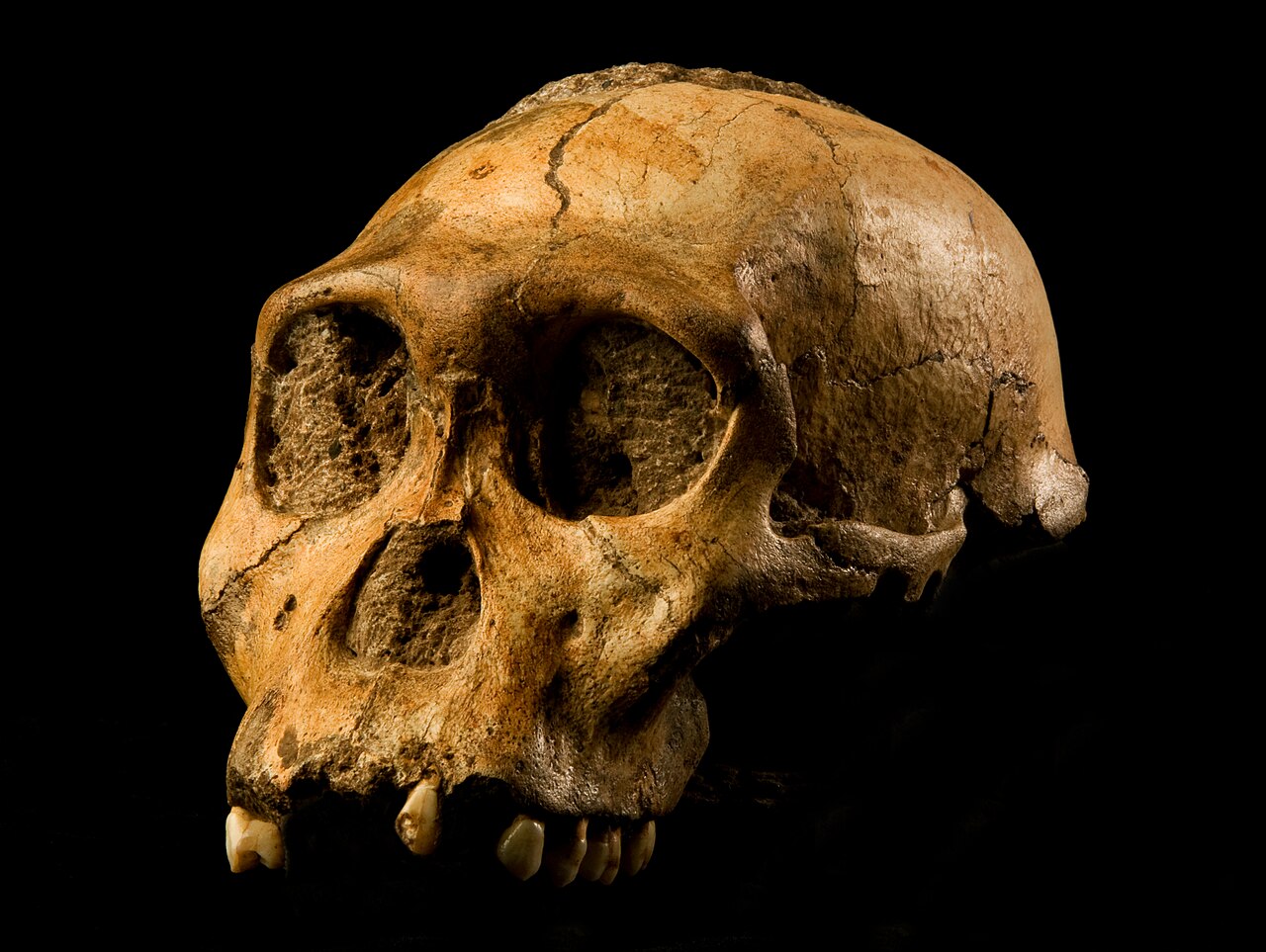

Discovery at Malapa
The discovery of Au. sediba has an improbable origin story. On August 15, 2008, nine-year-old Matthew Berger, son of paleoanthropologist Lee Berger of the University of the Witwatersrand, stumbled upon a fossil-bearing block of calcified sediment while exploring near his father at the Malapa site, located approximately 15 kilometers northeast of the well-known Sterkfontein caves.1, 3 The block contained a hominin clavicle, and subsequent excavation revealed a partial skeleton of a juvenile male, designated MH1, which became the holotype specimen for the new species.1 Within meters of MH1, a second partial skeleton belonging to an adult female, designated MH2, was recovered from the same sedimentary unit.1
The Malapa site is a de-roofed cave, meaning that the original cave roof has eroded away over time, exposing the fossil-bearing breccia to the surface. The hominin remains were preserved in a calcified clastic sediment known as facies D, which represents a debris flow that washed into the cave through a vertical shaft.3 Dirks and colleagues interpreted the taphonomic evidence as consistent with a scenario in which the two individuals, and possibly others, fell into the cave shaft, perhaps attracted by water at its base, and were then rapidly buried by a subsequent debris flow that sealed their remains in a natural tomb.3 The exceptional preservation of the skeletons, with many bones found in near-anatomical association and minimal carnivore damage, supports this rapid-burial hypothesis.3
Dating and geological context
The geological age of Au. sediba has been established through multiple independent dating methods. Initial uranium-lead dating of the flowstone capping the fossil-bearing sediment yielded an age of approximately 1.977 million years, providing a minimum age for the fossils.4, 13 Paleomagnetic analysis of the sediments confirmed this estimate, identifying a normal polarity interval consistent with deposition during the Olduvai subchron (1.95–1.78 Ma) or just before it.3 The combined evidence places the Au. sediba fossils at approximately 1.977 million years ago, with a tight uncertainty range of only a few thousand years, making this one of the most precisely dated hominin sites in Africa.4
This age is significant because it places Au. sediba roughly contemporaneous with the earliest fossils attributed to the genus Homo in East Africa, including specimens of Homo habilis from Olduvai Gorge.1, 13 Berger and colleagues argued that this chronological overlap does not preclude Au. sediba from being ancestral to Homo, since the earliest East African Homo fossils are fragmentary and their taxonomic assignments are debated.1 Critics, however, have pointed out that a jaw fragment attributed to Homo from Ledi-Geraru, Ethiopia, dates to approximately 2.8 million years ago, predating Au. sediba by some 800,000 years and making a direct ancestor-descendant relationship difficult to sustain without invoking ghost lineages.10
Mosaic anatomy
The defining characteristic of Au. sediba is its mosaic morphology, in which different parts of the body display different evolutionary grades. The brain, estimated at approximately 420 cubic centimeters from the juvenile MH1 endocast, falls within the range of other australopiths and well below the threshold traditionally used to define Homo.5 However, endocast analysis by Carlson and colleagues revealed that the frontal lobes of Au. sediba show a reorganization toward a more human-like configuration, with a shape that differs from Au. africanus and approaches the pattern seen in early Homo.5 This finding suggests that neural reorganization may have preceded significant brain expansion in hominin evolution.5
The hand of Au. sediba, described by Kivell and colleagues from MH2, combines a long, powerful thumb with relatively short fingers, a configuration more similar to modern humans than to other australopiths or even early Homo.6 The thumb-to-finger proportions and the morphology of the first metacarpal suggest that Au. sediba was capable of a forceful precision grip, the type of grip used in stone tool manufacture, while still retaining features associated with arboreal locomotion in the curved proximal phalanges.6 The pelvis, described by Kibii and colleagues, is remarkably human-like for an australopith. Its short, broad iliac blades and the orientation of the ischium more closely resemble the condition in Homo than in Au. africanus or Au. afarensis, suggesting a more efficient form of bipedal locomotion.7
In contrast to these derived features, the upper limbs of Au. sediba retain distinctly primitive proportions. The arms are long relative to the legs, and the shoulder and arm morphology indicate significant climbing ability.2 The foot presents its own mosaic: Zipfel and colleagues described a heel bone (calcaneus) that is more primitive than that of any known australopith, resembling the condition in great apes, yet the ankle joint shows features associated with bipedal weight transfer.8 The vertebral column shows evidence of lumbar lordosis, the inward curvature of the lower back characteristic of habitual bipeds, but with only four lumbar vertebrae rather than the five typical of modern humans.11 This region-by-region variation in evolutionary grade makes Au. sediba unlike any previously known hominin and illustrates that evolution did not advance uniformly across the body.2
Diet
Analysis of dental calculus and stable carbon isotopes from Au. sediba teeth by Henry and colleagues revealed a diet markedly different from that of other known australopiths. While most South African australopiths consumed significant quantities of C4 resources such as grasses or sedges, Au. sediba appears to have fed predominantly on C3 foods, including fruits, leaves, and bark from trees and shrubs.9 Phytolith analysis of the dental calculus preserved microscopic plant fragments, confirming the consumption of bark and woody plants, a dietary signal more similar to that of modern chimpanzees and savanna-woodland primates than to other contemporary hominins.9 This dietary evidence suggests that Au. sediba occupied a different ecological niche than sympatric hominins like Paranthropus robustus, potentially exploiting more wooded or forested habitats in the Cradle of Humankind region.9
Phylogenetic debate
The phylogenetic position of Au. sediba has been fiercely debated since the species was first announced. Berger and colleagues' original cladistic analysis placed Au. sediba as a sister taxon to the genus Homo, closer to Homo than either Au. africanus or Au. afarensis, and argued that it was the most plausible ancestor of Homo.1, 12 Irish and colleagues' expanded cladistic analysis in 2013 supported this position, recovering Au. sediba as a sister group to Homo + Au. africanus, though the authors acknowledged that the results were sensitive to which characters and taxa were included.12
Many paleoanthropologists remain skeptical of this placement. The primary objection concerns chronology: the earliest fossils attributed to Homo from East Africa predate Au. sediba, and a species cannot be ancestral to a lineage that already exists unless the known fossils are misidentified or the ancestor persisted alongside its descendants for a considerable period.10 De Ruiter and colleagues have argued that some of the supposedly derived cranial features of MH1 may be artifacts of its juvenile status, since the specimen represents a young individual whose adult morphology is unknown.10 Others have proposed that Au. sediba is better understood as a late-surviving descendant of Au. africanus that independently evolved some Homo-like features through convergent evolution rather than representing the actual ancestral stock of our genus.14
Regardless of whether Au. sediba is a direct ancestor of Homo, the species has transformed understanding of the australopith-Homo transition. Its mosaic anatomy demonstrates that the suite of features defining early Homo, including a reorganized brain, a precision-capable hand, and a human-like pelvis, did not necessarily evolve as a single integrated package but could be assembled incrementally, with different body regions evolving at different rates and potentially in different lineages.2, 15 The discovery has also reinforced the importance of South Africa, alongside East Africa, as a region central to understanding the origins of the genus Homo.15
References
Australopithecus sediba at 1.977 Ma and implications for the origins of the genus Homo
Australopithecus sediba and the emergence of Homo: questionable evidence from the cranium of the juvenile holotype MH 1
Australopithecus sediba at 1.977 Ma and implications for the origins of the genus Homo