Overview
- Upright walking on two legs is the defining locomotor hallmark of the hominin lineage, appearing in the fossil record at least 7 million years ago in Sahelanthropus tchadensis and fully expressed in Australopithecus afarensis by 3.7 million years ago, millions of years before significant brain enlargement.
- Bipedalism required a coordinated suite of skeletal redesigns across at least twelve anatomical regions—including the pelvis, femur, knee, ankle, foot, spine, and skull base—each of which is documented in successive hominin fossils from the Miocene and Pliocene.
- Multiple non-exclusive hypotheses explain why bipedalism evolved, including thermoregulatory advantage on open savanna, energetic efficiency relative to knuckle-walking, provisioning of offspring, postural feeding in woodland trees, and improved long-distance travel; experimental biomechanics and comparative anatomy continue to refine these models.
Of all the anatomical traits that distinguish humans from other living apes, the most ancient and arguably the most consequential is habitual upright walking on two legs—bipedalism. Every other member of the order Primates moves primarily on four limbs. Humans alone have committed to a locomotor strategy that frees both forelimbs completely from the demands of ground transport, reshaping every region of the skeleton from the feet to the base of the skull in the process. The fossil record traces this transformation across at least seven million years, from the earliest potential hominins of the late Miocene to the fully committed bipeds of the Pliocene, providing an unparalleled window into one of evolution's most dramatic experiments.1
Recognizing bipedalism in fossils requires understanding what obligate two-legged walking actually demands of the skeleton. Unlike the bent-knee, bent-hip gait of chimpanzees—which can walk upright but do so at high energetic cost—human bipedalism is characterized by extended limb posture, a striding heel-to-toe gait with a compliant arch in the foot, and a spine oriented vertically above a remodeled pelvis and hip joint. These demands imposed profound selective pressures on dozens of skeletal structures, and the resulting anatomical signatures are precisely what paleoanthropologists search for when evaluating a fossil's locomotor behavior.1, 23
The anatomical blueprint for bipedalism
The transition from the quadrupedal body plan shared by all other living apes to the obligate bipedal body plan of modern humans involved coordinated modification of at least twelve major anatomical regions. No single skeletal change is sufficient for bipedalism; the suite must be integrated for the system to function. Each modification is documented in the fossil record at different stages of hominin evolution, allowing researchers to reconstruct the sequence in which the changes accumulated.1, 23
The pelvis underwent the most dramatic transformation. In chimpanzees, the ilium (the large blade of the pelvis) is tall and blade-like, oriented mostly backward, directing the gluteal muscles toward hip extension. In humans, the ilium is short, broad, and laterally flared, wrapping around the side of the body. This repositions the gluteal muscles—particularly the gluteus medius and minimus—as abductors that prevent the trunk from collapsing sideways during single-leg stance, a critical requirement of walking where one foot is off the ground at a time.6, 23 The shortened ilium also lowers the body's center of mass and positions the trunk more directly over the hip joints, reducing the torques that would otherwise demand continuous muscular effort.6
The femur (thigh bone) is angled inward toward the knee in humans, producing a valgus, or bicondylar, angle of approximately 9 degrees. This positions the knees beneath the body's center of mass during the swing phase of gait, allowing a smooth, efficient stride rather than the side-to-side swaying required in chimpanzees walking upright. In apes, the femur is oriented more vertically below a laterally placed hip, requiring a pronounced lateral shift of the trunk with each step.18 The degree of valgus angulation is directly measurable in fossil femora and is one of the most reliable osteological indicators of habitual bipedalism.18
The knee joint itself expanded and its condyles (the rounded articular surfaces) became more symmetrical to bear the full body weight transmitted through a straight limb during stance. The ankle joint was reoriented so that weight passes through a stable, compact mortise joint rather than a grasping structure. The foot lost its opposable great toe, gaining instead a robust, non-divergent hallux fully aligned with the other toes; the longitudinal arch of the foot evolved as a spring mechanism that stores elastic energy during stance and releases it during toe-off, dramatically improving locomotor efficiency.19
The lumbar spine developed a pronounced lordotic (forward) curvature—entirely absent in apes—that centers the upper body's mass above the pelvis and reduces the muscular effort required to maintain an upright posture. Humans have more lumbar vertebrae capable of contributing to this curve and develop wider, more wedge-shaped lumbar vertebrae to accommodate the curvature.16 The sacrum, which connects the spine to the pelvis, is broader in humans than in apes, providing a wider base for weight transmission.6
The foramen magnum—the opening at the base of the skull through which the spinal cord passes—migrated from a rearward position (as in apes, reflecting a forwardly inclined skull atop a horizontal spine) to a central position beneath the skull, indicating that the head is balanced atop a vertical spine with minimal muscular effort. This repositioning is among the most readily evaluated characters in fossilized crania and was among the first features used to argue for bipedalism in early hominins including Sahelanthropus.2, 23
Additional modifications include the enlargement of the gluteus maximus (which in humans functions as a powerful hip extensor during running but is not strongly engaged in normal human walking, unlike in apes where it stabilizes the trunk during bipedal bouts), the development of the calcaneal tuberosity as a heel strike platform, and changes to the musculature of the lower leg that evolved a long Achilles tendon capable of storing and returning elastic energy during each stride.22
Anatomical modifications for bipedalism: ape versus human1, 6, 18, 23
| Skeletal region | Ape condition | Human biped condition | Functional significance |
|---|---|---|---|
| Ilium shape | Tall, blade-like, backward-facing | Short, broad, laterally flared | Repositions gluteal muscles for trunk stabilization |
| Femoral shaft angle | Near-vertical (0–2°) | Valgus (~9°) | Centers knee beneath body during swing phase |
| Femoral condyles | Asymmetrical, smaller medial | Symmetrical, enlarged | Transmit full body weight through extended limb |
| Lumbar curvature | Absent or minimal | Pronounced lordosis | Centers body mass above pelvis |
| Foramen magnum | Positioned posteriorly | Positioned centrally/anteriorly | Head balanced atop vertical spine |
| Great toe (hallux) | Divergent, opposable | Aligned, non-opposable | Provides push-off platform |
| Foot arch | Absent (flat, flexible) | Longitudinal and transverse arches | Elastic energy storage and return |
| Sacrum breadth | Narrow | Wide | Broader base for weight transmission |
| Femoral head size | Relatively small | Enlarged (bearing full body weight) | Distributes compressive forces at hip |
| Knee joint area | Relatively small | Enlarged | Supports full body weight in extended stance |
| Calcaneus (heel) | Small tuberosity | Large, robust tuberosity | Platform for heel-strike at foot contact |
| Achilles tendon | Short, small energy storage | Long, high elastic energy return | Powers each step at low metabolic cost |
The fossil sequence
The fossil record for bipedalism begins with the oldest known potential hominins of the late Miocene, approximately 7–6 million years ago, and becomes progressively richer through the Pliocene. Each major fossil taxon contributes distinct anatomical evidence, and together they reveal a transition from facultative, mosaic bipedalism to the obligate striding gait of later hominins.


Sahelanthropus tchadensis, described from a nearly complete cranium (TM 266-01-060-1, "Toumaï") recovered in Chad and dated to approximately 7 million years ago, offers the oldest cranial evidence relevant to bipedalism. Its foramen magnum is positioned more anteriorly than in any known ape, suggesting the head was oriented atop a more vertical neck and spine rather than in front of a horizontal spine as in quadrupedal primates.2 In 2022, the description of associated postcranial remains—a femur and two ulnae—intensified debate about whether Sahelanthropus was bipedal on the ground. The discoverers argued the femur showed features of bipedal hip function, while critics contended it more closely resembled ape femora adapted for climbing.3 The matter remains contested as of 2025, but the anteriorly positioned foramen magnum has not been challenged as a potentially bipedalism-related trait.
Orrorin tugenensis, recovered from the Tugen Hills of Kenya and dated to approximately 6 million years ago, contributed a femoral neck whose internal trabecular (spongy bone) architecture closely parallels that of Australopithecus and modern humans rather than apes. In bipeds, the femoral neck must resist the bending forces generated when the full body weight passes through a single hip joint; the pattern of cortical bone thickening on the inferior neck reflects this loading.4 Galik and colleagues, using finite element and comparative analyses, concluded in 2005 that the Orrorin femur indicates bipedal locomotion at least during ground travel, though arboreal ability was likely retained.4
Ardipithecus ramidus, at approximately 4.4 million years old and represented by the partial skeleton ARA-VP-6/500 ("Ardi"), is the most informative early hominin for understanding the transitional stage between ape-like locomotion and committed bipedalism. When White and colleagues published Ardi's description in 2009, they reported a mosaic unlike any living primate: the pelvis showed a distinctly broadened, laterally flared ilium consistent with bipedal gluteal function, yet the foot retained a fully opposable, divergent great toe capable of grasping branches.5, 6 Lovejoy and colleagues interpreted this combination as evidence for a novel form of locomotion—bipedal on the ground but with powerful above-branch arboreal capability, using the lateral toes for ground push-off rather than the hallux.6 The pelvis of Ardi is particularly significant: it demonstrates that the key pelvic remodeling for bipedalism predates the loss of the grasping toe, overturning assumptions that foot specialization necessarily preceded or accompanied pelvic change.5, 6
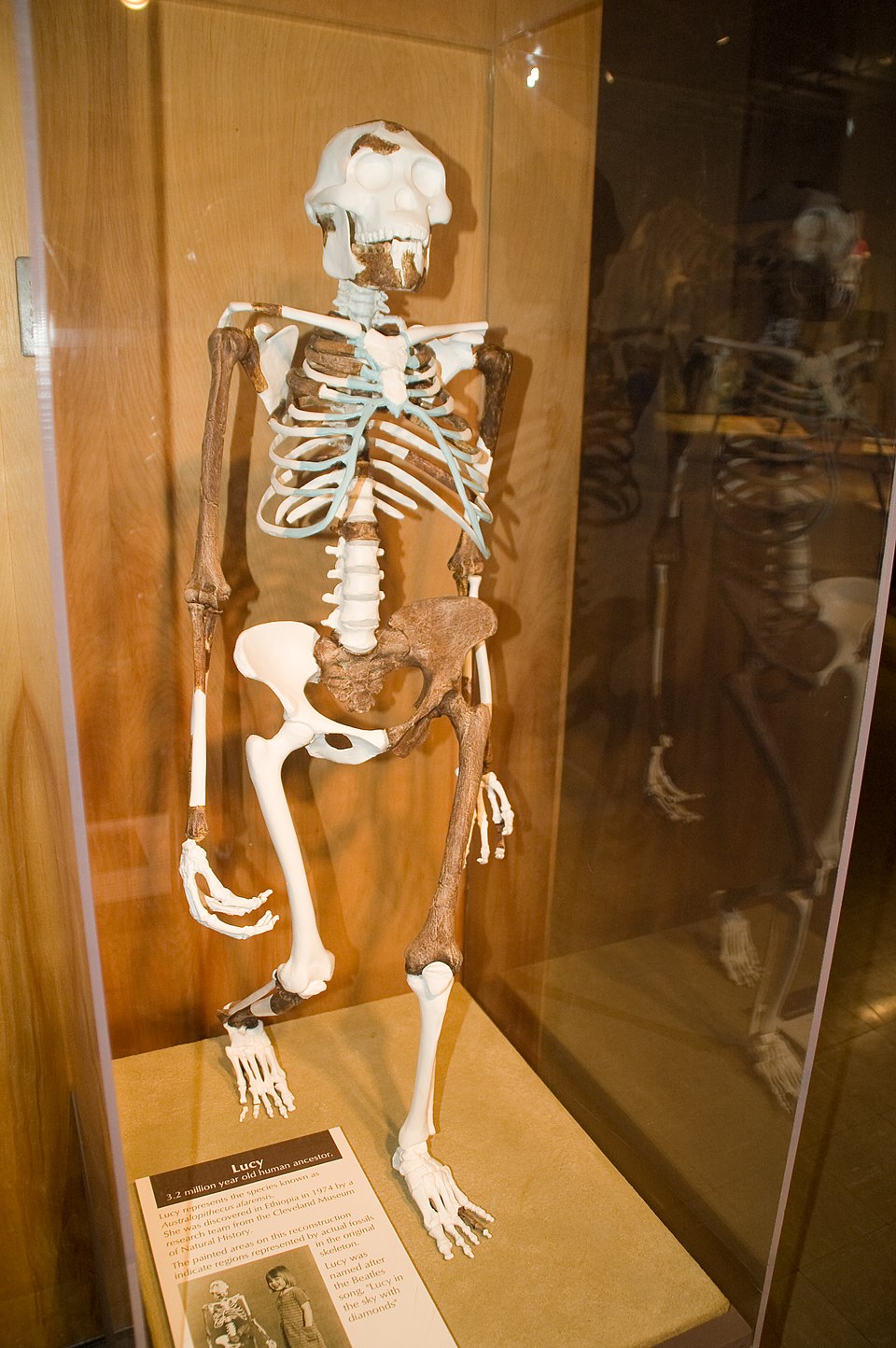
The record becomes richest with Australopithecus. The partial skeleton of A. afarensis known as "Lucy" (AL 288-1, 3.2 Ma) combines an angled femur, short and broad ilium, forward-positioned foramen magnum, and robust bipedal knee anatomy with curved finger and toe phalanges indicating significant climbing ability.25 The femoral bicondylar angle in Lucy falls well within the modern human range and far outside the ape range, providing quantitative osteological confirmation of habitual bipedalism.18 The foot bones of A. afarensis exhibit a stiffened midfoot and a longitudinal arch, though the great toe appears to retain some mobility compared with modern humans.19 Comparable evidence comes from Australopithecus africanus at Sterkfontein, South Africa, where Clarke and Tobias described a 3.6-million-year-old hominin foot in 1995 that also combines a non-divergent hallux with a medial longitudinal arch, reinforcing that committed bipedalism was widespread across southern and eastern African australopiths.24
The Laetoli footprints
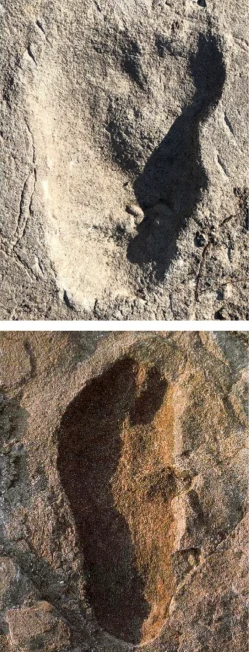
The most direct, unambiguous evidence for bipedal locomotion in any fossil species is not a bone but a footprint. In 1978, Mary Leakey's team excavating at Laetoli in northern Tanzania uncovered a set of hominin footprint trails preserved in hardened volcanic ash, which radiometric methods dated to approximately 3.66 million years ago.20
.jpg)
Biomechanical analysis of the prints confirmed several key features of modern bipedal gait. Two trails side by side—designated G1 and G2/3—extended for about 27 meters and preserved the tracks of at least two individuals walking in the same direction, possibly simultaneously.20 Leakey and Hay described them in Nature in 1979 as unmistakably human-like in their overall morphology, noting the absence of any knuckle impressions and the alignment of all five toes pointing forward.20
Biomechanical analysis of the prints confirmed several key features of modern bipedal gait. Crompton and colleagues found that the Laetoli prints are consistent with a compliant-limb bipedal gait, with evidence for heel strike, a medial longitudinal arch, and weight transfer across the lateral midfoot to the hallux at toe-off.8 The great toe is non-divergent and bears a substantial push-off impression, indicating it functioned as a propulsive lever rather than a gripping digit.8 Some analyses have suggested the Laetoli hominins walked with somewhat more hip and knee flexion than modern humans, indicating a gait that was bipedal but not fully modern in mechanics, though this interpretation remains debated.8
In 2021, analysis of newly discovered trails at Laetoli Site S provided additional insight into locomotor diversity within the population. McNutt and colleagues found that the S tracks showed a wider stride width and subtly different foot pressure distribution than the main G trails, suggesting at least two distinct locomotor patterns among contemporaneous hominins at the site, possibly reflecting sex differences or individual variation within a single species.21 An earlier 2016 study by Masao and colleagues had already reported additional tracks at Laetoli showing marked body size variation consistent with the sexual dimorphism known from A. afarensis skeletal material.28 Because A. afarensis is the only hominin known from contemporaneous deposits at Laetoli, these tracks are universally attributed to that species and constitute the earliest undisputed direct evidence of bipedal locomotion in the hominin fossil record.7, 21
Timeline of key bipedalism fossil evidence2, 4, 5, 20, 25
Why bipedalism evolved: major hypotheses
Understanding when and how bipedalism evolved is analytically separable from understanding why it evolved. The selective pressures that drove the transition remain debated, in part because multiple non-exclusive factors likely contributed and in part because the late Miocene ecological context of the earliest hominins is imperfectly known. Several major hypotheses have accumulated substantial empirical support.

The thermoregulatory hypothesis, developed by Peter Wheeler in the late 1980s and early 1990s, holds that bipedalism evolved primarily as an adaptation to the thermal challenges of life in more open, sun-exposed habitats.12, 11 An upright posture reduces the body surface area exposed to direct solar radiation at midday, when the sun is nearly overhead, compared with the horizontal posture of a quadruped. Wheeler's modeling demonstrated that a biped exposes roughly 40 percent less body surface to direct overhead sun than a quadruped of equivalent mass and also elevates the body into cooler air currents above the ground boundary layer, both effects reducing heat load.12 This would be particularly advantageous during long-distance foraging in open habitats, where solar heat gain is a limiting factor. The hypothesis is supported by the correlation between bipedalism's emergence and paleoclimate evidence of expanding open grassland and woodland habitats in East Africa during the Miocene and Pliocene.11
The energetic efficiency hypothesis received its strongest empirical test in a 2007 study by Sockol, Raichlen, and Pontzer, who measured the metabolic cost of bipedal and quadrupedal locomotion in five chimpanzees and compared it with human bipedalism.9 They found that chimpanzees expend approximately 75 percent more energy per unit distance walking bipedally compared with humans walking the same distance, and that even chimpanzee quadrupedal knuckle-walking is energetically more costly than human bipedalism, largely because of the biomechanically inefficient bent-knee, bent-hip posture chimpanzees use.9 Pontzer and colleagues extended this work in 2009, showing that the energetic cost of chimpanzee bipedalism correlates with individual variation in hip anatomy, with chimpanzees whose hip joints more closely approximate human geometry walking bipedally at lower cost.10 Earlier comparative work by Taylor and Rowntree had established that bipedal primates are not inherently more costly movers than quadrupeds at comparable speeds, challenging older assumptions that bipedalism must have been selected against on energetic grounds.27 Collectively, these studies indicate that the adoption of an extended-limb bipedal gait by early hominins would have produced a substantial reduction in locomotor energy expenditure, a clear selective advantage if food resources were scattered and foraging ranges were large.
The provisioning hypothesis, championed by C. Owen Lovejoy in his influential 1981 paper in Science, proposed that bipedalism evolved as part of a reproductive strategy in which males freed their forelimbs to carry food to females and offspring.13 On this view, the primary selective pressure was not locomotor efficiency per se but the increased reproductive success conferred by pair-bonding and male parental investment, with bipedalism facilitating food transport as a critical component. Lovejoy extended and updated this model in 2009, incorporating the Ardipithecus evidence to argue that reduced canine size and bipedalism evolved together as part of a suite of traits associated with reduced male-male competition and increased paternal investment.14 While the model remains influential, some researchers have questioned whether the energetic and reproductive models are independently sufficient or whether they are better viewed as complementary pressures acting simultaneously.
The postural feeding hypothesis, developed by Kevin Hunt in a 1994 paper in Current Anthropology, proposes that bipedalism evolved first as a feeding posture used in woodland rather than open-savanna settings.15 Hunt observed modern chimpanzees standing bipedally while reaching for food items in low shrubs and small trees, supported by one hand on a branch above—a posture that may be energetically favorable for accessing food items just beyond reach. He argued that selection could have initially favored bipedal postural feeding in a woodland-adapted hominin, with habitual terrestrial bipedalism emerging secondarily as populations moved between trees.15 This hypothesis aligns well with the Ardipithecus evidence, which indicates early bipedalism occurred in a woodland context rather than open savanna, and with the mosaic anatomy of Ardipithecus and early Australopithecus, which combined bipedal ground locomotion with persistent arboreal capacity.5
None of these hypotheses is mutually exclusive. Most researchers now view the evolution of bipedalism as driven by multiple selective pressures that varied in their relative importance at different points in time, in different habitat types, and at different stages of the anatomical transition. The energetic advantages, thermoregulatory benefits, and provisioning advantages may all have reinforced each other, producing directional selection across several million years of hominin evolution.
Facultative versus obligate bipedalism
A conceptually important distinction runs through the paleoanthropological literature on early hominin locomotion: the difference between facultative and obligate bipedalism. All great apes are capable of bipedal locomotion for brief periods; chimpanzees, bonobos, and gorillas are observed walking upright in natural settings, particularly when carrying objects or navigating shallow water. What distinguishes the hominin lineage is the progressive shift from bipedalism as one option in a locomotor repertoire to bipedalism as the primary—and eventually nearly exclusive—mode of ground locomotion.1
The anatomical evidence suggests this transition was not abrupt. Ardipithecus ramidus at 4.4 million years ago retained a grasping foot with an opposable hallux, indicating that powerful arboreal locomotion was still a significant component of its behavioral repertoire despite having evolved key pelvic features associated with bipedalism.5, 6 Australopithecus afarensis at 3.2–3.7 million years ago had committed more fully to bipedalism anatomically—the foot had lost the opposable hallux and developed a longitudinal arch—yet still retained curved manual and pedal phalanges indicating that tree-climbing remained a significant activity, perhaps for sleeping, refuge, and feeding.25 Crompton and colleagues have argued that the preserved biomechanics of the Laetoli footprints are consistent with a substantially human-like compliant bipedal gait, suggesting obligate or near-obligate bipedal ground locomotion by at least 3.66 million years ago, even if the makers of those prints could still climb trees.8
The question of whether early bipeds climbed trees as a regular behavioral strategy or only as a residual capacity became explicit in the debate over the functional interpretation of A. afarensis arboreal anatomy. Proponents of residual retention argue that the curved phalanges in A. afarensis are phylogenetic holdovers without functional significance—vestigial features no longer actively used. Others counter that the energetic cost of maintaining highly curved bones would lead to their rapid reduction by selection if they served no function, implying that arboreal locomotion continued to provide fitness benefits. The debate has been partially resolved by biomechanical studies demonstrating that curved phalanges confer mechanical advantage during power grasping, suggesting continued use rather than mere vestigiality.26
Experimental evidence on locomotor energetics
The case for energetic efficiency as a selective driver of bipedalism rests on experimental measurements of locomotor cost across primates. The foundational insight—that bipedalism need not be energetically more expensive than quadrupedalism—was established by Taylor and Rowntree in 1973, who trained chimpanzees to walk and run both bipedally and quadrupedally on treadmills while measuring oxygen consumption. They found no significant energetic difference between the two gaits in chimpanzees, contrary to the prevailing assumption that bipedalism was inherently costly.27
The more important question, addressed by Sockol, Raichlen, and Pontzer in 2007, was whether the particular biomechanical style of bipedalism matters energetically. Their experiment compared five chimpanzees using their natural bent-knee, bent-hip bipedal and knuckle-walking quadrupedal gaits with human subjects walking bipedally on the same treadmill. The metabolic measurements revealed that human bipedalism costs roughly 75 percent less energy per unit distance than chimpanzee bipedalism and approximately 75 percent less than chimpanzee knuckle-walking as well.9 The key variable explaining this difference was the degree of limb extension at the hip and knee: humans walking with extended limbs use an inverted-pendulum mechanism that recovers mechanical energy by trading kinetic and potential energy at each step, dramatically reducing the muscular work required to maintain forward motion. Chimpanzees, whose anatomy prevents full extension at the hip and knee, cannot use this mechanism effectively and must do substantially more muscular work per stride.9
Pontzer and colleagues' 2009 follow-up study reinforced these findings by demonstrating that individual chimpanzees with hip anatomy closer to the human condition—specifically, a more lateral orientation of the acetabulum and a longer femoral neck—incur lower metabolic costs during bipedal walking.10 This establishes a direct mechanistic link between hominin hip anatomy and the energetic advantage of bipedal locomotion: the skeletal changes documented in the hominin fossil record directly predict reductions in locomotor cost. The selective advantage of this energy saving would have been amplified for hominins foraging over large home ranges, where locomotor efficiency translates directly into net energy gain and thus reproductive success.10
Relative metabolic cost of locomotion (human bipedalism = 1.0)9
The costs of bipedalism
While bipedalism conferred clear locomotor and thermoregulatory advantages, it also introduced significant engineering compromises. The human body plan is not a perfectly optimized bipedal machine but an evolutionary modification of a primate body plan originally adapted for arboreality and quadrupedalism. The resulting mismatches between ancestral anatomy and bipedal demands produce a suite of vulnerabilities that have received sustained medical and paleoanthropological attention.16
The remodeled human pelvis is the most extensively analyzed source of bipedal costs. The shortening and broadening of the ilium for bipedal hip stabilization required the birth canal to pass through a bowl-shaped pelvis rather than the open ischial arch of apes. As hominin brain size increased through the Pleistocene, neonatal head size approached and eventually exceeded the pelvic outlet dimensions, creating a genuine obstetric constraint. The result is a tightly fitted birth canal in modern humans requiring rotation of the fetal head during passage—a mechanical complexity absent in other great apes—and a high rate of obstructed labor that, without medical intervention, carries substantial maternal and neonatal mortality.17 Tague and Lovejoy's 1987 quantitative comparison of australopith, early Homo, and modern human pelvic dimensions documented this progressive tightening of the birth canal as brain size increased, framing it as a constraint imposed by the competing demands of bipedalism and encephalization.17
The lumbar spine's lordotic curvature, while mechanically necessary for upright posture, creates elevated shear stresses on the intervertebral discs and facet joints of the lower back. The result is that lower back pain and intervertebral disc herniation are among the most prevalent musculoskeletal conditions in modern humans, affecting the majority of adults at some point in their lives. Plomp and colleagues demonstrated in a 2015 analysis of vertebral morphology across primates that the particular curvature and cross-sectional geometry of human lumbar vertebrae predisposes them to disc herniation and facet joint arthritis in ways not seen in our closest relatives.16
The knee joint, bearing the full body weight through a valgus-angled femur, is subjected to complex mediolateral loading that predisposes it to anterior cruciate ligament injuries and patellofemoral syndrome—conditions rare in quadrupedal apes. The foot's rigid arch, while energetically advantageous, creates vulnerability to plantar fasciitis and stress fractures that would be uncommon in the more flexible, shock-absorbing flat foot of a chimpanzee. The narrow birth canal also explains why human neonates are born at a relatively early developmental stage compared with other apes, necessitating prolonged post-natal brain growth and an extended period of infant dependency that is itself both a cost (increased parental investment) and a driver of the social complexity that characterizes the genus Homo.17
These costs do not negate the selective advantages of bipedalism; they simply illustrate that evolution does not produce perfect designs but rather workable compromises. The persistence and elaboration of bipedalism across seven million years of hominin evolution demonstrates unambiguously that its net selective benefits outweighed its costs across the range of environments and ecological challenges encountered by hominin lineages throughout the Pliocene and Pleistocene.
Evolutionary significance
The evolution of bipedalism occupies a unique position in the study of human origins because it is simultaneously the most ancient and most definitionally central modification of the hominin body plan. Every feature that distinguishes living humans from our common ancestor with chimpanzees traces, directly or indirectly, to downstream consequences of becoming committed bipeds: the freeing of the hands for tool manufacture and use, the developmental changes associated with prolonged infant dependency, the thermoregulatory modifications that reduced body hair and expanded eccrine sweat glands, and the social structures enabled by provisioning and pair-bonding.13, 14
The fossil evidence is equally clear that bipedalism was not the final step in human evolution but the first. When A. afarensis walked across the volcanic ash at Laetoli 3.66 million years ago, leaving prints indistinguishable in basic form from those of a modern human, the species had a brain scarcely larger than a chimpanzee's, no stone tools, and hands whose curved fingers still reflected a partly arboreal ancestry. Brain expansion, technological sophistication, and the full elaboration of human cognitive capacity lay millions of years in the future.20, 25 Bipedalism came first, establishing the anatomical and ecological context within which all subsequent hominin evolution unfolded.
References
Laetoli footprints preserve earliest direct evidence of human-like bipedal biomechanics
The costs of becoming bipedal: Musculoskeletal injuries as evidence of compromised locomotor function
New footprints from Laetoli (Tanzania) provide evidence for marked body size variation in early hominins