Overview
- The Laetoli footprint trackways, discovered in 1978 by Mary Leakey's team in Tanzania, preserve the footsteps of at least five bipedal hominins in volcanic ash dated to approximately 3.66 million years ago—the oldest unambiguous direct evidence of upright walking in the human lineage.
- The prints display a non-divergent big toe, a well-defined longitudinal arch, and heel-to-toe weight transfer indistinguishable in basic pattern from modern human walking, yet they were made by Australopithecus afarensis, a species with a brain one-third the size of ours.
- Additional trackways discovered at Site S (2015) and reanalyzed at Site A (2021) extended the known prints to over 27 meters and confirmed marked body size variation, while demonstrating that fully modern bipedal mechanics preceded brain expansion by millions of years.
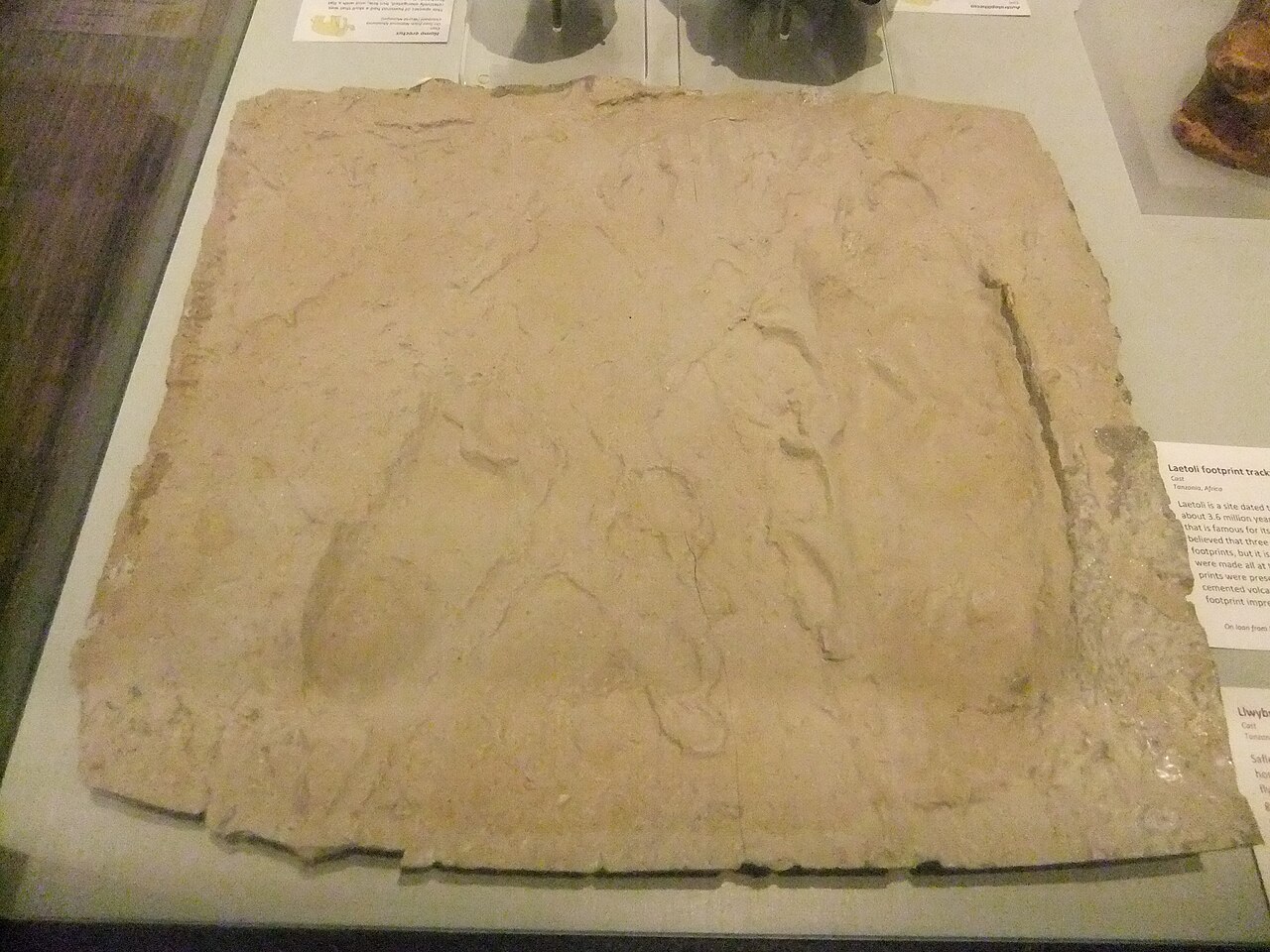
The Laetoli footprints are a series of hominin trackways preserved in volcanic ashfall tuff in northern Tanzania, dated by 40Ar/39Ar radiometry to approximately 3.66 million years ago.1, 9 Discovered in 1978 during fieldwork led by Mary Leakey, the prints constitute the oldest undisputed direct evidence of habitual bipedal locomotion in the human evolutionary lineage.1, 11 Their significance is difficult to overstate: they demonstrate that upright walking was fully established millions of years before the emergence of large brains, sophisticated stone tools, or any species belonging to the genus Homo.3, 14

Discovery and geological context
The footprint site lies within the Laetoli beds, a sequence of volcaniclastic sediments deposited on the flanks of the Sadiman volcano in the eastern Serengeti Plains, approximately 45 km south of Olduvai Gorge.1, 15 During fieldwork in 1976, Andrew Hill noticed animal prints preserved in a hardened ash layer while playfully throwing elephant dung at a colleague. Systematic excavation over the following two seasons, directed by Mary Leakey, revealed multiple trackways of animals and, critically, at least two trails of bipedal hominin footprints at Site G.1, 2
The preservation mechanism was extraordinary. The Sadiman volcano produced an eruption of carbonatite ash, which, when dampened by light rain, formed a cement-like surface. Hominins and other animals walked across this wet ash, leaving impressions that hardened rapidly in the equatorial sun. Subsequent ashfall buried the surface before erosion could destroy it, sealing the prints under additional volcanic layers for 3.66 million years.1, 9, 15 The result was a snapshot of a few hours or days of activity on a Pliocene landscape, frozen in stone with remarkable fidelity.
Site G: the original trackways
The primary excavation at Site G uncovered two roughly parallel trails extending approximately 27 meters, designated G-1 and G-2/3.1, 2 The G-1 trail contains the prints of a smaller individual, while G-2/3 records a larger individual whose prints were partially overstepped by a third, smaller individual walking in the same footsteps.2, 11 The stride length, foot proportions, and depth patterns indicate two or three individuals of markedly different body sizes walking in the same direction across the ash surface.1, 6
The anatomical detail preserved in the prints is striking. Each footprint shows a clearly defined heel impression, a longitudinal arch along the medial side of the foot, and a big toe (hallux) aligned with the other toes rather than splayed laterally as in apes.1, 3 The depth distribution within each print reveals a heel-strike followed by progressive weight transfer along the lateral midfoot to the ball of the foot and finally through the hallux at toe-off—a sequence that is the biomechanical hallmark of human walking.3, 8 Three-dimensional photogrammetric analysis by Bennett and colleagues confirmed that the prints exhibit a medial longitudinal arch functionally comparable to that of modern humans, a structure that stores and releases elastic energy during the gait cycle and is entirely absent in chimpanzees and gorillas.8
Biomechanical analysis
The biomechanics of the Laetoli trackmakers have been debated since the prints were first described. Leakey and Hay initially remarked that the prints were "remarkably similar" to those of modern humans.1 Subsequent quantitative analyses have both confirmed and refined this assessment. Crompton and colleagues used a combination of experimental human footprints and computer modeling to show that the Laetoli G-1 prints are most consistent with a fully extended, human-like limb posture during walking, rather than the bent-hip, bent-knee gait characteristic of chimpanzees.3
Raichlen and colleagues reached a broadly similar conclusion using experimental data from humans walking with both normal and "bent-knee, bent-hip" gaits, finding that the Laetoli toe depths best match normal extended-limb walking.4 However, Hatala, Demes, and Richmond introduced a note of complexity in 2016, demonstrating through experimentally produced footprints that the Laetoli trackmakers likely used a gait that was neither fully modern human nor chimpanzee-like, but intermediate—an extended limb posture with somewhat greater midfoot flexibility than is typical of Homo sapiens.5 This finding is consistent with the skeletal evidence from Australopithecus afarensis, which shows a mosaic of human-like lower limb features and retained arboreal adaptations in the foot and hand.5, 10
What no analysis disputes is the fundamental conclusion: the Laetoli trackmakers were obligate bipeds. The non-divergent hallux, the presence of a medial arch, and the heel-to-toe pressure pattern collectively rule out any form of quadrupedal or facultative locomotion.3, 8
Site S and Site A: expanding the record
In 2015, a team led by Fidelis Masao discovered additional hominin footprints at a new locality designated Site S, approximately 150 meters south of Site G.6 The Site S trackway comprises 14 prints from two individuals, one of whom was remarkably large—estimated at 165 cm tall and 45 kg, substantially exceeding the body size range previously inferred for A. afarensis.6 This discovery pushed the total known trackway length beyond 27 meters and revealed a degree of body size variation consistent with pronounced sexual dimorphism in a single species, rather than the presence of multiple species.6
A separate but equally significant development came in 2021, when McNutt and colleagues reexcavated and reanalyzed five footprints at Site A, originally discovered in 1976 but largely neglected because they were thought to belong to a bear.7 Using modern comparative data from bears, chimpanzees, and humans, the team demonstrated that the Site A prints were made by a bipedal hominin using a cross-stepping gait distinct from the trackmakers at Sites G and S. The cross-stepping pattern—in which each foot crosses the midline of the body—is unlike any known hominin gait and may represent a different hominin species, though this interpretation remains debated.7 At minimum, the Site A prints expand the documented locomotor diversity at Laetoli and suggest that bipedal experimentation may have been more varied than a single trackway could reveal.
Species attribution
The Laetoli footprints are almost universally attributed to Australopithecus afarensis, the only hominin species known from contemporaneous deposits at the site.1, 10, 11 The holotype specimen of A. afarensis—mandible LH 4—was in fact recovered from Laetoli in 1974, from sediments stratigraphically close to the footprint tuff.10 The body size estimates derived from the prints are consistent with the range of postcranial dimensions known for A. afarensis from sites such as Hadar and Dikika in Ethiopia, further supporting the attribution.6, 11
This attribution carries a profound implication. A. afarensis had a cranial capacity of approximately 380–550 cc—roughly one-third the volume of a modern human brain.10 The species lacked stone tools, symbolic behavior, or any evidence of cognitive sophistication beyond that of living great apes. Yet the footprints demonstrate that it walked with a gait fundamentally similar to our own. The Laetoli prints are therefore among the strongest single pieces of evidence that bipedalism evolved as the first major hominin adaptation, long before the brain expansion that would eventually characterize the genus Homo.3, 13, 14
Conservation and preservation
The physical preservation of the Laetoli footprints has been an ongoing challenge. After excavation in 1978–1979, the Site G trackway was reburied under sand and lava boulders to protect it from erosion, root damage, and tourist traffic.2, 12 Acacia trees subsequently grew over the buried site, and their roots began to penetrate and damage the tuff layer. A Getty Conservation Institute project in the mid-1990s removed the vegetation, stabilized the surface, and reburied the trackway under a more carefully engineered protective fill.12 The Tanzanian government has since constructed a museum and viewing facility at the site, though the original prints remain buried for protection, with casts and replicas on display.11
Evolutionary significance
The Laetoli footprints occupy a singular position in the study of human origins. Bones and teeth can demonstrate anatomical potential for bipedalism, but footprints capture the act itself—a direct behavioral record preserved across geological time.3, 8 The trackways confirm that by 3.66 million years ago, at least one hominin species had evolved a striding, heel-to-toe bipedal gait with an arched foot and adducted hallux. This suite of features represents a complete commitment to terrestrial bipedalism, even if the trackmakers retained some capacity for arboreal locomotion evident in their skeletal anatomy.3, 5
The prints also provide information unavailable from skeletal remains alone: stride length, walking speed, and the social context of locomotion. The parallel trails at Site G suggest two or three individuals traveling together, offering a rare glimpse of group behavior in deep time.1, 2 The body size variation across Sites G and S informs debates about sexual dimorphism and social structure in early hominins.6
Above all, the Laetoli footprints demonstrate that human-like walking is ancient—far older than human-like brains, human-like tools, or human-like culture. They are the trace of a small-brained, ape-faced creature walking upright across an East African volcanic plain 3.66 million years ago, and they remain one of the most powerful single discoveries in the history of paleoanthropology.1, 3, 14
References
Laetoli footprints preserve earliest direct evidence of human-like bipedal biomechanics
Laetoli footprints reveal bipedal gait biomechanics different from those of modern humans and chimpanzees
New footprints from Laetoli (Tanzania) provide evidence for marked body size variation in early hominins
A new species of the genus Australopithecus (Primates: Hominidae) from the Pliocene of eastern Africa