Overview
- Blombos Cave, a small coastal rockshelter on South Africa's southern Cape, preserves a Middle Stone Age sequence (~101–70 ka) that has yielded the densest concentration of early symbolic artefacts in Africa, including engraved ochres, perforated Nassarius shell beads, formal bone tools, finely flaked Still Bay points, and the world's oldest unambiguous drawing.
- Two engraved ochre pieces published in 2002, an ochre-processing workshop dated to ~100 ka, 70+ shell beads, and a 73,000-year-old cross-hatched drawing on a silcrete flake have together pushed the origin of behaviourally modern Homo sapiens back tens of thousands of years before its appearance in Eurasia.
- The Still Bay assemblage at Blombos preserves the earliest secure evidence for pressure flaking and routine heat-treatment of silcrete, technologies once thought to belong to the Upper Palaeolithic, and now anchors arguments that cognitive modernity emerged gradually in Africa rather than as a sudden European 'revolution.'
Blombos Cave is a small coastal rockshelter on the southern Cape of South Africa, roughly 300 kilometres east of Cape Town and 100 metres inland of the modern shoreline, whose Middle Stone Age (MSA) deposits have yielded the most influential body of evidence for the early emergence of symbolic behaviour in our species.10 Excavated by Christopher Henshilwood and colleagues since 1991, the cave contains a 2.5–3 metre stratigraphic sequence whose lower units have been dated to about 101–70 thousand years ago (ka) by optically stimulated luminescence (OSL) and thermoluminescence (TL).9, 20 Within those layers, archaeologists have recovered engraved ochres, perforated marine-shell beads, formal bone tools, finely shaped Still Bay bifacial points, an ochre-processing workshop, and a cross-hatched drawing on a silcrete flake that is currently the oldest unambiguous abstract drawing in the human record.1, 2, 4, 5, 7, 8
The site has reshaped a long-running debate over when and where Homo sapiens began to behave like modern humans. Until the late 1990s, many archaeologists tied the appearance of art, ornaments, and complex technology to a "human revolution" in Europe around 40–50 ka.12 The Blombos finds, alongside related discoveries at Pinnacle Point, Diepkloof, Sibudu, and Klasies River, instead place these behaviours in southern Africa tens of thousands of years earlier and frame the origin of cognitive modernity as a gradual, intermittent African process rather than a sudden European event.1, 12, 13
The site and its discovery
Blombos Cave sits in a calcarenite cliff face overlooking the Indian Ocean at 34°24′52″S, 21°13′21″E, on private land within the Blombos Private Nature Reserve in the Western Cape Province.10 The cave is small — the interior chamber covers about 39 square metres behind the drip line, with an additional outer talus platform of roughly 23 square metres — and it sits 34.5 metres above present sea level.10, 20 Christopher Henshilwood, who grew up nearby and played in the cave as a child, returned to it as a doctoral student at Cambridge in 1991 and recorded it under the original site code GSF8 (Garcia State Forest, site 8); it was renamed Blombos Cave in 1997.10
Henshilwood's PhD work targeted Holocene Later Stone Age (LSA) deposits, but in 1992 he encountered a sterile sand layer ("the Hiatus") sealing far older sediments below.10, 20 Subsequent field seasons from 1997 onward shifted the project toward the underlying Middle Stone Age sequence. Through 2011, ten field seasons of approximately six weeks each had exposed roughly 19.5 square metres of MSA deposits.10 Since 2017 the excavation has continued under the Centre for Early Sapiens Behaviour (SapienCE) at the University of Bergen, in collaboration with the University of the Witwatersrand and several European partners.20
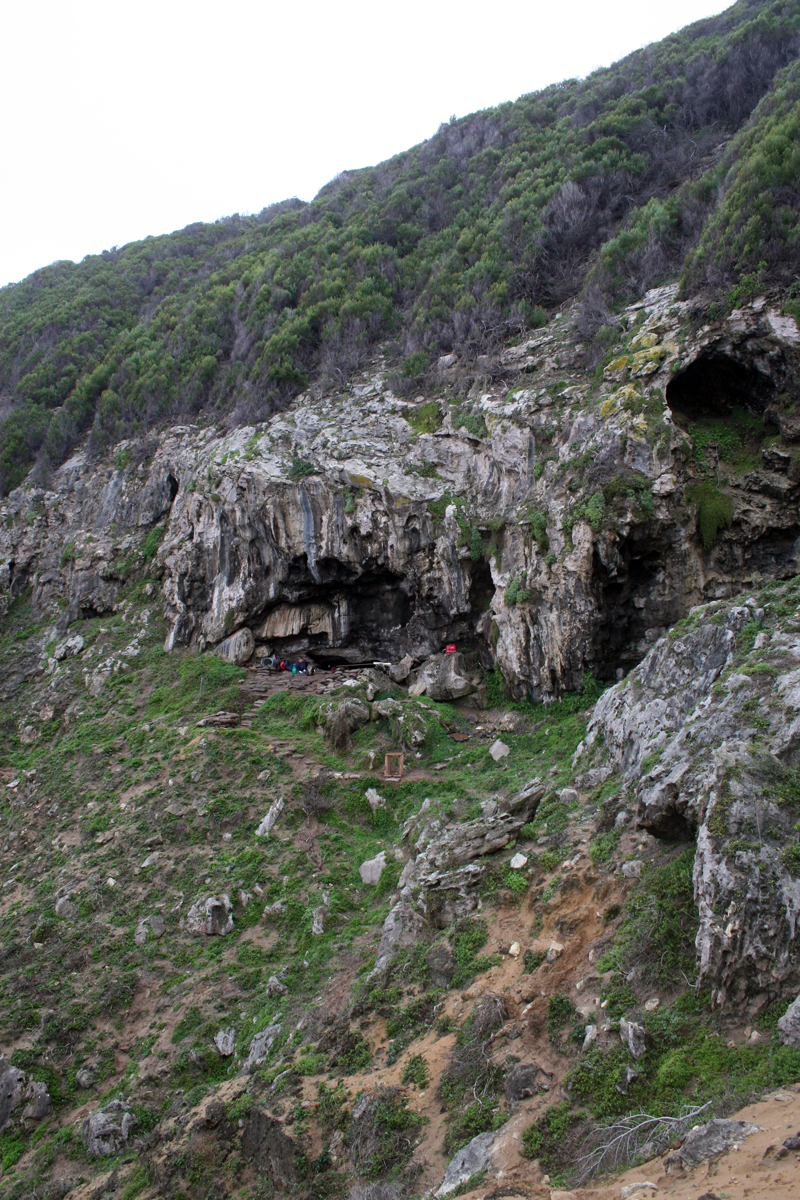

Only a small number of human remains — primarily isolated teeth — have been recovered from the Middle Stone Age levels, and their morphology is consistent with anatomically modern Homo sapiens.10 The site is therefore not a hominin "fossil cave" in the sense of Sterkfontein or Rising Star; its importance lies almost entirely in the artefacts that anatomically modern humans left behind.
Stratigraphy and chronology
The Blombos sequence is divided into seven main occupation phases. Three Later Stone Age phases (L1–L3), all dated to within the last 2,000 years, sit above a sterile aeolian sand body called the Hiatus that ranges from about 5 to 50 centimetres thick.10, 20 Below the Hiatus lie four Middle Stone Age phases: M1, Upper M2, Lower M2, and M3, in descending order. Lithic technology, raw-material use, and the presence of marker artefacts vary systematically through these phases.17, 18
Two independent luminescence techniques have produced concordant ages for the MSA sequence. Jacobs and colleagues' 2006 single-grain quartz OSL study yielded ages of 72.5 ± 4.6 to 74.9 ± 4.3 ka for the Still Bay layers in M1, ~78–79 ka for the lower M2, and ~100 ka for upper M3, with a preliminary age of more than 130 ka for the deepest excavated levels.9 Independent thermoluminescence ages on heated lithics gave 74 ± 5 ka and 78 ± 6 ka for M1, in agreement with the OSL results.1, 9 The chronology has been re-examined and refined, but the basic ordering of phases and their approximate ages remain robust.20
Stratigraphy and ages of the Blombos Cave sequence9, 10, 20
| Phase | Period | Approx. age | Industry / marker artefacts |
|---|---|---|---|
| L1–L3 | Later Stone Age | 2,000–300 BP | Wilton-like microliths, pottery, marine shellfish |
| Hiatus | (sterile) | – | Aeolian sand, no occupation |
| M1 | Middle Stone Age | ~73–75 ka | Still Bay points, engraved ochres, shell beads, silcrete drawing |
| Upper M2 | Middle Stone Age | ~76–78 ka | Bifacial point preforms, formal bone tools, ochre |
| Lower M2 | Middle Stone Age | ~78–79 ka | Levallois flakes, additional engraved ochres |
| M3 | Middle Stone Age | ~98–101 ka (upper); >130 ka (lower) | Discoidal cores, ochre workshop in CP unit (~100 ka) |
The Still Bay industry of M1 is bracketed between roughly 76 ka and 71 ka and likely lasted no more than a few thousand years at Blombos, making it a relatively brief but technologically distinctive episode in the southern African MSA.17, 18 The deeper M3 deposits push the occupation back into Marine Isotope Stage 5, when sea level was higher and the modern coastline was much closer to the cave than during M1 times.20
The engraved ochres of 2002
In January 2002, Henshilwood and colleagues published in Science a description of two pieces of red ochre from the M1 phase that had been deliberately incised with geometric patterns. The larger of the two specimens, AA 8938, bears a complex cross-hatched design framed by parallel lines, scratched into a flat ground surface; the second piece preserves a simpler set of intersecting lines.1 The two ochres were recovered in situ from layers dated by TL to ~77 ka and stratigraphically sealed beneath the Hiatus, ruling out contamination from younger LSA deposits.1
Microscopic and experimental analyses showed that the lines could not have been produced by use-wear, post-depositional abrasion, or natural processes. The grooves are V-shaped in profile, of consistent depth, and were cut after the surface had been intentionally ground flat — a sequence of acts (selecting a piece of ochre, grinding a facet, then engraving it) that indicates planned, non-functional behaviour.1 The engravers were therefore producing an abstract pattern for its own sake, satisfying one of the standard archaeological criteria for symbolic representation.1, 12
A 2009 follow-up by Henshilwood, d'Errico, and Watts re-examined a much larger sample of incised ochres from the M1, M2, and M3 phases at Blombos.6 Of more than 8,000 ochre fragments from the MSA deposits, the authors identified at least 13 additional pieces bearing intentional engravings, with the oldest examples coming from the c. 100 ka M3 levels. Patterns include cross-hatching, parallel lines, branching motifs, and right angles. The 2009 analysis demonstrated, for the first time, that engraved ochre at Blombos was not a one-off accident but a sustained tradition spanning roughly 30,000 years, with stylistic continuities that suggest the transmission of conventions from one generation to the next.6
Nassarius shell beads and personal ornaments
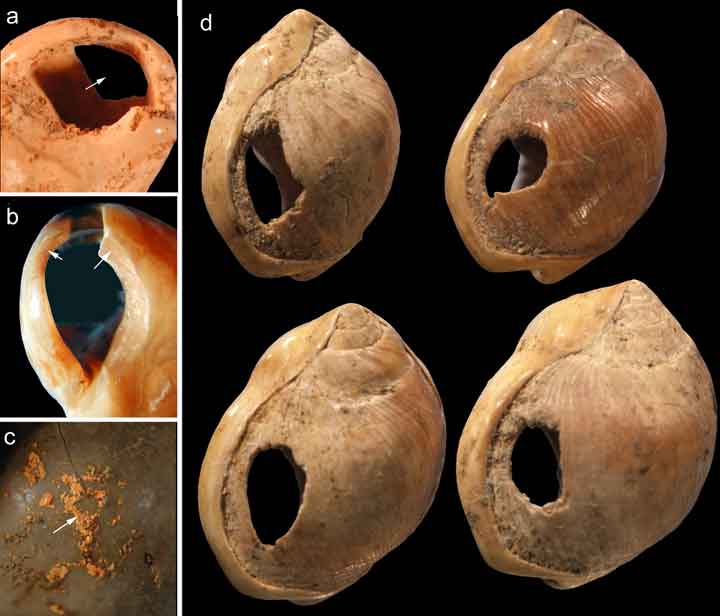
In 2004, the same team reported on the discovery of 41 perforated Nassarius kraussianus shells from the M1 layers, which they interpreted as personal ornaments — the earliest known beads anywhere in the world at the time of publication.2 A more detailed taphonomic study by d'Errico and colleagues followed in the Journal of Human Evolution in 2005, and additional beads from later excavation seasons brought the total to more than 70 specimens.3, 16
Nassarius kraussianus is a small estuarine snail that does not live on the open coast. The nearest estuaries during the Still Bay are estimated to have lain about 20 kilometres east or west of Blombos, meaning that the shells had to be deliberately collected and transported to the cave.2, 3 The shells are uniformly small, of a similar size, and were perforated by piercing the wall opposite the aperture with a sharp bone point — a perforation type and location that does not occur on naturally damaged shells in modern beach assemblages.3
Use-wear traces on the perforation rims, the outer lips, and the interior of the apertures are consistent with the shells having been strung together, with the cordage rubbing against neighbouring beads. Many specimens also retain residues of red ochre on their surfaces, suggesting that the strings were either dyed or worn against ochre-stained skin or clothing.3, 16 The 2013 "thinking strings" study by Vanhaeren and colleagues used cluster analysis of bead shape, perforation morphology, and use-wear to argue that beads from different stratigraphic levels reflect different stringing arrangements, and therefore changes in bead-string design over time.16

Comparable Nassarius shell beads have since been recovered from older deposits at the cave of Grotte des Pigeons (Taforalt) and from Oued Djebbana in North Africa, dated to roughly 82 ka by combined uranium-series and luminescence methods.11 The Taforalt and Blombos assemblages share genus, perforation strategy, and ochre staining, despite being separated by thousands of kilometres — suggesting either shared ancestry of the practice or convergent invention of the same simple ornament across early Homo sapiens populations. Either way, the geographic spread of similar beads pushes the ornament-making behaviour at Blombos out of the realm of isolated novelty and into a continent-wide pattern.11, 12
The 100,000-year-old ochre workshop
In 2008, excavation of the basal M3 deposits exposed two large Haliotis midae (abalone) shells, each containing the dried residue of a red ochre-rich mixture, embedded in a single sediment block. Henshilwood and colleagues published the find in Science in 2011, dating it to approximately 100 ka by OSL on associated quartz grains.5 The shells were not isolated: they were associated with grindstones, quartzite cobbles bearing red staining, ochre fragments, charcoal, and crushed mammalian bone, all of which together represent a coherent toolkit for producing and storing pigment.5
Chemical and petrographic analyses showed that the recipe combined ground ochre with crushed, heat-treated mammal bone (a source of fat and bone marrow), charcoal, quartzite chips, and a liquid binder, producing a viscous paint-like mixture that was poured into the abalone shells for storage.5 The discovery is the earliest known example of a planned, multi-stage chemical procedure: collecting raw materials, processing them in sequence, and storing the finished compound in a deliberately chosen container. Henshilwood's group emphasised that the workshop implies forward planning, mental templates, and at least a rudimentary grasp of how heating, mixing, and grinding alter material properties — all hallmarks of recursive, planning-rich cognition.5, 12
The function of the paint is not directly known. The same ochre-rich mixtures could have been used for body decoration, hide preservation, hafting adhesive, or a combination of these. What the workshop establishes is that, by 100 ka, the inhabitants of Blombos were operating a small-scale "chemistry lab" with all the cognitive prerequisites of symbolic production, even if the symbolic uses themselves are inferred from contemporaneous artefacts elsewhere in the sequence rather than from the paint residue itself.5, 6
The L13 silcrete drawing
In 2018, Henshilwood and colleagues described a small silcrete flake, designated L13, recovered from the M1 layers and dated by association to about 73 ka.4 The flake bears a pattern of nine red lines — three roughly parallel lines crossed by six obliquely oriented lines — deliberately drawn on its smooth dorsal surface. Microscopic, chemical, and Raman spectroscopic analyses showed that the pigment is haematite-rich red ochre, applied with a fine-tipped point that the authors describe as an "ochre crayon" used in much the same way as a modern pencil.4
Replication experiments using ground ochre crayons of varying tip sharpness reproduced the line widths, edge profiles, and pigment distribution of the L13 marks. The authors found that the lines on L13 terminate abruptly at the edges of the flake, suggesting that the original pattern extended onto a larger, now-lost surface that the flake was once part of.4 This is significant: the pattern is fragmentary not because the artist drew an incomplete design, but because the substrate broke after the drawing was made, preserving only a portion of the original composition.
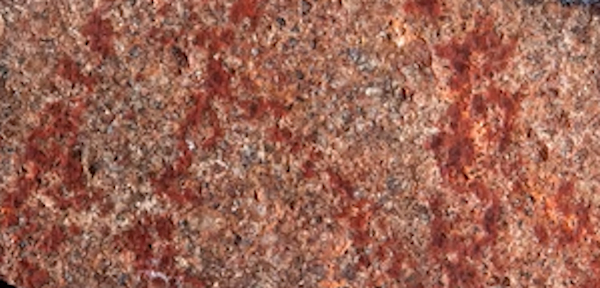

The L13 drawing is currently the oldest unambiguous example of a freehand drawing in the human archaeological record. Earlier candidates — such as the engraved Pseudodon shell from Trinil, attributed to Homo erectus, or the cross-hatched engraving from Diepkloof Rock Shelter — involve incised rather than drawn marks, and the Trinil shell in particular comes from a far older but more contested context. L13 demonstrates that the inhabitants of Blombos had moved from engraving on hard surfaces to drawing with a pigment delivery tool, a technological shift that is cognitively continuous with the rest of the Still Bay symbolic repertoire.4, 6
Still Bay points, pressure flaking, and heat treatment
The Still Bay layers at Blombos contain hundreds of bifacial foliate points — thin, leaf-shaped tools flaked on both faces and tapering to symmetric tips — manufactured predominantly on silcrete, with smaller numbers in quartzite and quartz.10, 18 These Still Bay points are the type fossil of the techno-complex of the same name, defined originally on the basis of surface collections from southern Africa and now anchored chronologically by Blombos and Sibudu.17
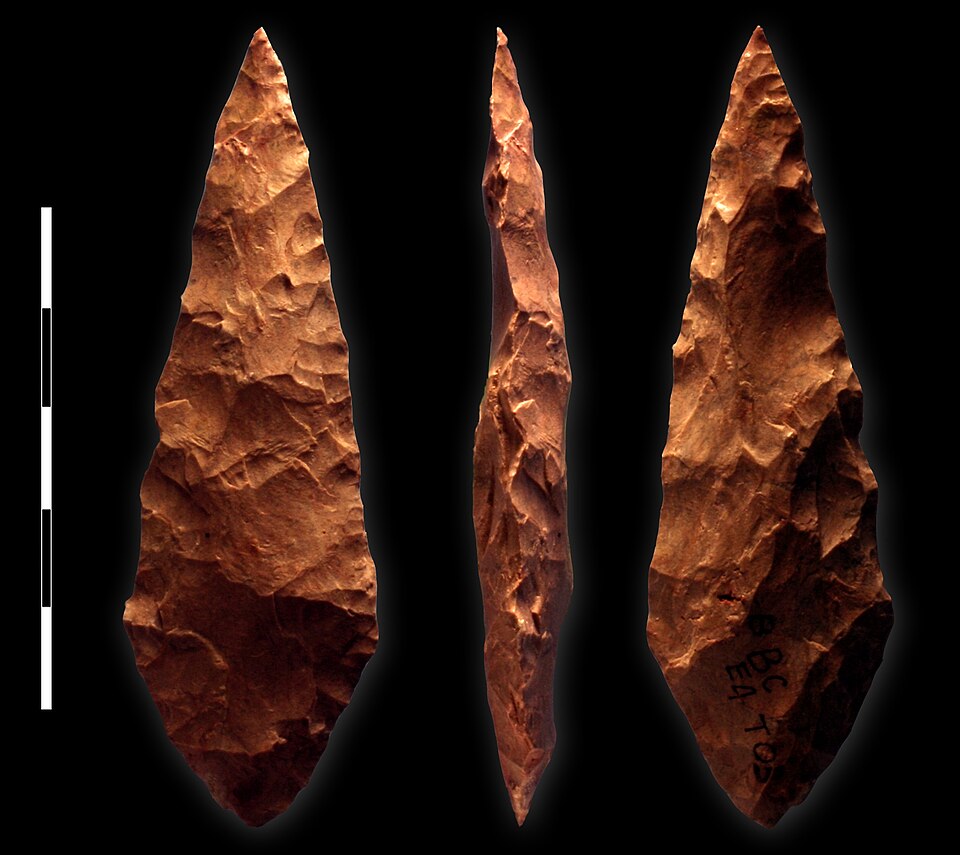

In 2010, Mourre, Villa, and Henshilwood published in Science the results of replication experiments and use-wear studies showing that many of the Still Bay points from M1 had been finished by pressure flaking — the controlled removal of small, regular flakes by pushing rather than striking the edge of the workpiece.7 Pressure flaking had previously been thought to be an Upper Palaeolithic innovation, with the earliest secure examples coming from Solutrean assemblages in Europe at about 20 ka. The Blombos evidence pushes the technique back by more than 50,000 years.7
Pressure flaking at Blombos was inseparable from another novel technology: heat treatment of silcrete. Brown and colleagues had shown in 2009 that South African MSA knappers were intentionally heating silcrete to roughly 300–400 °C in sand-bedded hearths, transforming a relatively coarse rock into a finer, glossier, and more easily flaked material. The earliest heat-treated silcrete dates to about 164 ka at Pinnacle Point, but by ~75 ka the technique was routine at Blombos and across southern Africa.13, 7 The combination of heat treatment plus pressure flaking is what enabled the production of the thin, narrow, sharply tipped Still Bay points; without the prior pyrotechnological step, the fine-grained finishing flakes characteristic of pressure flaking would not have been possible.7, 13
Selected innovations in the Blombos MSA sequence (ka)1, 2, 4, 5, 7
Subsequent technological studies of the Blombos Still Bay assemblage have shown internal change through time even within the brief duration of the industry. Archer and colleagues documented systematic shifts in point shape, raw-material selection, and reduction strategies between the lower and upper M1 layers, indicating that Still Bay knappers were not simply repeating a static template but adjusting their technology in response to mobility, raw-material availability, and possibly changing functional demands.18 Comparative analysis of Blombos and Sibudu by Soriano and colleagues confirmed that the Still Bay was technologically distinct from the slightly later Howiesons Poort, with bifacial point production replaced in the latter by backed bladelets.17
Bone tools and additional engravings
In 2001, Henshilwood and colleagues published the description of 28 formally shaped bone tools from the M1 and M2 layers — the largest collection of bone tools known from any African MSA site at the time and far older than the typical first appearance of bone-working in the Later Stone Age around 25 ka.8 The Blombos bone industry includes pointed awls and projectile-like tools manufactured by scraping, grinding, and polishing bone blanks. Use-wear analysis indicates that some of the awls were used for piercing, plausibly in connection with hide working or with the perforation of shells like those that became the Nassarius beads.8, 14
A 2007 study by d'Errico and Henshilwood expanded the bone-tool sample and documented additional shaping methods, while a separate paper by d'Errico, Henshilwood, and Nilssen described an engraved bone fragment from the M1 layers bearing parallel incisions that match the geometric patterns seen on the engraved ochres.14, 15 The engraved bone reinforces the impression that the Blombos inhabitants were applying a consistent decorative vocabulary across multiple media — ochre, bone, and stone — over a span of tens of thousands of years.15, 6
Together, the formal bone industry and the engraved bone fragment fill out a picture in which symbolic and practical innovations are tightly intertwined. The same technical capabilities that allowed the production of fine bone awls were enlisted to perforate shells for ornaments and to engrave abstract motifs on bone surfaces; the same ochre that was processed for paint also served as a substrate for the earliest geometric engravings.8, 14, 15
Subsistence and environment
The faunal assemblage from Blombos shows that the Middle Stone Age inhabitants pursued a broad subsistence strategy combining the hunting of large terrestrial mammals, the trapping or collecting of small animals, the harvesting of marine shellfish, and the catching of large fish from the coastal zone.10, 19 Eland, bushbuck, dune mole-rat, hyrax, tortoise, ostrich eggshell, fish vertebrae, and marine bird remains all appear in the MSA layers. The presence of large, deep-water fish in particular suggests that the inhabitants were capable of either active fishing from the rocky coast or scavenging from beach-stranded carcasses.10, 19
Reynard and Henshilwood compared the Still Bay subsistence record at Blombos with the Howiesons Poort record at the nearby Klipdrift Shelter, and found that the two assemblages reflect generally similar broad-spectrum diets but differ in the relative contribution of small and large game, plausibly in response to changing climate and shoreline distance through MIS 5 to MIS 4.19 Sediment micromorphology and stable-isotope work by Haaland and colleagues has reconstructed the depositional environment as a series of short-term occupations interspersed with periods of cave abandonment, with the cave's distance from the contemporaneous shoreline varying from a few hundred metres to several kilometres as global sea level changed.20
The combination of marine shellfish, marine and freshwater fish, and a long-distance source for the Nassarius beads indicates that the cave's occupants were tightly tied to coastal resources and were moving over distances of at least 20 kilometres between the cave, the open coast, and inland estuaries. This pattern of broad mobility and resource diversity is consistent with the wider picture of MSA Homo sapiens as flexible foragers exploiting heterogeneous coastal environments rather than narrowly specialised hunters.10, 19
Implications for cognitive modernity
Before the Blombos discoveries became widely known, many archaeologists accepted some version of Richard Klein's "cultural revolution" or "human revolution" model, which held that the modern human mind — capable of language, art, and symbolism — emerged abruptly around 50–40 ka, perhaps as a result of a neural mutation, and was first expressed in the Upper Palaeolithic of Europe.12 Under this model, anatomically modern humans living in Africa earlier than 50 ka were considered behaviourally archaic.12
Henshilwood and Marean's 2003 critique in Current Anthropology argued that this view rested on a Eurocentric set of test implications drawn from the rich Upper Palaeolithic record and applied unfairly to the more poorly preserved African MSA. They proposed that the appearance of unambiguous symbolic artefacts — engraved geometric patterns, ornaments, and standardised representations — should be taken as the diagnostic of behavioural modernity, regardless of geography.12 By that criterion, the Blombos engraved ochres, shell beads, and ochre workshop already met the standard of modernity at 75–100 ka.1, 2, 5, 12
The Blombos record does not show a single moment of cognitive transition. Instead, it preserves a suite of innovations — ochre processing, bone tools, engravings, ornaments, drawings, pressure-flaked points — that appear, sometimes vanish, and reappear over tens of thousands of years. This intermittent pattern, also seen at Diepkloof, Sibudu, Pinnacle Point, and Klasies River, has led many researchers to favour a "patchwork" or "innovation-and-loss" model, in which fully modern cognition existed in early Homo sapiens populations long before its associated cultural products became uniformly visible in the archaeological record. Variations in population size, demographic connectivity, and environmental stress would have governed how often and where these capacities were expressed.6, 12, 17
Ongoing debates
Despite the strength of the Blombos evidence, several interpretive questions remain open. The first concerns the chronology. The OSL ages published by Jacobs and colleagues have been challenged on methodological grounds, particularly with respect to dose-rate estimation and uncertainty handling. Subsequent re-analyses have generally supported the original ages but with somewhat broader error bars; the basic stratigraphic ordering and the placement of the Still Bay around 75 ka are now widely accepted.9, 20
The second concerns the meaning of the engraved ochres and the L13 drawing. Demonstrating that a pattern is intentional and non-functional is necessary, but not sufficient, to show that it is symbolic in the strong sense of carrying shared, conventionalised meaning. Critics have noted that intentional geometric patterns could in principle reflect doodling, mnemonic notation, or ritual marking without necessarily implying the kind of full symbolic communication used in modern human languages. Henshilwood, d'Errico, and Watts have responded that the recurrence of similar motifs across multiple specimens, materials, and stratigraphic levels at Blombos — and the appearance of comparable patterns at other southern African sites — is most parsimoniously explained by shared conventions transmitted across generations.6, 15
The third concerns the relationship between the Still Bay and Howiesons Poort techno-complexes and the question of why both industries appear, persist for a few thousand years, and then disappear. Some researchers tie these episodes to demographic pulses driven by climate change and population structure during MIS 5–4, while others emphasise the role of social learning networks and the intermittent loss of technological knowledge in small, isolated populations. The relatively short duration of the Still Bay at Blombos (less than 7,000 years on most chronologies) is central to these models, since it suggests that complex technological traditions could appear and disappear repeatedly in early Homo sapiens populations without leaving permanent marks.17, 18, 19
What is no longer in serious dispute is the basic empirical claim. The inhabitants of Blombos Cave were producing engraved ochres, perforated shell beads, formal bone tools, pressure-flaked stone points, drawings, and processed pigments tens of thousands of years before such things appeared in Europe. Whatever the precise nature of their cognition, by the standards routinely applied to the European Upper Palaeolithic, they were behaviourally modern Homo sapiens. Blombos Cave has become the type-site for that recognition, and the principal anchor of the case that the symbolic mind is an African inheritance.1, 2, 4, 5, 12
Legacy and place in the African MSA
Within twenty years of the first Science publication on the engraved ochres, Blombos Cave has become the most heavily cited Middle Stone Age site outside of Klasies River and Pinnacle Point and the standard reference point in textbook discussions of behavioural modernity. Its excavators have explicitly framed the site as one node in a network of MSA cave sites along the southern Cape coast — including Pinnacle Point, Klasies River, Klipdrift Shelter, Diepkloof Rock Shelter, Sibudu Cave, and Border Cave — that together preserve a record of repeated technological and symbolic experimentation through Marine Isotope Stages 5 to 3.13, 17, 19
Blombos has also reshaped how the southern African coast is interpreted in evolutionary terms. The combination of broad marine resource use, long-distance procurement of estuarine snails, sustained pyrotechnology, sophisticated lithic production, and recurring symbolic activity within a single small rockshelter suggests that early Homo sapiens in this region were operating with both the ecological flexibility and the cognitive resources characteristic of modern humans. The site does not stand alone, but its unusually rich and well-preserved sequence has made it the clearest single window onto that world.10, 12, 20
Continued excavation and analysis under the SapienCE programme since 2017 has begun to integrate the Blombos record with that of nearby sites to ask larger questions about MSA mobility, social networks, and population structure. The cave's stratigraphy, now traced down to deposits older than 130 ka, will likely yield further surprises as the deeper M3 and underlying levels are excavated and analysed in detail.9, 20
References
Nassarius kraussianus shell beads from Blombos Cave: evidence for symbolic behaviour in the Middle Stone Age
An early bone tool industry from the Middle Stone Age at Blombos Cave, South Africa: implications for the origins of modern human behaviour, symbolism and language
Extending the chronology of deposits at Blombos Cave, South Africa, back to 140 ka using optical dating of single and multiple grains of quartz
Blombos Cave, Southern Cape, South Africa: preliminary report on the 1992–1999 excavations of the Middle Stone Age levels
82,000-year-old shell beads from North Africa and implications for the origins of modern human behavior
The origin of modern human behavior: critique of the models and their test implications
An engraved bone fragment from c. 70,000-year-old Middle Stone Age levels at Blombos Cave, South Africa: implications for the origin of symbolism and language
Thinking strings: additional evidence for personal ornament use in the Middle Stone Age at Blombos Cave, South Africa
The Still Bay and Howiesons Poort at Sibudu and Blombos: understanding Middle Stone Age technologies
Subsistence strategies during the Late Pleistocene in the southern Cape of South Africa: comparing the Still Bay of Blombos Cave with the Howiesons Poort of Klipdrift Shelter
The chronological, sedimentary and environmental context for the archaeological deposits at Blombos Cave, South Africa