Overview
- The endurance running hypothesis, proposed by Bramble and Lieberman in 2004, argues that the ability to run long distances at moderate speeds was a key selective pressure in human evolution, favoured by natural selection for persistence hunting and scavenging in open habitats beginning with Homo erectus roughly 2 million years ago.
- Humans possess a suite of anatomical features absent in other great apes — including the Achilles tendon, enlarged gluteus maximus, nuchal ligament, expanded semicircular canals, and an unparalleled sweating capacity — that serve no obvious function in walking but are well suited to stabilisation and thermoregulation during sustained running.
- Ethnographic evidence from persistence hunting traditions among the San of southern Africa and the Rarámuri (Tarahumara) of Mexico demonstrates that endurance running remains a viable hunting strategy in modern humans, and the anatomical adaptations supporting it appear in the fossil record coinciding with the emergence of the genus Homo.
The endurance running hypothesis proposes that the ability to run long distances at moderate speeds was a significant selective pressure in human evolution, driving the development of a suite of anatomical and physiological adaptations that distinguish humans from other primates. First suggested by David Carrier in 1984 and developed more fully by Dennis Bramble and Daniel Lieberman in a landmark 2004 Nature paper, the hypothesis argues that endurance running capability, particularly for persistence hunting and competitive scavenging in open habitats, was favoured by natural selection in early Homo beginning approximately two million years ago.1, 20 Humans are remarkably good distance runners compared with other mammals: while many quadrupeds are faster sprinters, very few can sustain running over distances of 10 kilometres or more in hot conditions, a domain in which trained humans excel. The hypothesis connects this unusual capability to a coherent set of skeletal, muscular, and thermoregulatory features that appear in the fossil record with the emergence of Homo erectus and have no clear functional explanation in the context of walking alone.1, 2

Anatomical evidence
Bramble and Lieberman identified more than two dozen anatomical features that appear to be adaptations for endurance running rather than walking. These features are either absent or poorly developed in australopithecines, who were habitual bipeds but whose anatomy suggests they were primarily walkers, and they appear in the fossil record approximately coinciding with the emergence of the genus Homo.1
The Achilles tendon is perhaps the most striking of these adaptations. Humans possess a long, robust Achilles tendon that stores and releases elastic energy during the stance phase of running, acting as a biological spring that reduces the metabolic cost of locomotion. Ker and colleagues demonstrated that the arch of the human foot and the Achilles tendon together return approximately 35 percent of the energy absorbed during each running stride. Chimpanzees and other great apes lack a well-developed Achilles tendon, which is consistent with the fact that they are inefficient runners despite being competent climbers and occasional bipeds.1, 14
The gluteus maximus, the largest muscle in the human body, is markedly enlarged in humans compared with other primates. Lieberman and colleagues showed through electromyographic studies that the gluteus maximus is minimally active during walking but powerfully engaged during running, where it functions to stabilise the trunk and prevent forward pitching at each foot strike. This finding suggests that the evolutionary enlargement of the gluteus maximus was driven by the demands of running rather than walking, an interpretation supported by the relatively small gluteus maximus of australopithecines and great apes, which are walkers but not habitual runners.1, 15
The nuchal ligament is an elastic band of tissue that runs from the base of the skull to the cervical and thoracic vertebrae. It functions to stabilise the head during running by counteracting the forward pitching forces generated at each foot strike. The nuchal ligament is present in humans and in cursorial (running-adapted) mammals such as dogs and horses, but it is absent in chimpanzees and other apes that do not run. Bramble and Lieberman identified evidence of a nuchal ligament attachment site on the skulls of Homo erectus specimens but not on earlier hominins such as Australopithecus, suggesting that this stabilisation structure evolved with the transition to endurance running capability.1
The semicircular canals of the inner ear, which detect rotational acceleration and are critical for maintaining balance during locomotion, are enlarged in humans relative to body size compared with other great apes. Spoor and colleagues showed that the size of the semicircular canals correlates with locomotor agility across primates, and the enlarged canals of Homo are consistent with the greater demands placed on the vestibular system during running, when the head experiences more rapid and complex accelerations than during walking.1, 16
Additional running-related features include relatively long legs with a high leg-length-to-body-mass ratio, which increase stride length and reduce the energy cost per unit distance; short toes, which reduce the muscular effort required to stabilise the foot during push-off; a narrow waist that allows counter-rotation of the trunk relative to the hips, providing balance during the alternating single-leg stance phases of running; and broad shoulders that decouple arm swing from head movement. Each of these features is present in Homo erectus but absent or less developed in australopithecines, consistent with the hypothesis that endurance running became an important selective pressure with the emergence of the genus Homo.1, 10
Thermoregulation and sweating
A critical component of the endurance running hypothesis is the human thermoregulatory system, which is uniquely suited to sustained physical exertion in hot environments. Humans possess between two and five million eccrine sweat glands distributed across the body surface, producing up to two litres of sweat per hour during intense exercise. This sweating capacity, combined with the loss of most body hair, creates an evaporative cooling system that is far more effective than the panting mechanisms used by most cursorial mammals.11, 12, 13
Wheeler proposed in 1991 and 1992 that the evolution of hairlessness and enhanced sweating in hominins was driven by the need to dissipate metabolic heat during prolonged activity in the open, sun-exposed habitats of the African savanna. A running human generates roughly ten times the metabolic heat of a resting human, and in hot conditions, the ability to dump this heat through evaporative cooling is essential to prevent hyperthermia. Most quadrupedal mammals, including ungulates that are much faster sprinters than humans, rely on panting for thermoregulation, but panting is mechanically coupled to the respiratory cycle and becomes increasingly inefficient at high running speeds. Dogs, for example, can overheat after just a few kilometres of sustained running on a warm day, whereas a fit human can run continuously for hours in the same conditions.11, 12
The thermoregulatory advantage of humans over quadrupeds is amplified in hot, midday conditions, when ambient temperatures are highest and solar radiation is most intense. Bramble and Lieberman noted that this is precisely the time when most predators and prey animals rest in shade to avoid overheating, creating an ecological window that early Homo could have exploited for either scavenging carcasses abandoned by resting predators or pursuing prey that had been driven to hyperthermic exhaustion.1, 7
Persistence hunting
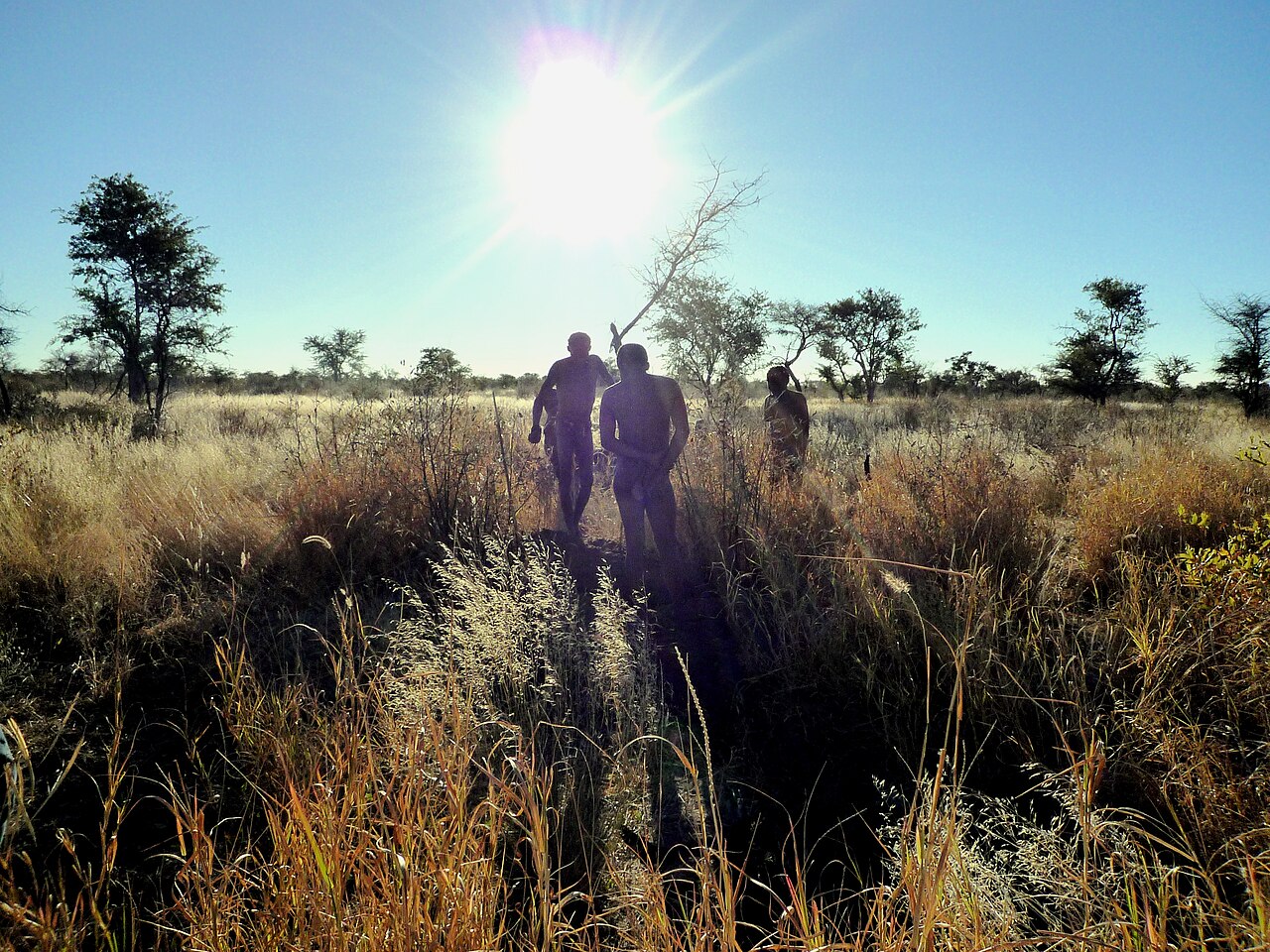
The most compelling ecological scenario for the selective advantage of endurance running is persistence hunting, a strategy in which a hunter pursues prey at a pace that prevents the animal from resting and cooling down, eventually driving it to hyperthermic collapse. Louis Liebenberg documented persistence hunting among the San (Bushmen) of the Kalahari Desert in southern Africa, providing detailed accounts of hunts in which San hunters pursued kudu, gemsbok, and other large antelopes over distances of 15 to 35 kilometres during the hottest part of the day, running at speeds of 6 to 10 kilometres per hour until the prey collapsed from heat exhaustion.7
Liebenberg demonstrated that persistence hunting is most effective during the hottest months and during the middle of the day, when ambient temperatures exceed 35°C and prey animals overheat rapidly. The hunters exploit the fact that quadrupeds pant to thermoregulate and cannot pant effectively while galloping, forcing them into a cycle of sprinting away from the pursuing hunter, stopping to pant, and being flushed into sprinting again before they have fully cooled. Each cycle drives the animal's core body temperature higher until it can no longer flee. The hunter, relying on sweating rather than panting, maintains a sustainable pace throughout and arrives at the collapsed animal relatively fresh.7, 8
The Rarámuri (Tarahumara) of the Copper Canyon region of Mexico are renowned for their extraordinary long-distance running abilities. Lieberman documented their tradition of foot racing over distances exceeding 200 kilometres, as well as hunting practices that involve running down deer and other game over extended pursuits. While the Rarámuri's running traditions are primarily recreational and ceremonial today, they demonstrate the remarkable endurance capabilities latent in human physiology and consistent with the demands of persistence hunting.9
Timing in hominin evolution
The anatomical features associated with endurance running appear in the fossil record approximately coinciding with the emergence of Homo erectus (also referred to as Homo ergaster in Africa) around 1.8 to 1.9 million years ago. Homo erectus exhibited a body plan that was fundamentally modern in its proportions: long legs relative to body mass, a narrow pelvis and waist, relatively short arms, and an overall body shape consistent with effective heat dissipation in tropical environments. These proportions contrast sharply with those of australopithecines, which had relatively short legs, long arms, a wide pelvis, and a body plan more consistent with arboreal climbing and short-distance walking than with sustained running.1, 10
The timing coincides with other major transitions in hominin ecology. Archaeological evidence shows that Homo erectus was the first hominin to regularly consume significant quantities of meat, as evidenced by butchery marks on large mammal bones at sites such as Olduvai Gorge and Koobi Fora. The increased caloric density of a meat-rich diet may have been both a consequence of endurance running capability (through persistence hunting and scavenging) and a prerequisite for the energetically expensive brain enlargement that characterised the genus Homo. Pontzer and colleagues have argued that the elevated total energy expenditure of humans, compared with other great apes, was supported in part by the dietary shift toward higher-quality foods made accessible by endurance running and tool use.3, 17, 18
The relationship between endurance running and the evolution of the human diet may also involve scavenging. Before the development of sophisticated hunting weapons, early Homo may have used endurance running to reach carcasses on the African savanna before competing scavengers, or to drive predators away from kills through aggressive group displays. The ability to cover large distances quickly during the heat of the day, when most large predators are resting, would have provided a significant competitive advantage in the scramble competition for meat on the open plains.1, 3
Comparison with other mammals
Humans are often described as mediocre athletes in comparison with other mammals: we are slower than cheetahs, weaker than gorillas, and less agile than cats. But this characterisation overlooks the one athletic domain in which humans are genuinely exceptional: sustained aerobic running over long distances in hot conditions. Bramble and Lieberman compared human running performance with that of cursorial mammals and found that while horses, dogs, and antelopes are faster over distances of up to a few kilometres, humans can outperform most quadrupeds at distances exceeding 10 to 15 kilometres, particularly in warm conditions where the sweating advantage becomes decisive.1, 19
Pontzer analysed the energetics of human locomotion in comparative context and showed that the cost of transport (energy per unit body mass per unit distance) during human running is comparable to that of similarly sized quadrupeds, but human walking is substantially more economical than chimpanzee bipedal or quadrupedal walking. This finding suggests that the human locomotor system was optimised for both economical walking and sustained running, rather than for either one exclusively. The combination of efficient walking for daily foraging and effective endurance running for periodic high-intensity activities such as hunting and scavenging may have been the overall selective package that shaped hominin locomotor evolution.19
Critiques and alternatives
The endurance running hypothesis has attracted several critiques. Some researchers have argued that the anatomical features cited by Bramble and Lieberman could have evolved for functions other than running, such as long-distance walking, throwing, or carrying loads during migration. Walking over long distances was certainly a major component of hominin locomotion, and some of the features interpreted as running adaptations, such as long legs and narrow waists, also improve walking economy.19
The rarity of persistence hunting in the ethnographic record has also been raised as a concern. While Liebenberg's documentation of San persistence hunts is detailed and persuasive, persistence hunting is not universally practised among modern hunter-gatherers, and some researchers question whether it was common enough in the Pleistocene to constitute a major selective pressure. The introduction of projectile weapons such as spears and later bows would have reduced the need for persistence hunting, potentially making the behaviour less archaeologically or ethnographically visible than its evolutionary importance warrants.7, 8
An alternative hypothesis emphasises the role of scavenging rather than hunting as the primary selective context for endurance running. In this view, early Homo used endurance running not to chase down live prey but to reach carcasses on the savanna before competing scavengers, particularly vultures that could spot carcasses from the air. This hypothesis has the advantage of not requiring the cognitive sophistication needed for persistence hunting, such as tracking skills and the ability to predict animal behaviour over long pursuit distances, which may not have been present in the earliest members of the genus Homo.1, 3
Significance
The endurance running hypothesis has provided a coherent functional explanation for a suite of human anatomical features that were previously puzzling, and it has connected human locomotor evolution to broader questions about diet, thermoregulation, brain evolution, and the ecological niche of early Homo. By demonstrating that many of the features that distinguish the human body plan from that of australopithecines are specific to running rather than walking, Bramble and Lieberman shifted the focus of locomotor evolution research from bipedal walking alone to the full range of human locomotor capabilities.1, 2
The hypothesis also has implications for understanding modern human health. Lieberman has argued that the human body evolved for a physically active lifestyle that included regular endurance exercise, and that the mismatch between this evolutionary heritage and the sedentary conditions of modern industrial societies contributes to the high prevalence of chronic diseases such as obesity, type 2 diabetes, and cardiovascular disease. While this evolutionary medicine perspective is not a direct test of the hypothesis, it underscores the depth of the human adaptation for sustained physical activity and the degree to which endurance running capability is embedded in human biology.4, 5
References
The loss of functional body hair in man: the influence of thermal environment, body form and bipedality