Overview
- Gigantopithecus blacki was the largest known primate, standing roughly three meters tall and weighing an estimated 200 to 300 kilograms, known exclusively from thousands of isolated teeth and four partial mandibles found in southern China and mainland Southeast Asia.
- Dental morphology, stable isotope analysis, and protein sequencing consistently point to a heavily herbivorous diet dominated by C3 forest plants, with thick-enameled, flat-cusped molars adapted for grinding tough, fibrous vegetation.
- Molecular phylogenetics based on ancient enamel proteins confirmed that Gigantopithecus belongs to the orangutan clade (Ponginae), diverging from the Pongo lineage approximately 10 to 12 million years ago, and the species went extinct around 295,000 years ago as its forest habitat contracted during Pleistocene climatic shifts.
Gigantopithecus blacki was the largest primate known to have existed, an enormous ape that inhabited the forests of southern China and mainland Southeast Asia during the Pleistocene epoch. Despite its extraordinary size, this animal is known entirely from dental and mandibular remains: roughly two thousand isolated teeth and four partial lower jaws, none accompanied by postcranial bones.1, 4 The absence of skeletal material beyond the jaws has made body size estimation uncertain, but scaling from molar dimensions suggests a mass on the order of 200 to 300 kilograms and a standing height that may have approached three meters, dwarfing any living primate.14 Despite decades of speculation about its relationship to hominins, molecular evidence published in 2019 conclusively placed Gigantopithecus within the orangutan clade (Ponginae), confirming it as a distant relative of the modern orangutan rather than a member of the human lineage.3

Discovery and naming
The story of Gigantopithecus begins not in a cave or an excavation trench, but in a pharmacy. In 1935, the Dutch-German paleontologist Gustav Heinrich Ralph von Koenigswald was examining bins of fossils sold as "dragon bones" in a Hong Kong apothecary shop — a traditional Chinese medicine practice in which fossilized animal remains were ground into powder. Among the miscellaneous teeth he purchased, von Koenigswald identified a single enormous molar that was clearly primate in origin yet far too large to belong to any known species. He named the new genus Gigantopithecus and the species G. blacki in honor of his colleague Davidson Black, who had described Sinanthropus pekinensis (now Homo erectus pekinensis).7
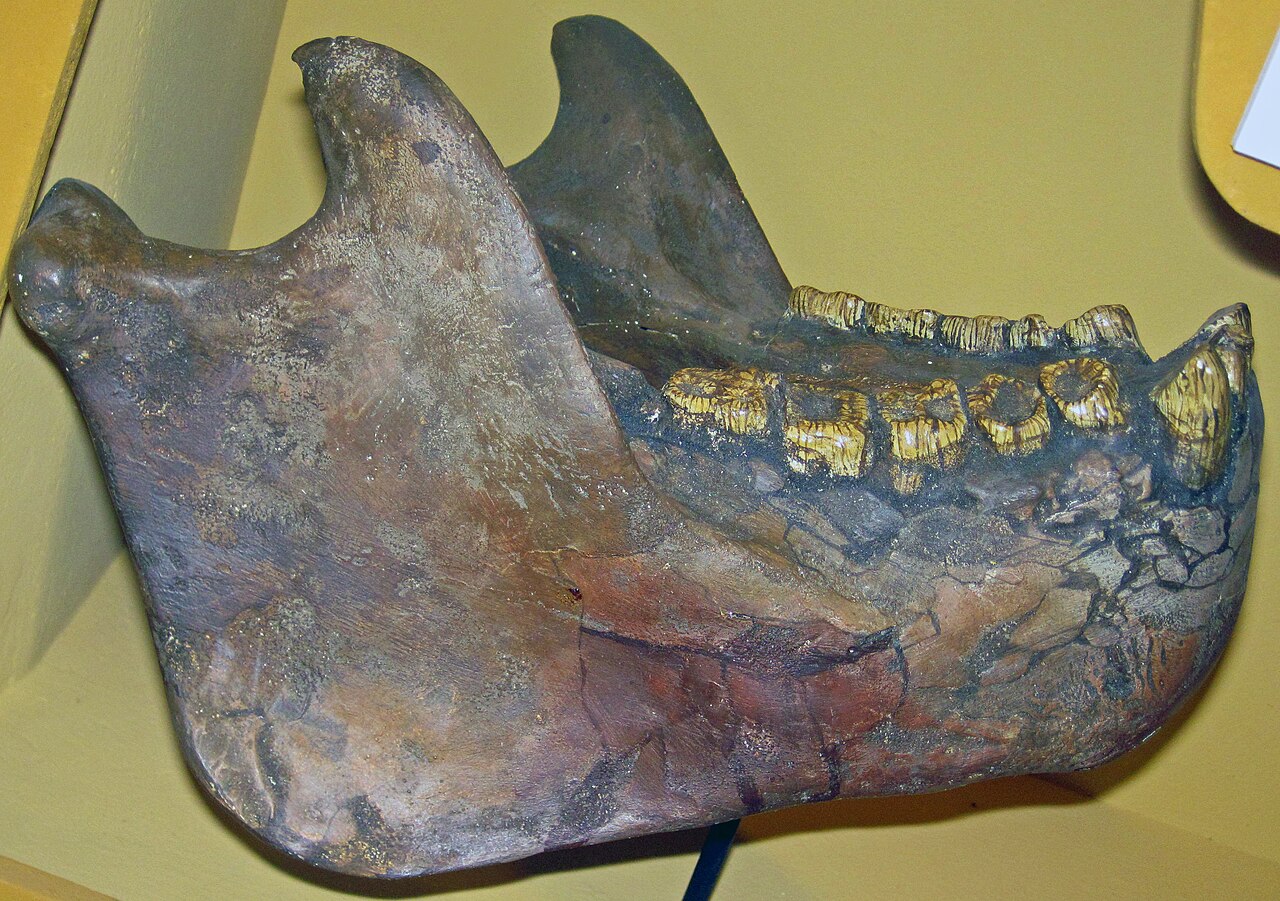
The Second World War delayed further investigation, but in the late 1950s Chinese paleontologists began systematic exploration of limestone cave sites in Guangxi Province, southern China. In 1956, three mandibles of Gigantopithecus blacki were recovered from Liucheng Cave, providing the first substantial evidence of jaw morphology and confirming that the animal had possessed a massive, deep mandibular corpus with enormous premolars and molars.6, 16 A fourth mandible was later recovered from the same region.12 Additional isolated teeth have since been found at more than a dozen cave sites across Guangxi, Guizhou, Hubei, and Hainan provinces in China, as well as in northern Vietnam and possibly Thailand, establishing a geographic range spanning much of subtropical and tropical East and Southeast Asia.1, 8
Dental and mandibular morphology
The teeth and jaws of Gigantopithecus blacki are its defining and virtually only known anatomical features. The mandibles are extraordinarily robust, with a symphyseal height (the vertical dimension at the midline of the jaw) exceeding that of any other known primate. The ascending ramus is tall and broad, suggesting powerful jaw muscles and a correspondingly massive skull, though no cranial material has ever been found.4, 12
The molars of Gigantopithecus are the largest of any known primate, with crown areas roughly twice those of a male gorilla. They are characterized by thick enamel, low and rounded cusps (bunodont morphology), and extensive crenulation of the enamel surface. The premolars are molarized — broadened and flattened in a manner that increases the grinding surface — a feature interpreted as an adaptation to processing large volumes of tough, fibrous plant material.4, 14 The canine teeth, by contrast, are relatively small compared to those of other large-bodied apes, and show less sexual dimorphism than would be expected in an ape of this size, a pattern also seen in early hominins and sometimes interpreted as reflecting reduced male-male competition or dietary specialization.2, 4
Because no postcranial remains of Gigantopithecus have been recovered, its body proportions, locomotor mode, and general appearance remain speculative. Body mass estimates derived from allometric scaling of molar and mandibular dimensions have ranged from approximately 200 kilograms to more than 300 kilograms, with considerable uncertainty owing to the lack of independent body-size indicators.14 Whether Gigantopithecus was primarily terrestrial (like gorillas) or retained some arboreal capacity remains unknown, though its inferred size would have made tree-climbing biomechanically challenging.4
Diet and paleoecology
Multiple independent lines of evidence converge on the conclusion that Gigantopithecus blacki was a specialized herbivore that fed primarily on C3 forest plants — likely fruits, leaves, roots, and possibly bamboo. Stable carbon and oxygen isotope analysis of tooth enamel from multiple Chinese localities demonstrates that Gigantopithecus fed exclusively within closed-canopy forest environments and did not exploit open grassland or savanna resources, which would have a distinct C4 isotopic signature.9
Phytolith analysis of dental calculus adhering to Gigantopithecus teeth from Vietnamese cave sites recovered grass phytoliths as well as seed and fruit remains, suggesting that the diet included grasses and fruits in addition to other plant tissues.5, 10 Dental microwear studies, which examine the microscopic scratching and pitting patterns left on enamel by food processing, reveal a texture pattern consistent with consuming hard or tough plant foods, showing more pitting than would be expected in a soft-fruit specialist and more scratching than in a dedicated leaf eater.15
The popular hypothesis that Gigantopithecus was a bamboo specialist — sometimes drawing parallels with the modern giant panda — has been difficult to confirm or refute definitively. The thick enamel and low-cusped molars are broadly consistent with bamboo consumption, but they are also consistent with a more generalized diet of tough forest plants. The isotopic evidence does not distinguish bamboo from other C3 vegetation.9 What can be stated with confidence is that Gigantopithecus was committed to forested habitats and did not diversify its diet to include the more open-environment resources available elsewhere in its geographic range.9, 11
Phylogenetic position
For much of the twentieth century, the phylogenetic placement of Gigantopithecus was debated. Some researchers, including von Koenigswald himself, speculated that it might be related to hominins, based on superficial dental similarities such as reduced canines and thick-enameled molars. Others placed it closer to the orangutan lineage based on morphological features of the mandible and teeth.4, 7 The absence of DNA-preservable material — teeth and mandibles from tropical cave sites rarely yield ancient DNA — long prevented molecular resolution of the question.
A breakthrough came in 2019, when Frido Welker and colleagues at the University of Copenhagen extracted ancient proteins (proteomics) from the enamel of a 1.9-million-year-old Gigantopithecus blacki molar from Chuifeng Cave in Guangxi, China. By comparing the amino acid sequences of several enamel proteins against those of living apes and fossil hominins, they demonstrated that Gigantopithecus falls unambiguously within the Ponginae — the clade that includes the modern orangutan (Pongo) — and estimated that it diverged from the Pongo lineage approximately 10 to 12 million years ago in the middle Miocene.3 This result settled the debate conclusively: Gigantopithecus is not a hominin and has no special relationship to the human lineage. It is instead the largest known member of the Asian great ape radiation, a sister taxon to orangutans that evolved its enormous body size independently of any trends in hominin evolution.3
Extinction
The timing and causes of the extinction of Gigantopithecus blacki remained poorly constrained until a comprehensive study published in 2024 by Yingqi Zhang and colleagues. Using luminescence dating, uranium-series dating, and electron spin resonance across 22 cave sites in Guangxi — eleven that contained Gigantopithecus remains and eleven that did not — they established that the species went extinct approximately 295,000 years ago (with a confidence interval of 215,000 to 375,000 years ago), during the Middle Pleistocene, well before the arrival of Homo sapiens in the region.11
The same study reconstructed the environmental context of the extinction by analyzing pollen, sediment, and stable isotope data from the dated cave sequences. The results paint a picture of progressive environmental deterioration. Before approximately 700,000 years ago, the Gigantopithecus sites were characterized by dense, closed-canopy forest with high floral diversity. Between 700,000 and 300,000 years ago, the forests became increasingly open and seasonal, with grasslands expanding at the expense of closed woodland. Faunal community analysis revealed that the mammals co-occurring with Gigantopithecus at earlier sites were predominantly forest-adapted species, while later assemblages increasingly included open-habitat taxa.11
Zhang and colleagues concluded that Gigantopithecus blacki was unable to adapt to the progressive loss of its preferred forest habitat during a period of increasing climatic variability in the Middle Pleistocene. Stable isotope analysis of Gigantopithecus teeth spanning this interval showed no shift in dietary niche — the species continued to feed within closed forest even as that habitat shrank — suggesting that it lacked the ecological flexibility to exploit alternative food sources.11 In contrast, the contemporaneous orangutan ancestor (Pongo weidenreichi) showed evidence of dietary broadening during the same period and survived the environmental transition. The extinction of Gigantopithecus, therefore, appears to have been driven by ecological specialization in the face of habitat loss — a pattern repeated throughout the evolutionary history of large-bodied specialists.11
Significance for primate evolution
Gigantopithecus blacki holds a unique position in the study of primate evolution for several reasons. It represents the extreme upper end of primate body size, demonstrating that apes were capable of evolving to dimensions far exceeding those of any living species. It also exemplifies the phenomenon of island-like gigantism on a continental scale: a large-bodied herbivore occupying a specialized niche in the rich tropical forests of Pleistocene Southeast Asia, comparable in ecological terms to the giant pandas with which it may have shared some bamboo resources.4, 13
The confirmation of its pongine affinities through proteomics has had broader methodological significance. The successful extraction and phylogenetic analysis of proteins from a nearly two-million-year-old tooth in a tropical environment — where ancient DNA preservation is essentially impossible — demonstrated that enamel proteomics can resolve evolutionary relationships at temporal depths far beyond the reach of ancient DNA, opening new possibilities for placing other enigmatic fossil primates and mammals within the tree of life.3
Despite its fame, Gigantopithecus remains in many ways one of the most poorly known large mammals of the Pleistocene. Without postcranial remains, fundamental aspects of its biology — its locomotion, its body proportions, its sexual dimorphism beyond the dentition, its social structure — remain matters of inference rather than observation. Whether future discoveries in the limestone caves of southern China and Southeast Asia will yield bones beyond the jaws remains an open and tantalizing question. For now, the largest primate that ever lived is known only by its teeth and the massive jaws that held them.4, 11
References
The dating and context of three new Gigantopithecus blacki fossils from southern China
New Gigantopithecus blacki localities and evidence of coexistence with Homo erectus in mainland Asia