Overview
- The hominin fossil record comprises thousands of specimens spanning approximately 7 million years, representing at least 20 recognized species distributed across Africa, Europe, and Asia—far from the handful of fragmentary bones sometimes claimed by critics.
- The record documents a clear temporal pattern: bipedalism appears first (by ~6–7 Ma), followed by habitual tool use (~3.3 Ma), then progressive brain enlargement (~2.5–0.3 Ma), and finally symbolic behavior and language (~300–100 Ka)—a sequence incompatible with the simultaneous appearance of human traits.
- Hominin evolution was not a single line of descent but a branching bush in which multiple species routinely coexisted; for most of the last 4 million years, two or more hominin species lived on Earth at the same time.
The human fossil record is the accumulated physical evidence—bones, teeth, skulls, and occasionally preserved footprints—documenting the evolution of the hominin lineage over approximately seven million years. It is often caricatured as consisting of a few ambiguous bone fragments, but in reality the record comprises thousands of catalogued specimens from dozens of sites across three continents, representing at least twenty recognized species.11, 12 This article provides an overview of the record itself: its scope, its quality, the patterns it reveals, and its significance for understanding human origins.

Scope of the record
The sheer volume of hominin fossils has grown dramatically since the first recognized discovery of a Neanderthal skullcap in 1856. Today, major collections number in the thousands. The Rising Star cave system in South Africa alone has yielded over 1,550 specimens of Homo naledi from two chambers, making it the largest single assemblage of a non-sapiens hominin species ever recovered from the African continent.1 The Sima de los Huesos site in Atapuerca, Spain, has produced more than 6,500 human fossils from at least 28 individuals, representing a Middle Pleistocene population closely related to Neanderthals.11 Hadar, Ethiopia—the site of "Lucy" and the "First Family"—has contributed hundreds of specimens of Australopithecus afarensis spanning nearly a million years.10
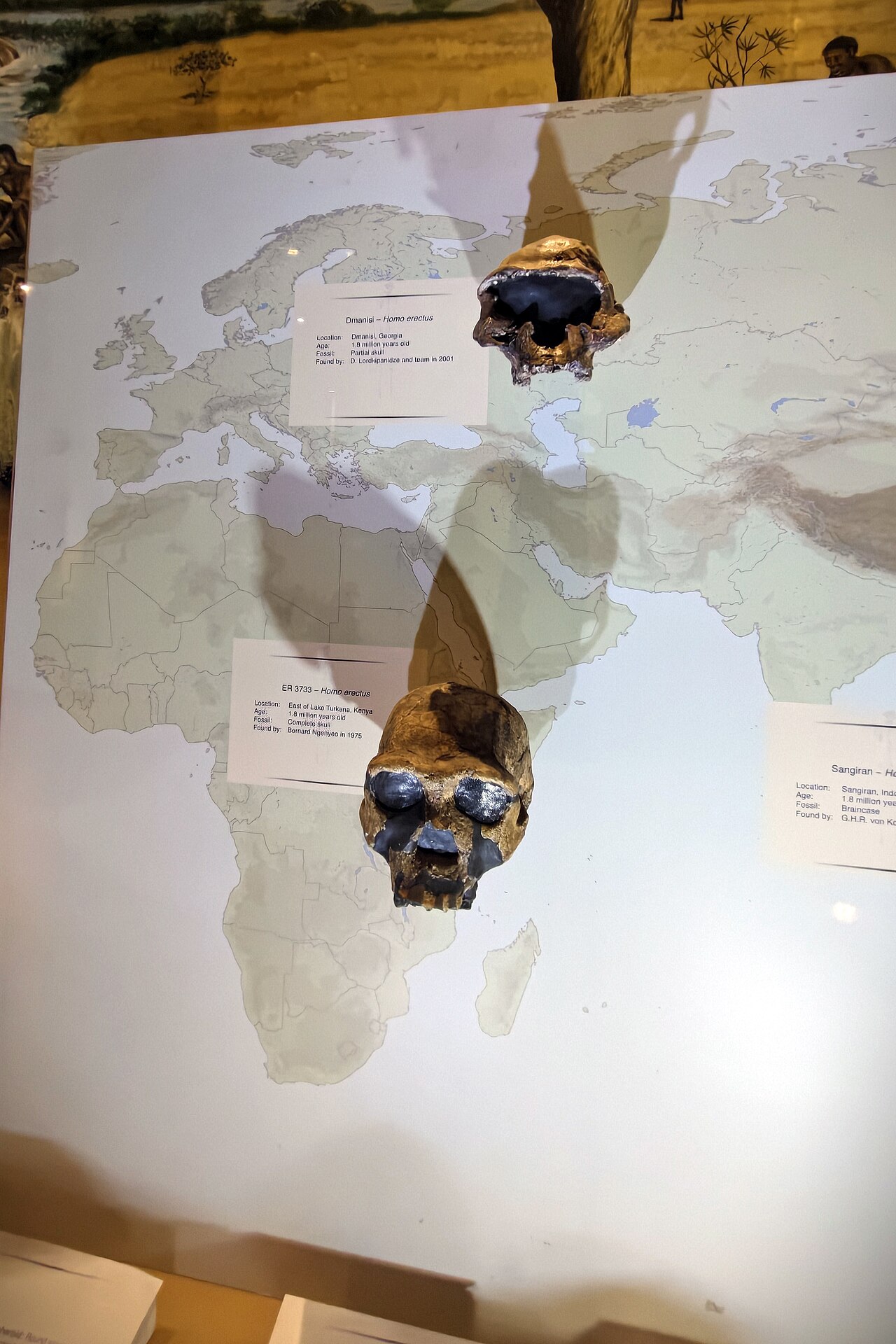
The geographic range of the record is equally extensive. The earliest known hominin fossils come from sites in Chad (Sahelanthropus tchadensis, ~7 Ma), Kenya and Ethiopia (Orrorin tugenensis, ~6 Ma; Ardipithecus, ~5.8–4.4 Ma), and Tanzania (the Laetoli footprints, ~3.66 Ma).3, 9, 16 By 1.8 million years ago, hominins had expanded to the Republic of Georgia, where the Dmanisi site preserves five skulls of early Homo along with stone tools and animal bones.13 Homo erectus fossils are known from Java, China, and across Africa and western Asia. Neanderthal remains span Europe and western Asia from Gibraltar to the Altai Mountains. The fossil record of Homo sapiens extends across every inhabited continent, with the oldest specimens—from Jebel Irhoud, Morocco—dated to approximately 300,000 years ago.14, 15
Species diversity
The number of recognized hominin species has grown steadily as new discoveries are made and analytical techniques improve. Current estimates range from roughly 20 to 25 species, depending on taxonomic opinion, distributed across at least seven genera: Sahelanthropus, Orrorin, Ardipithecus, Australopithecus, Paranthropus, Kenyanthropus, and Homo.12 Some of these taxa are represented by single specimens (Sahelanthropus by one cranium and associated material), while others are documented by hundreds or thousands of fossils (Homo neanderthalensis, H. erectus, A. afarensis).3, 12
Critically, the record does not describe a single line of descent from an ape-like ancestor to modern humans. It describes a branching bush.11, 12 At multiple points in the past, several hominin species existed simultaneously. Between 2 and 1.5 million years ago, for example, eastern and southern Africa were home to at least three or four contemporaneous hominin lineages: robust australopiths (Paranthropus boisei and P. robustus), gracile australopiths, and early members of the genus Homo (H. habilis, H. erectus).4, 12 Even as recently as 50,000 years ago, Homo sapiens shared the planet with Neanderthals, Denisovans, Homo floresiensis, Homo luzonensis, and possibly late-surviving H. erectus.11 The coexistence of multiple hominin species is the norm in the fossil record, not the exception. Our current status as the sole surviving hominin is historically anomalous.
The temporal pattern
Despite the branching complexity, the fossil record reveals a clear directional pattern when viewed across its full seven-million-year span. The major innovations of human biology did not appear simultaneously. They appeared in a well-documented temporal sequence.12, 14
Bipedalism came first. Postcranial evidence from Sahelanthropus (~7 Ma) and Orrorin (~6 Ma) suggests habitual upright posture, and the Laetoli footprints (~3.66 Ma) confirm fully striding bipedal locomotion in A. afarensis—a species whose brain was only slightly larger than a chimpanzee's.3, 9, 16 Tool use followed: cut marks on animal bones from Dikika, Ethiopia, suggest stone-tool-assisted butchery by 3.39 million years ago, and the Lomekwian stone tools from West Turkana date to 3.3 million years ago.5, 6 Significant brain enlargement began with early Homo around 2.5–2.0 million years ago and accelerated in the Middle Pleistocene, with cranial capacity approximately tripling from ~450 cc in Australopithecus to ~1,400 cc in late Homo sapiens.7 Symbolic behavior—art, personal ornaments, burial practices—appears in the archaeological record of both Homo sapiens and Neanderthals within the last 300,000–100,000 years.8, 14
This sequence is deeply informative. If human traits had appeared together in a single event, the fossil record would show a sharp boundary: ape-like forms on one side and fully modern forms on the other. Instead, the record shows a gradual, mosaic accumulation of features over millions of years, with different traits appearing at different times in different lineages. Bipedalism without big brains. Big brains without language. Tools without symbolic thought. Each stage is documented by multiple fossils from multiple sites.12
Quality and completeness
The quality of the hominin fossil record varies by time period and geography, but it is far better than is sometimes claimed. The early record (7–4 Ma) is admittedly sparse, with key species known from relatively few specimens. Sahelanthropus tchadensis is represented primarily by a single cranium and postcranial elements; Orrorin tugenensis by a handful of femoral, dental, and manual fragments.3, 16 But from 4 million years onward, the record becomes increasingly rich. A. afarensis alone is represented by hundreds of specimens from multiple Ethiopian and Tanzanian sites plus the Laetoli footprint trackways.9, 10
For the genus Homo, the record is extensive. The Dmanisi site preserves five skulls with associated postcranial material from a single early Homo population, providing an unprecedented view of within-population variation at 1.8 million years ago.13 Neanderthals are known from hundreds of sites and dozens of relatively complete skeletons. Homo naledi, described only in 2015, is already known from over 1,550 specimens representing at least 15 individuals.1, 2 The Jebel Irhoud fossils of early H. sapiens include crania, mandibles, and postcranial elements from at least five individuals.14, 15
The record also continues to grow at an accelerating pace. New species described since 2000 include Homo floresiensis (2004), Australopithecus sediba (2010), Homo naledi (2015), and Homo luzonensis (2019), among others.1, 12 Ancient DNA technology has revealed entirely new populations—such as the Denisovans, initially identified from a single finger bone—and demonstrated interbreeding among multiple hominin lineages.11 Each decade brings discoveries that add resolution to the picture, filling gaps and occasionally revealing previously unknown branches of the hominin tree.
What the record demonstrates
Taken as a whole, the human fossil record demonstrates several conclusions with overwhelming consistency. First, the hominin lineage extends back at least seven million years, with the earliest species showing a mosaic of ape-like and bipedal features.3, 16 Second, the acquisition of distinctively human traits—bipedalism, tool use, enlarged brains, symbolic cognition—occurred incrementally over millions of years, not all at once.5, 7, 12 Third, human evolution was not a ladder but a bush, with multiple species coexisting and sometimes interbreeding throughout most of the lineage's history.11, 13 Fourth, the record is extensive, well-dated, geographically widespread, and growing—a body of physical evidence that places the evolutionary origin of Homo sapiens beyond reasonable doubt.12, 14
The common objection that the fossil record consists of "only a few bone fragments" is contradicted by the evidence. The record includes complete skulls, nearly complete skeletons, assemblages of dozens of individuals from single sites, footprint trackways preserving behavior in real time, and—increasingly—ancient DNA sequences that confirm and extend the morphological evidence. It is one of the best-documented evolutionary transitions in the vertebrate fossil record, and it continues to improve with every field season.1, 11, 12
Dating the record
The chronological framework of the human fossil record rests on multiple independent dating methods whose concordance provides mutual verification. For sites older than approximately 50,000 years, potassium-argon and argon-argon dating of volcanic minerals have been essential, particularly at the East African rift sites where volcanic eruptions periodically deposited datable ash layers above and below fossil-bearing sediments. The Jebel Irhoud Homo sapiens fossils were dated by thermoluminescence methods applied to heated flints found in direct association with the fossils.14, 15 The Homo naledi remains were dated through a combination of uranium-thorium disequilibrium, electron spin resonance, and paleomagnetism, all yielding concordant ages of 236,000–335,000 years.2
The application of multiple independent dating methods to the same sites means that the chronological sequence of the fossil record is not reliant on any single technique. Errors or limitations in one method are caught by discordance with the others. The result is a temporal framework that is both internally consistent and externally validated by its agreement with the stratigraphic and biostratigraphic evidence — older fossils are found in older rocks, and the morphological intermediacy of transitional forms corresponds to their temporal position in the sequence, precisely as evolutionary theory predicts.11, 12
References
Evidence for stone-tool-assisted consumption of animal tissues before 3.39 million years ago at Dikika, Ethiopia
Symbolic use of marine shells and mineral pigments by Iberian Neandertals 115,000 years ago
The age of the hominin fossils from Jebel Irhoud, Morocco, and the origins of the Middle Stone Age