Overview
- Early hominins such as Ardipithecus and the australopithecines were small-bodied, typically weighing 25–50 kg, comparable to modern chimpanzees; a dramatic increase in body mass occurred with the emergence of Homo erectus around 1.8 million years ago, reaching 50–65 kg or more and establishing the body size range characteristic of later Homo.
- The increase in body size is closely linked to dietary shifts toward higher-quality foods including meat, improvements in thermoregulation for open-habitat endurance, and the metabolic demands of encephalization, with brain and body size scaling allometrically across the hominin lineage.
- Body size evolution was not a simple linear trend: Homo floresiensis demonstrates insular dwarfism in a hominin context, and global human populations have undergone modest body size reduction since the early Holocene, likely driven by the nutritional transition to agriculture.
Body size is among the most fundamental biological parameters of any organism, shaping metabolic rate, diet, locomotion, life history, and ecological interactions. In the hominin lineage, body size underwent one of the most dramatic evolutionary shifts documented in any primate clade: from small-bodied ancestors weighing roughly 30–50 kilograms to the substantially larger frames of Homo erectus and later humans averaging 50–80 kilograms.1, 2 This shift was neither gradual nor linear. It unfolded in a complex pattern punctuated by a major increase around 1.8 million years ago, episodes of insular dwarfism, and a modest reversal following the adoption of agriculture in the Holocene. Tracking body size through the fossil record provides a window into the ecological and dietary transformations that shaped the human lineage.2, 4

Early hominins and australopithecines
The earliest hominins for which body size can be estimated were small-bodied primates broadly comparable to modern chimpanzees and bonobos. Ardipithecus ramidus, dated to approximately 4.4 million years ago and known from the partial skeleton ARA-VP-6/500 ("Ardi"), is estimated to have weighed roughly 50 kilograms, with a stature of about 120 centimeters.5 This places Ardipithecus within the body size range of living chimpanzees, though its postcranial proportions differed markedly from any living ape, reflecting its mosaic of arboreal and bipedal adaptations.5
The australopithecines, which dominated the hominin record from approximately 4.2 to 2.0 million years ago, were consistently small-bodied. Henry McHenry's comprehensive analyses of postcranial remains established that Australopithecus afarensis, represented most famously by the partial skeleton "Lucy" (AL 288-1), had a female body mass of approximately 29 kilograms and a male body mass of approximately 45 kilograms, yielding a species average around 37 kilograms.3, 4 Australopithecus africanus was similarly sized, with estimated body masses ranging from about 30 to 41 kilograms depending on the specimen and estimation method.3 The robust australopithecines (Paranthropus) were somewhat larger, with P. boisei males possibly reaching 49 kilograms, though they remained within the small-bodied range characteristic of the australopithecine grade.4
Sexual dimorphism in body size
One of the most striking features of australopithecine body size is the degree of sexual dimorphism. In Australopithecus afarensis, males were substantially larger than females, with body mass ratios estimated at approximately 1.5:1, comparable to the levels of dimorphism seen in modern gorillas and orangutans, species in which male-male competition for mates is intense.12 This pronounced dimorphism has been interpreted as evidence for a social structure involving significant male-male competition, possibly including polygynous mating systems.12
Over the course of hominin evolution, sexual dimorphism in body size decreased progressively. By the time of Homo erectus, the male-to-female body mass ratio had diminished to approximately 1.2–1.3:1, and in modern Homo sapiens it averages approximately 1.15:1, among the lowest levels of dimorphism in any great ape.2, 7 The reduction in dimorphism has been linked to changes in social organization, including reduced male-male competition, increased pair-bonding, and greater levels of male parental investment and cooperative behavior.7 This trend is not perfectly monotonic—some early Homo populations retained considerable size variation—but the overall trajectory is unmistakable across the genus.1
The Homo erectus transition
The most dramatic change in hominin body size occurred with the emergence of Homo erectus (sensu lato) around 1.8–1.9 million years ago. This species represents a fundamental reorganization of the hominin body plan, moving decisively away from the small-bodied, relatively long-armed, short-legged proportions of the australopithecines toward a body form recognizably similar to modern humans.7, 8
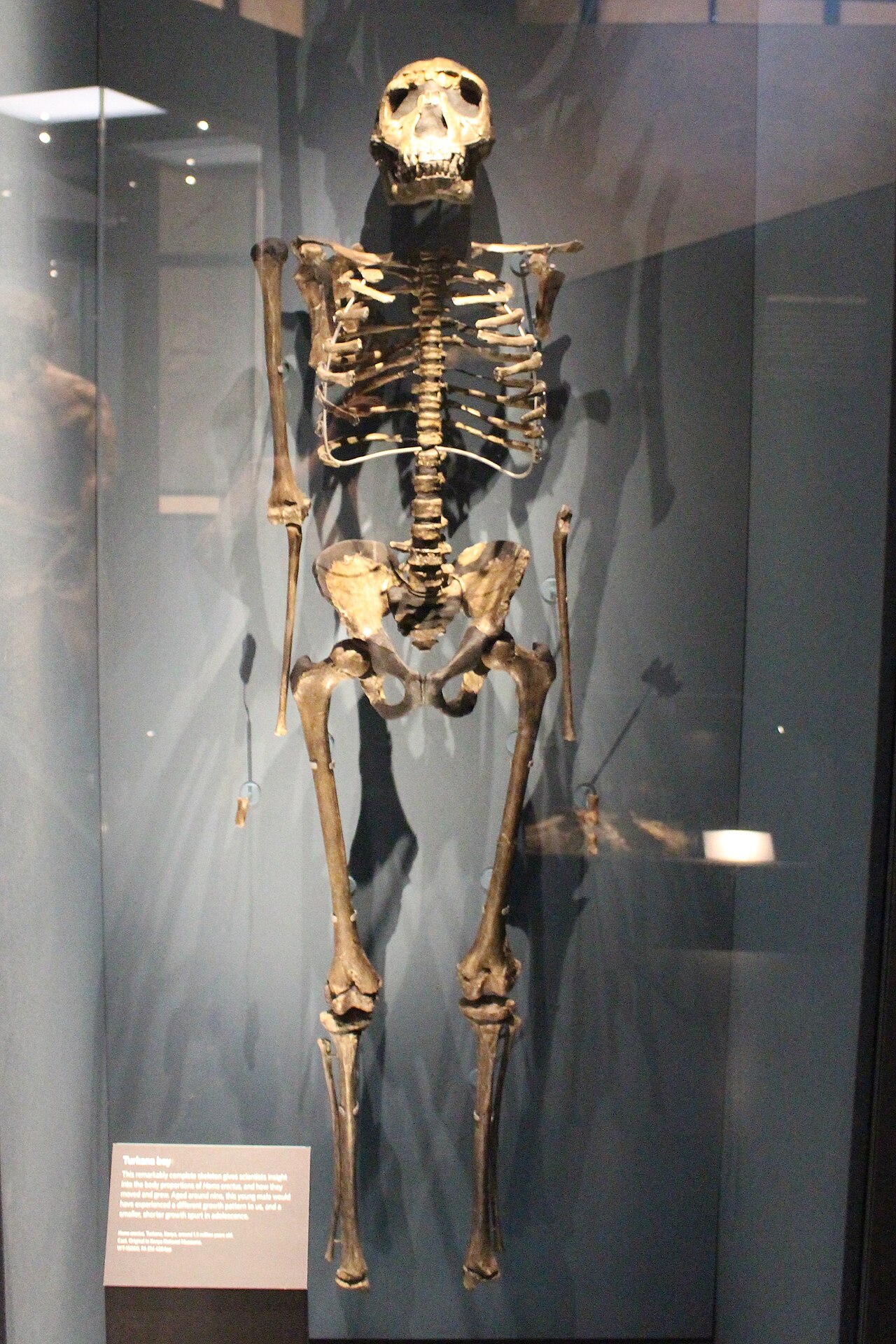
The juvenile skeleton KNM-WT 15000 ("Turkana Boy"), recovered from Nariokotome on the western shore of Lake Turkana, Kenya, and dated to approximately 1.5 million years ago, provides the most complete evidence for H. erectus body size. Despite being an adolescent estimated at roughly 8–11 years of age at death, the individual stood approximately 160 centimeters tall, and adult stature projections range from 175 to 185 centimeters depending on the growth model applied.8 Adult body mass estimates for the Nariokotome individual and other early African H. erectus specimens typically fall in the range of 50–65 kilograms, representing a 50–70 percent increase over australopithecine averages.7, 8
This increase in body size was accompanied by a proportional shift toward longer legs relative to the trunk, a feature that improved locomotor efficiency and reduced the energetic cost of long-distance travel.20 Susan Antón's analyses of the H. erectus postcranium demonstrated that early African populations were not only taller and heavier than their predecessors but had body proportions adapted for sustained walking and running in open environments, consistent with the expansion of hominin home ranges and the exploitation of more dispersed food resources.7 The shift to a larger body size in H. erectus is widely regarded as one of the most consequential transitions in human evolution, reflecting a cascade of changes in diet, energetics, and ecology.7, 20
Diet, meat eating, and energetic demands
The increase in body size from the australopithecine to the Homo grade is closely linked to dietary shifts. Larger bodies require greater absolute energy intake, and the archaeological and isotopic evidence indicates that early Homo populations gained access to substantially higher-quality foods, particularly animal protein and fat, through hunting and scavenging.9 Peter Ungar and Matt Sponheimer's review of hominin dietary evolution demonstrated that the transition to a diet richer in animal foods and underground storage organs provided the caloric density necessary to support both a larger body and a significantly larger brain.9
The relationship between body size and brain size introduces an additional layer of complexity. Leslie Aiello and Peter Wheeler's expensive-tissue hypothesis proposed that the metabolically costly enlargement of the hominin brain was made possible by a corresponding reduction in gut size, enabled by a shift to higher-quality, more easily digestible foods.10 A larger body with a shorter, less energetically demanding gut could allocate more of its metabolic budget to maintaining a larger brain without increasing total metabolic rate beyond the level expected for a primate of that body size.10 While subsequent work has refined and partially challenged the specific trade-off Aiello and Wheeler proposed, the fundamental insight that dietary quality, body size, and brain size are metabolically interconnected in hominin evolution remains widely accepted.10, 20
Herman Pontzer's comparative energetic analyses have further clarified the relationship between body size and total energy expenditure in hominins. Humans have a total daily energy expenditure substantially higher than expected for a primate of their body mass, and this elevated metabolic rate supports not only the large brain but also greater fat storage, longer developmental periods, and higher reproductive output than would be predicted from body size alone.20 The increase in body size in Homo erectus was thus not merely a matter of growing larger; it was part of a comprehensive reorganization of the energy budget that enabled a distinctly human life history pattern.20
Thermoregulation and body proportions
Body size and body shape interact with thermoregulatory demands in ways that shaped hominin evolution across different climatic environments. Peter Wheeler's thermoregulatory models demonstrated that a taller, more linear body form reduces heat gain from solar radiation and improves convective heat loss, advantages that would have been critical for hominins active during the day in the open habitats of Pliocene and Pleistocene Africa.11 The elongated limbs and narrow trunk of Homo erectus and later African Homo populations conform to ecogeographic predictions (Bergmann's and Allen's rules), in which tropical populations tend to be more linearly built with relatively longer limbs, maximizing the surface-area-to-volume ratio for heat dissipation.2, 11
As Homo populations dispersed out of Africa and into higher latitudes during the Middle and Late Pleistocene, body proportions shifted in accordance with these same principles. Neanderthals, adapted to the cold glacial environments of Europe and western Asia, evolved shorter, more robust limbs and wider trunks that reduced the surface-area-to-volume ratio, conserving body heat.2 Christopher Ruff and colleagues documented these ecogeographic patterns systematically across Pleistocene hominins, demonstrating that body shape varied predictably with latitude and climate while overall body mass remained in the range of 55–80 kilograms across most Late Pleistocene populations.2, 19
Brain-body allometry
The relationship between brain size and body size follows a well-characterized allometric scaling pattern in mammals: larger-bodied species tend to have larger brains, but the relationship is not isometric. In hominins, brain size increased far more rapidly than body size, resulting in a progressive increase in encephalization quotient (EQ)—the ratio of actual brain size to the brain size expected for a mammal of equivalent body mass.2, 16
Australopithecines had brain volumes of approximately 400–530 cubic centimeters housed in bodies of 30–50 kilograms, yielding EQ values modestly above those of living great apes.3, 4 Homo erectus, with brain volumes of approximately 600–1100 cubic centimeters and body masses of 50–65 kilograms, showed a substantial increase in EQ.7 Modern humans, with brain volumes averaging approximately 1350 cubic centimeters and body masses of 50–80 kilograms, have EQ values roughly three times those of the australopithecines.2 The key insight from the allometric data is that the increase in brain size cannot be explained simply as a byproduct of increasing body size; it represents an independent evolutionary trajectory of encephalization that occurred against the backdrop of, but was not fully determined by, changes in body mass.2, 16
Insular dwarfism: Homo floresiensis
The discovery of Homo floresiensis on the Indonesian island of Flores in 2003 demonstrated that body size evolution in hominins was not a one-way ratchet toward larger size. The type specimen (LB1) was an adult female who stood approximately 106 centimeters tall and weighed an estimated 25–30 kilograms, comparable in stature to the smallest australopithecines despite living as recently as approximately 50,000–100,000 years ago.13 The brain volume of LB1 was approximately 380–420 cubic centimeters, smaller than any known australopithecine and drastically reduced relative to contemporaneous Homo sapiens.13
William Jungers and colleagues conducted detailed analyses of the postcranial skeleton and concluded that H. floresiensis had body proportions distinct from those of modern human pygmies, with relatively long arms and short legs more reminiscent of early Homo or even australopithecines, suggesting derivation from a small-bodied ancestor rather than secondary dwarfism from a Homo sapiens-sized population.14 However, the phenomenon of insular dwarfism—the evolutionary reduction in body size on islands, well documented in many mammalian lineages including elephants, hippopotamuses, and deer—provides a compelling explanatory framework.15 Mark Lomolino's analyses of body size evolution on islands established that large-bodied mainland species consistently evolve smaller body sizes on islands, driven by limited resources, reduced predation pressure, and smaller population sizes.15 Homo floresiensis represents the most dramatic known example of insular dwarfism in a hominin, demonstrating that the selective pressures that shape body size in other mammals operated on human ancestors as well.13, 14, 15
Holocene body size reduction
The past 10,000 years have witnessed a general, though geographically variable, reduction in human body size relative to Late Pleistocene populations. This trend is closely associated with the transition from foraging to agriculture, which altered both nutritional quality and disease ecology in ways that affected growth and adult body size.17, 18
Amanda Mummert and colleagues reviewed skeletal evidence from multiple archaeological transitions to agriculture worldwide and documented consistent reductions in stature, body mass, and indicators of nutritional health in populations that adopted farming.18 The shift from diverse, protein-rich forager diets to cereal-dominated agricultural diets reduced the quality and variety of nutrient intake, while the increased population densities enabled by agriculture elevated exposure to infectious diseases, both of which constrain growth during childhood and adolescence.18 Richard Steckel's analyses of long-term stature trends confirmed that human height reached its historical nadir in many populations during the early agricultural and industrial periods, with recovery occurring only in the past one to two centuries as nutritional quality and public health improved.17
Whether the Holocene reduction in body size reflects purely phenotypic responses to nutritional stress or includes a genetic component remains debated. The rapid recovery of stature in well-nourished modern populations suggests that much of the reduction was phenotypic—a plastic response to environmental conditions rather than an evolutionary shift in the genetic potential for body size. However, some researchers have proposed that the relaxation of selection pressures associated with the shift from active foraging to sedentary agriculture may have permitted a modest genetic reduction in average body size in some populations.17, 18
Estimated body mass across hominin species (species averages, kg)1, 3, 7, 13
Patterns and significance
The evolutionary trajectory of body size in the hominin lineage reveals several important patterns. First, body size was remarkably stable across the australopithecine grade for roughly two million years, suggesting that the ecological niches occupied by these species did not strongly select for size increase.3, 4 Second, the increase in body size with Homo erectus was rapid in evolutionary terms and coincided with major changes in diet, technology, habitat use, and geographic range, indicating that body size was part of an integrated adaptive package rather than an isolated trait under selection.7, 20 Third, the Homo floresiensis example demonstrates that body size evolution in hominins was reversible under appropriate ecological conditions, conforming to the same island biogeographic principles that govern body size in other mammalian lineages.13, 15 Finally, the Holocene reduction and subsequent recovery in body size underscore that the body size of living humans is not a fixed evolutionary endpoint but a trait that remains responsive to nutritional and environmental conditions on timescales of centuries to millennia.17, 18
References
The expensive-tissue hypothesis: The brain and the digestive system in human and primate evolution