Overview
- Jebel Irhoud is a Middle Stone Age cave site in western Morocco that has yielded the oldest fossils currently attributed to Homo sapiens, dated by thermoluminescence to approximately 315,000 years ago and pushing the origin of our species back by more than 100,000 years.
- The fossils, originally discovered by miners in 1961 and reinvestigated by a team led by Jean-Jacques Hublin from 2004 onward, preserve a mosaic of modern facial and dental anatomy combined with an elongated, archaic-shaped braincase, indicating that the modern human face evolved before the modern human brain.
- Hublin and colleagues argued that the Irhoud population, together with broadly contemporaneous fossils from Florisbad in South Africa and Olorgesailie in Kenya, supports a pan-African model of Homo sapiens origins in which our species emerged from a continent-wide network of populations rather than a single East African cradle.
Jebel Irhoud is a karstic cave site in western Morocco that has produced the oldest fossils currently attributed to Homo sapiens. Discovered by barite miners in 1961 and excavated intermittently for more than half a century, the site preserves the partial remains of at least five hominin individuals together with thousands of Middle Stone Age stone tools, burned flints, and the bones of hunted animals.1, 2 When a team led by Jean-Jacques Hublin published a new analysis in 2017, the combination of refined thermoluminescence dating, additional fossils recovered between 2004 and 2011, and a comprehensive morphological reassessment placed the assemblage at 315 ± 34 thousand years ago—more than 100,000 years older than any other fossil then attributed to our species.1, 2
The Jebel Irhoud fossils preserve a striking pattern. Their faces, mandibles, and teeth fall comfortably within the modern human range, but their braincases retain the elongated, low profile characteristic of more archaic members of the genus Homo.1, 4 This mosaic anatomy, combined with the geographic distance between Morocco and the East African sites that long served as the presumed cradle of our species, prompted Hublin and colleagues to argue that Homo sapiens emerged across the entire African continent through interconnected regional populations rather than from a single founding group.1, 13
The site and its setting
Jebel Irhoud lies in Youssoufia Province, approximately 100 kilometres west of Marrakesh and 50 kilometres southeast of the Atlantic port city of Safi. The site occupies a karstic limestone outcrop on the northern edge of the Rehamna massif and originally formed part of an enclosed cave system that has since been opened by erosion and mining into a partly exposed shelter.9, 17 Approximately eight metres of stratified Pleistocene sediment accumulated within the cavity, preserving a sequence of human occupation horizons interspersed with sterile layers.2
Renewed excavations directed by Hublin and Abdelouahed Ben-Ncer of the Institut National des Sciences de l'Archéologie et du Patrimoine in Rabat distinguished a series of stratigraphic units, of which Layer 7 proved the most informative. This horizon yielded the bulk of the recently described hominin remains together with concentrations of hearths, burned bones, and the heated flint artefacts on which the new dating ultimately rested.2, 17 Sediment micromorphology and the distribution of charcoal in the layer indicate repeated, in-place fire use rather than secondary deposition—a critical condition for the thermoluminescence dating that defined the site's age.2
The faunal assemblage from Jebel Irhoud reflects a relatively open Middle Pleistocene landscape. Teresa Steele's analysis of the bone collection identifies gazelle as the dominant prey species, accompanied by hartebeest, wildebeest, zebra, and other large bovids, as well as porcupines, hares, tortoises, ostrich eggshell, and freshwater molluscs.1, 2 Cut marks and percussion fractures on the long bones, combined with the scarcity of carnivore tooth marks, indicate that the Irhoud hominins were the primary agents accumulating the bone assemblage and were practising systematic hunting, butchery, and marrow extraction.1, 18
Discovery and early excavations
The first hominin fossil from Jebel Irhoud emerged not from a planned excavation but from the operations of a barite mining concession active in the early 1960s. According to contemporary reports, miners working a face in the cave wall in 1961 exposed a nearly intact human skull, which was recovered and eventually transferred to the University of Rabat. The find prompted the French paleontologist Émile Ennouchi to organize a more systematic recovery effort at the site.9, 17
Ennouchi's team began excavations the following year and described the original specimen as Irhoud 1, a remarkably complete adult cranium preserving most of the face, frontal bone, and lateral parietals.11 A second cranium, Irhoud 2, was recovered in 1962 and consisted of a partial calvaria of another adult. A juvenile mandible, Irhoud 3, came to light in 1968 and was distinguished by its relatively small size and apparent immaturity.9, 12 In his 1962 publication in the Comptes Rendus de l'Académie des Sciences, Ennouchi described Irhoud 1 as a Mousterian-associated cranium with affinities he interpreted as Neanderthal-like, an interpretation shaped both by the apparently European character of the associated stone tools and by the assumption that anatomically intermediate forms in North Africa must reflect contact with the Eurasian Neanderthal lineage.11, 12
Two further field campaigns followed in 1967 and 1969, conducted by the French archaeologists Jacques Tixier and Roger de Bayle des Hermens. These excavations established a stratigraphic framework for the deposits and recovered additional hominin remains, including the juvenile humerus designated Irhoud 4 and a coxal bone fragment designated Irhoud 5.9, 12 The 1960s assemblage also produced a fragmentary mandible, Irhoud 6, identified during examination of the faunal collection. After the 1969 season, however, work at Jebel Irhoud effectively ceased for more than three decades, and the site fell into relative obscurity even as its taxonomic interpretation remained unresolved.12
From Neanderthals to early Homo sapiens
The taxonomic status of the Jebel Irhoud fossils was contested throughout the late twentieth century. Ennouchi's original Neanderthal designation gave way during the 1980s and 1990s to a series of reinterpretations that variously classified the remains as North African Neanderthals, archaic Homo sapiens, or representatives of an intermediate population that might have hybridized with Eurasian populations.12 Hublin himself, in a 2001 review of northwestern African Middle Pleistocene hominins, drew attention to the modern aspects of the Irhoud facial morphology and argued for an affinity with the African Homo sapiens lineage rather than with Neanderthals.12
The dating of the assemblage was equally unsettled. Initial radiocarbon attempts in the 1960s returned only minimum ages, indicating that the deposits exceeded the roughly 50,000-year ceiling of the technique.9 Through the 1990s the Irhoud sequence was conventionally placed in the late Middle Pleistocene on the basis of its associated fauna, with most authors favouring an age in the range of 90,000 to 190,000 years ago. A 2007 dating effort applied combined uranium-series and electron-spin-resonance methods to a tooth attributed to the Irhoud 3 mandible and produced an age of approximately 160,000 years.5, 12 That figure was widely cited in the years that followed and aligned the Irhoud population with other purportedly transitional African fossils such as Florisbad and the Omo Kibish hominins.
The 160,000-year date underpinned an influential 2007 study by Tanya Smith, Hublin, and colleagues, which used synchrotron microtomography to examine internal dental structure in the juvenile mandible. The team concluded that the Irhoud child showed a pattern of dental development closer to that of modern humans than to that of Neanderthals, with crown formation times somewhat extended relative to recent human means but root development still slightly accelerated. The result was interpreted as the earliest then-known evidence for a prolonged, modern-style life history in Homo, including a delayed maturation that would have permitted extended childhood learning.5
The Hublin excavations and new specimens
Convinced that the site retained intact deposits, Hublin secured permission from Moroccan authorities to reopen Jebel Irhoud in 2004. The renewed campaign was a significant logistical undertaking. Mining and erosion had left the cave's southern wall partly collapsed, and the team had to rebuild the access road and remove approximately 200 cubic metres of rocky debris before in-situ archaeological deposits could be exposed.17 Excavation continued in seasonal campaigns through 2011 under the joint direction of Hublin, Ben-Ncer, and the archaeologist Shannon McPherron of the Max Planck Institute for Evolutionary Anthropology.1, 2
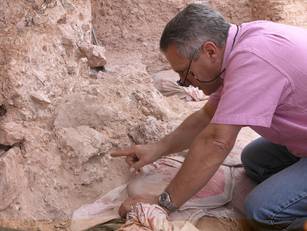

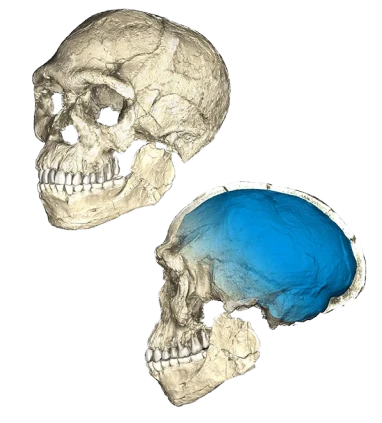
The new excavations recovered sixteen additional hominin specimens, including teeth, cranial fragments, postcranial elements, and—most consequentially—a partial adult cranium designated Irhoud 10 and a near-complete adult mandible designated Irhoud 11.1, 18 Together with the earlier finds, the assemblage now includes the remains of at least five individuals: three adults, one adolescent, and the Irhoud 3 child. The composite material allowed Hublin and colleagues to reconstruct facial proportions for Irhoud 10 using virtual anthropology and to examine the mandibular morphology of Irhoud 11 in detail for the first time.1

The recovered material spans several stratigraphic layers. Most of the new fossils derive from Layer 7, the principal occupation horizon, but additional teeth and fragments come from the lower Layer 4 and from what the excavators designated Layer A. The fact that hominins, lithics, and burned flints occur together in the same stratigraphic units provided the foundation for the integrated dating program described by Daniel Richter and colleagues, in which the age of the heated flints was treated as a direct estimate of the age of the human occupation.2
Thermoluminescence dating and the 315 ka result
The 2017 redating of Jebel Irhoud relied on three independent lines of chronological evidence brought together by Richter and colleagues.2 The primary technique was thermoluminescence dating of fire-heated flint artefacts. When silica-rich material such as flint is exposed to high temperatures, accumulated radiation damage in its crystal lattice is reset to zero. Thereafter, ionizing radiation from naturally occurring uranium, thorium, and potassium in the surrounding sediment progressively rebuilds the trapped electron population at a measurable rate. Heating the flint in the laboratory releases this stored signal as light, allowing the time elapsed since the original burning to be calculated.2
Richter's team analysed fourteen burned flints recovered during the new excavations from contexts directly associated with the hominin fossils. Each sample was assessed for completeness of zeroing, sediment dose rate, and measurement uncertainty. The weighted average of the individual ages converged on 315 ± 34 thousand years ago, with all individual samples falling within a relatively narrow range that supported a single primary occupation horizon rather than a long, drawn-out accumulation.2 The result was published in the same issue of Nature as the morphological analysis by Hublin and colleagues, and the two papers together constituted the formal redating of the site.1, 2
To independently corroborate the thermoluminescence chronology, Rainer Grün recalculated the combined uranium-series and electron-spin-resonance age of a tooth from the Irhoud 3 juvenile mandible using updated dose-rate models. The revised calculation produced an age of 286 ± 32 thousand years, statistically indistinguishable from the thermoluminescence result.2 A third constraint came from optically stimulated luminescence dating of sediment grains directly beneath Layer 7, which yielded a stratigraphically consistent minimum age. The convergence of three independent techniques on a late Middle Pleistocene age for the Irhoud occupations resolved decades of chronological uncertainty.2, 8
Successive age estimates for the Jebel Irhoud hominins2, 5, 12
The redating did more than reposition Jebel Irhoud within the Middle Pleistocene; it transformed the site into the oldest securely dated occurrence of fossils attributable to Homo sapiens anywhere in the world. The previous record was held by the Omo Kibish I cranium from Ethiopia, conventionally dated to about 195,000 years ago at the time and subsequently revised to a minimum age of approximately 233,000 years.1, 8 The Irhoud chronology was therefore not a marginal adjustment but a step change of more than a hundred thousand years in the recognised antiquity of our species.
Cranial and dental anatomy
The morphological analysis presented by Hublin and colleagues focused on the most complete crania from the site—Irhoud 1, Irhoud 2, and the partly reconstructed Irhoud 10—and on the new adult mandible Irhoud 11. The team applied geometric morphometric methods to compare the Irhoud crania with a large sample of fossil and recent human skulls and used micro-CT to extract internal structures otherwise hidden by matrix or breakage.1
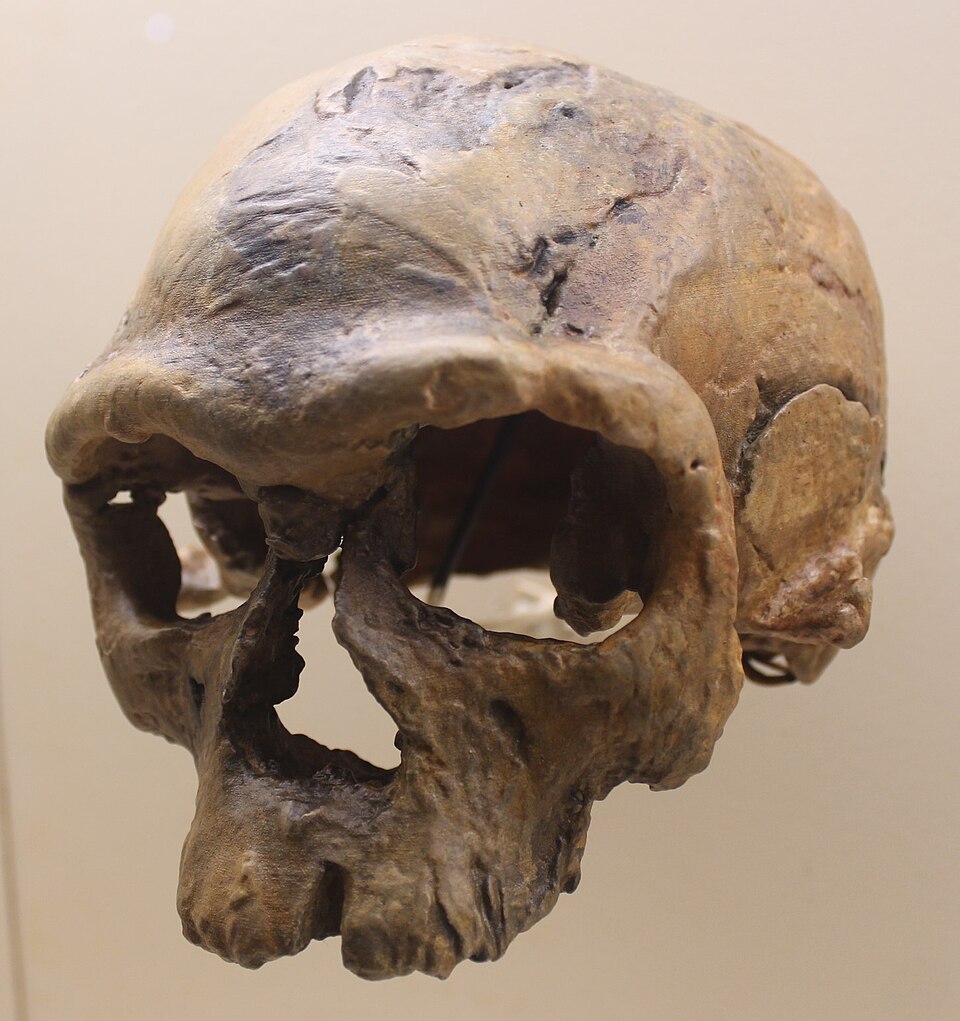

The face is the most diagnostic region. The Irhoud midface is short and retracted, with reduced subnasal prognathism, gracile zygomatic bones, and a narrow nasal aperture. The brow ridge is continuous and moderately developed but lacks the projecting torus seen in Homo heidelbergensis specimens such as Kabwe and Bodo. In quantitative shape analysis the Irhoud faces fall within the range of variation observed in early modern humans from Omo Kibish, Skhūl, and Qafzeh, and are clearly distinct from Neanderthals on the one hand and from middle Pleistocene archaic Homo on the other.1, 10
The mandible reinforces this assessment. Irhoud 11, the first nearly complete adult mandible from the site, is large and robust, with a vertical symphysis and a tear-shaped symphyseal cross-section that Hublin and colleagues identified as characteristic of Homo sapiens. The corpus height decreases from front to back, matching the modern human pattern, and the dental arcade follows the parabolic shape typical of our species rather than the more rectangular configuration of Neanderthal and earlier Pleistocene mandibles.1 A faint mental tubercle is present, foreshadowing but not yet matching the well-developed chin of fully modern humans.1, 12
The dentition combines large, archaically proportioned tooth crowns with derived features that align with the Homo sapiens lineage. Skinner and colleagues' analysis of internal enamel-dentine junctions identified non-metric traits—simplified molar occlusal patterns, reduced cusps, and characteristic root configurations—that group the Irhoud teeth with later modern humans rather than with Neanderthals or with archaic African forms.1 An author correction to the original paper subsequently adjusted minor numerical figures in the dental tables but did not alter the underlying taxonomic conclusions.3
The neurocranium tells a different story. The Irhoud crania preserve a long, low vault with a flattened parietal region, a relatively prominent occipital bun, and an estimated endocranial volume of approximately 1,375 millilitres for Irhoud 1 and 1,467 millilitres for Irhoud 2.4, 16 These volumes lie within the range of recent human variation, but the overall shape—elongated rather than globular—is reminiscent of Homo heidelbergensis and Neanderthals rather than of fully modern humans.1, 4 The braincase, in other words, appears archaic in shape even though it was already modern in size.
Brain size, brain shape, and the mosaic pattern
The Jebel Irhoud crania played a central role in the 2018 study of brain shape evolution by Simon Neubauer, Hublin, and Philipp Gunz. Using geometric morphometric analysis of digital endocasts, the team measured 935 endocranial landmarks and semilandmarks across a sample of twenty Homo sapiens crania spanning from approximately 300,000 to 10,000 years ago, together with comparative samples of Neanderthals, Homo erectus, and 89 living humans.4 The Jebel Irhoud specimens represented the earliest end of the Homo sapiens sample.
Neubauer and colleagues found that the modern globular braincase, distinguished by parietal bulging and an enlarged, more domed cerebellum, did not appear at the origin of Homo sapiens but emerged gradually through the Middle and Late Pleistocene.4 The Jebel Irhoud crania, despite their large overall capacities, retain an elongated, archaic shape close to that of Homo heidelbergensis. The Omo Kibish, Herto, and Skhūl-Qafzeh specimens occupy intermediate positions, with progressively more globular profiles. Only fossils younger than approximately 35,000 years consistently fall within the shape range of living humans.4 The transition between the Irhoud-like and modern endocranial shapes occurred somewhere between 100,000 and 35,000 years ago.4
This trajectory has substantive implications for how anatomical modernity should be understood. Brain size and brain shape evolved on different schedules: by 315,000 years ago the Jebel Irhoud population already possessed brains as large as those of recent humans, but the internal architecture of the cerebrum continued to remodel for hundreds of thousands of years afterwards.4 Bruner and Pearson, in an earlier morphometric study of the Irhoud 1 cranium, had already drawn attention to the discrepancy between the modern face and the archaic vault and had argued that the specimen documented an early phase of Homo sapiens in which the facial skeleton had reached essentially modern proportions while the brain had not.16 The 2017 reanalysis confirmed this interpretation on a much larger sample.
Endocranial volume of Jebel Irhoud crania compared with other early Homo sapiens1, 4
Middle Stone Age artefacts and behaviour
The lithic assemblage from Jebel Irhoud is dominated by Levallois prepared-core products, including pointed flakes, side scrapers, and a small number of retouched implements that earlier authors classified within the North African Mousterian. The new excavations recovered more than two thousand pieces, the great majority struck from high-quality flint apparently transported to the site from sources between roughly twenty and thirty kilometres away.1, 17 Handaxes of the Acheulean tradition, which characterise older Middle Pleistocene sites in the same region, are entirely absent from the Irhoud assemblage.2
Together with sites such as Olorgesailie in southern Kenya, where Alison Brooks and colleagues described early Middle Stone Age technology and long-distance pigment transport in deposits dated to between approximately 320,000 and 305,000 years ago, the Irhoud lithics establish that prepared-core technologies and the broader Middle Stone Age toolkit were already widespread across Africa by the late Middle Pleistocene.14 Shannon McPherron, the lead lithic analyst on the Hublin team, observed that the Irhoud points and scrapers closely resemble Middle Stone Age assemblages from East and southern Africa, suggesting that broadly similar technological traditions had spread across the continent at roughly the same time as the early Homo sapiens populations themselves.8, 17
Layer 7 also documents in-place fire use. The horizon contains hearths, microcharcoal, burned bones, and the heated flints on which the new dating depended. Temperatures inferred from the thermoluminescence signal indicate that the flints were exposed to fires hot enough to fully reset the trapped-charge population, consistent with cooking or hearth maintenance rather than incidental burning.2, 18 The same layer preserves cut-marked and percussion-fractured bones of gazelle and other ungulates, indicating that the Irhoud occupants were processing carcasses on the spot for meat and marrow.1
Despite this evidence for sophisticated subsistence and tool-making behaviours, the Irhoud assemblage so far lacks several markers often associated with later Middle Stone Age symbolic culture. The excavators have reported no shell beads, no engraved ochre fragments, and no clear use of mineral pigments at the site, in contrast to younger Middle Stone Age occurrences such as Blombos in South Africa or Pinnacle Point.14, 15 This pattern is consistent with a model in which the technological core of the Middle Stone Age, including controlled fire and Levallois production, was already established by 315,000 years ago, while the elaboration of symbolic behaviours took place later within the Homo sapiens lineage.14, 15
The pan-African origin model
Hublin and colleagues framed the Jebel Irhoud results as evidence for a pan-African origin of Homo sapiens. Until 2017, the conventional model placed our species' origin within a narrow window of time and space, most often invoking East African populations of around 200,000 years ago as the source. The new Moroccan dates, together with the broadly contemporaneous Florisbad cranium from South Africa, the Olorgesailie Middle Stone Age artefacts from Kenya, and revised age estimates for the Omo Kibish hominins, instead pointed to a continent-wide phenomenon spanning North, East, and southern Africa.1, 13, 14
The model proposed by Hublin and colleagues, and developed in greater detail by Eleanor Scerri and a multidisciplinary team in 2018, holds that Homo sapiens emerged not from a single, geographically restricted ancestral population but from a network of regional groups distributed across the continent and connected by intermittent gene flow. Periodic shifts in climate and vegetation, including the cyclical greening and aridification of the Sahara, alternately fragmented and reconnected these populations, allowing morphological and genetic novelties to spread across the network without requiring a single point of origin.13
Within this framework, the morphological diversity observed across early Homo sapiens fossils—the modern face and archaic braincase of Jebel Irhoud, the more globular vault of Omo I, the transitional features of Florisbad, the long-vaulted Omo II—represents not noise around a single ancestral form but the genuine variation of a subdivided population in which different traits were assembled at different rates in different regions.1, 13 Hublin made the point bluntly in interviews surrounding the 2017 publication, stating that the discovery obliged paleoanthropologists to revise the textbooks: by 300,000 years ago, Homo sapiens "was already represented all over the African continent and not restricted to a small 'garden of Eden' in East or Southern Africa."18
Key specimens
Principal hominin specimens from Jebel Irhoud1, 9, 12
| Specimen | Discovery | Element | Stratigraphy | Significance |
|---|---|---|---|---|
| Irhoud 1 | 1960 | Adult cranium (largely complete) | Lower deposits | Type cranium; modern face, archaic vault, ~1375 ml |
| Irhoud 2 | 1962 | Adult calvaria | Lower deposits | Largest endocranial volume (~1467 ml) |
| Irhoud 3 | 1968 | Juvenile mandible | Lower deposits | Subject of 2007 dental development study; redated to 286 ± 32 ka |
| Irhoud 4 | 1969 | Juvenile humerus | Tixier excavation | First postcranial element described |
| Irhoud 5 | 1969 | Juvenile coxal fragment | Tixier excavation | Adds postcranial diversity |
| Irhoud 10 | 2007 | Adult cranium (partial) | Layer 7 | Basis for 2017 facial reconstruction |
| Irhoud 11 | 2007 | Adult mandible (near complete) | Layer 7 | First nearly complete adult mandible from the site |
Irhoud 1 remains the most iconic specimen from the site and was the cranium that anchored the original taxonomic debate. Its preservation is exceptional for a Middle Pleistocene cranium: most of the face, the entire frontal bone, the parietals, and a substantial portion of the occipital are present. The reconstruction of Irhoud 10, achieved by mirroring preserved elements and warping them onto a virtual reference, allowed Hublin and colleagues to assess facial proportions on a second adult and to confirm that the modern facial morphology of Irhoud 1 was not idiosyncratic but characteristic of the population.1
Irhoud 11 is arguably the most informative new specimen. As the first nearly complete adult mandible from the site, it permitted detailed comparison of dental arcade shape, symphyseal morphology, and mandibular corpus dimensions with both Neanderthal and early modern human samples. Hublin and colleagues found that Irhoud 11 fell within the range of early Homo sapiens on every metric examined, even though its overall robusticity placed it at the upper end of that range.1 The juvenile mandible Irhoud 3, originally thought to be Neanderthal-like, proved on detailed study by Smith and colleagues to display a chin region with the inverted T-shape characteristic of Homo sapiens, and by 2017 had become a key piece of evidence for the species attribution of the entire assemblage.5, 12
Reception and ongoing debates
The 2017 publication received extensive attention in the paleoanthropological community and the popular press alike, with most observers regarding the new chronology as robust and the morphological case for Homo sapiens attribution as persuasive.6, 7 Chris Stringer of the Natural History Museum in London described the Irhoud finds as "the oldest association of probable early members of the Homo sapiens lineage and Middle Stone Age tools" and welcomed the shift of Morocco from a perceived backwater of human evolution to a prominent position in the story.10 Stringer emphasized, however, that the Irhoud population should be regarded as an early or "archaic" form of Homo sapiens rather than as fully modern, and that the gap between such early forms and the anatomically modern humans seen at Omo Kibish would likely narrow as more fossils were recovered.10
Not all responses were uniformly positive. The paleoanthropologist John Hawks raised the alternative possibility that the Irhoud population might be more usefully placed within an extended Homo heidelbergensis grade, or assigned to a separate species linked more closely to Homo antecessor.7 The dispute is partly definitional: where one draws the boundary between Homo heidelbergensis and early Homo sapiens depends on which traits are weighted most heavily, and the Irhoud specimens, which combine modern facial features with archaic braincase shape, fall close to whatever line is drawn. Hublin's team responded that the dental and facial evidence in particular places the assemblage firmly on the Homo sapiens side of any defensible boundary.1, 10
A more substantive limitation is the absence of ancient DNA. North African climates are unfavourable for the preservation of biomolecules in Middle Pleistocene fossils, and attempts by Hublin and collaborators to extract genetic material from the Jebel Irhoud remains have so far been unsuccessful.1 Without DNA, the relationship of the Irhoud population to later African Homo sapiens and to non-African populations cannot be tested directly, and the species attribution rests entirely on morphology and stratigraphic context. A 2018 author correction to the original paper updated several minor numerical values in the supplementary tables but did not affect the main conclusions of the study.3
Even granting these uncertainties, the case for treating Jebel Irhoud as the oldest known site of Homo sapiens has not been seriously challenged in the years since 2017. The convergent dating, the careful morphometric analysis, the parallel evidence for early Middle Stone Age technology and pan-African connectivity from sites such as Olorgesailie, and the broader pattern of subdivided African population structure recognized in genomic studies have all reinforced rather than undermined Hublin and colleagues' interpretation.13, 14
Significance for human origins
Jebel Irhoud now occupies a central place in narratives of human origins for three connected reasons. First, the site's age sets a minimum date for the appearance of recognisable Homo sapiens features at approximately 315,000 years ago, more than 100,000 years earlier than any previous estimate.1, 2 Second, its geographic position in northwestern Africa, at the opposite end of the continent from the East African Rift sites that long dominated discussion of human origins, makes it impossible to maintain the model of a single regional cradle for our species.1, 13 Third, its mosaic morphology illustrates the gradual, region-specific assembly of the modern human body plan, with the face and dentition reaching essentially modern conditions while the braincase still retained an archaic shape.1, 4
These findings have changed the textbook account of when and where Homo sapiens appeared. Where earlier accounts spoke of a "speciation event" at around 200,000 years ago in East Africa, the current synthesis treats the origin of our species as an extended, geographically distributed process that began at least 300,000 years ago and continued for hundreds of thousands of years afterwards, with different anatomical and behavioural features arising in different parts of the African continent and gradually merging through gene flow.1, 13 The Jebel Irhoud population, with its modern face, archaic braincase, Levallois toolkit, controlled fires, and gazelle-rich diet, captures one moment in that long process and gives it a tangible identity.
Within the broader fossil record, Jebel Irhoud functions as a reference point for what very early Homo sapiens looked like, how they lived, and where they lived. It complements rather than displaces the East African record at Omo Kibish and Herto and the southern African record at Florisbad, and in doing so it provides the geographic third leg of the pan-African origin model.1, 8, 13 Whatever future fossils may add to the picture, the redating of Jebel Irhoud already stands as one of the most consequential single results in twenty-first-century paleoanthropology.
References
The age of the hominin fossils from Jebel Irhoud, Morocco, and the origins of the Middle Stone Age
Author Correction: New fossils from Jebel Irhoud, Morocco and the pan-African origin of Homo sapiens
Northwestern African Middle Pleistocene hominids and their bearing on the emergence of Homo sapiens
Did our species evolve in subdivided populations across Africa, and why does it matter?
Chronology for the Aterian of North Africa and implications for the dispersal of modern humans