Overview
- The Oldowan industry is the earliest widely recognized stone tool tradition, first appearing in the archaeological record approximately 2.6 million years ago at sites such as Gona in Ethiopia, and persisting until roughly 1.7 million years ago when it was gradually supplemented by the more sophisticated Acheulean technology.
- Oldowan toolmakers produced sharp-edged flakes by striking one cobble (the hammerstone) against another (the core), a deceptively simple technique that nevertheless required precise understanding of fracture mechanics, raw material properties, and appropriate striking angles — cognitive abilities that no living nonhuman primate has convincingly demonstrated in the wild.
- Although traditionally attributed to Homo habilis, the identity of the earliest Oldowan toolmakers remains debated, with some researchers arguing that late australopithecines such as Australopithecus garhi or even Paranthropus species may have been capable of producing simple flaked stone tools.
The Oldowan industry is the earliest widely recognized tradition of deliberately manufactured stone tools, named after Olduvai Gorge in Tanzania where Mary and Louis Leakey first systematically described the technology in the 1930s through 1960s.11, 14 Dated from approximately 2.6 million years ago to roughly 1.7 million years ago, the Oldowan represents a technological revolution of the first order: the moment when hominins began to systematically fracture stone to produce sharp cutting edges, fundamentally altering their relationship with the environment and opening ecological niches that would have been inaccessible without tools.1, 5 Although the flaked cobbles and simple cores of the Oldowan may appear crude to modern eyes, experimental archaeology has demonstrated that their manufacture requires a suite of cognitive and motor abilities far exceeding those documented in any nonhuman primate, including an understanding of conchoidal fracture mechanics, the ability to select appropriate raw materials, and the capacity to plan and execute multi-step reduction sequences.4, 6
Earliest evidence and the Lomekwian question
The oldest securely dated Oldowan artifacts come from the site of Gona (also known as Kada Gona or EG 10 and EG 12) in the Afar region of Ethiopia, where Sileshi Semaw and colleagues recovered thousands of flaked stone artifacts from deposits dated by argon-argon methods to approximately 2.6 million years ago.1, 3 These earliest Gona tools already display a surprisingly competent level of craftsmanship: the knappers selected high-quality volcanic raw materials, struck flakes at appropriate platform angles, and produced artifacts that show clear evidence of systematic, intentional reduction rather than accidental breakage.3, 13 The sophistication of the Gona assemblage suggests that the origins of stone toolmaking may extend even further back in time, beyond the current archaeological visibility.
That suspicion received dramatic support in 2015 when Sonia Harmand and colleagues announced the discovery of stone tools at Lomekwi 3 in West Turkana, Kenya, dated to approximately 3.3 million years ago — some 700,000 years older than the oldest Oldowan.2 Dubbed the "Lomekwian," this putative industry consists of large cores and flakes produced by what Harmand's team described as passive hammer (anvil) and bipolar techniques, differing from the Oldowan in both the size and the apparent knapping strategy of the artifacts.2 The Lomekwian remains controversial: some researchers have questioned whether all the specimens are genuinely artifactual rather than products of natural fracture processes, and the relationship between the Lomekwian and the Oldowan — whether the former represents a true precursor tradition or an independent phenomenon — remains unresolved.5 If the Lomekwian is confirmed as a legitimate stone tool industry, it would push the origins of deliberate stone tool manufacture back to a time when only australopithecines and Kenyanthropus are known from the fossil record, implying that stone toolmaking predates the genus Homo.2
Core-and-flake technology
The defining technological principle of the Oldowan is the production of sharp-edged flakes by striking a cobble or nodule (the core) with another stone (the hammerstone), exploiting the property of conchoidal fracture in fine-grained rocks such as basalt, chert, quartzite, and obsidian.4, 5 When a hammerstone strikes a core at the correct angle and with sufficient force, a flake detaches along a predictable fracture plane, producing a piece of stone with an edge sharp enough to cut through hide, sever tendons, and slice meat from bone. The resultant cores, often described as "choppers" or "polyhedrons" in older literature, retain scars from multiple flake removals and may themselves have served as tools for heavy-duty tasks such as breaking bones to access marrow.5, 14
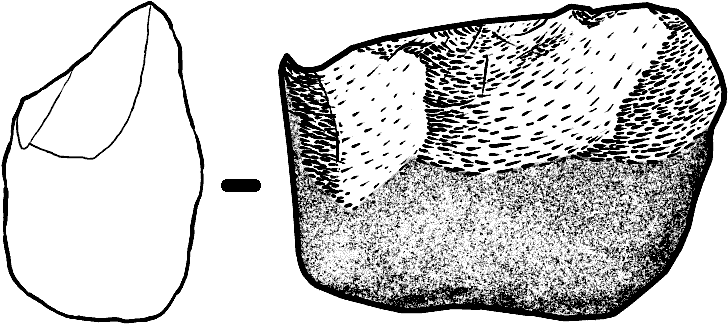

Nicholas Toth's landmark experimental program in the 1980s demonstrated that successful Oldowan flake production is not a trivial task. The knapper must identify and maintain an appropriate striking platform — a flat or slightly angled surface on the core — and strike at an acute angle (less than 90 degrees) relative to the platform, directing force through the core to propagate a fracture that detaches a usable flake.4 Toth's experiments with novice human knappers showed that achieving consistent, controlled flake removal required extended practice and a conceptual understanding of how force, angle, and raw material interact — skills that cannot be acquired through simple trial and error alone.4 The Oldowan assemblage from Lokalalei 2C in West Turkana, dated to approximately 2.34 million years ago, provides striking evidence of early hominin technical competence: refitting studies showed that individual cores were reduced through long, carefully sequenced series of removals, demonstrating planning depth and an ability to maintain flaking surfaces through multiple stages of reduction.9
Key sites and geographic distribution
Beyond Gona, the Oldowan is documented at dozens of sites across eastern and southern Africa and, in its later phases, in parts of western Asia. Olduvai Gorge in northern Tanzania, the type site for which the industry is named, preserves a rich sequence of Oldowan and early Acheulean deposits in Beds I and II, spanning from approximately 1.9 to 1.5 million years ago. Mary Leakey's meticulous excavations at Olduvai revealed dense concentrations of stone tools associated with fragmented animal bones, which she interpreted as "living floors" — places where hominins brought carcasses and raw materials for tool production and food processing.11, 14
The site of Lokalalei in the Nachukui Formation of West Turkana, Kenya, has yielded some of the most informative Oldowan assemblages. At Lokalalei 2C, dated to approximately 2.34 million years ago, Roche and colleagues recovered an assemblage in which numerous flakes could be refitted onto their parent cores, revealing the step-by-step reduction sequences employed by the original knappers.9, 8 These refitting studies demonstrated that Oldowan toolmakers at Lokalalei already possessed a sophisticated understanding of core geometry and were capable of rotating cores to exploit fresh platforms when existing ones became exhausted — a level of technical planning that challenges any characterization of the Oldowan as a purely ad hoc, unsophisticated technology.9
Outside Africa, Oldowan-like assemblages have been reported from Dmanisi in Georgia, dated to approximately 1.8 million years ago, and from several sites in China and Indonesia at dates ranging from 1.8 to 1.5 million years ago, demonstrating that the earliest hominin dispersals out of Africa were accomplished with an Oldowan-grade toolkit rather than the more sophisticated Acheulean technology that emerged later.14
Raw material selection
One of the most revealing aspects of Oldowan technology is the evidence for deliberate raw material selection. At Gona, Stout and colleagues documented that the earliest toolmakers preferentially selected high-quality volcanic cobbles — particularly fine-grained phonolite and trachyte — from among the diverse range of rock types available in local stream gravels.13 The selected materials were consistently those that produced the sharpest, most predictable flakes when struck, indicating that Oldowan hominins understood the fracture properties of different rock types and made informed choices about which stones to collect and knap.13, 3
At many Oldowan sites, raw materials were transported significant distances from their geological sources to the locations where tools were manufactured and used. Transport distances of two to ten kilometres are commonly documented, and some cases suggest transport of raw material over even greater distances.14 This pattern of raw material transport implies a degree of landscape knowledge, planning, and anticipation of future needs that exceeds the cognitive demands typically attributed to nonhuman primates. The toolmaker had to remember the locations of suitable raw material sources, carry heavy stones over substantial distances, and delay the reward of tool use until the material was brought to the place where it was needed.6, 14
Who made the Oldowan tools?
The identity of the earliest Oldowan toolmakers is one of the most contested questions in paleoanthropology. The traditional attribution to [Homo habilis](/human-evolution/homo-habilis-rudolfensis), the "handy man" named by Louis Leakey and colleagues in 1964 precisely because of its association with stone tools at Olduvai Gorge, has been complicated by several developments.12, 14 First, the oldest Oldowan tools at Gona (2.6 Ma) predate the earliest confidently identified fossils of Homo by several hundred thousand years, leaving open the possibility that the first toolmakers belonged to a different genus entirely.1, 16 Second, some researchers have questioned whether H. habilis should be classified in Homo at all, arguing that its small brain and ape-like body proportions place it closer to the [australopithecines](/human-evolution/australopithecines).12
The discovery of Australopithecus garhi in Ethiopia, dated to approximately 2.5 million years ago and found in close association with stone-tool-cut-marked animal bones, raised the possibility that at least some australopithecine species were capable of producing and using stone tools.10 The Lomekwian tools from Lomekwi 3, if accepted as genuine artifacts, would push toolmaking back to 3.3 million years ago, a time when only australopithecines and Kenyanthropus platyops are known from the fossil record.2 In the later Oldowan, between about 2.0 and 1.5 million years ago, multiple hominin species coexisted in eastern and southern Africa — including Homo habilis, Homo rudolfensis, early Homo erectus, and Paranthropus boisei — and direct association between tools and specific species is rarely possible at any given site.14, 16
Cognitive implications and legacy
The cognitive demands of Oldowan toolmaking have been illuminated by neuroimaging studies of modern humans learning to knap stone. Stout and colleagues used positron emission tomography (PET) to show that Oldowan-style flake production activates the premotor cortex and the cerebellum — regions involved in motor planning and coordination — but does not significantly engage the prefrontal cortex or Broca's area, the brain regions associated with higher-order planning and language.7 This stands in contrast to Acheulean handaxe production, which does recruit prefrontal and language-related areas, suggesting that the Oldowan and [Acheulean](/human-evolution/acheulean-industry) represent qualitatively different levels of cognitive complexity.7, 6
Nevertheless, the Oldowan should not be dismissed as cognitively trivial. Experimental studies consistently show that naive human subjects require substantial instruction and practice to produce even simple Oldowan flakes, and no nonhuman primate — including chimpanzees and bonobos trained in laboratory settings — has achieved the level of control and consistency documented in the archaeological Oldowan record.4, 6 The Oldowan represents the foundation upon which all subsequent stone tool technologies were built, and its appearance marks a threshold in hominin evolution: the point at which our ancestors began to externalize cognitive and physical capabilities into manufactured objects, inaugurating a trajectory of cumulative technological change that has continued, with increasing acceleration, to the present day.6, 14
References
Neural correlates of Early Stone Age toolmaking: technology, language and cognition in human evolution
Technological, luminescence, and fauna data from Lokalalei 2C and GaJi 5 and their implications for the Mode I/Mode II transition in the Turkana Basin
Early hominid stone tool production and technical skill 2.34 Myr ago in West Turkana, Kenya