Overview
- Sima de los Huesos ('Pit of Bones'), a deep shaft within the Atapuerca cave system in northern Spain, has yielded more than 7,000 hominin fossils representing at least 28 individuals dated to approximately 430,000 years ago, making it by far the largest assemblage of Middle Pleistocene hominins anywhere in the world.
- Ancient DNA extracted from the Sima hominins produced a landmark surprise: their mitochondrial DNA grouped with Denisovans rather than Neanderthals, while their nuclear DNA confirmed them as early members of the Neanderthal lineage, revealing a complex genetic history involving lineage sorting or ancient introgression.
- The concentration of bodies in the pit, accompanied by a single bifacial handaxe dubbed Excalibur, has been interpreted as possible evidence of deliberate corpse disposal — and potentially the earliest funerary behavior in the hominin record.
Sima de los Huesos, Spanish for "Pit of Bones," is an underground chamber within the Cueva Mayor cave system in the Sierra de Atapuerca, a limestone hill range approximately 14 kilometers east of the city of Burgos in northern Spain.1 The site consists of a clay-filled chamber at the bottom of a 13-meter vertical shaft, accessible only through a tortuous series of narrow passages deep within the cave system.1, 17 Since systematic excavations began in 1984 under the direction of Juan Luis Arsuaga, more than 7,000 hominin fossils have been recovered from the site, representing at least 28 individuals of both sexes and a range of ages from adolescence to old age.1, 2 Dated to approximately 430,000 years ago by a combination of uranium-series and paleomagnetic methods, the Sima de los Huesos assemblage is the largest collection of Middle Pleistocene hominin remains ever discovered, and it has provided unparalleled insight into the morphology, genetics, and possibly the behavior of the population ancestral to the Neanderthals.2, 8

The Atapuerca complex
The Sierra de Atapuerca is a modest limestone massif, rising barely 100 meters above the surrounding Meseta, yet it contains one of the richest concentrations of Pleistocene hominin sites in the world. The cave system that riddles the limestone was first exposed to modern investigation in the late nineteenth century when a railway cutting, the Trinchera del Ferrocarril, sliced through the hillside and revealed sediment-filled cave passages in cross-section.17 Three major sites within the Trinchera — Gran Dolina, Galería, and Sima del Elefante — have yielded archaeological and paleontological material spanning more than a million years, including hominin fossils attributed to Homo antecessor at Gran Dolina (dated to approximately 800,000 years ago) and a mandible fragment from Sima del Elefante dated to roughly 1.2 million years ago, the oldest known hominin fossil in western Europe.14, 15
Sima de los Huesos lies within the Cueva Mayor system, a separate cave entrance approximately 500 meters north of the Trinchera. Reaching the fossil-bearing chamber requires navigating roughly 500 meters of cave passage from the entrance, including crawling through low galleries and descending the vertical shaft that gives the site its name.17 The difficulty of access is itself significant for interpreting how the hominin remains came to be deposited in the pit, a question that has occupied researchers since the first bones were recovered.1
The Atapuerca sites collectively were designated a UNESCO World Heritage Site in 2000, recognized for their exceptional contribution to the understanding of human evolution in Europe. The long temporal span represented by the different sites, from the Early Pleistocene at Sima del Elefante to the Middle Pleistocene at Sima de los Huesos to later Neanderthal and modern human occupations in other parts of the cave system, makes Atapuerca one of the few localities in the world where the full arc of European hominin evolution can be studied within a single geographical setting.17
Dating
Establishing the age of the Sima de los Huesos assemblage has been a protracted effort, complicated by the deep underground setting and the absence of volcanic materials suitable for radiometric dating methods such as argon-argon. Early estimates placed the assemblage at roughly 300,000 years ago based on biostratigraphy and electron spin resonance dating of associated bear teeth.7
The definitive dating was achieved through a combination of uranium-series analysis of speleothem (cave carbite) deposits overlying and intercalated with the fossil-bearing clay, and paleomagnetic measurements of the sediments. In 2014, Arsuaga and colleagues reported that the Sima hominins date to at least 430,000 years ago, a minimum age established by a uranium-series date of 430 ± 15 thousand years on a speleothem capping the fossil-bearing layer.2 Further geochronological work by Aranburu and colleagues in 2015 confirmed and refined this date, establishing that the accumulation of hominin remains occurred during a relatively brief interval within Marine Isotope Stage 12, a cold glacial period.8
The 430,000-year date places the Sima hominins squarely in the Middle Pleistocene, well before the appearance of classic Neanderthals in the European fossil record (which are generally dated to between 130,000 and 40,000 years ago) but after the earliest proposed members of the Neanderthal lineage in Europe.2 This temporal position makes the Sima population critical for understanding the evolutionary transition from earlier European Homo populations (often classified as Homo heidelbergensis) to the Neanderthals.2
Morphology: proto-Neanderthals
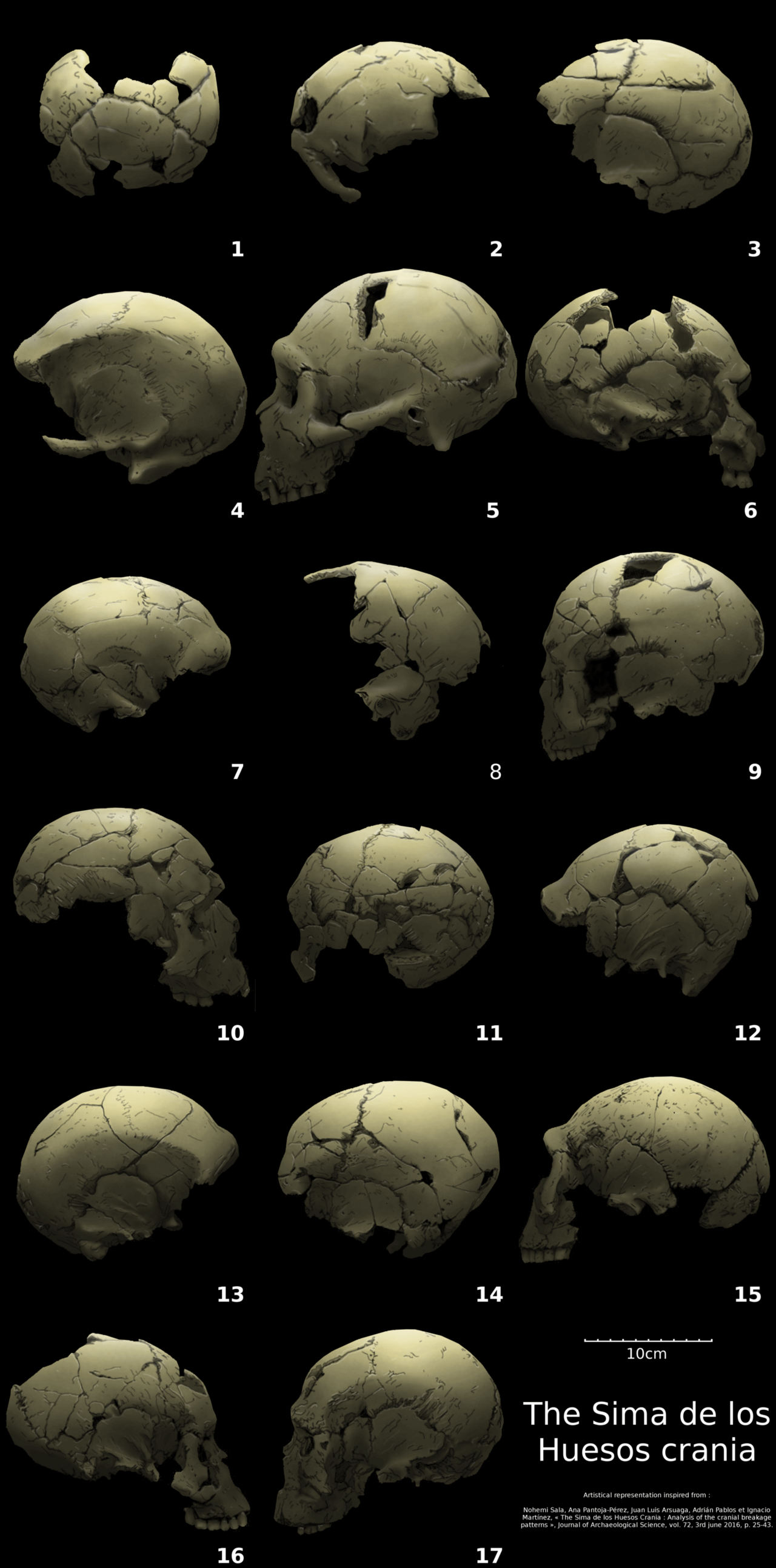
The exceptional size of the Sima de los Huesos sample has permitted a level of morphological analysis impossible at any other Middle Pleistocene hominin site. The collection includes 17 skulls, many of them complete or nearly complete, along with mandibles, vertebrae, ribs, pelvic bones, and limb elements representing nearly every part of the skeleton.1, 12 This comprehensive skeletal representation has revealed that the Sima hominins display a mosaic of primitive and derived features, with some cranial traits clearly anticipating the classic Neanderthal morphology while other features remain more generalized.2
The cranial morphology, described in detail by Arsuaga and colleagues in a landmark 2014 study, shows that the Sima hominins share with later Neanderthals a suite of midfacial features including a projecting midface, inflated maxillary sinuses, and a distinctive configuration of the nasal aperture and infraorbital region.2 The supraorbital torus (brow ridge) is prominent but less continuous than in classic Neanderthals, and the occipital bone lacks the fully developed "chignon" or bun-shaped protrusion characteristic of later Neanderthal crania.1, 2 Cranial capacities range from approximately 1,100 to 1,390 cubic centimeters, with a mean of roughly 1,230 cc, which falls within the lower range of later Neanderthals but well above the values typical of earlier Homo species.1
Cranial capacity of Sima de los Huesos specimens compared to Neanderthals and modern humans1, 2
Arsuaga and colleagues characterized the Sima morphological pattern as "proto-Neanderthal," reflecting their interpretation that the Sima population had already begun to evolve the distinctive Neanderthal facial architecture but had not yet acquired the full suite of derived features seen in classic Neanderthals from the Late Pleistocene.2 This interpretation supports a model of gradual, accretional evolution of Neanderthal features over hundreds of thousands of years, rather than a sudden transformation.2
The postcranial skeleton, described comprehensively by Arsuaga and colleagues in 2015, reveals a population of robust, powerfully built individuals. A nearly complete male pelvis (Pelvis 1) is the oldest complete hominin pelvis known and shows a distinctive morphology combining wide bi-iliac breadth with a large birth canal, features shared with Neanderthals but different from both earlier Homo erectus and modern humans.3, 12 Limb bone proportions indicate a cold-adapted body plan with relatively short distal limb segments (forearms and lower legs), consistent with Bergmann's and Allen's rules for populations adapted to glacial European climates.12
A hyoid bone recovered from the site, described by Martínez and colleagues in 2008, is morphologically similar to those of Neanderthals and modern humans, and distinctly different from those of great apes and Australopithecus. This finding was interpreted as evidence that the Sima hominins possessed the anatomical prerequisites for speech, or at least for vocal communication more complex than that of non-human primates.4 Auditory studies of the temporal bones by the same research group suggested that the Sima hominins had a hearing range optimized for frequencies between 2 and 4 kilohertz, the range most important for perceiving consonants in human speech, further supporting the possibility of vocal communication.16
The ancient DNA surprise
The extraction of ancient DNA from the Sima de los Huesos fossils, accomplished by Matthias Meyer and colleagues at the Max Planck Institute for Evolutionary Anthropology, pushed the limits of ancient DNA technology to recover genetic material from specimens more than 400,000 years old. The results produced one of the most unexpected findings in the history of paleogenetics.5
The first ancient DNA results from Sima, published in 2014, reported the mitochondrial genome of a Sima hominin. Given that the morphology of the Sima population had long been interpreted as ancestral to Neanderthals, the expectation was that their mitochondrial DNA would cluster with Neanderthal sequences. Instead, the Sima mitochondrial genome was more closely related to the mitochondrial DNA of Denisovans, the archaic hominins known primarily from Denisova Cave in Siberia.5 This was bewildering: morphologically, the Sima hominins looked like Neanderthal ancestors, but their maternal lineage pointed toward a different archaic group that lived thousands of kilometers to the east.5
The resolution came in 2016 when Meyer and colleagues published nuclear DNA sequences from the Sima fossils. Unlike mitochondrial DNA, which is inherited exclusively from the mother and represents a single lineage, nuclear DNA is inherited from both parents and provides a far more comprehensive picture of evolutionary relationships. The nuclear DNA unambiguously placed the Sima hominins within the Neanderthal lineage, confirming the morphological assessment and resolving the apparent contradiction with the mitochondrial results.6
Several hypotheses have been proposed to explain the discrepancy between the mitochondrial and nuclear DNA signals. One possibility is incomplete lineage sorting: the ancestral population from which both Neanderthals and Denisovans descended carried multiple mitochondrial lineages, and the lineage that happened to survive in the Sima population (and later in Denisovans) was different from the one that ultimately became fixed in later Neanderthals.6 Another possibility is that the Neanderthal mitochondrial lineage seen in later Neanderthals was introduced through gene flow from an African population, perhaps early Homo sapiens, which replaced the original Neanderthal maternal lineage sometime after 430,000 years ago.6 Both scenarios underscore the complex, reticulate nature of hominin evolution, in which gene flow, lineage sorting, and population replacement could produce patterns that are invisible in the morphological record but detectable through genetics.5, 6
Taphonomy and the question of deliberate disposal
The question of how at least 28 individuals came to be deposited at the bottom of a 13-meter shaft, deep within a cave system far from any known habitation area, has been debated since the first bones were recovered. The Sima de los Huesos assemblage is unusual in several respects: it contains only hominin remains and those of the cave bear Ursus deningeri; there are no stone tools apart from a single handaxe; there is no evidence of habitation, food processing, or other domestic activities; and the bones show no evidence of carnivore gnawing, cut marks, or other signs of perimortem processing.1, 9
Several natural accumulation mechanisms have been considered and largely rejected. Water transport is unlikely because the bones show no evidence of hydraulic sorting or abrasion, and the sedimentological context does not support significant water flow through the shaft during the period of accumulation.1 Predator accumulation is inconsistent with the absence of carnivore tooth marks on the hominin bones and the absence of other prey species. Accidental falls are improbable given the number of individuals involved: 28 people accidentally falling into the same shaft over a geologically brief interval would require an implausible pattern of repeated accidents.1
The excavation team, led by Arsuaga, has argued that the most parsimonious explanation is deliberate corpse disposal: members of the Sima population intentionally dropped or carried the bodies of their dead into the shaft.1, 2 The presence of a single bifacial handaxe, fashioned from red quartzite and named Excalibur by the excavators, has been interpreted as possible evidence of symbolic or ritual behavior, as if the handaxe were deliberately placed with the dead rather than lost accidentally.9 If this interpretation is correct, Excalibur would represent the oldest known grave offering in the hominin record.9
The deliberate disposal hypothesis is not universally accepted. Skeptics have noted that the complexity of the cave system makes it difficult to exclude all possible natural accumulation pathways, and that a single handaxe is a thin foundation for claims of symbolic behavior.9 The cave bear remains, which constitute the only significant non-hominin fauna in the deposit, could represent animals that fell into the shaft accidentally or that used the deep cave as a hibernation site, and their presence may have nothing to do with the hominin accumulation.1 Nevertheless, the deliberate disposal interpretation has gained broad, if not universal, acceptance in the field, and Sima de los Huesos is frequently cited alongside much later sites as evidence that mortuary behavior may have deep roots in the hominin lineage.2
Cranial studies and population biology
The 17 skulls from Sima de los Huesos represent by far the largest sample of crania from any single Middle Pleistocene population, enabling statistical analyses of variation that would be impossible with the isolated specimens typical of most hominin sites. Arsuaga and colleagues have used this sample to study sexual dimorphism, ontogenetic (growth-related) variation, and individual variation within the population, providing a baseline for understanding the range of variation expected within a single hominin species.1, 10
The crania show clear sexual dimorphism in overall size but relatively little dimorphism in shape, a pattern consistent with later Neanderthals and modern humans. Body mass estimates derived from the postcranial remains suggest males weighed approximately 80 to 90 kilograms and females approximately 60 to 70 kilograms, indicating a level of sexual dimorphism similar to that in modern human populations.12
One of the most celebrated specimens is Cranium 5, nicknamed "Miguelón," a nearly complete male skull with a cranial capacity of approximately 1,390 cubic centimeters. Miguelón shows evidence of a severe dental infection that invaded the mandibular bone and may have contributed to the individual's death, providing a poignant glimpse of disease and suffering in the Middle Pleistocene.1 Another notable specimen, Cranium 17, bears two perimortem impact fractures on the frontal bone, interpreted by the research team as evidence of lethal interpersonal violence — potentially the oldest known murder victim in the human fossil record, although this interpretation has been debated.1
The age-at-death profile of the Sima population is also informative. The assemblage includes adolescents and young adults as well as middle-aged and older individuals, but no infants or young children. This age distribution could reflect differential preservation (infant bones are fragile and less likely to survive), sampling bias (the deposits have not been fully excavated), or a genuine pattern in which infants and young children were treated differently from older individuals in whatever disposal practice produced the assemblage.1
Evolutionary significance
Sima de los Huesos occupies a pivotal position in the current understanding of human evolution in Europe and the origin of the Neanderthal lineage. The combination of a large, well-dated fossil sample with both morphological and genetic data makes it uniquely informative for several key questions.2, 6
The morphological evidence from the site supports the accretional model of Neanderthal evolution, which holds that the distinctive Neanderthal phenotype did not appear all at once but accumulated gradually over several hundred thousand years, with different anatomical regions evolving at different rates.2 The Sima hominins had already acquired the derived midfacial morphology of Neanderthals 430,000 years ago, but their braincase shape, occipital morphology, and some dental features remained more primitive. This pattern suggests that natural selection or genetic drift acted on different parts of the skeleton at different times, producing a mosaic of modern and archaic features at any given point in the evolutionary trajectory.2
The genetic data from the site have had an equally profound impact. The demonstration that 430,000-year-old DNA could be extracted and sequenced pushed the effective time horizon of paleogenetics deep into the Middle Pleistocene, opening up possibilities for genetic analysis of other ancient specimens previously thought too old for DNA preservation.5 The discrepancy between the mitochondrial and nuclear DNA results revealed that the relationship between Neanderthals, Denisovans, and modern humans was far more complicated than a simple three-way split, involving gene flow, hybridization, and population replacement events that left different signatures in different parts of the genome.5, 6
The question of whether the Sima hominins should be classified as Homo heidelbergensis, early Homo neanderthalensis, or some other taxon remains a matter of ongoing discussion. Arsuaga and colleagues have generally referred to them as "Middle Pleistocene hominins" or as early Neanderthals, emphasizing their morphological continuity with later Neanderthal populations.2 Others prefer to classify them as H. heidelbergensis, a species that in this interpretation serves as the common ancestor of both Neanderthals and modern humans.17 The taxonomic debate is partly semantic — the Sima population's evolutionary position is the same regardless of the species name applied to it — but it reflects genuine disagreements about how to carve the continuum of human evolution into discrete species categories.2, 17
The broader Atapuerca complex, of which Sima de los Huesos is the most famous component, continues to produce new discoveries that extend and complicate the European hominin record. The presence of Homo antecessor at Gran Dolina, roughly 800,000 years old, and the even older fossils from Sima del Elefante raise questions about the relationship between the earliest European hominins and the later populations represented at Sima de los Huesos.14, 15 Whether these represent a continuous lineage evolving in place, or successive waves of immigration from Africa or western Asia, is one of the central unresolved questions in European paleoanthropology.17 Sima de los Huesos, with its unrivaled sample size and its combination of morphological and genetic evidence, will remain central to efforts to answer that question for decades to come.2, 6
The preservation conditions at the Sima de los Huesos site have been remarkably favorable. The deep underground location, with its stable temperature of approximately 10.6°C and high humidity, has protected the fossils from the freeze-thaw cycles, root penetration, and weathering that degrade surface-exposed bone. The clay matrix in which the fossils are embedded has maintained a relatively stable chemical environment, contributing to the exceptional preservation of bone microstructure and, critically, of ancient DNA molecules that would have been destroyed at warmer, more variable surface sites of comparable age.5, 6 The success of ancient DNA extraction from the Sima specimens, at 430,000 years the oldest hominin nuclear DNA ever recovered at the time of publication, was directly attributable to these favorable preservation conditions and to the rapid improvements in molecular techniques developed at the Max Planck Institute.6
The demographic profile of the Sima assemblage has been studied in detail. The minimum number of 28 individuals includes both males and females, with a slight preponderance of adolescents and young adults and relatively few older individuals, a mortality profile that some researchers have likened to a catastrophic assemblage (reflecting the living population's age structure) rather than an attritional one (reflecting the age-specific mortality rate).1 However, the absence of infants and young children complicates this interpretation, as a truly catastrophic event would be expected to kill individuals of all ages in proportion to their representation in the population. The selective absence of the youngest age classes could reflect differential treatment of infant and child corpses, differential preservation of fragile juvenile bone, or incomplete excavation of the deposit.1, 12
Pathological conditions observed in the Sima fossils provide glimpses into the health and life history of Middle Pleistocene hominins. In addition to the dental abscess in Cranium 5 and the cranial trauma in Cranium 17, the skeletal collection includes examples of degenerative joint disease, healed fractures, dental hypoplasia (indicating episodes of growth disruption during childhood), and pronounced muscular attachments reflecting habitual heavy physical activity.12 The range of pathologies documented in the sample is broadly similar to what is seen in later Neanderthal populations and in pre-industrial modern human populations, suggesting that the Sima hominins faced comparable physical stresses and health challenges despite living 400,000 years earlier.1, 12
References
Symbolic use of marine shells and mineral pigments by Iberian Neandertals 115,000 years ago
Postcranial morphology of the middle Pleistocene humans from Sima de los Huesos, Spain
Early Pleistocene human mandible from Sima del Elefante (TE) cave site in Sierra de Atapuerca (Spain): a comparative morphological study
Evidence of earliest human occurrence in Europe: the site of Sima del Elefante, Sierra de Atapuerca
Auditory capacities in Middle Pleistocene humans from the Sierra de Atapuerca in Spain
The Atapuerca sites and their contribution to the knowledge of human evolution in Europe