Overview
- Wild chimpanzees across Africa use a diverse array of tools — including termite-fishing probes, nut-cracking hammer-and-anvil sets, and leaf sponges — with different populations maintaining distinct tool-use traditions that are socially learned and culturally transmitted, constituting the strongest evidence for culture outside the human lineage.
- Tool use is not unique to great apes: wild capuchin monkeys in Brazil use stone hammers and anvils to crack nuts in a manner strikingly convergent with chimpanzee nut cracking, and archaeological excavation of capuchin tool-use sites has revealed a 3,000-year record of stone tool use in nonhuman primates.
- The archaeological discovery of 4,300-year-old chimpanzee stone tools in Côte d'Ivoire demonstrates that nonhuman primate tool traditions can persist across millennia, and comparative analysis of primate tool use provides crucial context for understanding how and why hominin stone toolmaking first emerged.
The discovery that nonhuman primates manufacture and use tools shattered one of the most deeply held assumptions about human uniqueness. When Jane Goodall first reported in 1960 that wild chimpanzees at Gombe Stream in Tanzania stripped leaves from twigs to fashion probes for extracting termites from their mounds, the observation prompted Louis Leakey's famous remark that "now we must redefine tool, redefine Man, or accept chimpanzees as humans."1 In the decades since, tool use has been documented across a wide range of primate species — including chimpanzees, bonobos, orangutans, and several species of capuchin monkey — revealing a spectrum of technological sophistication that provides essential comparative context for understanding the origins of hominin toolmaking.2, 10 While no nonhuman primate approaches the systematic stone knapping of even the earliest [Oldowan industry](/human-evolution/oldowan-industry), the diversity and cultural complexity of primate tool behaviour demonstrates that the cognitive foundations for technology did not arise de novo in the human lineage but were built upon capacities shared with our closest living relatives.2, 3
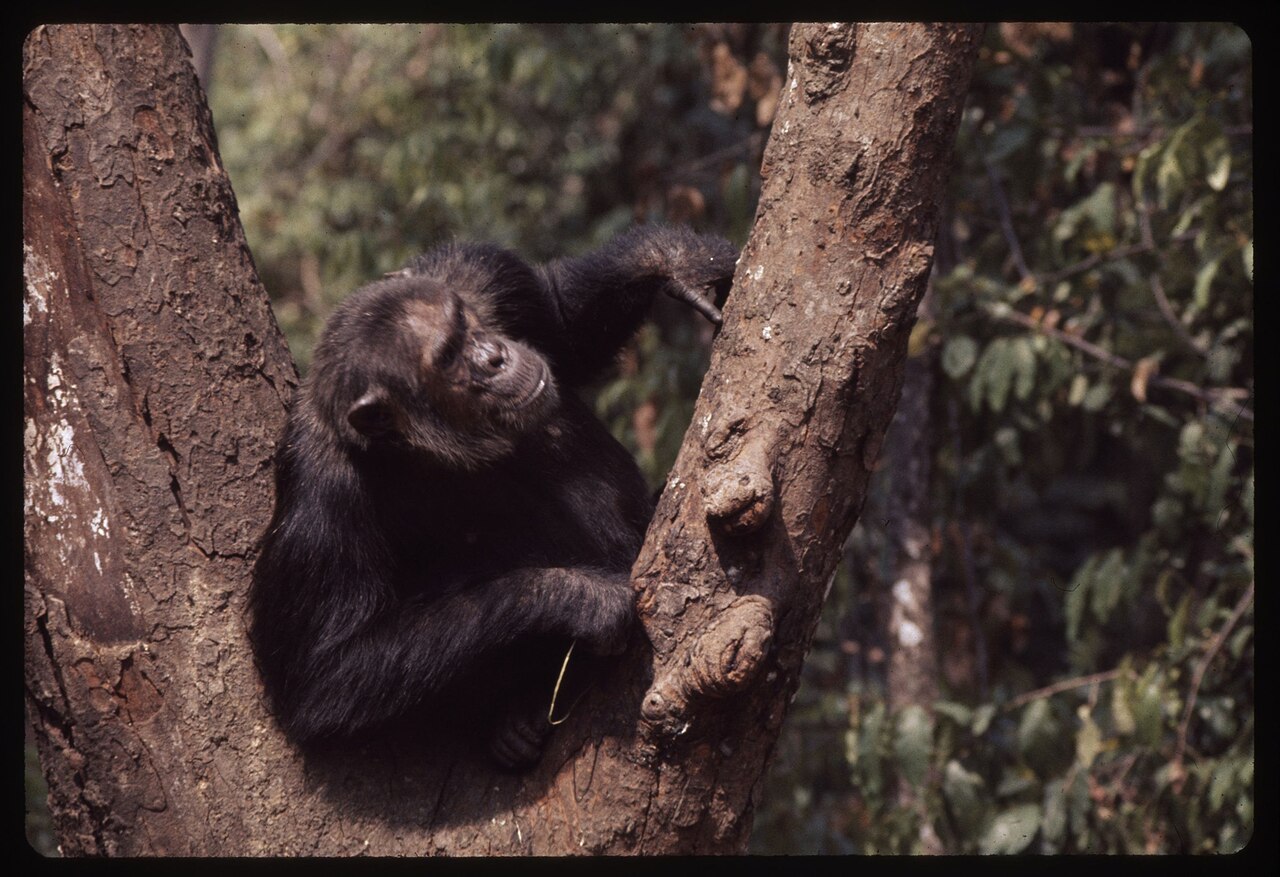

Chimpanzee tool use
Chimpanzees (Pan troglodytes) exhibit the most diverse and sophisticated tool behaviour of any nonhuman primate, with more than 40 distinct tool-use behaviours documented across different wild populations.3, 2 The most widely studied of these is termite fishing, first described by Goodall at Gombe, in which chimpanzees insert a modified stick or grass stem into the openings of a termite mound, wait for termites to bite the probe, and then withdraw it to eat the clinging insects.1 The behaviour involves deliberate modification of raw materials — stripping side branches, trimming the probe to an appropriate length, and sometimes fraying the tip to create a more effective "brush" — satisfying even the most restrictive definitions of tool manufacture.1, 2
Perhaps the most impressive chimpanzee tool behaviour is nut cracking, documented extensively by Christophe Boesch and colleagues in the Taï Forest of Côte d'Ivoire and at other West African sites.5, 7 Chimpanzees place hard-shelled nuts on a flat stone or root (the anvil) and strike them repeatedly with a stone or wooden hammer, calibrating the force of each blow to crack the shell without pulverizing the edible kernel inside.7 This behaviour requires the coordinated use of two objects — hammer and anvil — in a functionally complementary relationship, a level of technological complexity that some researchers consider analogous to the core-and-hammerstone relationship in Oldowan stone knapping.2, 8 Luncz and colleagues showed that neighbouring chimpanzee communities in the Taï Forest differ in their preferred hammer materials — some groups favouring stone hammers while adjacent groups prefer wooden ones, even when both materials are equally available — demonstrating that hammer choice is a socially transmitted cultural preference rather than an ecologically determined response.14
Other chimpanzee tool behaviours include the use of leaf sponges to extract water from tree hollows, the fashioning of wooden spears for hunting bushbabies in tree cavities (documented in Senegalese chimpanzees), the use of sticks as levers to extract honey from bee nests, and the deployment of stone and wooden clubs in agonistic displays.2, 13 Kühl and colleagues documented a striking behaviour in West African chimpanzees in which individuals repeatedly threw or placed stones against particular trees, accumulating cairn-like piles of rocks at specific sites — a behaviour with no obvious foraging function that some authors have interpreted as potentially ritualistic, though this interpretation remains highly controversial.13
Cultural traditions in chimpanzees
The landmark 1999 study by Whiten and colleagues synthesized decades of field data from seven long-term chimpanzee study sites across Africa, identifying 39 behavioural patterns that varied among communities in ways that could not be explained by ecological differences alone.3 These included tool-use behaviours (such as termite fishing, ant dipping, and nut cracking), social customs (such as the "hand clasp" grooming posture), and foraging techniques that were habitual in some communities but absent in others despite similar ecological conditions.3 Whiten and colleagues argued that this pattern of inter-community behavioural variation, maintained through social learning rather than genetic transmission, met the essential criteria for culture as understood in the anthropological sense — though the question of whether chimpanzee cultural transmission relies on true imitation, emulation, or some combination of social learning mechanisms remains actively debated.3, 16
The cultural dimension of chimpanzee tool use has important implications for understanding hominin technological origins. If the last common ancestor of chimpanzees and humans possessed the capacity for socially transmitted tool-use traditions, then the earliest hominins would have inherited this capacity and could have maintained their own perishable tool traditions — using sticks, leaves, and other organic materials — long before the first stone tools appeared in the archaeological record.2, 3 The archaeological visibility of stone tools beginning at 2.6 million years ago (or 3.3 million years ago if the Lomekwian is accepted) may thus represent not the origin of technology itself but the point at which hominins began to work a material durable enough to survive in the geological record.4
Capuchin monkey tool use
Wild capuchin monkeys (Sapajus libidinosus) in the dry forests and cerrado of northeastern Brazil provide the most striking example of tool use outside the great apes. Visalberghi and colleagues documented populations of bearded capuchins that use stone hammers weighing up to one kilogram to crack palm nuts and other hard-shelled foods on stone or log anvils, a behaviour convergent with chimpanzee nut cracking despite the approximately 35-million-year evolutionary distance separating New World monkeys from African apes.6 Capuchin stone tool use is habitual, involves the selection and transport of hammer stones to anvil sites, and produces distinctive percussive damage patterns on both hammers and anvils that are archaeologically recognizable.6, 11
In a remarkable extension of primate archaeology into the New World, Proffitt and colleagues excavated capuchin stone tool use sites in Serra da Capivara National Park, Brazil, and recovered stratified deposits of battered hammerstones and nut-cracking anvils spanning approximately 3,000 years — demonstrating that capuchin stone tool traditions can persist across millennia and leave recoverable archaeological traces.12 The excavated capuchin tools showed changes in size, weight, and percussive damage patterns through time, suggesting that tool-use behaviours evolved within the capuchin tradition independently of any hominin influence.12 Long-tailed macaques in Thailand and Myanmar have also been documented using stone tools to process shellfish on coastal platforms, producing lithic assemblages that can superficially resemble early hominin stone tool sites, a finding that carries cautionary implications for the interpretation of ambiguous early archaeological sites.11
Orangutan and other primate tool use
Wild orangutans (Pongo pygmaeus and P. abelii) use tools in a range of foraging contexts, including the use of sticks to extract seeds from Neesia fruits, the fashioning of leaf gloves to handle spiny fruits, and the use of sticks to probe tree holes for insects and honey.10 Van Schaik and colleagues demonstrated that orangutan tool-use repertoires vary among populations in a pattern consistent with cultural transmission: populations with higher rates of social interaction and opportunities for observational learning exhibit more diverse tool-use repertoires, while more solitary populations show fewer tool behaviours despite inhabiting ecologically similar habitats.10 This social-learning hypothesis predicts that tool-use diversity should correlate with the frequency of close-range social observation rather than with ecological need alone, a prediction supported by data from multiple orangutan field sites across Borneo and Sumatra.10, 9
Outside the great apes and capuchins, tool use in wild primates is comparatively rare. Some populations of long-tailed macaques use stones to crack shellfish and nuts. Gorillas, despite being phylogenetically close to chimpanzees, use tools only occasionally in the wild, though captive gorillas readily learn tool behaviours, suggesting that the capacity exists but is not routinely expressed in their natural foraging ecology.2 The phylogenetic distribution of primate tool use — concentrated in chimpanzees, orangutans, and capuchins, with sporadic occurrences in other lineages — indicates that the cognitive prerequisites for tool use have evolved independently multiple times in the primate order, driven by different ecological pressures in each case.2, 10
Primate archaeology and implications for hominin origins
The emerging field of primate archaeology — the application of archaeological methods to the study of nonhuman tool-use sites — has produced one of the most striking findings in recent paleoanthropology. In 2007, Mercader, Panger, and Boesch reported the excavation of stone tools from deposits at the Noulo site in the Taï Forest of Côte d'Ivoire, dated to approximately 4,300 years ago, that were produced by chimpanzees rather than humans.4 The excavated stones bore starch residues from nut species cracked by chimpanzees but not processed by humans, and their size, weight, and damage patterns matched those of modern chimpanzee nut-cracking tools rather than human stone implements.4 This discovery demonstrated for the first time that nonhuman primate tool traditions can leave recoverable archaeological traces spanning thousands of years, and it raised the possibility that some ambiguous stone artifact assemblages in the early hominin record could, in principle, have been produced by nonhuman primates.4
Laboratory studies have further illuminated the gap between primate tool use and hominin stone knapping. Toth, Schick, and colleagues taught the bonobo Kanzi to produce stone flakes by striking cobbles together, and while Kanzi succeeded in producing sharp flakes that he used to cut cords, his technique differed fundamentally from that of early hominin knappers: he relied heavily on throwing stones against hard surfaces rather than employing the controlled, aimed percussion documented in the Oldowan record, and he never developed the ability to maintain striking platforms or manage core geometry in the systematic way that characterizes even the earliest archaeological assemblages.15 The persistent gap between the best efforts of trained apes and the products of even the earliest hominin knappers underscores that the transition to systematic stone tool production involved cognitive and motor advances — particularly in the domains of [manual dexterity](/human-evolution/evolution-of-the-human-hand), hierarchical planning, and understanding of fracture mechanics — that went significantly beyond the capacities of any living nonhuman primate.15, 2
References
Chimpanzee choice of nut-cracking tools: raw materials, cultural traditions and individual differences
Spontaneous cross-species imitation in interactions between chimpanzees and zoo visitors