Overview
- The human hand is distinguished from those of other great apes by its relatively long thumb, shortened fingers, and robust thenar musculature—features that together enable the forceful precision grip essential for stone tool manufacture and fine manipulation.
- Fossil evidence from Ardipithecus ramidus through Australopithecus sediba and Homo naledi documents a mosaic transition from hands adapted for arboreal locomotion to hands capable of sophisticated tool use, with key features like the third metacarpal styloid process appearing by at least 1.4 million years ago.
- Hand evolution was not a simple response to tool use but a coevolutionary process linking manual dexterity, stone technology, and brain reorganization, supported by genetic changes such as the HACNS1 enhancer that altered limb developmental patterning on the human lineage.
The human hand is one of the most versatile organs in the animal kingdom, capable of threading a needle, gripping a hammer, and shaping a stone flake with sub-millimeter accuracy. Its anatomy represents a significant departure from the hands of other living great apes, and the evolutionary path that produced it is recorded in a growing body of fossil, biomechanical, genetic, and trabecular bone evidence. Understanding how the hand evolved illuminates not only locomotor transitions among hominins but also the origins of stone tool technology, the expansion of the human brain, and the feedback loops that tie cognition to manual skill.
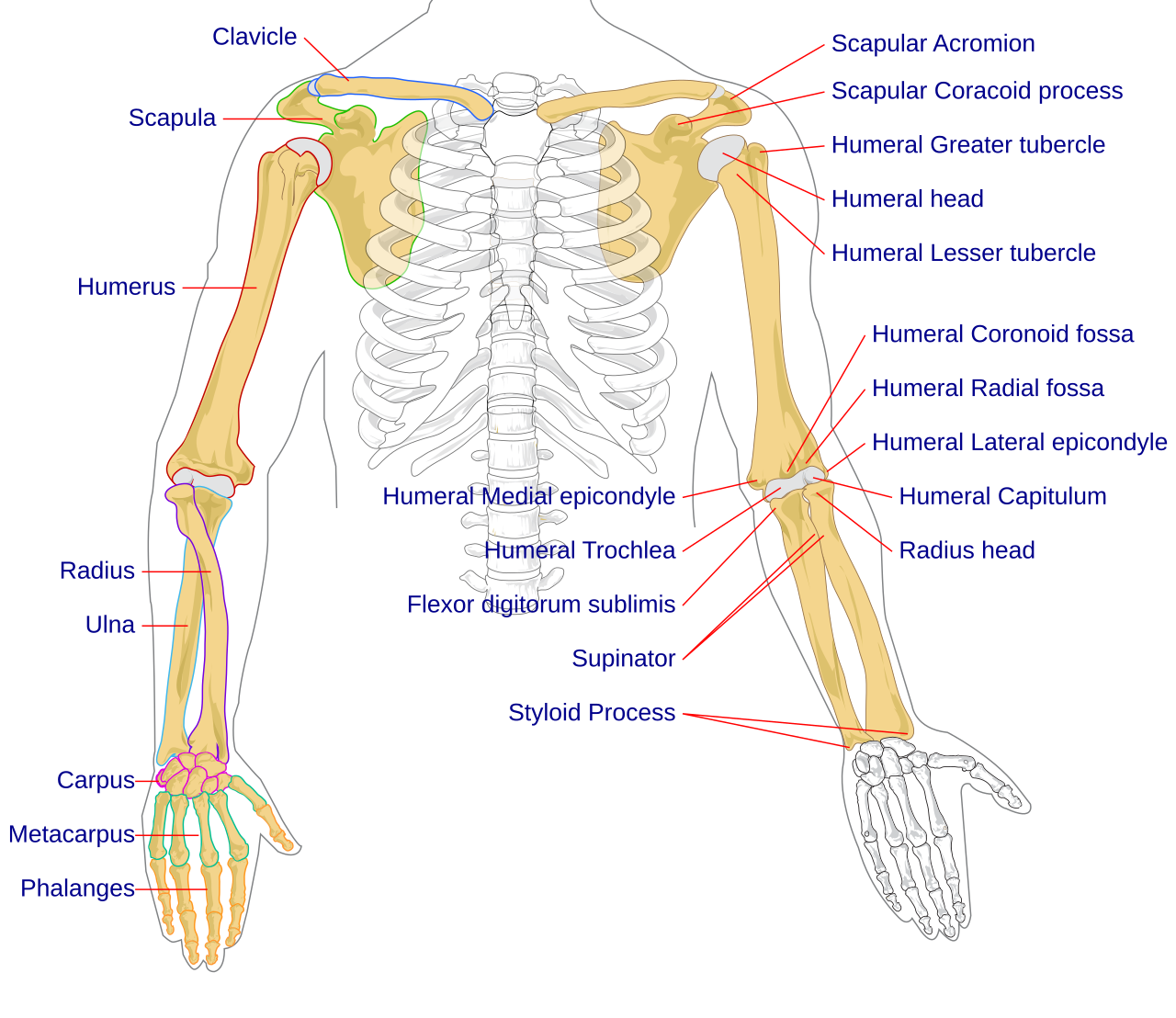

Napier's grip classification
In his foundational 1956 study, the British primatologist John Napier divided human prehension into two fundamental categories: the power grip and the precision grip.1, 2 In a power grip the fingers curl around an object and clamp it against the palm, with the thumb acting as a buttress; this is the grip used when swinging a hammer or holding a branch during climbing. In a precision grip the object is held between the pads of the fingertips and the opposing thumb, permitting fine rotational control; this is the grip used when turning a key or removing a stone flake. Both grips are available to chimpanzees in rudimentary form, but the human hand executes them with far greater force and control owing to its distinctive proportions and musculature.1
Napier recognized that precision handling places specific anatomical demands on the hand: a long, robust, and fully opposable thumb; relatively short fingers that can meet the thumb pad-to-pad; broad fingertips with well-developed apical tufts; and powerful intrinsic muscles, especially in the thenar eminence at the base of the thumb.2 Each of these features has been shaped by natural selection over the past several million years, and each can be tracked in the hominin fossil record.
Comparative anatomy: ape and human hands
The hands of chimpanzees and humans share a common structural plan inherited from the last common ancestor of the African apes, yet they differ strikingly in proportion. Chimpanzees possess elongated metacarpals and phalanges relative to thumb length, producing long, curved fingers well suited to suspensory climbing and knuckle-walking. The human hand, by contrast, has a relatively longer thumb and shorter fingers, yielding a thumb-to-finger ratio roughly 25–30 percent higher than that of chimpanzees.11 Almécija and colleagues demonstrated in 2015 that human hand proportions are actually closer to the inferred ancestral condition for African apes than are the elongated hands of chimpanzees or gorillas, suggesting that the specialized suspensory anatomy of extant great apes may be derived rather than primitive.11
Beyond proportions, the human thumb is distinguished by greatly expanded thenar muscles—the opponens pollicis, flexor pollicis brevis, and adductor pollicis—that allow forceful opposition of the thumb against each of the other digits.15 The human flexor pollicis longus tendon, which bends the thumb’s distal phalanx, is consistently present and powerful; in chimpanzees it is variably developed and often weak. These muscular differences underwrite the forceful precision grip that is essential for flaking stone and for the pad-to-pad pinch used in delicate manipulation.14, 15
The fingertips themselves also differ. Human distal phalanges are broader and flatter than those of chimpanzees, with larger apical tufts that support fleshy, innervation-rich fingertip pads. This broadening improves the area of contact during precision grips and increases sensory feedback—a critical input for the fine motor adjustments needed during tool manufacture.5
The hand of Ardipithecus
Ardipithecus ramidus, dated to approximately 4.4 million years ago in the Middle Awash region of Ethiopia, preserves some of the earliest direct evidence of hominin hand morphology. Lovejoy and colleagues described the Ardipithecus hand as lacking the specialized features associated with knuckle-walking in extant African apes: the metacarpals are not dorsally ridged, and the wrist does not show the locking mechanisms that stabilize the hand during quadrupedal locomotion in chimpanzees and gorillas.7, 8 Instead, the hand retains a generalized, flexible structure consistent with careful climbing and palmigrade support on branches.
Importantly, the Ardipithecus hand already shows a degree of thumb robusticity that exceeds the condition in chimpanzees, although it falls well short of the human state.8 The fingers remain relatively long and somewhat curved, indicating continued reliance on arboreal locomotion. This mosaic morphology—neither fully ape-like nor fully human-like—suggests that the hand began its evolutionary trajectory toward enhanced manipulative ability early in the hominin lineage, well before the appearance of stone tools in the archaeological record.
Australopith hand morphology
The hand of Australopithecus sediba from Malapa, South Africa (approximately 1.98 million years ago) is among the most complete early hominin hands ever recovered. Kivell and colleagues showed that it combines a remarkably human-like thumb—long, robust, with broad apical tufts—with relatively long, curved fingers that retain clear arboreal adaptations.3 The thumb’s proportions and musculature would have permitted a forceful precision grip, raising the possibility that Au. sediba or closely related species were capable of at least rudimentary tool use, even though no associated stone tools have been found at Malapa.3
Trabecular bone analysis has provided a complementary line of evidence. Skinner and colleagues used micro-CT imaging to examine the internal spongy bone architecture of hand bones attributed to Australopithecus africanus from Sterkfontein, South Africa. They found that the trabecular pattern in the first metacarpal of Au. africanus is consistent with the loading regime produced by forceful opposition of the thumb during tool-related gripping, closely matching the pattern seen in modern humans and differing from that of chimpanzees.4 This internal structural evidence suggests that human-like hand use extends back at least 3 million years, predating the genus Homo and coinciding roughly with the oldest known stone tools.4, 13
Dunmore and colleagues extended this trabecular approach to Au. sediba, finding that trabecular bone distribution in its metacarpals is consistent with both tool-related precision gripping and locomotor loading of the hand during climbing, reinforcing the picture of a hand serving dual functions.9
The hand of Homo naledi
The hand of Homo naledi, recovered from the Rising Star cave system in South Africa and dated to approximately 236,000–335,000 years ago, presents another striking mosaic. Kivell and colleagues described a hand with strongly curved proximal phalanges—more curved than those of almost any other hominin—combined with a wrist and thumb that are remarkably modern in form.5 The thumb is long relative to the fingers, the thenar muscle attachments are well developed, and the third metacarpal possesses a styloid process, a small bony projection at its base that is otherwise known only in Homo sapiens, Neanderthals, and some Homo erectus specimens.5, 6
The third metacarpal styloid process is functionally significant because it locks the third metacarpal against the capitate bone of the wrist during forceful gripping, stabilizing the hand when striking a hammerstone against a core.6 Ward and colleagues identified this feature on a 1.4-million-year-old metacarpal from West Turkana, Kenya, establishing that the derived wrist architecture associated with habitual tool use was present early in the evolution of the genus Homo.6 Its presence in Homo naledi alongside markedly primitive finger curvature underscores the mosaic nature of hand evolution: different anatomical modules responded to different selective pressures on different timescales.
Hand–tool coevolution
The relationship between hand anatomy and stone technology is not a simple cause-and-effect sequence but a coevolutionary feedback loop. The oldest known stone tools—the Lomekwian industry from West Turkana, dated to 3.3 million years ago—were produced by hominins whose hand morphology was almost certainly more australopith-like than human-like.13 The Lomekwian artifacts are large, crudely struck cores that could have been produced with relatively simple gripping strategies. By the time of the Oldowan industry beginning around 2.6 million years ago, however, tool makers were producing sharper flakes through more controlled, repetitive strikes that would have benefited from a forceful precision grip and a stable wrist.15
Marzke argued that the selective pressures associated with habitual tool use drove the progressive shortening of the fingers, lengthening of the thumb, broadening of the apical tufts, and strengthening of the thenar muscles over the course of the Pliocene and Pleistocene.15 As hand anatomy improved, more sophisticated reduction sequences became feasible, which in turn increased the selective advantage of yet finer manual control—a ratcheting dynamic that parallels the coevolution of brain size and technological complexity. Experimental studies of stone tool production confirm that both precision and power grips are employed during knapping and that the forces generated at the thumb tip during hard-hammer percussion are considerable, consistent with the robust pollical anatomy observed in later Homo.12
Brain evolution and manual dexterity
The hand does not function in isolation from the brain. The primary motor cortex in humans devotes a disproportionately large region to hand and finger control, reflected in the well-known cortical homunculus. The expansion of premotor and parietal cortical areas involved in planning and executing complex manual sequences is a hallmark of human brain evolution, and it likely coevolved with increasing demands for precise hand coordination during tool manufacture and use.15
Neuroimaging studies of modern humans performing stone knapping tasks reveal activation in Broca’s area, a cortical region classically associated with language production. This overlap has led several researchers to propose that the neural circuits underlying language and complex tool use share an evolutionary history—that selection for one capacity may have facilitated the other through shared demands on hierarchical motor planning and sequencing.15 The hand, in this view, was not merely a passive beneficiary of brain expansion but an active driver of it: the selective advantages of superior manual skill created feedback pressure for cortical reorganization, which in turn enabled still more complex manual behaviors.
Genetic evidence: the HACNS1 enhancer
Comparative genomics has identified specific regulatory changes associated with human hand evolution. Prabhakar and colleagues identified a genomic element designated HACNS1 (Human-Accelerated Conserved Noncoding Sequence 1) that is highly conserved across vertebrates but has accumulated an unusual number of substitutions on the human lineage since the divergence from chimpanzees.10 When tested in transgenic mouse embryos, the human version of HACNS1 drove expression in the developing limb bud, particularly in the presumptive thumb region, whereas the chimpanzee ortholog did not show this limb-specific activity.10
Although HACNS1 is a regulatory enhancer rather than a protein-coding gene, its altered expression pattern suggests it contributed to the developmental repatterning of the human hand—potentially influencing thumb length, digit proportions, or the growth of intrinsic hand muscles. It remains one of the clearest examples of a human-specific genetic change with a plausible connection to a key adaptive phenotype, though the precise downstream targets and developmental mechanisms are still under investigation.10
Synthesis
The evolution of the human hand was neither linear nor monolithic. The fossil record reveals a mosaic pattern in which different components of hand anatomy—thumb length, finger curvature, wrist stability, apical tuft breadth, intrinsic muscle robusticity—evolved at different rates and in response to overlapping selective pressures from arboreal locomotion, terrestrial manipulation, and tool production. Ardipithecus had already begun to depart from the ape hand plan by 4.4 million years ago.8 Australopiths like Au. sediba and Au. africanus possessed thumbs capable of forceful precision gripping while retaining fingers suited to climbing.3, 4 By the time of early Homo, the third metacarpal styloid process and other wrist features had stabilized the hand for habitual stone tool manufacture.6 And throughout this sequence, brain evolution and hand evolution reinforced each other through a coevolutionary dynamic that ultimately produced the extraordinary manual dexterity that defines the human species.
References
Careful climbing in the Miocene: The forelimbs of Ardipithecus ramidus and humans are primitive
A highly conserved enhancer in human and chimpanzee genomes shows limb-specific expression in the developing hand
Morphological affinities of the proximal ulna from Klasies River main site: Novel insights into hominin hand function