Overview
- Ankylosauria was a clade of heavily armored herbivorous dinosaurs within Thyreophora that ranged from the Early Jurassic to the end of the Cretaceous, achieving a near-global distribution across both Laurasia and Gondwana, with their bodies sheathed in osteoderms that formed an extensive dermal shield unmatched by any other vertebrate group.
- The two traditionally recognized families, Ankylosauridae and Nodosauridae, differ most conspicuously in that ankylosaurids evolved massive tail clubs formed by fused distal caudal vertebrae and enlarged terminal osteoderms, while nodosaurids lacked tail clubs but often bore prominent lateral shoulder spines, though recent phylogenetic analyses have challenged this simple dichotomy by recovering four or more distinct ankylosaur clades.
- The exceptionally preserved nodosaurid Borealopelta markmitchelli from the Early Cretaceous of Alberta preserves original melanin pigments revealing a countershaded color pattern, dark dorsally and light ventrally, demonstrating that even a multi-tonne armored dinosaur faced sufficient predation pressure to require camouflage.
Ankylosauria is a clade of armored herbivorous dinosaurs that constitutes one of the two major subdivisions of Thyreophora, the other being Stegosauria.1, 2 From their origins in the Early Jurassic through their extinction at the end of the Cretaceous Period 66 million years ago, ankylosaurs occupied low-browsing herbivore niches on every continent, their bodies encased in a dermal shield of bony plates, keels, and spines collectively known as osteoderms that is without parallel among terrestrial vertebrates.2, 8 The group includes some of the most morphologically distinctive dinosaurs ever discovered: the massive, club-tailed Ankylosaurus magniventris, the well-armored Euoplocephalus tutus, and the extraordinarily preserved Borealopelta markmitchelli, whose fossilized skin retains original melanin pigments revealing the animal's coloration in life.9, 12 Once divided simply into the club-bearing Ankylosauridae and the club-lacking Nodosauridae, ankylosaur systematics has undergone substantial revision in recent years, with comprehensive phylogenetic analyses recovering four or more distinct clades and challenging the traditional two-family framework that prevailed for decades.1
Phylogenetic position within Thyreophora
Ankylosauria belongs to Thyreophora, the clade of armored ornithischian dinosaurs that also includes the plate-bearing stegosaurs. Thyreophorans are united by the possession of parasagittal rows of osteoderms along the body, a feature present in even the most basal members of the group such as Scutellosaurus from the Early Jurassic of Arizona.1, 2 Within Thyreophora, Ankylosauria and Stegosauria are sister clades: they share a common ancestor that was not shared with any other dinosaur group, and their divergence is estimated to have occurred by the Middle Jurassic, approximately 170 million years ago, based on the stratigraphic distribution of early representatives of both lineages.1
Whereas stegosaurs are characterized by tall dorsal plates and tail spikes (thagomizers) and reached their peak diversity during the Late Jurassic before declining sharply in the Cretaceous, ankylosaurs are defined by a more comprehensive covering of low-profile osteoderms across the dorsal surface and, in derived forms, by the presence of a tail club.1, 2 Ankylosaurs survived the Late Jurassic decline that affected their stegosaurian relatives and continued to diversify throughout the Cretaceous, ultimately achieving a near-global distribution before their extinction in the end-Cretaceous mass extinction.2, 3 The most comprehensive phylogenetic analysis of Thyreophora to date, conducted by Raven and Maidment in 2023 using 340 characters scored across 91 taxa, confirmed the sister-group relationship of Ankylosauria and Stegosauria but substantially revised the internal relationships within Ankylosauria itself.1
Classification and major groups
For most of the twentieth and early twenty-first centuries, Ankylosauria was divided into two families: Ankylosauridae, diagnosed primarily by the presence of a bony tail club and a broad, triangular skull, and Nodosauridae, characterized by the absence of a tail club, a narrower and more elongated skull, and the frequent presence of prominent lateral spines projecting from the shoulder region.2, 3 This binary classification was supported by multiple phylogenetic analyses and became deeply embedded in the paleontological literature, with Ankylosaurus and Euoplocephalus serving as the archetypal ankylosaurids and Edmontonia and Panoplosaurus as the representative nodosaurids.2, 12
The traditional dichotomy was challenged in 2023 by Raven and Maidment's comprehensive phylogenetic analysis, which found that the traditional Nodosauridae is not a natural (monophyletic) group. Instead of two families, their analysis recovered four distinct ankylosaur clades: Ankylosauridae (retaining Euoplocephalus, Ankylosaurus, and the Asian ankylosaurines), Panoplosauridae (containing Edmontonia and Panoplosaurus), Polacanthidae (including Gastonia and related forms), and Struthiosauridae (comprising the European ankylosaur Struthiosaurus and its relatives).1 Each of these clades was found to possess a distinctive morphotype, differing in skull proportions, osteoderm shape, and postcranial anatomy. Arbour and Currie's earlier phylogenetic work on Ankylosauridae, using a character matrix of 177 characters across 41 taxa, had already demonstrated considerable diversity within that family, identifying a nested hierarchy of increasingly derived clades leading to the most specialized tail-club-bearing forms of the Late Cretaceous.3, 4
The discovery of Stegouros elengassen from the Late Cretaceous of subantarctic Chile further complicated ankylosaur systematics. This small, approximately two-metre-long armored dinosaur possessed ankylosaurian cranial features but a largely ancestral postcranial skeleton with some stegosaur-like characters, and its tail bore a unique weapon unlike any other dinosaur: a flat, frond-like structure formed by seven pairs of laterally projecting osteoderms encasing the distal half of the tail.16 Phylogenetic analysis placed Stegouros in a new clade, Parankylosauria, together with Kunbarrasaurus from Australia and Antarctopelta from Antarctica, representing a Gondwanan lineage that diverged from all other ankylosaurs early in the group's history.16
Major ankylosaur clades and their distinguishing features1, 2, 3, 16
| Clade | Representative genera | Temporal range | Key features |
|---|---|---|---|
| Ankylosauridae | Ankylosaurus, Euoplocephalus, Zuul | Late Jurassic–Late Cretaceous | Tail club, broad triangular skull, nasal sinuses |
| Panoplosauridae | Panoplosaurus, Edmontonia | Late Cretaceous | No tail club, narrow skull, large lateral shoulder spines |
| Polacanthidae | Gastonia, Polacanthus | Early–Late Cretaceous | No tail club, sacral shield of fused osteoderms |
| Struthiosauridae | Struthiosaurus, Hungarosaurus | Late Cretaceous | No tail club, small body size, European distribution |
| Parankylosauria | Stegouros, Kunbarrasaurus, Antarctopelta | Late Cretaceous | Frond-like tail weapon, Gondwanan distribution |
Osteoderms and dermal armor
The defining morphological feature of ankylosaurs is their extensive dermal armor, composed of osteoderms—bony elements that develop within the dermis of the skin and are overlain by keratinous epidermal sheaths.2, 8 Ankylosaur osteoderms occur in a wide range of shapes and sizes, from flat, polygonal scutes that tile the dorsal surface in a mosaic pattern to tall, conical spines that project laterally from the flanks and shoulders, and from small, pebble-like ossicles filling the interstices between larger plates to the massive terminal osteoderms that form the knob of the ankylosaurid tail club.8, 10 In life, the keratinous sheaths covering each osteoderm would have substantially increased its external dimensions, meaning that the bony armor visible in fossil skeletons represents only the core of a much larger protective structure.10
,_Royal_Tyrrell_Museum,_Drumheller,_Alberta,_2025-07-13.jpg)
Histological studies of ankylosaur osteoderms have revealed a consistent internal architecture across different osteoderm types: a thin outer layer of compact bone, a thick interior of cancellous (spongy) bone permeated by large vascular canals, and abundant collagen fibers oriented to resist mechanical stress.8 This structural pattern is broadly similar across spikes, plates, and tail club knobs despite their dramatically different external shapes, suggesting that a common developmental program underlies the formation of all ankylosaur osteoderms, with differences in shape determined by local growth signals rather than fundamentally different tissue types.8 The dense vascularization of ankylosaur osteoderms has prompted comparisons with the osteoderms of modern crocodilians, which are known to play a role in thermoregulation through controlled blood flow. A thermoregulatory function may have been secondarily important for ankylosaur armor, though the primary function was almost certainly defensive.2, 8
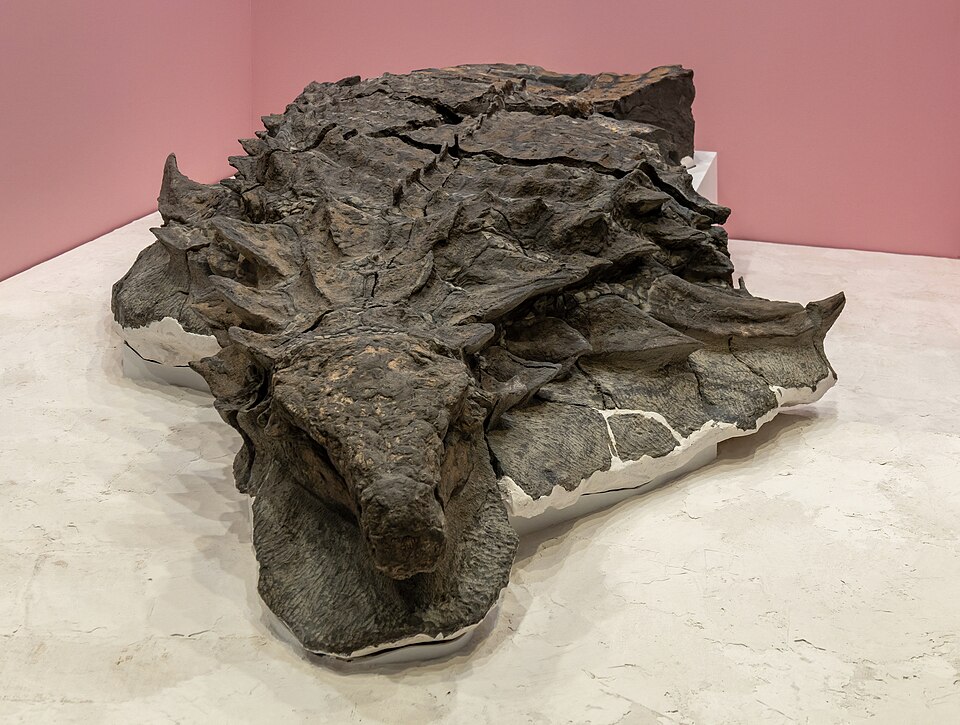
The exceptional preservation of Borealopelta markmitchelli, a nodosaurid from the Early Cretaceous Clearwater Formation of northern Alberta, has provided an unparalleled view of ankylosaur integument. The holotype specimen preserves osteoderms and their overlying keratinous sheaths in three-dimensional anatomical position across the entire precaudal body, allowing quantification of 172 individual osteoderms.10 Morphometric analysis revealed that osteoderm spine length and height scale with positive allometry relative to basal dimensions, meaning that larger osteoderms are disproportionately taller and more spike-like than smaller ones, a pattern that would have accentuated the animal's defensive profile as seen from the side.10 The parascapular spines—large, laterally projecting osteoderms above the shoulders—were particularly prominent, each capped by a horn-like keratinous sheath that extended well beyond the bony core, producing formidable lateral projections that would have been difficult for any predator to circumvent.9, 10
The tail club: evolution, mechanics, and function
The tail club of ankylosaurid dinosaurs is one of the most distinctive skeletal weapons in the history of vertebrate life. Composed of two structural elements—the handle, formed by a series of interlocking distal caudal vertebrae with elongated prezygapophyses that overlap at least half the length of the preceding vertebra, and the knob, formed by two or more greatly enlarged, fused terminal osteoderms—the tail club functions as a rigid, bony mace connected to the muscular base of the tail.4, 5
The evolution of the tail club was not a sudden innovation but a stepwise process spanning tens of millions of years. Arbour and Currie demonstrated in 2015 that the individual components of the tail club were acquired sequentially across ankylosaur phylogeny. Basal ankylosaurs possessed unmodified distal caudal vertebrae with minimal overlap of the prezygapophyses. More derived forms such as Gobisaurus evolved stiffened distal tails with extensively overlapping prezygapophyses but lacked the enlarged terminal osteoderms that form the knob. Only in the most derived ankylosaurines, appearing in the last approximately 20 million years of the Cretaceous, were both a fully developed handle and a knob present together to form a complete tail club.4 This stepwise acquisition pattern suggests that tail stiffening evolved first, perhaps for balance or display, and was subsequently co-opted for a weaponized function when the terminal knob was added.4, 7
Biomechanical analysis of ankylosaurid tail clubs has quantified the forces that could be generated during a tail swing. By modeling the tail as a series of segments and calculating the mass, muscle cross-sectional area, torque, and angular acceleration of each segment, Arbour estimated that large tail club knobs could generate impact forces sufficient to break bone, while average and small knobs produced forces below the threshold for bone fracture.5 This finding suggested that the tail club was a functional weapon capable of inflicting serious injury, but the question of whether it was used primarily in defense against predators or in combat with conspecifics remained unresolved for over a decade.
That question was addressed directly in 2022, when a detailed palaeopathological study of the ankylosaurid Zuul crurivastator revealed a striking pattern of injuries. The holotype specimen preserves pathological osteoderms—armor plates bearing healed fractures and reactive bone growth—that are localized specifically to the flanks in the hip region, precisely the body area that would be struck by the lateral swing of another ankylosaurid's tail club during ritualized side-to-side combat.6 The injuries were not distributed randomly across the body, as would be expected from predator attacks, but were concentrated in the zone consistent with intraspecific sparring. The researchers also noted that tail club knobs showed high variation in size through time and were not fully developed until late in ontogeny, both characteristics of sexually selected structures rather than purely defensive weapons.6 A broader comparative study by Arbour and Zanno found that tail weaponization in amniotes is robustly correlated with large body size, body armor, and herbivory—all characteristics that define ankylosaurs—suggesting that the ecological and morphological prerequisites for the evolution of tail weapons were uniquely met in this clade.7
Stepwise acquisition of tail club features across ankylosaur phylogeny4
Cranial anatomy and ornamentation
Ankylosaur skulls are among the most heavily modified of any dinosaur group. In all ankylosaurs, the external surfaces of the skull bones are overlain or fused with osteoderms, producing a solid, rugose cranial surface that obscured the underlying sutures and made the skull extremely robust.2, 12 The degree of cranial ornamentation varies among ankylosaur clades: ankylosaurids possess broad, triangular skulls with elaborate nasal sinuses and ornamented squamosal horns projecting from the posterior corners, while panoplosaurids (traditional nodosaurids) have narrower, more elongated skulls with less pronounced cranial ornamentation but often with a more complex nasal passage.2, 3
Ankylosaurus magniventris, the largest known ankylosaurid and the namesake of the entire clade, possessed a skull approximately 64 centimeters long and 74 centimeters wide, with prominent pyramidal squamosal horns at the posterior corners and smaller horns above the orbits.12 Carpenter's 2004 redescription of Ankylosaurus based on specimens from the Hell Creek Formation of Montana, the Lance Formation of Wyoming, and the Scollard Formation of Alberta clarified many aspects of the skull architecture, demonstrating that the cranial osteoderms were fully coossified with the underlying skull bones, creating a composite structure of exceptional strength.12 The teeth of Ankylosaurus, like those of most ankylosaurs, are small, leaf-shaped, and laterally compressed, with denticulate margins suited to cropping soft vegetation but lacking the sophisticated grinding or shearing surfaces seen in hadrosaurs or ceratopsians.2, 12
The internal anatomy of ankylosaur skulls reveals further complexity. Ankylosaurid skulls contain elaborate systems of paranasal sinuses—air-filled chambers within the nasal passage—that are far more developed than in any other dinosaur group. These sinuses create a tortuous, looping airway through the skull before reaching the pharynx, a configuration that has been interpreted as an adaptation for warming and humidifying inspired air, enhancing olfaction, or producing low-frequency vocalizations.3, 12 The functional significance of these elaborate sinuses remains an active area of research, but their consistent presence across Ankylosauridae suggests that whatever function they served was important enough to be maintained over tens of millions of years of evolution.3
Feeding ecology and diet
Ankylosaurs were obligate herbivores whose feeding apparatus, though less sophisticated than the dental batteries of hadrosaurs and ceratopsians, was effective for processing low-growing vegetation.2, 13 The typical ankylosaur dentition consists of small, leaf-shaped cheek teeth with coarsely denticulate crowns, arranged in relatively short tooth rows that provided a limited occlusal surface compared to the extensive dental batteries of contemporary ornithischian herbivores.2 All ankylosaurs possessed a keratinous beak at the anterior of the jaws, formed by the predentary bone in the lower jaw and the premaxillae above, which served as the primary tool for cropping vegetation.2, 13
A 2023 study by Ballell, Mai, and Benton applied finite element analysis and lever mechanics to the skulls of the ankylosaurid Euoplocephalus tutus and the nodosaurid Panoplosaurus mirus, revealing fundamentally different feeding strategies between the two groups.13 Mandibular stress levels were found to be higher in Euoplocephalus, indicating that its skull was less well suited to processing tough foodstuffs, while Panoplosaurus had a relatively more forceful and efficient bite capable of handling harder or more fibrous vegetation.13 These divergent feeding strategies may have facilitated the coexistence of ankylosaurids and nodosaurids in the same Late Cretaceous ecosystems by allowing them to exploit different food sources, a form of dietary niche partitioning analogous to that documented between ankylosaurs and other herbivorous dinosaur families.13, 14
The most direct evidence of ankylosaur diet comes from the stomach contents preserved in the Borealopelta markmitchelli holotype. Analysis of the fossilized cololite (stomach mass) revealed well-preserved plant material dominated by leaf tissue, which constituted 88 percent of the identifiable remains.11 The leaf fraction was overwhelmingly dominated by leptosporangiate ferns (85 percent of leaf material), with minor contributions from cycads and cycadophytes (3 percent) and only trace amounts of conifer foliage.11 The prominence of ferns in the stomach is consistent with selective feeding on low-growing vegetation rather than indiscriminate bulk feeding, suggesting that Borealopelta actively selected particular plant types over others. The presence of charcoal fragments in the stomach contents further suggests that the animal may have been foraging in recently burned areas where fern regrowth would have been particularly abundant, a feeding strategy observed in some modern herbivorous mammals.11
Ecomorphological studies of Late Cretaceous herbivore communities have consistently found that ankylosaurs occupied a distinct region of ecomorphospace compared to ceratopsians and hadrosaurs. In the Dinosaur Park Formation of Alberta, ankylosaurs were restricted to feeding at or below approximately one metre above the ground, substantially lower than the feeding envelopes of hadrosaurs, which could access vegetation up to five metres high when standing bipedally.14, 15 This height stratification, combined with differences in jaw mechanics and inferred diet selectivity, enabled multiple megaherbivore families to coexist in the same formations throughout the approximately 1.5-million-year record of the Dinosaur Park Formation.14
Notable genera
Ankylosaurus magniventris, first described by Barnum Brown in 1908 from the Hell Creek Formation of Montana, is the largest known ankylosaur, estimated at six to eight metres in length and several tonnes in body mass.12 It is also the youngest, dating to the latest Maastrichtian stage of the Late Cretaceous, approximately 68 to 66 million years ago, making it one of the last non-avian dinosaurs to exist before the Chicxulub impact.12 Despite being the archetypal ankylosaur and the namesake of the entire clade, Ankylosaurus is known from surprisingly few specimens, and many aspects of its anatomy were poorly understood until Carpenter's comprehensive 2004 redescription.12
Euoplocephalus tutus, from the Late Cretaceous Dinosaur Park Formation and Horseshoe Canyon Formation of Alberta, was historically one of the most over-lumped ankylosaur species, with dozens of specimens spanning several million years assigned to a single species. Systematic revision by Arbour and Currie demonstrated that this material actually represents multiple genera and species, including the resurrected taxa Anodontosaurus lambei, Scolosaurus cutleri, and Dyoplosaurus acutosquameus, each differing in osteoderm shape, tail club morphology, and cranial ornamentation.3 The recognition of this previously hidden diversity substantially increased the known species richness of Late Cretaceous ankylosaurids and has implications for understanding ecological partitioning among sympatric armored dinosaurs.
Zuul crurivastator, described in 2017 from the Judith River Formation of Montana, is an ankylosaurid remarkable for the exceptional preservation of its dermal armor, which includes soft tissue impressions and keratinous sheath remnants across much of the body. Its species name, meaning "destroyer of shins," refers to the presumed function of its large tail club in striking the lower limbs of adversaries.6 The palaeopathological study of Zuul, documenting localized flank injuries consistent with intraspecific tail-club combat, provided the first direct evidence that ankylosaurid tail clubs were used against conspecifics rather than solely against predators.6
Borealopelta markmitchelli, a nodosaurid from the Early Cretaceous (approximately 110 million years ago) Clearwater Formation of northern Alberta, is arguably the best-preserved large dinosaur ever discovered.9, 10 The holotype, now housed at the Royal Tyrrell Museum of Palaeontology, preserves the entire front half of the animal in three-dimensional articulation, complete with osteoderms, keratinous sheaths, epidermal scales, and stomach contents, providing an extraordinary window into ankylosaur biology. The significance of this specimen extends beyond anatomy to include the first direct evidence of color patterning in an armored dinosaur, as discussed below.9
Borealopelta and the evidence for countershading
The discovery that the nodosaurid Borealopelta markmitchelli preserved original melanin pigments in its fossilized skin represented a landmark in dinosaur paleobiology, providing direct evidence of coloration in an armored dinosaur and, more broadly, revealing the predation pressures that shaped the ecology of even the most heavily defended herbivores of the Mesozoic.9
Mass spectrometric analysis of the organic residues preserved in the skin of Borealopelta identified chemical signatures consistent with pheomelanin, a reddish-brown pigment found in the integument of many living vertebrates. The distribution of this pigment across the body was not uniform: the dorsal (upper) surface of the animal retained dense concentrations of melanin, producing a dark reddish-brown coloration, while the ventral (underside) regions showed markedly lighter pigmentation.9 This dorsal-dark, ventral-light pattern constitutes countershading, one of the most widespread forms of camouflage in the animal kingdom. In living animals, countershading works by counteracting the natural shadow cast on the underside of the body by overhead sunlight, making the animal appear more uniformly colored and less three-dimensional when viewed from a distance, thereby reducing its visibility to predators.9
The presence of countershading in a multi-tonne armored dinosaur carries profound ecological implications. Borealopelta, with its extensive osteoderm armor, formidable shoulder spines, and estimated body mass exceeding 1,300 kilograms, was by no means a defenseless animal. The fact that it nevertheless invested metabolic resources in cryptic coloration implies that predation pressure from large theropods was sufficiently intense to favor camouflage even in a heavily armored species.9 Among living animals, countershading is most commonly observed in species that experience predation from visually hunting predators, and its occurrence in animals above a certain body size threshold is relatively rare, because very large animals typically have few or no natural predators. The countershading of Borealopelta thus suggests that the theropod predators of the Early Cretaceous were formidable enough to represent a genuine threat to even well-armored megaherbivores.9
The parascapular spines of Borealopelta exhibited a distinct pattern of lighter pigmentation compared to the surrounding body armor, a contrast that is inconsistent with simple camouflage and may instead represent a display signal.9 This dual function—countershading for predator avoidance combined with conspicuous ornamentation for intraspecific signaling—parallels patterns observed in many modern ungulates, such as oryxes and pronghorns, which combine cryptic body coloration with contrasting facial or limb markings used in social communication.
Global distribution and biogeography
Ankylosaurs achieved a near-global distribution during the Cretaceous Period, with fossils recovered from every continent including Antarctica.2, 3, 16 Their biogeographic history reflects the progressive fragmentation of Pangaea throughout the Mesozoic and the resulting isolation and differentiation of regional faunas on increasingly separated landmasses.
The earliest ankylosaurs are known from the Early to Middle Jurassic of Europe and North America, with genera such as Scelidosaurus from the Early Jurassic of England occupying a phylogenetic position near the base of Thyreophora that may represent the earliest branch of the ankylosaur stem lineage.1, 2 By the Late Jurassic and Early Cretaceous, ankylosaurs had dispersed across much of Laurasia, with representatives known from North America, Europe, and Asia. The Early Cretaceous of North America and Asia was a period of particular diversification, producing a wide range of ankylosaur body plans including the heavily spined polacanthids of Europe and North America and the first ankylosaurids of Asia.2, 3
The Late Cretaceous saw the most extensive radiation of ankylosaurs. In western North America (the island continent of Laramidia), ankylosaurids and panoplosaurids (traditional nodosaurids) coexisted in the Campanian and Maastrichtian stages, with assemblages from the Dinosaur Park Formation of Alberta including at least two sympatric ankylosaur genera at any given time.3, 14 In Asia, ankylosaurid diversity was particularly high in the Late Cretaceous of Mongolia and China, with genera such as Pinacosaurus, Saichania, and Tarchia representing a radiation of advanced ankylosaurines in semi-arid desert environments.3 The European archipelago supported a distinctive ankylosaur fauna dominated by the small-bodied struthiosaurids, interpreted as insular dwarfs resulting from the limited land area available on the islands of the Tethyan realm.1
Ankylosaur presence in Gondwana was long considered sparse and predominantly the result of dispersal from Laurasia, but discoveries over the past two decades have substantially expanded the known Gondwanan record. Antarctopelta oliveroi from the Late Cretaceous of James Ross Island, Antarctica, Kunbarrasaurus from the Early Cretaceous of Queensland, Australia, and Stegouros from Chile together define the Parankylosauria, a basal clade whose Gondwanan distribution suggests either a very early divergence from Laurasian ankylosaurs or a separate dispersal event across a Gondwanan land connection.16 Additional ankylosaur material from the Late Cretaceous of South America, including fragmentary specimens from Patagonia, indicates that ankylosaurs maintained a presence in southern Gondwana through to the end of the Cretaceous, likely via a dispersal route through South America and the Antarctic Peninsula.16
Paleoecology and community role
Ankylosaurs were persistent but typically low-abundance members of Mesozoic terrestrial ecosystems. Unlike hadrosaurs and ceratopsians, which often dominated Late Cretaceous herbivore communities in terms of individual abundance and which are frequently preserved in mass-mortality bonebeds suggestive of large herds, ankylosaurs are generally rarer in the fossil record and are almost never found in monodominant bonebeds.14, 15 This pattern has been interpreted as reflecting a solitary or small-group lifestyle rather than the gregarious, herd-forming behavior characteristic of hadrosaurs and ceratopsians, though taphonomic biases—ankylosaurs may have preferred upland habitats less conducive to preservation—cannot be entirely ruled out.14
Ecomorphological analysis of the Dinosaur Park Formation herbivore assemblage, encompassing 21 variables measured across 14 genera of megaherbivorous dinosaurs, demonstrated that ankylosaurs occupied a distinct region of ecomorphospace that did not overlap with the regions occupied by ceratopsians or hadrosaurs.14 The separation was maintained consistently through the approximately 1.5 million years of deposition represented by the formation, despite continuous turnover of species within each clade, indicating that the ecological differentiation of these herbivore groups was robust and persistent rather than the product of chance associations between particular species.14 Ankylosaurs were the lowest feeders in these communities, restricted to vegetation below approximately one metre in height, a constraint imposed by their short limbs, squat body plan, and the limited flexibility of the heavily armored neck and trunk.15
The low individual abundance but persistent ecological presence of ankylosaurs through the Cretaceous suggests that they occupied a specialized niche as selective low browsers, exploiting food resources—particularly ferns and other ground-cover plants, as demonstrated by the Borealopelta stomach contents—that were not efficiently harvested by the taller, more abundant hadrosaurs and ceratopsians.11, 14 In this respect, the ecological role of ankylosaurs may have been loosely analogous to that of modern tortoises or wombats: heavily armored, low-slung herbivores that achieve ecological persistence through defensive adaptation and niche specialization rather than through numerical dominance.
Extinction and legacy
All ankylosaurs perished in the end-Cretaceous mass extinction 66 million years ago, alongside all other non-avian dinosaurs. The ankylosaur fossil record of the latest Maastrichtian, though limited, indicates that the clade was still present and apparently viable in the final stages of the Cretaceous: Ankylosaurus magniventris is one of the last documented ankylosaurs, occurring in the Hell Creek and Lance Formations of western North America right up to the Cretaceous–Paleogene boundary.12 There is no clear evidence that ankylosaur diversity was in decline prior to the impact event, though the low sample sizes characteristic of the ankylosaur record make it difficult to detect gradual trends with confidence.2
The ecological roles vacated by ankylosaurs were not immediately filled after their extinction. The niche of a heavily armored, low-browsing herbivore has been convergently occupied by various mammalian lineages during the Cenozoic, most notably the glyptodonts of South America, whose domed carapace of fused osteoderms and in some species a bony tail club represent one of the most striking examples of convergent evolution in the vertebrate fossil record.7 The giant ground tortoises of the Galapagos and Seychelles, though far smaller than the largest ankylosaurs, occupy a broadly comparable ecological role as armored, low-feeding herbivores in island ecosystems. These convergences testify to the adaptive value of the body plan that ankylosaurs perfected over more than 100 million years of evolution: a combination of heavy armor, low center of gravity, and specialized herbivory that proved successful across a wide range of Mesozoic environments before the catastrophe that ended the Age of Dinosaurs.2, 7
References
The phylogenetic relationships and evolutionary history of the armoured dinosaurs (Ornithischia: Thyreophora)
An exceptionally preserved three-dimensional armored dinosaur reveals insights into coloration and Cretaceous predator-prey dynamics
An exceptionally preserved armored dinosaur reveals the morphology and allometry of osteoderms and their horny epidermal coverings
Dietary palaeoecology of an Early Cretaceous armoured dinosaur (Ornithischia; Nodosauridae) based on floral analysis of stomach contents
Redescription of Ankylosaurus magniventris Brown 1908 (Ankylosauridae) from the Upper Cretaceous of the Western Interior of North America
Divergent strategies in cranial biomechanics and feeding ecology of the ankylosaurian dinosaurs
Feeding height stratification among the herbivorous dinosaurs from the Dinosaur Park Formation (upper Campanian) of Alberta, Canada