Overview
- The Carboniferous period (359–299 million years ago) produced the most extensive tropical forests in Earth's history, dominated by giant lycopsid trees such as Lepidodendron and Sigillaria that reached heights of 40 metres and generated the peat deposits that became the world's major coal seams.
- Atmospheric oxygen rose to approximately 35 percent during the late Carboniferous, driven by massive organic carbon burial in waterlogged swamps, enabling the evolution of giant arthropods including the 70-centimetre-wingspan dragonfly Meganeura and the 2.5-metre myriapod Arthropleura, the largest land invertebrate of all time.
- The Carboniferous rainforest collapse around 305 million years ago, triggered by increasing aridity during Gondwanan glacial–interglacial cycles, devastated amphibian diversity but favoured the radiation of amniotes (early reptiles), whose waterproof eggs freed them from dependence on standing water for reproduction.
The Carboniferous period, spanning from approximately 359 to 299 million years ago, witnessed the growth of the most extensive tropical forests in Earth's history. Vast swamps blanketed the equatorial lowlands of the supercontinent assemblage that would become Pangaea, dominated by trees unlike anything alive today: giant lycopsids (club-moss relatives) that reached 40 metres in height, tree-sized horsetails, and towering seed ferns. The organic matter produced by these forests accumulated in waterlogged, anoxic conditions far faster than it could decompose, building up enormous thicknesses of peat that, over hundreds of millions of years of burial and compression, became the coal seams that fuelled the Industrial Revolution and continue to supply a substantial fraction of the world's energy.1, 4
The Carboniferous coal forests reshaped the planet's atmosphere, drawing down carbon dioxide to levels not seen again until the Pleistocene and driving atmospheric oxygen to a peak of approximately 35 percent, far above the present 21 percent. This elevated oxygen enabled the evolution of giant arthropods, including dragonflies with 70-centimetre wingspans, while the forests themselves provided the habitat in which the first amniotes (ancestors of all modern reptiles, birds, and mammals) evolved the shelled egg that freed vertebrate life from dependence on water for reproduction.5, 8, 14
Geological and climatic setting
The Carboniferous period is divided into two sub-periods: the Mississippian (359–323 million years ago) and the Pennsylvanian (323–299 million years ago). During the Mississippian, much of the equatorial land area was covered by shallow tropical seas, and terrestrial vegetation, while increasingly diverse, had not yet achieved the swamp-forest dominance that would characterise the later Carboniferous. The great coal forests are primarily a Pennsylvanian phenomenon, reaching their maximum extent during the Westphalian stage (roughly 315–307 million years ago).1, 3
The tectonic configuration of the Carboniferous placed large continental landmasses along the equator. The collision between Laurussia (comprising modern North America, northern Europe, and parts of Asia) and Gondwana (South America, Africa, India, Antarctica, and Australia) was assembling the supercontinent Pangaea. The equatorial lowlands of Euramerica, stretching from modern Appalachian North America across the British Isles to central Europe, provided the vast, low-lying basins that accumulated coal-forming swamps. Simultaneously, the southern continent Gondwana was positioned over the South Pole, where massive ice sheets developed during the Late Paleozoic Ice Age, the longest glaciation of the Phanerozoic eon.2, 21
This glaciation exerted a powerful control on tropical vegetation through glacio-eustatic sea-level cycles. As Gondwanan ice sheets waxed and waned on timescales of hundreds of thousands of years, global sea level rose and fell by tens of metres, alternately flooding and exposing the low-lying equatorial basins. During sea-level lowstands, swamp forests expanded across broad coastal plains; during highstands, marine transgressions drowned the swamps and deposited limestone or marine shale over the peat. The repetitive stacking of coal seams separated by marine or fluvial sediments, visible in outcrops from Pennsylvania to Poland, records these glacial–interglacial oscillations with remarkable fidelity.2, 18
The dominant vegetation
The trees that built the Carboniferous coal forests bore no resemblance to the flowering trees and conifers that dominate modern forests. The canopy was formed primarily by arborescent (tree-sized) lycopsids, a group related to the small, inconspicuous club mosses of the modern forest floor. The two most abundant genera were Lepidodendron and Sigillaria, both of which could exceed 30 to 40 metres in height with trunk diameters of over one metre at the base.1, 9
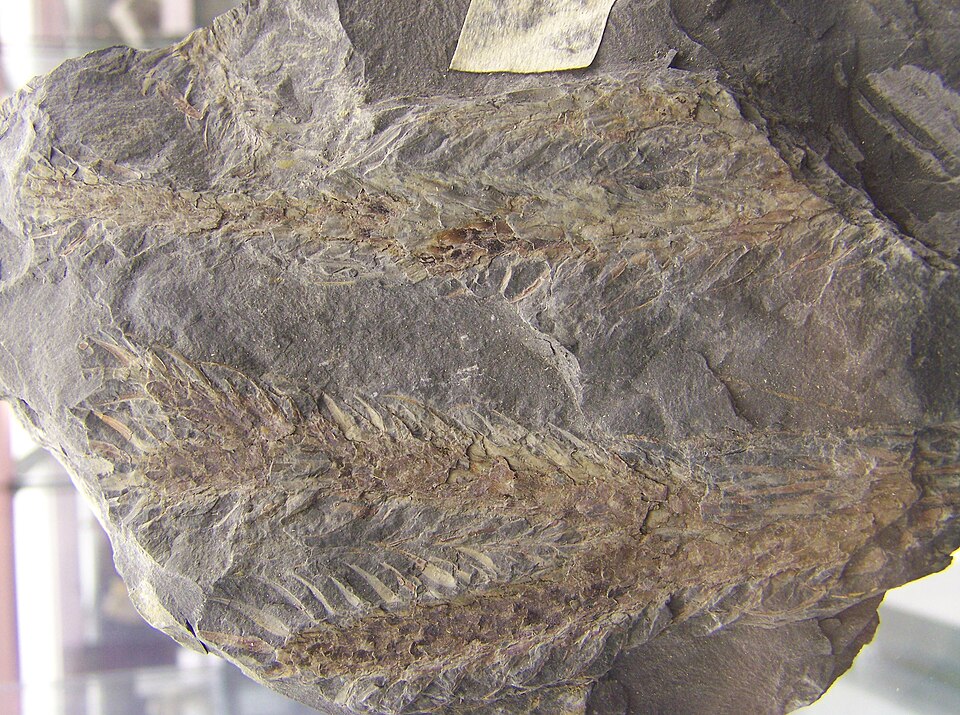

Lepidodendron, often called the "scale tree," is identifiable by the diamond-shaped leaf scars that covered its trunk in a spiralling pattern, giving the bark a reptilian texture. Unlike modern trees, which grow by adding wood year after year, lycopsid trunks were composed largely of a thin outer layer of bark surrounding a core of pith, with only a narrow zone of secondary xylem (wood). The majority of the trunk's structural support came from its massively thickened outer bark (periderm), which in Lepidodendron could constitute up to 90 percent of the trunk's cross-sectional area. This architecture made lycopsid trees remarkably lightweight for their size: a Lepidodendron trunk 40 metres tall may have weighed less than a modern hardwood tree one-third its height.9, 1
Sigillaria was generally shorter and more columnar than Lepidodendron, with leaf scars arranged in vertical rows rather than spirals. Both genera reproduced by spores rather than seeds, and their reproductive structures (strobili, or cones) were borne at the tips of branches. The underground root systems of these lycopsids are preserved as fossils assigned to the form genus Stigmaria, characterised by a radiating pattern of rootlets extending from a central axis. Stigmaria is among the most common plant fossils in Carboniferous coal-bearing strata worldwide.1, 3
Beneath and between the lycopsid canopy grew a diverse understory. Giant sphenopsids (horsetail relatives), assigned to the genus Calamites, formed thickets along waterways and in clearings, reaching heights of 10 to 20 metres. Unlike modern horsetails, which rarely exceed two metres, Calamites had a secondary growth capacity that allowed them to produce woody trunks with a segmented, jointed appearance. Tree ferns of the family Marattiales spread their fronds beneath the lycopsid canopy, while seed ferns (pteridosperms) such as Medullosa and Neuropteris occupied both the understory and forest margins. Cordaites, an early gymnosperm group, formed stands in better-drained habitats at the margins of the wetlands.1, 2
Growth strategies and ecology
The growth biology of arborescent lycopsids differed fundamentally from that of modern trees. Thomas and Cleal proposed that Lepidodendron and its relatives followed a deterministic growth programme: each tree's ultimate height and branching pattern were established early in development, and growth proceeded as a single, rapid trajectory from a pole-like sapling to a fully branched adult that reproduced once and then died, in a life cycle analogous to that of a giant herb rather than a long-lived tree.9 This hypothesis is supported by the absence of known small juvenile Lepidodendron specimens with the characteristic diamond-shaped bark pattern, suggesting that young trees grew rapidly through a morphologically distinct phase before adopting their adult form.
The rapid, determinate growth of lycopsids had profound ecological consequences. Dense stands of young, pole-like trees could colonise newly exposed substrates quickly, much like modern pioneer species in disturbed habitats. The lightweight trunk architecture and determinate growth pattern meant that individual lycopsids probably completed their life cycle in one to two decades, far shorter than the centuries-long lifespans typical of large modern trees.9, 1 When mature lycopsids reproduced and died, their trunks toppled into the swamp water, where the acidic, anoxic conditions inhibited decomposition and allowed organic matter to accumulate as peat.
The ecology of the coal swamp was strongly zoned by water depth and substrate stability. The wettest, most permanently flooded areas were dominated by lycopsids, whose Stigmaria root systems were adapted to waterlogged, oxygen-poor soils. Better-drained levees and channel margins supported Calamites and cordaites, while tree ferns colonised areas of intermediate moisture. This ecological zonation is preserved in the composition of individual coal seams: the proportion of lycopsid versus non-lycopsid plant material varies systematically through a seam's thickness, recording changes in water table depth as the swamp matured and subsided.1, 2
Coal formation and organic carbon burial
The Carboniferous and earliest Permian produced more coal than any other interval in Earth's history. Approximately 90 percent of the world's economically significant coal deposits were formed during the period from roughly 323 to 290 million years ago, a concentration of organic carbon burial unmatched before or since.10, 12 The transformation of living forest into coal required a specific sequence of conditions: prolific plant growth, waterlogged substrates that prevented aerobic decomposition, sustained subsidence of the basin floor to accommodate thick peat accumulation, and eventual burial beneath sediment that initiated the compaction and chemical transformation of peat into lignite and ultimately into bituminous coal or anthracite.
For decades, a prominent hypothesis attributed the extraordinary coal production of the Carboniferous to a "lignin gap" — a proposed evolutionary delay between the appearance of lignin (the structural polymer that makes wood rigid) in Devonian plants and the subsequent evolution of white-rot fungi capable of efficiently decomposing it. Under this scenario, the absence of effective lignin-degrading organisms allowed dead plant material to accumulate without decay for tens of millions of years. However, a comprehensive reassessment by Nelsen and colleagues in 2016, combining phylogenomic, geochemical, and stratigraphic evidence, rejected this hypothesis. They demonstrated that lignin-degrading fungi and bacteria were likely present before or during the Carboniferous, that lignin was of secondary importance in many coal-forming floras (lycopsid bark, the dominant source of Carboniferous peat, was composed primarily of suberinised periderm rather than lignin), and that the decline in coal production after the Permian correlated with tectonic and climatic changes rather than with the appearance of wood-rotting fungi.10
The current understanding attributes Carboniferous coal production to a unique confluence of tectonic, climatic, and biological factors. The assembly of Pangaea created extensive low-lying equatorial basins where subsidence matched peat accumulation. The glacial–interglacial cycles provided the cyclical flooding and exposure that allowed peat to build up during lowstands and be sealed by marine sediment during highstands. And the dominant vegetation — arborescent lycopsids — was biochemically and architecturally suited to peat formation, with their suberinised bark resisting decay even in the presence of decomposing organisms.10, 18
The scale of carbon burial during this interval was sufficient to alter the planet's climate trajectory. Modelling by Feulner (2017) demonstrated that the formation of the world's coal deposits drew atmospheric CO2 down to levels that brought Earth close to a global glaciation event. Had coal-forming swamps been even more extensive, or had they persisted longer, the resulting carbon drawdown might have tipped the climate system into a snowball-Earth state analogous to the Neoproterozoic glaciations.12
Estimated atmospheric oxygen levels through the Phanerozoic5, 7
Atmospheric oxygen and the hyperoxic peak
The massive burial of organic carbon in Carboniferous swamps had a direct consequence for atmospheric composition: as photosynthesis removed CO2 from the atmosphere and locked carbon in peat and coal, the liberated oxygen accumulated, driving atmospheric O2 concentrations to the highest levels of the entire Phanerozoic eon. Robert Berner's GEOCARBSULF model, the most widely used reconstruction of deep-time atmospheric chemistry, estimates that oxygen reached approximately 35 percent of the atmosphere by the late Carboniferous, compared to 21 percent today.5, 6, 7
This hyperoxic atmosphere had far-reaching biological and physical consequences. At 35 percent oxygen, the partial pressure of O2 at sea level would have been roughly 67 percent higher than it is today, enhancing the efficiency of gas exchange across respiratory surfaces and potentially enabling metabolically costly body plans that would be unsustainable under modern atmospheric conditions. The elevated oxygen also increased the density of the atmosphere and may have facilitated the flight of large-bodied insects that would be aerodynamically marginal in today's thinner air.8
However, high oxygen concentrations carry a significant hazard: fire. At 35 percent O2, even damp vegetation is readily flammable, and fires can propagate through wet forests that would be essentially fireproof at modern oxygen levels. The fossil record confirms that wildfires were pervasive in the late Carboniferous. Charcoal (fusain) is a ubiquitous component of Carboniferous coal seams, and in some deposits it constitutes a substantial fraction of the total organic material. The prevalence of fire likely acted as a feedback mechanism constraining oxygen levels: more fire meant more combustion of organic matter, reducing carbon burial and thereby limiting further oxygen accumulation.19, 5
The simultaneous drawdown of atmospheric CO2 by coal-forming forests contributed to the glaciation of Gondwana. As carbon was sequestered in peat and coal rather than cycling back to the atmosphere through decomposition, CO2 levels fell from the elevated concentrations of the early Carboniferous to values estimated at 300–400 parts per million by the late Pennsylvanian, comparable to or lower than pre-industrial modern levels. This greenhouse-gas reduction, combined with the polar positioning of Gondwana, drove the Late Paleozoic Ice Age, during which continental ice sheets extended to latitudes of 30–35 degrees south.17, 21
Giant arthropods of the coal age
The hyperoxic atmosphere of the late Carboniferous coincided with the evolution of the largest terrestrial arthropods in Earth's history. The most iconic of these is Meganeura monyi, a griffinfly (order Meganisoptera) with a wingspan of approximately 70 centimetres and a body length of over 40 centimetres, dwarfing all modern dragonflies. Meganeura was an aerial predator of the coal swamp canopy, hunting smaller insects in flight with the same general body plan used by modern dragonflies but at a dramatically larger scale.8, 16
Even more massive was Arthropleura, a terrestrial myriapod that reached lengths of at least 2 metres and possibly over 2.5 metres, making it the largest land-dwelling invertebrate of all time. Recent micro-computed tomography of exceptionally preserved specimens from the Montceau-les-Mines Lagerstatte in France has revealed details of Arthropleura's head anatomy and mouthparts for the first time, and phylogenomic analysis places it as a stem-group member of the clade containing millipedes and centipedes rather than belonging exclusively to either group.15 Despite its formidable size, Arthropleura was probably a detritivore or herbivore, feeding on the abundant decaying plant matter of the forest floor, and its trackways have been found preserved in Carboniferous sandstones from Kentucky to Scotland.
The oxygen hypothesis — the proposal that elevated atmospheric O2 permitted arthropod gigantism by enhancing oxygen delivery through the tracheal respiratory system — was tested experimentally by Harrison, Kaiser, and VandenBrooks (2010), who reared modern insects under varying oxygen regimes. They found that higher oxygen levels permitted larger maximum body sizes in several insect lineages, supporting a causal connection between atmospheric oxygen and arthropod size, though they also noted that other factors including predation pressure and ecological opportunity likely contributed.8 Clapham and Karr (2012), analysing the entire fossil record of insect body size, confirmed a broad correlation between atmospheric oxygen and maximum insect size through the Paleozoic and early Mesozoic, but found that the correlation broke down after the Cretaceous evolution of birds and bats, whose predation appears to have imposed a size ceiling on aerial insects regardless of oxygen levels.16
Giant arthropods of the Carboniferous coal forests8, 15, 16
| Organism | Group | Maximum size | Ecology |
|---|---|---|---|
| Meganeura monyi | Meganisoptera (griffinflies) | ~70 cm wingspan | Aerial predator |
| Arthropleura | Myriapoda (stem group) | ~2.5 m body length | Terrestrial detritivore |
| Pulmonoscorpius kirktonensis | Scorpiones | ~70 cm body length | Terrestrial predator |
| Megarachne servinei | Eurypterida (sea scorpions) | ~54 cm body length | Aquatic predator |
The origin of amniotes
The Carboniferous coal forests were the cradle of the amniotes, the group of vertebrates that includes all modern reptiles, birds, and mammals. The innovation that defines amniotes is the amniotic egg: a self-contained reproductive unit enclosed in a shell or membrane that protects the developing embryo from desiccation, allowing reproduction on dry land without the need for standing water. This adaptation, which evolved within the coal-forest ecosystem, ultimately freed vertebrate life from its ancestral dependence on aquatic environments and paved the way for the full colonisation of terrestrial habitats.14, 11
The oldest unambiguous amniote in the fossil record is Hylonomus lyelli, a small, lizard-like animal approximately 20 centimetres long, preserved in the famous Joggins Formation of Nova Scotia, Canada. The Joggins Fossil Cliffs, designated a UNESCO World Heritage Site in 2008, expose a 15-kilometre-long sequence of Pennsylvanian-age strata that preserves an extraordinary record of the coal-forest ecosystem. Hylonomus is found entombed inside the upright, hollowed-out stumps of Sigillaria trees that were buried in growth position by flooding events. As the trees died and their trunks rotted from the inside, the hollow stumps became natural pitfall traps, capturing small tetrapods, millipedes, and snails that fell in and could not climb out.13, 14
Hylonomus dates to approximately 312 million years ago, making it one of the oldest known crown-group amniotes, though the true divergence of the amniote lineage from its amphibian ancestors almost certainly occurred earlier, during a period for which the terrestrial fossil record is sparse. The Joggins section preserves not only body fossils but also a rich array of trackways, burrows, and coprolites that document the behaviour and ecology of the coal-forest vertebrate community, from large temnospondyl amphibians that inhabited the waterways to small insectivorous amniotes that foraged in the leaf litter beneath the lycopsid canopy.20, 13
The Carboniferous rainforest collapse
The coal-forest ecosystem did not persist unchanged through the Pennsylvanian. Around 305 million years ago, at the boundary between the Westphalian and Stephanian stages (equivalent to the Moscovian–Kasimovian boundary in the global chronostratigraphy), the tropical rainforests suffered a dramatic collapse that fundamentally altered the structure and composition of equatorial vegetation. This event, termed the Carboniferous rainforest collapse, represents one of the most significant ecological upheavals of the Paleozoic era.11, 2
The collapse was driven primarily by increasing aridity in the equatorial zone, linked to changes in the intensity and pattern of Gondwanan glacial–interglacial cycles. As the Late Paleozoic Ice Age evolved, glacial periods became more pronounced and intervening interglacials became drier, reducing the year-round moisture that the hygrophilous (moisture-loving) lycopsid forests required. The continuous belt of tropical rainforest that had spanned equatorial Euramerica fragmented into isolated patches separated by drier habitats, in a process analogous to the fragmentation of modern tropical forests by deforestation.11, 2
The ecological consequences were severe. Approximately 67 percent of plant species in the peat-forming swamp communities were eliminated, including most species of the dominant lycopsid genus Lepidodendron. The surviving flora was reorganised around tree ferns (marattialean ferns), which became the dominant canopy-formers in the smaller, more fragmented Stephanian swamps. This transition from lycopsid-dominated to tree-fern-dominated wetlands is one of the most clearly documented examples of a major vegetation turnover in the pre-angiosperm fossil record.1, 2, 3
The impact on animal communities was equally profound. Sahney, Benton, and Falcon-Lang (2010) documented a sharp increase in tetrapod extinction rates coinciding with the rainforest collapse, accompanied by a collapse in alpha diversity (the number of species found at individual localities) and the development of endemism (geographic restriction of species) for the first time in the Carboniferous tetrapod record. Amphibians, which depended on moist habitats for reproduction and skin respiration, were disproportionately affected. Amniotes, whose shelled eggs and relatively impermeable skin pre-adapted them to drier conditions, weathered the collapse more successfully. The fragmentation of the formerly continuous forest into isolated refugia appears to have promoted speciation in amniote lineages by creating reproductively isolated populations — a pattern consistent with allopatric speciation driven by habitat fragmentation.11
The Joggins Fossil Cliffs
No single locality better preserves the Carboniferous coal-forest ecosystem than the Joggins Fossil Cliffs on the shore of the Bay of Fundy in Nova Scotia, Canada. The Joggins section exposes approximately 15 kilometres of continuously eroding coastal cliffs that span roughly 310 to 303 million years of Pennsylvanian-age strata, comprising repeating cycles of sandstone, mudstone, limestone, and coal that record the rhythmic flooding and emergence of a tropical coastal plain during glacial–interglacial sea-level oscillations.13, 20
The scientific significance of Joggins was recognised as early as the mid-nineteenth century, when Sir Charles Lyell and William Dawson described the site's extraordinary preservation of upright fossil trees, an observation that helped establish the principle that coal originated from forests growing in place rather than from drifted plant debris. Dawson's discovery of Hylonomus lyelli inside a fossilised Sigillaria stump in 1859 was one of the landmark finds of Victorian palaeontology, establishing Joggins as the type locality for the world's oldest known reptile.13
The site has yielded 148 species of fossils belonging to 96 genera, encompassing plants, invertebrates, and vertebrates from three distinct palaeoenvironments: the coal swamp forests dominated by lycopsids and Calamites, the dryland habitats on levees and interfluves, and the brackish to freshwater aquatic environments of the coastal lagoons and river channels. The preservation of organisms in ecological context — trees standing where they grew, tetrapod footprints preserved on bedding surfaces where they were made, amphibian dens with remnants of their prey — makes Joggins an unparalleled window into the daily life of a coal-age community.20
In recognition of this exceptional fossil record, the Joggins Fossil Cliffs were inscribed as a UNESCO World Heritage Site in 2008. The ongoing erosion of the cliffs by the Bay of Fundy's extreme tides continuously exposes new fossil material, ensuring that the site remains an active source of new discoveries. Recent research has expanded the known diversity of the Joggins biota and refined understanding of the sedimentary processes that preserved it, confirming its status as the world's premier locality for studying Pennsylvanian terrestrial ecosystems.20
Legacy and global impacts
The Carboniferous coal forests left an imprint on the Earth system that extends far beyond the geological period in which they grew. The coal they produced has been one of the most consequential geological resources in human history. The British Industrial Revolution of the eighteenth and nineteenth centuries was powered overwhelmingly by Carboniferous coal extracted from the coalfields of Wales, Yorkshire, Lancashire, and the Midlands — the very same peat deposits laid down in Euramerican swamps more than 300 million years earlier. The Appalachian coalfields of the eastern United States, the Ruhr Basin of Germany, the Donets Basin of Ukraine, and the coal measures of Poland and the Czech Republic are all Carboniferous in age, and together they have supplied the majority of the coal burned by human civilisation.4, 12
The atmospheric effects of Carboniferous carbon burial persisted long after the forests themselves disappeared. The drawdown of CO2 contributed to the continuation of the Late Paleozoic Ice Age into the early Permian, and the elevated oxygen levels lingered for tens of millions of years before declining as coal formation waned and volcanic outgassing gradually restored atmospheric CO2. The oxygen peak may have played a role in the end-Permian mass extinction: the precipitous decline in O2 from Carboniferous highs to lower Permian and Triassic levels imposed physiological stress on organisms adapted to hyperoxic conditions, potentially contributing to the vulnerability of late Permian ecosystems to the volcanic disruption of the Siberian Traps.5, 6
Ecologically, the Carboniferous coal forests established patterns that would shape terrestrial life for the remainder of the Paleozoic and beyond. The amniote radiation triggered by the rainforest collapse set the stage for the diversification of reptiles and synapsids (the lineage that would eventually produce mammals) during the Permian. The displacement of lycopsid-dominated wetlands by tree-fern and gymnosperm-dominated communities during the late Carboniferous and Permian initiated the long-term transition toward the seed-plant-dominated floras that would characterise the Mesozoic era. And the coal-age ecosystem demonstrated, for the first time in geological history, the capacity of terrestrial vegetation to alter global atmospheric chemistry on a planetary scale, a process whose modern analogue — the burning of those same coal deposits — is now driving anthropogenic climate change in the opposite direction.4, 17, 21
Key fossil localities
Beyond Joggins, several other localities provide critical evidence for understanding the Carboniferous coal forests. The Mazon Creek Lagerstatte of Illinois, United States, dated to approximately 309 million years ago, preserves an extraordinary diversity of organisms in siderite (iron carbonate) concretions, including soft-bodied animals rarely preserved elsewhere. Mazon Creek has yielded hundreds of species of plants, insects, arachnids, myriapods, fish, and the enigmatic soft-bodied animal Tullimonstrum (the "Tully Monster"), providing a uniquely comprehensive picture of both the swamp community and the adjacent marine environment.3
The Fossil Grove of Victoria Park, Glasgow, Scotland, preserves a stand of Lepidodendron stumps in growth position, discovered during the construction of a park pathway in 1887. Though smaller in extent than Joggins, the Glasgow Fossil Grove offers a vivid snapshot of a lycopsid forest floor, with stumps and Stigmaria root systems preserved exactly as they stood in life. The site is now protected within a purpose-built building and is one of the most accessible coal-forest localities in the world.3
The coalfields of the Saar-Lorraine Basin (Germany and France), the Upper Silesian Basin (Poland and the Czech Republic), and the South Wales Coalfield (United Kingdom) have produced extensive collections of Carboniferous plant fossils that underpin the biostratigraphic zonation of the Westphalian and Stephanian stages. The systematic study of plant macrofossils and spores from these European basins, carried out over more than a century, established the framework within which Carboniferous time is subdivided and correlated worldwide.3, 4
In the Southern Hemisphere, Carboniferous and Permian coal deposits in India, Australia, southern Africa, and South America record a different flora, adapted to the cool temperate to glacial climates of Gondwana rather than the tropical conditions of the equatorial belt. The Gondwanan coal floras were dominated by the seed-fern Glossopteris, whose distinctive tongue-shaped leaves are among the most important biostratigraphic index fossils of the Southern Hemisphere Paleozoic. The distribution of Glossopteris across India, Australia, Africa, Antarctica, and South America provided some of the earliest evidence for the former unity of these continents, contributing to Alfred Wegener's hypothesis of continental drift.4
References
Palaeozoic tropical rainforests and their effect on global climates: is the past the key to the present?
A history of research at the Joggins Fossil Cliffs of Nova Scotia, Canada, the world's finest Pennsylvanian section
Head anatomy and phylogenomics show the Carboniferous giant Arthropleura belonged to a millipede-centipede group
Climate, pCO₂ and terrestrial carbon cycle linkages during late Palaeozoic glacial–interglacial cycles