Overview
- The Late Carboniferous period (approximately 323–299 million years ago) produced the largest terrestrial arthropods in Earth’s history, including the griffenfly Meganeura monyi with a wingspan of approximately 70 centimeters and the millipede-like Arthropleura reaching lengths of over 2.5 meters.
- The leading explanation for Carboniferous arthropod gigantism is the hyperoxia hypothesis, which proposes that atmospheric oxygen concentrations of 30–35% (compared to today’s 21%) enabled the passive tracheal respiratory system of arthropods to supply oxygen to much larger body volumes than is possible under modern conditions.
- The decline of giant arthropods in the early Permian correlates with falling oxygen levels and the diversification of early reptiles and large amphibians, suggesting that both atmospheric and ecological factors ultimately constrained the maximum body size of terrestrial arthropods.
The Late Carboniferous period, spanning approximately 323 to 299 million years ago, is distinguished by the largest terrestrial arthropods in Earth's history. Giant griffenflies with wingspans approaching 70 centimeters, millipede-like arthropleurids exceeding 2.5 meters in length, and outsized scorpions, spiders, and cockroach relatives populated the dense coal swamp forests that covered much of the tropical landmasses during this interval.1, 7, 14 The phenomenon of Carboniferous arthropod gigantism has attracted intense scientific interest because it appears to be correlated with a unique set of atmospheric conditions, specifically oxygen levels far higher than those of the present day, raising fundamental questions about the physiological constraints on arthropod body size and the relationship between atmospheric composition and evolutionary possibility.1, 2, 4
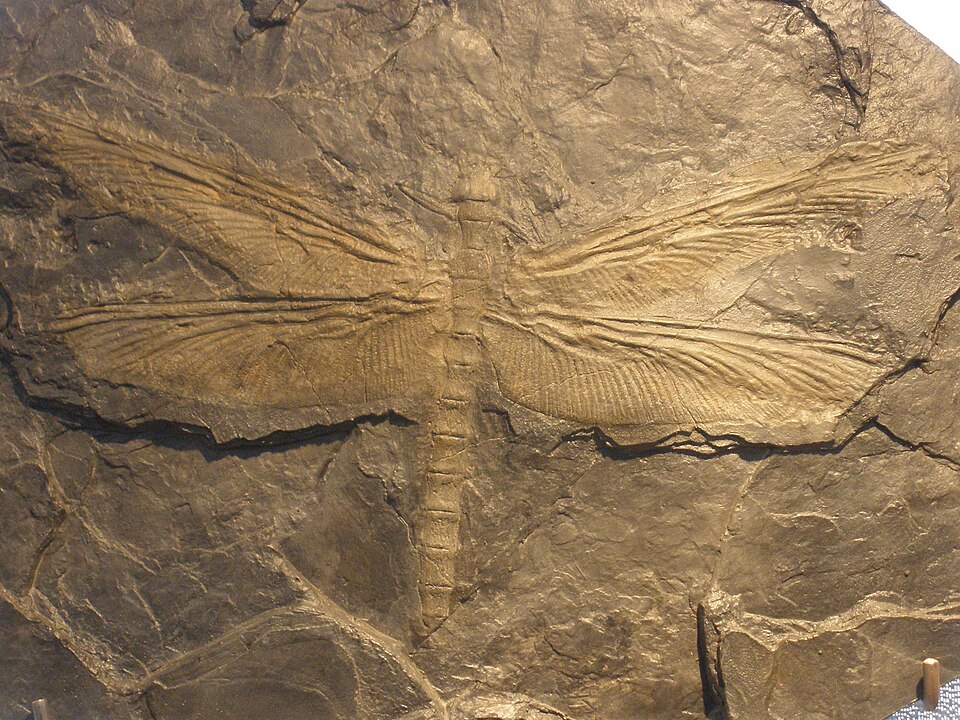

The giants
Meganeura monyi, described from the Upper Carboniferous of Commentry, France, is the most famous of the Carboniferous giant insects. With a wingspan of approximately 70 centimeters and an estimated body length of 30 to 40 centimeters, Meganeura and its relatives in the order Meganisoptera (also known as griffenflies or "giant dragonflies") are the largest known flying insects of all time.9, 10, 14 Despite their superficial resemblance to modern dragonflies, meganisopterans are not true dragonflies (Odonata) but rather stem-group relatives that diverged before the evolution of the pterostigma and other features diagnostic of the modern order.9, 14 Their predatory lifestyle, however, was likely similar: Meganeura was an aerial predator that captured smaller insects and possibly small vertebrates in flight, using its robust, spined legs and powerful mandibles.9
Arthropleura, a genus of giant arthropleurid myriapods, represents the largest terrestrial arthropod of all time by body length. Trackways and body fossils from the Upper Carboniferous of Europe and North America indicate body lengths of up to 2.63 meters, based on a recently described trackway from the Stainmore Formation of Northumberland, England.6, 7, 8 Arthropleura was a flat-bodied, multi-segmented animal superficially resembling a giant millipede, though its exact phylogenetic position among myriapods remains debated. Its diet is uncertain; the absence of preserved mandibles in most specimens and the association of some fossils with lycopsid plant material has led to suggestions that it was an herbivore or detritivore, though a predatory or omnivorous diet has not been excluded.7 The sheer size of Arthropleura meant it had no terrestrial arthropod predators and few vertebrate predators capable of threatening an adult, making it an apex invertebrate in Carboniferous forest-floor ecosystems.7, 8
The hyperoxia hypothesis
The dominant explanation for Carboniferous arthropod gigantism is the hyperoxia hypothesis, which links maximum arthropod body size to atmospheric oxygen concentration. Robert Berner's geochemical modeling of Phanerozoic atmospheric composition, particularly the GEOCARBSULF model, indicates that atmospheric oxygen levels peaked at approximately 30 to 35 percent during the Late Carboniferous and early Permian, compared to the present-day level of approximately 21 percent.4, 5 This oxygen peak resulted from the massive burial of organic carbon in the form of coal deposits, driven by the proliferation of vascular land plants in the extensive tropical wetlands of the period, combined with the limited capacity of contemporary decomposer organisms to break down lignin-rich plant tissue.4, 11
Terrestrial arthropods breathe through a tracheal system, a network of branching tubes that deliver oxygen directly from spiracular openings on the body surface to the tissues by diffusion and, in some insects, active ventilation.1, 3 Because oxygen delivery in the tracheal system depends on diffusion over at least part of the pathway, there is a physical limit to how far oxygen can penetrate into increasingly large body volumes. Robert Dudley first articulated the connection between hyperoxia and insect gigantism in 1998, arguing that elevated atmospheric oxygen would increase the partial pressure gradient driving diffusion through the tracheal system, permitting the evolution of larger body sizes before oxygen delivery becomes limiting.1 Experimental work by Jon Harrison, Alexander Kaiser, and John VandenBrooks has provided empirical support for this mechanism, demonstrating that modern insects reared under hyperoxic conditions (31 to 40 percent oxygen) grow significantly larger than controls reared at ambient oxygen, while insects reared under hypoxic conditions are smaller.2, 3
Alternative and complementary factors
While the hyperoxia hypothesis remains the leading explanation, several complementary factors have been proposed to account for Carboniferous arthropod gigantism. The absence of large, agile, aerial vertebrate predators during the Carboniferous may have been important: early tetrapods were predominantly aquatic or semi-aquatic, and the first flying vertebrates (pterosaurs) did not appear until the Late Triassic, meaning that large flying insects faced no vertebrate aerial predators for over 100 million years.9, 14 The removal of this predatory constraint may have been a necessary precondition for the evolution of large body size in flying insects, complementing the physiological permission granted by hyperoxia.2, 15
Temperature may also have played a role. The Late Carboniferous was a period of significant glaciation at high latitudes (the Late Paleozoic Ice Age), but tropical regions, where the giant arthropods are predominantly found, remained warm and humid.11 Warm temperatures increase metabolic rates and growth rates in ectotherms, and the combination of high oxygen and warm, stable tropical climates may have synergistically promoted large body size.12 Matthew Clapham and Jered Karr's comprehensive analysis of insect body size through the Phanerozoic found that oxygen concentration was the primary predictor of maximum insect size during the Paleozoic, but that the correlation weakened after the Cretaceous, suggesting that ecological factors, particularly the diversification of insectivorous birds and bats, imposed an additional ceiling on insect body size that overrode atmospheric effects.15
Ecological context
The Carboniferous giant arthropods inhabited some of the most productive terrestrial ecosystems in Earth's history. The coal swamp forests of the Late Carboniferous, dominated by lycopsid trees (such as Lepidodendron and Sigillaria), tree ferns, horsetails, and seed ferns, formed dense canopy forests with extensive understory vegetation and thick accumulations of decaying plant litter on waterlogged substrates.11 This environment provided abundant food resources for herbivorous and detritivorous arthropods and created the humid, enclosed microhabitats that would have minimized water loss for large-bodied terrestrial invertebrates.11, 14
The giant arthropods occupied a range of ecological roles. Meganisopterans were aerial predators, arthropleurids were likely ground-dwelling herbivores or detritivores, giant scorpions such as Pulmonoscorpius (body length approximately 70 centimeters) were terrestrial predators, and giant cockroach relatives were omnivorous scavengers.7, 14 This ecological diversity suggests that gigantism was not confined to a single lineage or a single ecological strategy but was a pervasive phenomenon affecting multiple arthropod groups simultaneously, consistent with a common environmental driver such as atmospheric oxygen rather than a lineage-specific genetic innovation.2, 15
Decline of the giants
The Carboniferous giant arthropods declined during the late Carboniferous and early Permian, a period that saw falling atmospheric oxygen levels, the collapse of the coal swamp ecosystems as global climate became drier, and the diversification of early amniotes, including the first large, fully terrestrial predators.4, 11, 15 The last known meganisopterans persisted into the Early Permian, and Arthropleura disappears from the fossil record by the earliest Permian, roughly coinciding with the transition from the wet, coal-forming environments of the Carboniferous to the drier, more seasonal climates of the Permian.7, 14 Whether the decline was driven primarily by falling oxygen, habitat loss, predation by increasingly effective vertebrate predators, or some combination of these factors remains uncertain, but the correlation between maximum arthropod body size and atmospheric oxygen through deep time strongly suggests that physiology, ecology, and atmospheric composition were inextricably linked in shaping the possibilities for arthropod gigantism.2, 4, 15
References
Atmospheric oxygen, giant Paleozoic insects and the evolution of aerial locomotor performance
Modelling the physiology of the aquatic temnospondyls and the terrestrial arthropods of the Carboniferous
Late Palaeozoic high atmospheric oxygen levels balance out the lack of evidence for limiting effects of oxidative stress on terrestrial arthropod body size