Overview
- The first true mammals appeared in the Late Triassic roughly 225–210 million years ago, sharing the world with dinosaurs for the next 160 million years in a relationship long mischaracterised as one of suppression and ecological marginality.
- Fossils discovered since the 1990s have overturned the textbook portrait of Mesozoic mammals as uniformly small, nocturnal, and insectivorous, revealing swimmers, gliders, burrowers, and predators of juvenile dinosaurs coexisting across the Jurassic and Cretaceous.
- The nocturnal bottleneck hypothesis proposes that prolonged nighttime activity during the Mesozoic left a lasting imprint on mammalian eye anatomy and sensory biology, even in lineages that later became fully diurnal.
For 160 million years — from the Late Triassic to the close of the Cretaceous — mammals shared the planet with non-avian dinosaurs. For much of the twentieth century, this coexistence was read as one of ecological suppression: the dinosaurs dominated every large-bodied terrestrial niche, and mammals were confined to a narrow existence as small, nocturnal, insect-eating generalists, waiting in the undergrowth until an asteroid delivered their inheritance. This picture was never entirely accurate, and discoveries accumulating since the 1990s have dismantled it almost entirely. Mesozoic mammals were ecologically diverse, anatomically inventive, and geographically widespread, occupying roles from aquatic predator to aerial glider to herbivorous burrower tens of millions of years before the end-Cretaceous extinction opened the ecological space that their descendants would fill.1, 2 To understand this story, it is necessary to begin at the origin of the group itself, a transition from the synapsid stem lineage that unfolded gradually across the Triassic.
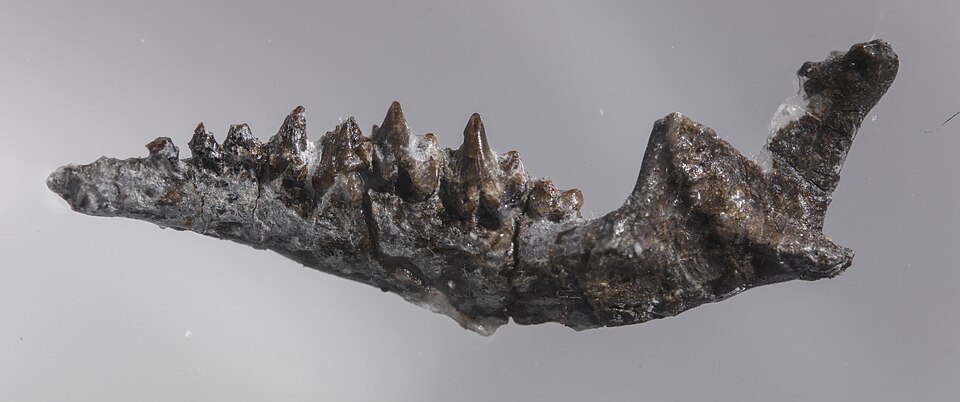

The first true mammals
Defining precisely when a mammal-line animal became a mammal is complicated by the gradual, mosaic nature of the transition. By the most widely used node-based definition, Mammalia comprises the last common ancestor of monotremes and therians (marsupials and placentals) and all its descendants. On this definition, the earliest crown mammals appear in the fossil record no earlier than approximately 178–166 million years ago, in the Middle Jurassic.2 However, the broader concept of Mammaliaformes — which includes extinct stem lineages sharing most diagnostic mammalian features — extends the record back considerably further, to the Late Triassic.
Morganucodon, known from Triassic–Jurassic boundary deposits of Wales, China, and North America and dating to approximately 205–195 million years ago, is among the best-studied early mammaliaforms.4 It possessed the fully derived dentary-squamosal jaw joint that is the single most diagnostic skeletal feature of mammals, along with differentiated teeth replaced only once during life — the diphyodont condition that allows the complex occlusal relationships characteristic of mammalian chewing.4 Its closely contemporaneous southern-hemisphere counterpart, Megazostrodon from the Elliot Formation of Lesotho, preserves broadly similar anatomy and confirms that mammaliaforms had achieved a global distribution by the earliest Jurassic.1 Both animals were small — estimated body masses in the range of 20–30 grams — and almost certainly insectivorous, consistent with the traditional view. What the traditional view got wrong was in treating this ancestral condition as the whole story of the next 160 million years.
Overturning the orthodox view
The textbook portrait of Mesozoic mammals as uniformly "small, nocturnal, and insectivorous" dominated paleontology for most of the twentieth century and reflected the state of the fossil record at the time. The earliest-known Mesozoic mammals were indeed mostly small-bodied, and the dominant Mesozoic groups — multituberculates, triconodonts, symmetrodonts — were long known primarily from isolated teeth and jaw fragments, which were difficult to interpret in ecological terms.1 The discovery of articulated or near-complete skeletons, many from the spectacularly productive Yanliao Biota of the Middle to Late Jurassic in northeastern China, transformed the field in the 1990s and 2000s.
Castorocauda lutrasimilis, described in 2006 from the Jurassic of Inner Mongolia, was a beaver-sized mammal of approximately 500–800 grams whose skeleton preserves a broad, flattened tail and robust forelimbs with reduced digits — adaptations strikingly convergent with those of modern semi-aquatic mammals.6 Its teeth are adapted for fish-eating rather than insectivory, and isotopic analysis of bone chemistry is consistent with a diet of aquatic prey.6 At roughly 164 million years old, it predates any previously recognised semi-aquatic mammal by more than 100 million years. In the same year, Volaticotherium antiquum was reported from the same geological unit: a gliding mammal with a membrane-bearing patagium extending between elongated limbs, convergent in body plan with modern colugos and flying squirrels.5 Its molar teeth, bearing multiple cusps, indicate a diet of insects or soft plant material rather than vertebrate prey.5
Perhaps the most dramatic single specimen to emerge from this period of discovery was Repenomamus robustus and its larger relative R. giganticus, eutriconodont mammals from the Early Cretaceous Yixian Formation of Liaoning.7 R. giganticus had an estimated body mass of approximately 12–14 kilograms, making it the largest known Mesozoic mammal at the time of its description and substantially larger than many of the small dinosaurs with which it coexisted. More dramatically still, the stomach contents of one R. robustus specimen preserve the disarticulated bones of a juvenile Psittacosaurus, a ceratopsian dinosaur — direct evidence that at least some Mesozoic mammals were capable of predating small dinosaurs rather than merely evading them.7 Fruitafossor windscheffeli from the Late Jurassic Morrison Formation of Colorado represents yet another ecological specialisation: a small mammal with strongly built forelimbs, reduced and simplified peg-like teeth, and body proportions convergent with modern armadillos and aardvarks, interpreted as a specialist feeder on colonial insects such as termites.11 Together, these forms collectively demolished the monolithic picture of the ecologically constrained Mesozoic mammal.
Major Mesozoic mammal groups
The Mesozoic mammalian fauna comprised numerous clades, most now entirely extinct, whose interrelationships and precise phylogenetic positions remain subjects of ongoing research. The multituberculates are the most species-rich and longest-lived of these groups, first appearing in the Middle Jurassic and persisting until the Eocene, some 35 million years after the extinction of non-avian dinosaurs.9 Their distinctive multi-cusped molars — the source of their name — are adapted for herbivory, and the group as a whole diversified extensively into seed-eating and omnivorous niches. Molecular and morphological evidence indicates that multituberculates were already undergoing significant ecological radiation before the end of the Cretaceous, not merely opportunistically expanding into vacated space afterwards.9
The monotremes — represented today by the platypus and echidnas — are the sole surviving members of the earliest-diverging mammalian lineage. Their Mesozoic fossil record is frustratingly sparse, but the group almost certainly has deep Jurassic or even Triassic roots consistent with molecular clock estimates.2 Monotremes retain several ancestral features absent from therians, including egg-laying, electrosensory bills, and the absence of a corpus callosum, that reflect their ancient divergence from the therian stem.1 The symmetrodonts and dryolestoids are extinct groups whose precise placement within the mammalian tree varies between analyses; both were predominantly small insectivores or carnivores, though dryolestoids achieved their greatest diversity in the Gondwanan continents and persisted into the Cenozoic in South America.1, 2
The therians — the clade uniting marsupials (metatherians) and placentals (eutherians) — diverged from one another sometime in the Early Cretaceous, with molecular clock estimates typically placing the split between 180 and 160 million years ago and the fossil record yielding confirmed eutherians by approximately 125 million years ago in the Yixian Formation.19 Juramaia sinensis, described from the Jurassic of China in 2011, has been proposed as the oldest known eutherian at approximately 160 million years, though its placement remains debated.19 By the Late Cretaceous, both metatherians and eutherians were present on multiple continents, though neither had yet achieved the ecological and morphological diversity that would characterise them in the Cenozoic.18
The nocturnal bottleneck
The hypothesis that Mesozoic mammals were constrained to predominantly nocturnal activity — and that this constraint left a lasting mark on mammalian biology — was first articulated in anatomical terms by Gordon Lynn Walls in his landmark 1942 work on vertebrate eye evolution.9 Walls noted that the eyes of living mammals differ from those of reptiles and birds in ways consistent with an ancestral period of nocturnal adaptation: mammals generally lack the oil droplets in their cone photoreceptors that enhance colour discrimination in diurnal vertebrates, possess a high ratio of rods to cones, and have eyes that sacrifice acuity for sensitivity. He proposed that these features reflected a prolonged "nocturnal bottleneck" during which the mammalian lineage was ecologically confined to nighttime activity by competition with, or predation pressure from, diurnal dinosaurs.
The hypothesis was formalised and tested empirically by Heesy and Hall in 2010, who analysed retinal cell proportions and eye morphology across a broad sample of living mammals and outgroups.8 Their analysis confirmed that the retinal organisation of mammals is consistent with an ancestral phase of scotopic (low-light) specialisation that predates the diversification of the crown group, and that the secondary evolution of diurnality in various mammalian lineages — primates, ground squirrels, many ungulates — involved independent modifications superimposed on a fundamentally nocturnal retinal ground plan.8 Scleral ring analysis of dinosaur eyes, published in 2011, suggested that many non-avian dinosaurs were indeed diurnal or cathemeral, consistent with the hypothesis that nocturnal niches were differentially available to small mammals during the Mesozoic.10 The nocturnal bottleneck is now broadly accepted as the most parsimonious explanation for the distinctive retinal organisation of mammals, even if its precise ecological drivers remain subjects of discussion.
Key adaptations of the Mesozoic period
The Mesozoic was not merely a period of ecological stasis for mammals; it was the interval during which the defining biological features of the class were refined and consolidated. Endothermy — the capacity to generate and regulate body heat metabolically — was not a sudden mammalian invention but the culmination of a trend that began in non-mammalian therapsids of the Permian and Triassic. Oxygen isotope evidence from bone carbonate of late therapsids suggests that elevated metabolic rates were present well before the first mammaliaforms appeared.14 By the time of Morganucodon and its relatives, endothermy was almost certainly present, as inferred from bone histology, turbinal bone development in the nasal cavity (which conserves respiratory moisture in animals with high ventilation rates), and the refined dental occlusion that demands high food intake.14
Lactation is among the most distinctive mammalian features and one of the most ancient, with its evolutionary origins likely predating the mammaliaform node. The secretion of nutritive fluid from modified skin glands is thought to have evolved initially as a means of keeping eggs moist rather than as direct offspring nourishment, consistent with the egg-laying biology retained by modern monotremes.13 True mammary glands with nipples are a therian synapomorphy, but the underlying glandular secretory capacity is ancient.13 Hair, which is universal among living mammals, is difficult to preserve in the fossil record, but integument impressions from Jurassic mammaliaforms confirm its presence by at least 164 million years ago, and molecular and developmental evidence suggests hair follicles are homologous with reptilian scales, implying a shared origin deep in the amniote stem.20
The transformation of the jaw and middle ear that defines the synapsid-to-mammal transition reached its completion during the early Mesozoic. The postdentary bones — the articular and quadrate that formed the jaw joint in all pre-mammalian amniotes — were progressively reduced and ultimately detached from the jaw to become the malleus and incus of the mammalian middle ear, joining the stapes already present in the ancestral tetrapod ear to create the three-ossicle chain unique to mammals.15 This transformation dramatically improved high-frequency hearing sensitivity, a particularly valuable adaptation for nocturnal animals navigating and locating prey in darkness.15 The complete detachment of the postdentary ossicles occurred independently in multiple mammaliaform lineages, a remarkable instance of convergence driven by consistent selective pressures.22
The mid-Jurassic radiation
Although the first mammaliaforms appear in the Late Triassic record, the ecological and morphological diversification of the group appears to have accelerated markedly in the Middle Jurassic, approximately 175–160 million years ago. Analysis of mammalian body-size distributions and dental disparity through the Mesozoic, published in 2015, identified a significant pulse of diversification in this interval that predates and is distinct from the post-K-Pg radiation.11 The Yanliao Biota of northeastern China, deposited during this period, preserves the remarkable assemblage of ecologically diverse mammaliaforms — the swimming Castorocauda, the gliding Volaticotherium, the arboreal docodont Agilodocodon — that has been instrumental in revising the standard narrative.12
The drivers of this mid-Jurassic diversification are not fully understood, but several factors have been proposed. The end-Triassic mass extinction approximately 201 million years ago eliminated many competing groups of non-dinosaurian archosaurs and non-mammalian synapsids, potentially opening ecological space in the earliest Jurassic.11 The concurrent diversification of flowering plants in the Cretaceous, and of the insects associated with them, would later provide additional ecological opportunities, but in the Jurassic the driving factors were more likely the structural reorganisation of terrestrial communities following the end-Triassic crisis. Whatever its causes, the mid-Jurassic radiation established the basic ecological template — multiple body sizes, multiple dietary guilds, multiple locomotor strategies — that Mesozoic mammalian communities would maintain through to the end of the Cretaceous.
The K-Pg boundary and what followed
At the close of the Cretaceous, approximately 66 million years ago, the bolide impact at Chicxulub triggered the end-Cretaceous mass extinction that eliminated all non-avian dinosaurs and between 70 and 80 percent of all species on Earth. For mammals, the extinction was severe: the multituberculates, though they survived, lost substantial diversity; the metatherians were heavily affected, particularly in North America; and numerous Mesozoic lineages — the eutriconodonts, the symmetrodonts, most gondwanatherian groups — disappeared entirely.18 The event thus simultaneously destroyed much of the diversity that had accumulated across the Mesozoic and removed the ecological incumbents that had structured terrestrial communities for 160 million years.
The result was the explosive mammalian adaptive radiation of the Paleocene and Eocene, one of the most rapid large-scale diversifications in vertebrate history. The surviving therian lineages — eutherians in particular — diversified into the full range of large-bodied herbivorous, carnivorous, and omnivorous roles within approximately 10 million years of the boundary, a blink of geological time.21 Molecular clock analyses indicate that many of the deep divergences among placental orders had already occurred in the Cretaceous, meaning that the K-Pg boundary did not generate the ordinal-level diversity of placentals so much as it unleashed an ecological and morphological radiation in lineages whose phylogenetic roots were already in place.16, 17 The 160-million-year apprenticeship of the Mesozoic, with its sustained refinement of endothermy, lactation, dentition, hearing, and locomotor versatility, had produced an extraordinarily generalist and adaptable body plan. When the competitive landscape was cleared by catastrophe, that body plan proved capable of producing, in geological short order, virtually every large-bodied terrestrial vertebrate ecological role on Earth.
The Mesozoic mammals are therefore best understood not as a prelude to mammalian history but as its first chapter — one characterised by genuine ecological innovation, persistent evolutionary experimentation, and the slow accumulation of the biological toolkit that would make the Cenozoic the age of mammals in every meaningful sense.
References
A swimming mammaliaform from the Middle Jurassic and ecomorphological diversification of early mammals
Evolution of lactation: ancient origin and extreme adaptations of the lactation system
Impacts of the Cretaceous Terrestrial Revolution and KPg extinction on mammal diversification
Therian mammals experience an ecomorphological radiation during the Late Cretaceous and selective extinction at the K–Pg boundary
Exceptional continental record of biotic recovery after the Cretaceous–Paleogene mass extinction