Overview
- Hadrosauridae, the duck-billed dinosaurs, were the most species-rich and ecologically dominant large herbivores of the Late Cretaceous, with more than 80 described species distributed across every continent except Australia, united by a distinctive broadened, toothless beak and an extraordinarily complex dental battery containing up to 300 teeth per jaw ramus that functioned as a self-sharpening grinding surface.
- The two major subfamilies diverged in cranial ornamentation: Saurolophinae (formerly Hadrosaurinae) possessed solid bony crests or flat skulls, while Lambeosaurinae evolved elaborate hollow crests formed by hypertrophied nasal passages that served as resonating chambers for low-frequency vocalization, as demonstrated by acoustic analyses and CT-based endocranial studies.
- Evidence from bonebeds preserving thousands of individuals, nesting colonies with closely spaced nests and altricial hatchlings at the Maiasaura sites in Montana, and exceptional soft-tissue preservation in specimens such as the Dakota mummy collectively reveal that hadrosaurs were gregarious, fast-growing animals with complex social behaviors that filled the ecological role of dominant terrestrial herbivores analogous to modern ungulate herds.
Hadrosauridae, commonly known as the duck-billed dinosaurs, were the most diverse and ecologically successful large herbivorous dinosaurs of the Late Cretaceous Period. Recognized by their distinctive broad, flattened snouts and remarkable dental batteries containing hundreds of interlocking teeth, hadrosaurs dominated terrestrial herbivore communities across much of the globe from approximately 85 to 66 million years ago.1, 2 As members of the ornithopod clade within Ornithischia, hadrosaurs represent the culmination of a long evolutionary trajectory in which the feeding apparatus underwent progressive elaboration, from the simple dentitions of basal ornithopods to the complex, self-sharpening grinding surfaces of the hadrosaurid dental battery.3, 4
With more than 80 described species spanning North America, South America, Asia, Europe, Africa, and Antarctica, hadrosaurs achieved a near-global distribution unmatched by any other ornithischian clade.1, 2 Their spectacular cranial crests—ranging from the massive hollow resonating tubes of Parasaurolophus to the solid bony protuberances of Saurolophus—represent one of the most dramatic examples of display-structure diversification in the fossil record.8, 14 The discovery of hadrosaur nesting colonies, bonebeds preserving thousands of individuals, and mummified specimens with intact skin has provided unparalleled insight into dinosaurian social behavior, growth biology, and soft-tissue anatomy, making hadrosaurs among the best-understood non-avian dinosaurs.9, 12
Phylogenetic position and classification
Hadrosauridae is nested within Ornithopoda, a diverse clade of herbivorous ornithischian dinosaurs that ranged from small, bipedal forms to the large, specialized hadrosaurs. Within Ornithopoda, hadrosaurs belong to the superfamily Hadrosauroidea, which also includes a series of progressively more derived non-hadrosaurid hadrosauroids such as Bactrosaurus, Telmatosaurus, and Eolambia that document the stepwise acquisition of hadrosaurid features during the Early to mid-Cretaceous.1 The most comprehensive phylogenetic analysis of the group, conducted by Prieto-Márquez in 2010 using 286 phylogenetically informative characters (196 cranial and 90 postcranial), redefined Hadrosauridae as the clade stemming from the most recent common ancestor of Hadrosaurus foulkii and Parasaurolophus walkeri.1
Within Hadrosauridae, two major subfamilies are recognized: Saurolophinae (historically called Hadrosaurinae) and Lambeosaurinae.1, 14 Saurolophines include flat-headed genera such as Edmontosaurus and Maiasaura, as well as forms bearing solid bony crests such as Saurolophus and the kritosaurins. Lambeosaurines are distinguished by their elaborate hollow cranial crests formed by hypertrophied premaxillary and nasal bones that enclose extended nasal passages; this subfamily includes Parasaurolophus, Lambeosaurus, Corythosaurus, and Hypacrosaurus.1, 6 Biogeographic analysis indicates that Hadrosauridae originated in North America and dispersed to Asia no later than the Late Santonian, with saurolophines originating in North America and lambeosaurines in Asia, followed by subsequent intercontinental dispersals by both groups.2
The dental battery
The most remarkable anatomical innovation of hadrosaurs is their dental battery, a densely packed array of hundreds of small teeth arranged in vertical columns within each jaw quadrant. A single hadrosaurid jaw ramus could contain up to 300 individual teeth organized into as many as 60 vertical tooth families, each family stacking three to five replacement teeth beneath each functional tooth position.3 Together, these teeth formed a continuous, pavement-like grinding surface that functioned as a single integrated unit for processing tough plant material—an arrangement without parallel among living or extinct reptiles and convergent in function, though not in structure, with the continuously erupting cheek teeth of mammalian ungulates.3, 4
The ontogeny of the hadrosaurid dental battery, studied at the tissue level by LeBlanc and colleagues in 2016, reveals that this structure was far more dynamic than a simple stack of replacement teeth. Each battery was an integrated matrix of living replacement teeth and, remarkably, dead grinding teeth connected by a network of periodontal ligaments that permitted fine-scale flexibility within the battery as a whole.3 The key evolutionary innovation was the ability to arrest normal tooth replacement and retain older generations of teeth, functionalizing their roots as part of the occlusal surface. This retention was driven by acceleration in the timing and rate of dental tissue formation, including rapid deposition of cementum and dentine that cemented successive tooth generations together into a rigid but flexible composite structure.3
The functional significance of this dental apparatus was enormous. Whereas most reptiles swallow food with minimal oral processing, hadrosaurs could grind plant material between the upper and lower batteries through a specialized jaw mechanism that combined orthal (vertical) and propalinal (fore-aft) chewing motions.4 Analysis of dental evolution across Ornithopoda has demonstrated that the hadrosaurid dental battery represents the endpoint of a long evolutionary trajectory of increasing dental complexity, punctuated by four major bursts of evolutionary rate increase: one among basal iguanodontians in the Middle to Late Jurassic, and three others within Hadrosauridae during the middle of the Late Cretaceous.4 Significantly, these evolutionary bursts do not correspond to times of major plant diversification, suggesting that dental innovation was driven by intrinsic competitive dynamics within ornithopod communities rather than by coevolution with flowering plants.4
Teeth per jaw ramus across ornithopod evolution3, 4
Cranial crest diversity and function
Hadrosaurid cranial ornamentation is among the most varied of any dinosaur group. The two subfamilies exhibit fundamentally different types of cranial elaboration: saurolophines possess either flat skulls (as in Edmontosaurus) or solid bony crests formed by extensions of the nasal bones (as in Saurolophus), while lambeosaurines developed hollow crests of extraordinary size and shape formed by the dorsally expanded premaxillary and nasal bones enclosing elongated nasal passages.6, 8
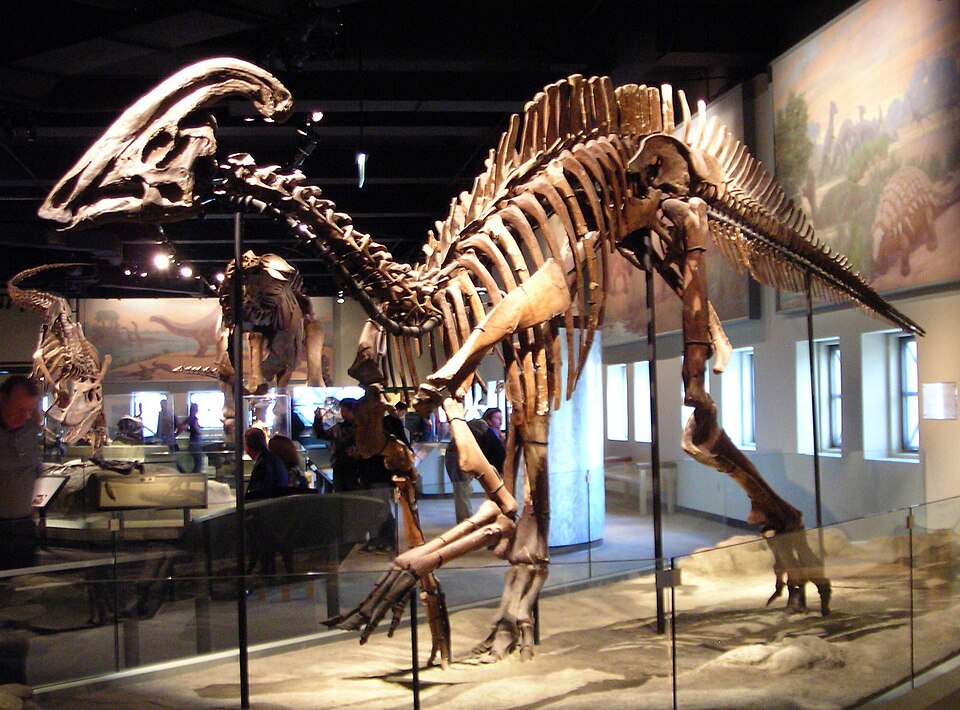

In 1975, James Hopson proposed that hadrosaurid cranial crests served primarily as visual and acoustical display structures functioning as premating isolating mechanisms—signals that allowed individuals to identify and attract conspecific mates in environments where multiple closely related hadrosaurid species coexisted.8 Hopson tested five predictions of this hypothesis: that hadrosaurs had well-developed eyes and ears; that external crest features varied independently of internal structure; that crest variation was species-specific and sexually dimorphic; that crest distinctiveness correlated with species diversity; and that crests tended to increase in size through time. All five predictions were broadly supported by the available evidence.8
David Weishampel extended Hopson's acoustic hypothesis in a landmark 1981 study that subjected the internal nasal cavities of lambeosaurine crests to formal acoustic analysis.5 Weishampel demonstrated that the elongated, looping nasal passages within the crests of Parasaurolophus were structurally analogous to the tube of a crumhorn, a medieval woodwind instrument, and were fully capable of producing resonant sounds. He estimated that adult Parasaurolophus could have generated tones ranging from approximately 55 to 720 hertz—low-frequency sounds that would have propagated effectively over long distances through the forested environments these animals inhabited.5 Critically, the acoustic properties of the crest varied with ontogeny: juveniles, with their smaller and differently proportioned crests, would have produced higher-frequency calls that travelled shorter distances, while adults generated low-frequency honks audible over much wider areas, suggesting a sophisticated system of age-dependent vocal communication between parents and offspring.5
Subsequent CT-based studies of lambeosaurine endocranial anatomy by Evans and colleagues confirmed and refined Weishampel's acoustic model. Evans (2006) used computed tomography to reconstruct the internal nasal anatomy of multiple lambeosaurine species and demonstrated that a significant portion of the nasal cavity proper was located outside the crest cavities, with the primary olfactory region situated rostromedial to the orbits rather than within the crest itself.6 This finding argued against the hypothesis that crest evolution was driven by enhanced olfactory acuity and instead supported behavioral functions, particularly acoustic resonance for intraspecific communication, as the primary selective driver of crest elaboration.6 A follow-up study in 2009 examined endocasts of the brain and inner ear in four lambeosaurine taxa and found that the cochlea (the auditory portion of the inner ear) was elongated relative to that of other dinosaurs, emphasizing sensitivity to low-frequency sounds consistent with the hypothesized low-frequency calls produced by the crests.7 The plesiomorphically small olfactory bulbs further confirmed that olfactory enhancement played no causal role in crest evolution.7
Morphological innovation and body plan
Despite their spectacular cranial diversity, hadrosaurs were remarkably conservative in their postcranial anatomy. A comprehensive morphometric study by Stubbs and colleagues (2019) confirmed that hadrosauroid skull evolution was highly dynamic, with rapid and repeated bursts of morphological innovation, while the postcranial skeleton remained morphologically stable across the entire clade.14 The unique hadrosaurid jaw apparatus—including the dental battery, the predentary bone forming the lower beak, and the powerful jaw adductor musculature—evolved rapidly and then stabilized at the root of the clade, whereas the cranial crests continued to diversify in several independent bursts of rapid evolution throughout hadrosaurid history.14 Body-size change was ruled out as an important source of innovation; instead, the key evolutionary novelties were concentrated in the skull, particularly in the feeding apparatus and display structures.14
Hadrosaurs were large-bodied animals, typically ranging from 7 to 12 metres in length, though some species attained considerably greater dimensions. Shantungosaurus giganteus from the Late Cretaceous of Shandong Province, China, is the largest known hadrosaurid and among the largest ornithischian dinosaurs ever discovered, with estimated lengths of 15 to 17 metres and body masses of 13 to 16 tonnes.1 At the other end of the size spectrum, some insular hadrosauroids from the Late Cretaceous European archipelago were dwarfed relative to their continental relatives, a pattern consistent with the island rule observed in many modern and fossil vertebrate lineages.2
All hadrosaurs possessed the characteristic duck-bill—a broadly expanded, spatulate premaxilla covered in life by a keratinous rhamphotheca (beak sheath)—that gave the group its common name. This beak functioned as a cropping tool for gathering vegetation, which was then passed to the dental batteries for thorough mastication before swallowing.1, 3 Hadrosaurs were primarily bipedal or facultatively quadrupedal, capable of both bipedal locomotion and quadrupedal walking, with robust forelimbs bearing hoof-like unguals on the middle digits suggesting habitual use of all four limbs during slow-speed travel and foraging.1
Nesting colonies and parental care
The discovery of hadrosaurid nesting grounds in Montana in the late 1970s fundamentally transformed scientific understanding of dinosaurian reproductive behavior. In 1979, Jack Horner and Robert Makela described the first known hadrosaurid nest from the Two Medicine Formation near Choteau, Montana, containing a clutch of juvenile Maiasaura peeblesorum—the "good mother lizard"—that provided the first direct evidence of family structure in non-avian dinosaurs.9 The nests were bowl-shaped depressions in the earth, approximately two metres in diameter, containing 30 to 40 eggs arranged in a circular or spiral pattern. Remarkably, the nests were spaced approximately seven metres apart—less than the body length of an adult Maiasaura—a colonial nesting density comparable to that of modern seabird colonies and indicative of a high degree of social organization during the breeding season.9
Horner and Weishampel (1988) compared the skeletal development of embryonic Maiasaura with that of the contemporaneous troodontid theropod and found striking differences in the degree of limb bone ossification at hatching.16 Maiasaura hatchlings exhibited poorly ossified articular surfaces on their long bones, suggesting that they were incapable of independent locomotion immediately after hatching—a condition analogous to the altricial (helpless at birth) young of many modern birds and mammals. By contrast, the troodontid hatchlings had well-ossified limb bones, indicating precocial (mobile at birth) development.16 The altricial condition of Maiasaura hatchlings implied an extended period of parental care during which adults provisioned their nest-bound young with food, a behavioral inference supported by the presence of trampled eggshell fragments within the nests and the recovery of juvenile specimens with worn teeth, indicating that the young had been feeding in the nest for some time before departing.9, 16
The Maiasaura nesting grounds extend over an area of several square kilometres and preserve multiple nesting horizons in superimposed stratigraphic layers, indicating that the same locality was used as a colonial nesting site repeatedly over many generations—a pattern of site fidelity also observed in modern colonial nesting birds such as penguins and albatrosses.9
Growth biology and herding behavior
Bone histological studies of Maiasaura have produced the most detailed growth curve for any non-avian dinosaur. Horner, de Ricqlès, and Padian (2000) examined an ontogenetic series of tibiae spanning from nestling to adult and identified six distinct growth stages: early nestling, late nestling, early juvenile, late juvenile, sub-adult, and adult.10 The bone tissue of nestlings was composed of rapidly deposited woven-fibered bone indicative of extremely fast growth, with the nesting period lasting an estimated one to two months. Late juvenile size (approximately 3.5 metres) was attained in one to two years, and adult size was reached in six to eight years—a growth trajectory far more rapid than that of any living reptile and broadly comparable to that of large mammals.10
A subsequent large-sample population study by Woodward and colleagues (2015) examined 50 Maiasaura tibiae histologically—the largest histological sample for any dinosaur species—and refined these growth estimates further.11 The study determined that Maiasaura achieved a bone apposition rate of 86.4 micrometres per day, comparable to rates observed in rapidly growing modern birds. Individuals attained over half of their asymptotic tibial circumference within the first year of life and reached 36 percent of asymptotic body mass by their third year.11 The survivorship analysis was equally revealing: the first-year mortality rate was 89.9 percent, followed by a seven-year period of peak performance during which survivorship was highest, before mortality increased again in older adults—a life-history pattern strikingly similar to those of modern large mammals and consistent with the pressures of a gregarious lifestyle with high juvenile predation but enhanced adult survival through herd protection.11
Direct evidence for herding comes from monodominant bonebeds that preserve the remains of thousands of Maiasaura individuals in single catastrophic death assemblages. The largest of these bonebeds in the Two Medicine Formation contains an estimated 10,000 or more individuals of all ages, interpreted as the remains of an enormous herd killed by a volcanic ashfall or drought event.11 Similar monodominant bonebeds are known for other hadrosaurid species, including Edmontosaurus and Hypacrosaurus, indicating that gregarious behavior was widespread across the family rather than restricted to a single lineage.1
Growth stages and life-history milestones in Maiasaura peeblesorum10, 11
| Growth stage | Approximate age | Estimated body length | Key histological features |
|---|---|---|---|
| Early nestling | < 1 month | ~0.4 m | Woven-fibered bone, no growth marks |
| Late nestling | 1–2 months | ~0.6 m | Rapidly deposited fibrolamellar bone |
| Early juvenile | ~1 year | ~2 m | First annual growth mark (LAG) |
| Late juvenile | 1–2 years | ~3.5 m | Fibrolamellar bone, wider LAG spacing |
| Sub-adult | 3–5 years | ~6 m | Decelerating growth, closer LAG spacing |
| Adult | 6–8 years | ~9 m | External fundamental system (growth plateau) |
Skin impressions and soft-tissue preservation
Hadrosaurs possess the most extensive record of skin preservation of any dinosaur group. Fossil skin impressions have been documented for approximately one-third of all described hadrosaurid species, far exceeding the integumentary record of any other dinosaur family.13 These impressions reveal that hadrosaur skin was covered by a mosaic of non-overlapping, polygonal scales of varying sizes, organized into distinct regional patterns across the body. Larger, conical or tuberculate scales were typically concentrated along the dorsal midline and tail, while smaller, flatter, pavement-like scales covered the flanks and ventral surfaces.13
Bell (2012) demonstrated for the first time that soft-tissue anatomy could be used to distinguish hadrosaurid species. In a comparative study of skin impressions from two species of Saurolophus—S. osborni from Canada and S. angustirostris from Mongolia—Bell showed that the two species, previously validated on osteological grounds alone, could be differentiated based solely on scale shape and pattern.13 This finding established that integumentary morphology carried taxonomically useful information in hadrosaurs, just as pelage patterns and skin textures differ among closely related species of modern mammals and reptiles.13
The most spectacular example of hadrosaurid soft-tissue preservation is the specimen known as "Dakota," an Edmontosaurus from the Hell Creek Formation of North Dakota that preserves three-dimensional, mineralized soft tissues including skin envelope, tendons, and ungual sheaths.12 Studied in detail by Manning and colleagues (2009), Dakota retains soft-tissue replacement structures in which mineral cements precipitated within the original cell boundaries of the epidermis, partially preserving the microstructure of the skin at a cellular level. Fourier transform infrared spectroscopy (FTIR) detected the presence of compounds containing amide functional groups, characteristic of proteins, within the fossilized skin and ungual phalanx.12 The three-dimensional preservation of Dakota's body envelope allowed researchers to estimate the volume and mass of the living animal more precisely than is possible from skeletal remains alone, yielding estimates that suggest hadrosaurs carried more muscle mass in the hindquarters and tail than previously assumed.12
Global distribution and Late Cretaceous dominance
Hadrosaurs achieved a remarkably broad geographic distribution during the Late Cretaceous, with fossil occurrences documented on every continent except Australia.1, 2 Dispersal-vicariance analysis by Prieto-Márquez (2010) reconstructed the biogeographic history of the clade and concluded that Hadrosauridae originated in North America during the Santonian stage, approximately 85 million years ago, and rapidly dispersed to Asia across the Bering land bridge no later than the Late Santonian.2 The most recent common ancestor of the two major hadrosaurid subclades (Saurolophinae and Lambeosaurinae) was inferred to have been widespread across both North America and Asia, with subsequent vicariance driving the initial divergence of the two subfamilies: saurolophines diversified primarily in North America while lambeosaurines initially radiated in Asia before dispersing back to North America.2
From these Northern Hemisphere centers of origin, hadrosaurs subsequently colonized more distant landmasses. They reached South America via dispersal no later than the late Campanian, with kritosaurin saurolophines such as Secernosaurus documented from Argentine Patagonia, establishing that hadrosaurs crossed the marine barrier between North and South America well before the formation of a continuous land connection in the Cenozoic.2 In Europe, which during the Late Cretaceous consisted of an archipelago of islands surrounded by shallow epicontinental seas, hadrosauroids including both non-hadrosaurid forms such as Telmatosaurus and true lambeosaurines colonized multiple island platforms.2 Hadrosaur remains have also been reported from Africa and Antarctica, confirming the near-global scope of the family's distribution by the end of the Cretaceous.2
In North America, hadrosaurs were the numerically dominant large herbivores in many Late Cretaceous ecosystems. In the well-sampled Dinosaur Park Formation of Alberta, Canada (late Campanian, approximately 76.5 to 75 million years ago), hadrosaurs comprised a substantial proportion of the megaherbivore fauna, coexisting with ceratopsians, ankylosaurs, and sauropods.15 Mallon (2019) conducted a meta-analysis of 21 ecomorphological variables across 14 megaherbivorous dinosaur genera from this formation and found that the pattern of taxon separation in ecomorphospace was persistent through the approximately 1.5-million-year span of the formation despite continual species turnover, indicating that interspecific competition was a long-term structuring force in these communities.15 Hadrosaurs and ceratopsids partitioned resources through differences in feeding height, oral processing mechanics, and probable habitat preference: hadrosaurs, with their taller bodies and higher feeding envelopes, exploited vegetation at greater heights than the low-browsing ceratopsids, while their grinding dental batteries processed food differently from the shearing dentitions of ceratopsian jaws.15
Ecological role as the cows of the Cretaceous
Hadrosaurs have been characterized as the "cows of the Cretaceous" for good reason: they were large-bodied, gregarious herbivores that occurred in enormous populations and likely exerted a profound influence on the structure and composition of Late Cretaceous plant communities.11, 15 The combination of their efficient dental batteries, rapid growth rates, high reproductive output (clutches of 30 to 40 eggs), colonial nesting behavior, and herding habits created a life-history strategy broadly analogous to that of modern migratory ungulates such as wildebeest and caribou, which similarly occur in vast herds, breed colonially, grow rapidly, and experience high juvenile mortality offset by enhanced adult survival.9, 11
The ecological impact of hadrosaur herds on Late Cretaceous landscapes was likely substantial. Herds numbering in the thousands, as documented by the Maiasaura bonebeds, would have consumed enormous quantities of vegetation daily, potentially maintaining open habitat structure through sustained browsing pressure in a manner analogous to the role of large mammalian herbivore herds in modern savannas and grasslands.11 Their dental batteries equipped them to process the toughest available plant material, including conifers, ferns, and the increasingly abundant angiosperms (flowering plants) that were diversifying throughout the Late Cretaceous.3, 4
Hadrosaurs also served as the primary prey base for the large theropod predators of their ecosystems. In the Two Medicine Formation, Maiasaura herds coexisted with the tyrannosaurid Daspletosaurus, while in the Hell Creek Formation, Edmontosaurus was among the chief prey species of Tyrannosaurus rex.15 The trophic coupling between enormous hadrosaur populations and apex theropod predators would have formed the energetic backbone of Late Cretaceous terrestrial food webs across much of the Northern Hemisphere.15
Extinction
All hadrosaurs perished in the end-Cretaceous mass extinction approximately 66 million years ago, along with all other non-avian dinosaurs.1 The fossil record of the latest Maastrichtian indicates that hadrosaurs remained diverse and abundant in the final million years before the extinction event. In the Hell Creek Formation of western North America, Edmontosaurus annectens was one of the most commonly preserved large dinosaurs right up to the Cretaceous–Paleogene boundary, and multiple hadrosaurid species are known from latest Cretaceous deposits on multiple continents, arguing against a gradual decline of the clade prior to its abrupt termination.1, 2
The persistence of diverse, abundant hadrosaur populations until the very end of the Cretaceous is consistent with the catastrophic extinction scenario linked to the Chicxulub asteroid impact and its cascading environmental effects, which would have devastated the photosynthetic base of terrestrial food webs and collapsed the herbivore populations that depended upon it.1 The loss of hadrosaurs eliminated the dominant large-bodied herbivore guild from terrestrial ecosystems worldwide. No ecological equivalent—gregarious, fast-growing, dentally specialized megaherbivores occurring in vast herds—would evolve again until the adaptive radiation of ungulate mammals tens of millions of years later during the Cenozoic, underscoring the irreplaceable ecological role that hadrosaurs played in the final chapter of the Mesozoic Era.14, 15
References
Global phylogeny of Hadrosauridae (Dinosauria: Ornithopoda) using parsimony and Bayesian methods
Acoustic analyses of potential vocalization in lambeosaurine dinosaurs (Reptilia: Ornithischia)
Endocranial anatomy of lambeosaurine hadrosaurids (Dinosauria: Ornithischia): a sensorineural perspective on cranial crest function
Long bone histology of the hadrosaurid dinosaur Maiasaura peeblesorum: growth dynamics and physiology based on an ontogenetic series of skeletal elements
Maiasaura, a model organism for extinct vertebrate population biology: a large sample statistical assessment of growth dynamics and survivorship
Mineralized soft-tissue structure and chemistry in a mummified hadrosaur from the Hell Creek Formation, North Dakota (USA)
Standardized terminology and potential taxonomic utility for hadrosaurid skin impressions: a case study for Saurolophus from Canada and Mongolia