Overview
- Otodus megalodon was the largest shark and one of the largest marine predators in Earth's history, reaching an estimated maximum length of 15 to 20 meters and a mass of 50 to 100 tonnes, based on scaling from its fossilized teeth — which can exceed 17 centimeters in slant height.
- Isotopic evidence and modeling studies suggest megalodon may have been partially endothermic (warm-blooded), maintaining body temperatures significantly above ambient seawater, which would have given it the metabolic capacity for active predation on large marine mammals but also made it vulnerable to disruption of its caloric requirements during periods of oceanic cooling.
- Megalodon went extinct approximately 3.6 million years ago during the Pliocene, likely as a result of declining ocean temperatures, shrinking coastal nursery habitats, and reduced prey availability — not from competition with the great white shark, which occupied a different ecological niche.
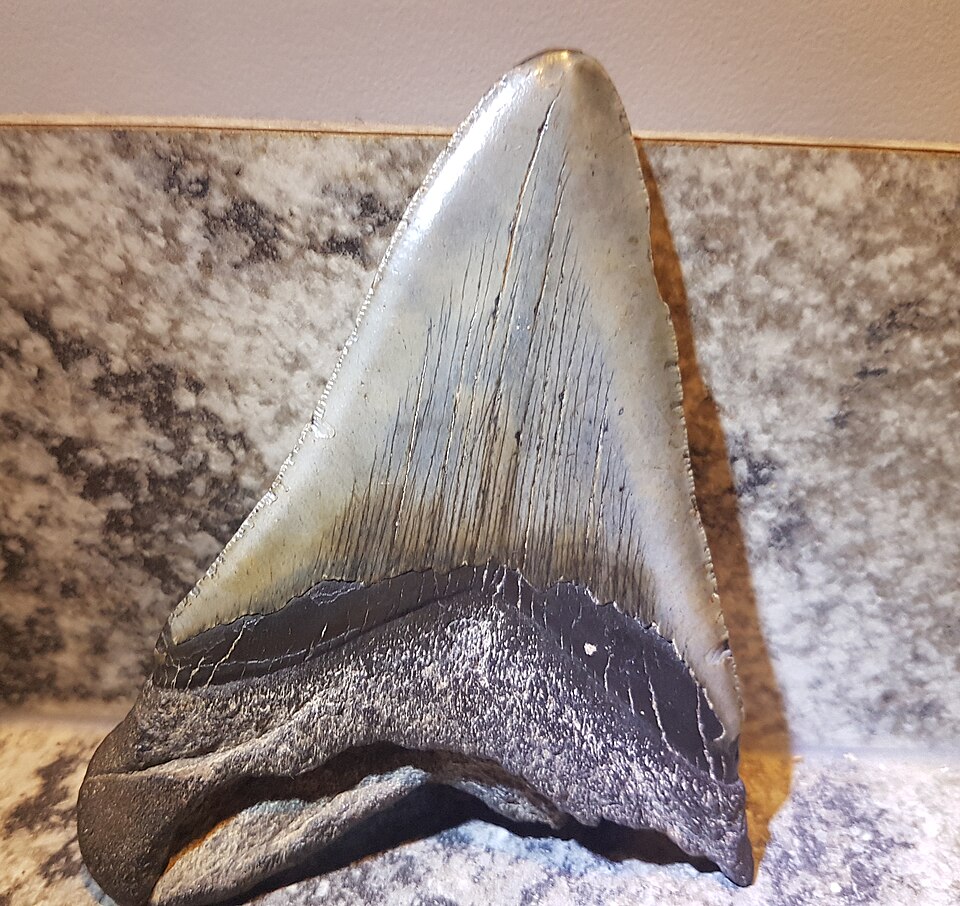
Otodus megalodon, commonly known as megalodon, was the largest shark and one of the most formidable marine predators in the history of life.1, 2 It lived from the early Miocene to the mid-Pliocene, approximately 23 to 3.6 million years ago, ranging across warm and temperate oceans worldwide before going extinct during a period of global oceanographic change.3, 4 Known primarily from its enormous teeth — which can exceed 17 centimeters in diagonal (slant) height — and from occasional finds of vertebral centra, megalodon's body has been reconstructed through scaling relationships with living lamniform sharks, yielding estimated maximum lengths of 15 to 20 meters and body masses potentially exceeding 50 tonnes.1, 2 Its evolutionary history, paleobiology, and extinction have generated intense scientific interest and considerable public fascination, though both have occasionally been muddied by sensationalized media claims about its possible survival, which have no basis in the fossil record.4

Taxonomy and evolutionary relationships
The taxonomic placement of megalodon has been debated for over a century. Early workers assigned it to the genus Carcharodon — the same genus as the extant great white shark (Carcharodon carcharias) — largely because both species possess large, triangular, serrated teeth.11 This classification implied a direct ancestor-descendant relationship between the two, a view that persisted in popular culture and some scientific literature through the twentieth century. However, detailed comparative study of dental morphology, particularly the presence of lateral cusplets in earlier members of the megatooth lineage and differences in enamel microstructure, has led most modern researchers to place megalodon in the extinct genus Otodus within the family Otodontidae, well separated from the great white shark's lineage within Lamnidae.11, 13
The otodontid lineage can be traced from Otodus obliquus in the Paleocene through a chronospecies sequence including Otodus angustidens in the Oligocene, culminating in O. megalodon in the Miocene.11 This evolutionary series shows a progressive increase in tooth size and the gradual loss of lateral cusplets, eventually producing the massive, triangular, cusplet-free teeth characteristic of megalodon. The great white shark, by contrast, evolved from a separate lineage of mako-like sharks (genus Isurus) and independently acquired its serrated, triangular teeth through convergent evolution — a classic example of how similar ecological pressures can produce superficially similar morphologies in distantly related organisms.13, 8
Body size and reconstruction
Because shark skeletons are composed primarily of cartilage, which rarely fossilizes, the body dimensions of megalodon must be estimated indirectly from the preserved hard tissues: teeth and occasional vertebral centra.1 The most widely used method extrapolates total body length from the relationship between tooth crown height and body size in living lamniform sharks, particularly the great white. Using this approach, Shimada estimated a maximum total length of approximately 14.2 to 15.3 meters, though he cautioned that extrapolation beyond the size range of living analogs introduces substantial uncertainty.2 Cooper and colleagues employed a different strategy in 2020, constructing a two-dimensional reconstruction of the entire body based on the proportions of five living lamniform species scaled to match the dentition and a vertebral column from a single large individual, obtaining maximum length estimates of approximately 16 meters with plausible upper bounds near 20 meters.1
Regardless of the precise methodology, all modern estimates converge on a shark far larger than any living species. For comparison, the largest confirmed great whites measure approximately six meters, and the largest living fish, the whale shark (Rhincodon typus), reaches 12 to 13 meters but is a filter feeder. Megalodon was not only longer but far more massive than either, with a deep-bodied, robust build suggesting a weight of 50 to over 100 tonnes depending on the length and girth assumed.1 Bite force modeling by Wroe and colleagues estimated that megalodon could exert a maximum bite force of approximately 108,500 to 182,200 newtons, the most powerful bite of any animal known, living or extinct.16
Paleobiology and warm-bloodedness
Megalodon inhabited warm to temperate oceans globally, with fossil teeth recovered from every continent except Antarctica.15 Isotopic analysis of its geographic distribution and the oxygen isotope composition of its tooth enamel suggests a preference for waters in the range of 12 to 27 degrees Celsius, with a concentration of records in subtropical and warm-temperate coastal zones.15, 6
Two landmark studies published in 2023 provided strong evidence that megalodon was at least partially endothermic — capable of maintaining a body temperature substantially above ambient water temperature. Robert and colleagues analyzed the clumped isotope composition of megalodon tooth enameloid and concluded that the shark's body temperature was approximately 7 degrees Celsius warmer than co-occurring fish, consistent with regional endothermy similar to that observed in living lamnid sharks such as the great white and mako.6 Griffiths and colleagues independently reached a comparable conclusion using a different isotopic proxy, estimating megalodon body temperatures around 27 degrees Celsius even when inhabiting waters considerably cooler than that.7 This capacity for elevated body temperature would have conferred significant advantages — faster swimming speeds, greater sustained metabolic output, and the ability to range into cooler waters — but it also imposed a steep caloric cost, requiring megalodon to consume substantially more food than an equivalently sized ectothermic shark.6, 7
The diet of megalodon included marine mammals, particularly baleen whales, as evidenced by bite marks and associated tooth fragments found on cetacean bones.10, 5 Pimiento and colleagues documented ontogenetic and geographic dietary shifts, with juveniles apparently feeding on smaller prey such as fish and sea turtles in warm, shallow nursery areas while adults targeted larger marine mammals in open waters.5 Fossil evidence of nursery areas — sites with concentrations of juvenile megalodon teeth — has been identified in Panama, the eastern United States, and elsewhere, suggesting a reproductive strategy similar to that of many modern sharks, in which young are born in protected nearshore environments.9
Extinction
Megalodon disappeared from the fossil record approximately 3.6 million years ago, during the Pliocene epoch, in what Pimiento and colleagues determined through an optimal linear estimation analysis of its final occurrence data.4 The extinction coincided with a period of significant global cooling, declining sea levels, and the reorganization of ocean circulation patterns associated with the closure of the Central American Seaway and the intensification of Northern Hemisphere glaciation.3, 14
Several interacting causes have been proposed. First, the cooling of ocean temperatures during the late Miocene and Pliocene would have reduced the geographic extent of the warm coastal habitats megalodon favored and may have been particularly detrimental to nursery areas in shallow, warm-water zones.3, 12 Second, the high metabolic costs of endothermy meant that megalodon required a large and reliable prey base; the restructuring of marine mammal communities during this interval — including the decline of some small cetacean lineages and the evolution of faster, more agile baleen whales — may have reduced prey availability below the threshold required to sustain such an energetically demanding predator.6, 12 Third, the evolution and diversification of the great white shark during the Pliocene has sometimes been cited as a competitive factor, though the two species likely occupied different ecological niches — megalodon targeting larger prey — and the temporal overlap between them was substantial, suggesting that competition alone was insufficient to drive extinction.13, 3
The most parsimonious explanation integrates these factors: a combination of oceanic cooling, habitat loss, and prey-base disruption overwhelmed the physiological and ecological tolerances of a warm-water apex predator with exceptionally high caloric demands.12, 14 The disappearance of megalodon was part of a broader pattern of marine vertebrate diversity loss during the Pliocene that also affected many other large marine animals, suggesting that the causes were systemic rather than specific to any single species.14
The fossil record and popular culture
Megalodon teeth are among the most commonly encountered marine vertebrate fossils, in part because each individual shark produced and shed thousands of teeth over its lifetime and because the enameloid that covers each tooth is highly resistant to dissolution and abrasion.2 Teeth have been collected from Miocene and Pliocene marine sediments on every inhabited continent, and they are especially abundant in phosphate-rich deposits such as those of the Atlantic Coastal Plain of the United States, the Pisco Formation of Peru, and the Bone Valley Formation of Florida.3, 15 Vertebral centra, though far rarer, have been found at a few sites; the most notable is a partial vertebral column from Belgium comprising approximately 150 centra from a single individual, with the largest centrum measuring about 15.5 centimeters in diameter.1
The dramatic size and photogenic quality of megalodon teeth have made this species one of the most publicly recognizable of all extinct megafauna, but the intense popular interest has also generated persistent misinformation. Television programs and social media posts periodically claim that megalodon may still survive in the deep ocean, but there is no credible evidence for this proposition: the species has no verified occurrence younger than 3.6 million years, modern deep-ocean environments bear no resemblance to the warm coastal habitats megalodon required, and the extensive monitoring of global shark populations through fisheries bycatch, satellite tagging, and environmental DNA sampling has yielded no trace of any surviving megatoothed shark.4, 12 Megalodon is, by every measure available to paleontology, unambiguously extinct.
References
Body length estimation of Neogene macrophagous lamniform sharks (Carcharodon and Otodus) derived from associated fossil dentitions
The Early Pliocene extinction of the mega-toothed shark Otodus megalodon: a view from the eastern North Pacific
Endothermy in the megatooth shark Otodus megalodon inferred from oxygen isotopes of fossil tooth enamel
The megatooth shark Otodus megalodon (Lamniformes: Otodontidae), a thermophysiological apex predator of Neogene oceans
The extinction of the megatoothed shark Otodus megalodon: preliminary tests of hypotheses
Ancient DNA reveals that the giant megatooth shark (Otodus megalodon) was not closely related to the great white shark (Carcharodon carcharias)
The largest known mackerel shark, Otodus megalodon (Lamniformes: Otodontidae), lived in warm waters