Overview
- The Devonian period (419–359 million years ago), often called the Age of Fishes, witnessed the greatest diversification of vertebrate body plans in Earth's history, with armored placoderms, acanthodians, chondrichthyans, actinopterygians, and sarcopterygians all radiating into marine and freshwater ecosystems simultaneously.
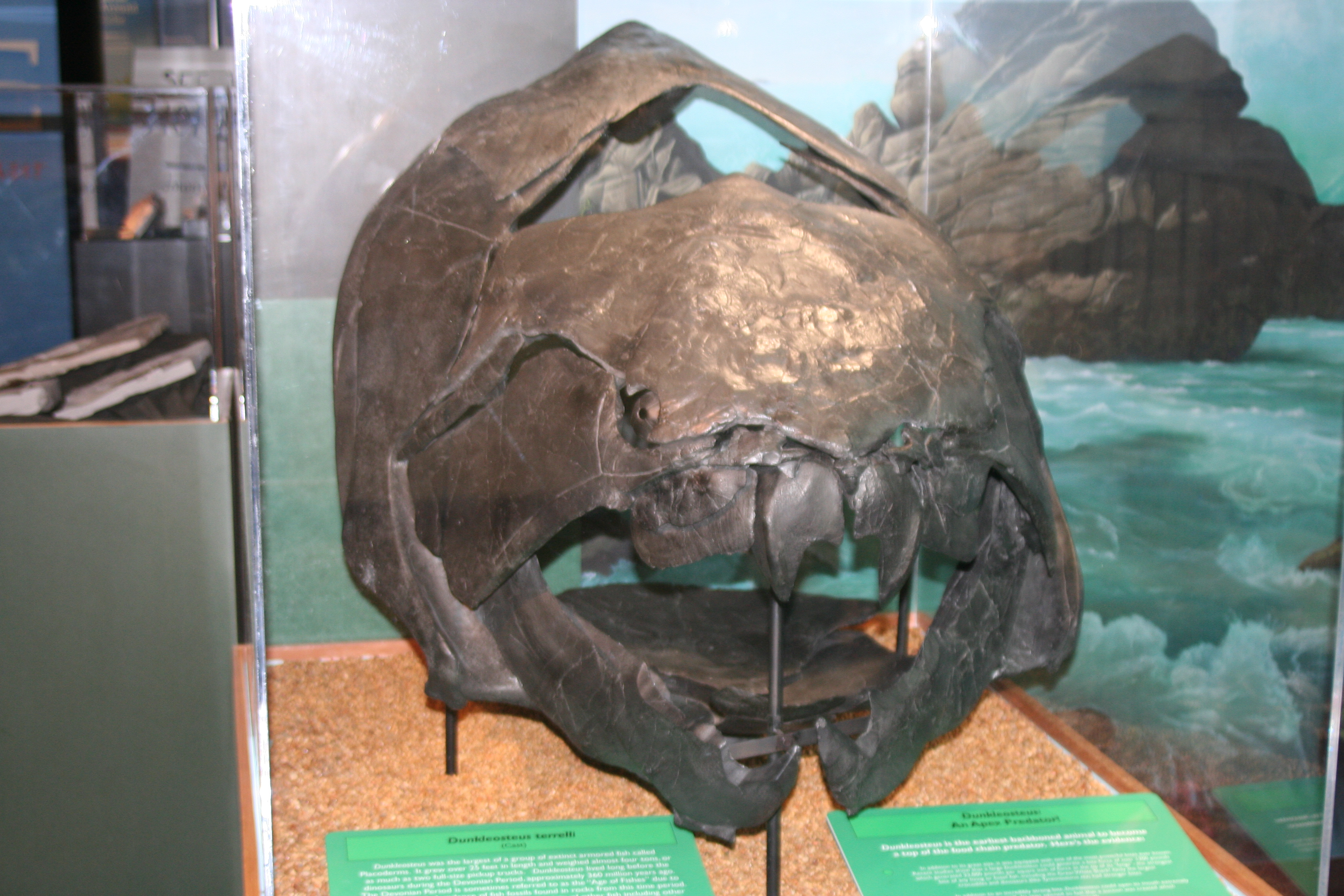
- Placoderms, the dominant vertebrates of the Devonian, evolved forms ranging from the ten-meter apex predator Dunkleosteus to tiny bottom-dwelling antiarchs, and their extinction at the end-Devonian removal of this entire class opened ecological space that jawed fishes of modern lineages subsequently filled.
- The sarcopterygian (lobe-finned) fishes of the Devonian gave rise to tetrapods, with transitional forms such as Tiktaalik and Acanthostega documenting the gradual evolution of weight-bearing limbs, air breathing, and terrestrial locomotion from fully aquatic ancestors.
The Devonian period, spanning from 419 to 359 million years ago, is widely known as the Age of Fishes for the extraordinary diversification of jawed and jawless vertebrates that dominated its marine, brackish, and freshwater environments.1, 16 During these sixty million years, every major group of fishes either originated or underwent explosive radiation: armored placoderms achieved global dominance as the period's apex predators, sharks and their relatives established the chondrichthyan body plan that persists today, ray-finned fishes began their ascent toward becoming the most species-rich vertebrate lineage, and lobe-finned fishes produced the ancestors of all land vertebrates.1, 2
The Devonian fish fauna is preserved in exceptional fossil localities across every continent, from the Gogo Formation of Western Australia to the red sandstones of Scotland and the Cleveland Shale of Ohio, providing a detailed record of vertebrate evolution at a pivotal moment when jawed fishes were replacing jawless forms and the first tetrapods were beginning to emerge onto land.1, 7
Jawless fishes and the Devonian transition
At the opening of the Devonian, jawless vertebrates—ostracoderms in the broadest sense—still constituted a significant component of aquatic faunas, though their diversity was already declining from a Silurian peak.1 Groups such as the heterostracans, osteostracans, and thelodonts occupied a range of ecological niches as bottom-feeding detritivores and filter feeders in marine and freshwater settings, their bodies encased in bony shields or covered in minute scales that provided protection but limited maneuverability.1, 2 By the Late Devonian, nearly all armored jawless fish groups had gone extinct, outcompeted and ecologically displaced by the increasingly diverse jawed fishes that combined mobile jaws with paired fins for superior feeding efficiency and locomotor control.2
The transition from jawless to jaw-bearing vertebrate dominance is one of the most consequential ecological shifts in vertebrate history. The evolution of jaws from gill arch elements, first proposed by Karl Gegenbaur in the nineteenth century and supported by developmental and paleontological evidence, opened fundamentally new feeding strategies—biting, crushing, suction—that jawless fishes could not match.2 Lampreys and hagfishes, the only jawless vertebrates to survive to the present, represent highly specialized lineages that diverged before the evolution of jaws and persisted by occupying parasitic and scavenging niches unavailable to most jawed fishes.1

Placoderms: the armored rulers
Placoderms (class Placodermi) were the most diverse and ecologically dominant vertebrates of the Devonian, comprising an estimated 300 to 400 genera that occupied nearly every aquatic habitat from shallow tropical reefs to deep ocean basins.8, 1 Their defining feature was a dermal skeleton of interlocking bony plates covering the head and anterior trunk, connected by a craniothoracic joint that allowed the head shield to rotate upward during jaw opening—a unique mechanism among vertebrates.8, 9
The arthrodires, the largest placoderm order, included both small generalist predators and the massive dunkleosteids that reached body lengths of up to ten meters.9 Dunkleosteus terrelli, from the Late Devonian Cleveland Shale of Ohio, possessed self-sharpening bone blades instead of teeth, capable of generating bite forces estimated at over 6,000 newtons—among the most powerful of any fish, living or extinct.9, 1 At the opposite extreme, antiarchs such as Bothriolepis were small, heavily armored bottom-dwellers with jointed pectoral appendages that may have assisted in "walking" along substrates, prefiguring (though not ancestral to) the limbed locomotion of later tetrapods.5
Placoderms also hold significance for the evolution of vertebrate reproduction. The discovery of embryos preserved inside specimens of the Late Devonian placoderm Materpiscis attenboroughi from the Gogo Formation demonstrated that some placoderms were viviparous—giving birth to live young—pushing back the earliest evidence of internal fertilization in vertebrates by approximately 200 million years.14 This discovery implied that intromittent organs (clasper-like structures) evolved early in gnathostome history and may have been lost in some lineages rather than independently evolved in sharks and certain bony fishes.14, 2
Chondrichthyans: sharks, rays, and their relatives
The Chondrichthyes—cartilaginous fishes including sharks, rays, skates, and chimaeras—first appeared in the fossil record during the Late Ordovician as isolated scales, but it was during the Devonian that the group underwent its first major diversification.11, 12 The oldest known shark with a well-preserved body fossil, Doliodus problematicus from the Early Devonian of New Brunswick, Canada, possessed both fin spines characteristic of "acanthodian" grade fishes and the tooth morphology of true sharks, suggesting that early chondrichthyans retained a mosaic of primitive and derived features.12
By the Late Devonian, sharks had diversified into several distinct body forms. Cladoselache, from the Cleveland Shale, was a streamlined, fast-swimming predator reaching about two meters in length, with a broadly forked tail and large pectoral fins but no claspers, suggesting that not all early sharks employed internal fertilization.1, 11 Stethacanthus, from the same deposits, bore a bizarre anvil-shaped dorsal fin capped with denticles, whose function remains debated but may have been involved in sexual display or species recognition.1 The extinction of placoderms at the end of the Devonian opened apex predator niches that chondrichthyans would increasingly fill during the Carboniferous, eventually producing large predators such as the Permian Helicoprion with its spiral tooth whorl.10, 11
Acanthodians: the "spiny sharks"
Acanthodians, sometimes called "spiny sharks" despite being more closely related to bony fishes than to true sharks, were small, streamlined fishes characterized by stout spines supporting most of their fins and a covering of small, closely fitting scales.1, 2 First appearing in the Late Ordovician, acanthodians reached their greatest diversity during the Early Devonian and persisted into the Early Permian, making them the longest-ranging group of early jawed vertebrates.2
The phylogenetic position of acanthodians has been radically revised by recent cladistic analyses, which demonstrate that "Acanthodii" is not a natural group (monophyletic clade) but rather a grade of stem gnathostomes, with some acanthodian lineages falling closer to chondrichthyans and others closer to osteichthyans (bony fishes).2 This reinterpretation has transformed acanthodians from an evolutionary dead end into key evidence for understanding the ancestral condition of all jawed vertebrates, suggesting that the common ancestor of sharks and bony fishes may have been a small, spiny, acanthodian-like fish rather than either a shark-like or bony-fish-like form.2, 4
Ray-finned fishes: the early actinopterygians
The Actinopterygii, or ray-finned fishes, are today the most species-rich vertebrate group, comprising over 30,000 living species—more than half of all living vertebrates—but during the Devonian they were a relatively minor component of fish faunas, vastly outnumbered by placoderms and lobe-finned fishes.1, 2 Early actinopterygians such as Cheirolepis from the Middle Devonian of Scotland were small, fast-swimming predators with large eyes, gaping mouths, and fins supported by slender bony rays rather than the fleshy lobes characteristic of sarcopterygians.1
Despite their modest Devonian diversity, ray-finned fishes possessed anatomical features—lightweight scales, flexible fins, efficient jaw mechanics—that would prove advantageous in the long term.1 The end-Devonian extinction events, which eliminated placoderms and drastically reduced sarcopterygian diversity, opened ecological opportunities that actinopterygians exploited during the Carboniferous and Permian, beginning the radiation that would eventually make them the dominant vertebrates in aquatic ecosystems worldwide.10, 15
Major Devonian fish groups and approximate peak generic diversity1, 10
Lobe-finned fishes and tetrapod origins
The Sarcopterygii, or lobe-finned fishes, are represented today by only eight living species—six lungfishes and two coelacanths—but during the Devonian they constituted a diverse and ecologically important group that included the ancestors of all land vertebrates.13, 3 Sarcopterygians are characterized by fleshy, muscular fins supported by an internal bony skeleton that is homologous with the limb bones of tetrapods, a feature that proved critical for the eventual transition from water to land.7
The Devonian sarcopterygian radiation produced several major lineages. Lungfishes (Dipnoi) diversified extensively in the Early and Middle Devonian, with some forms developing the ability to breathe air using vascularized swim bladders modified as lungs, an adaptation to seasonally anoxic freshwater habitats.13 The rhizodont sarcopterygians, including Rhizodus hibberti from the Carboniferous (which originated in the Late Devonian), grew to lengths exceeding six meters and were among the largest freshwater predators of the Paleozoic.1 The elpistostegalians, a group of sarcopterygians more closely related to tetrapods than to other fishes, included Panderichthys, Tiktaalik, and Elpistostege, which displayed progressively more tetrapod-like features including flattened heads, dorsally placed eyes, reduced gill covers, and fins with internal skeletal elements corresponding to the humerus, radius, and ulna of tetrapod forelimbs.6, 7
Tiktaalik roseae, discovered in 2004 in Late Devonian sediments of Ellesmere Island in the Canadian Arctic, is among the most informative transitional fossils between fishes and tetrapods. It possessed fish-like scales and fins but also a mobile neck, a flat crocodile-like skull, and robust pectoral fins capable of supporting the body in a push-up position, suggesting it could prop itself up in shallow water or on mudflats.6 Together with the slightly more derived Acanthostega and Ichthyostega from the Late Devonian of Greenland, which possessed limbs with digits but retained fish-like internal gills and tail fins, these transitional forms document the incremental assembly of the tetrapod body plan from sarcopterygian fish ancestors.7
End-Devonian extinction and its aftermath
The Late Devonian witnessed a series of extinction pulses, particularly the Frasnian–Famennian boundary event (c. 372 Ma) and the end-Famennian Hangenberg Crisis (c. 359 Ma), which collectively eliminated approximately 70% of marine invertebrate species and fundamentally restructured vertebrate communities.10 Placoderms, which had dominated Devonian seas for over 50 million years, were entirely eliminated by the Hangenberg event, as were most acanthodians and many sarcopterygian lineages.10, 15
Analysis of body-size patterns across the Devonian–Carboniferous boundary reveals a striking "Lilliput effect": surviving vertebrate lineages experienced significant body-size reduction following the extinction, with median vertebrate body size declining by approximately 50% and not recovering for tens of millions of years.15 The extinction preferentially removed large-bodied taxa across all vertebrate groups, effectively resetting vertebrate ecosystems and opening ecological space for the subsequent Carboniferous radiation of chondrichthyans and actinopterygians.10, 15
The causes of the Late Devonian extinctions remain debated, with proposed mechanisms including global anoxia driven by the expansion of land plants (whose root systems enhanced rock weathering and nutrient runoff into oceans), bolide impacts, volcanic activity, and rapid climatic fluctuations.10, 16 The spread of forests during the Devonian, by stabilizing soils and altering hydrological cycles, may have fundamentally changed the chemistry of rivers and coastal waters in ways that stressed marine ecosystems already under pressure from other environmental changes.16
Significance for vertebrate evolution
The Devonian fish radiation represents a formative chapter in vertebrate history, during which the basic body plans of all modern fish groups were established, the transition from water to land began, and the ecological dynamics of vertebrate communities first assumed recognizable form.1, 2 The period demonstrates how evolutionary innovation—jaws, paired fins, internal fertilization, air breathing, weight-bearing limbs—can arise in rapid succession when ecological opportunity coincides with developmental possibility.2, 7
Exceptional fossil preservation at sites such as the Gogo Formation, where three-dimensional, acid-prepared specimens preserve muscle tissue, nerve canals, and embryos, has made Devonian fishes among the best-understood vertebrates of any geological period.1, 14 Ongoing discoveries continue to reshape understanding of early vertebrate phylogeny. The recognition that placoderms may be paraphyletic rather than monophyletic, with some lineages more closely related to living jawed vertebrates than to other placoderms, has transformed the group from an extinct side branch into potential ancestors of modern gnathostome diversity.2 Similarly, the reclassification of acanthodians as stem gnathostomes rather than a unified clade has revised understanding of what the common ancestor of all jawed vertebrates may have looked like.2, 4
References
A Devonian predatory fish provides insights into the early evolution of modern sarcopterygians