Overview
- Opabinia regalis is a Cambrian marine animal from the Burgess Shale of British Columbia, approximately 508 million years old, famous for its five stalked eyes, a forward-facing flexible proboscis ending in a grasping claw, fifteen pairs of lateral lobes, and a fan-shaped tail—a body plan so unlike any living animal that its reconstruction provoked laughter at a 1972 paleontology meeting.
- Originally described by Charles Walcott in 1912 and spectacularly reinterpreted by Harry Whittington in 1975, Opabinia became a symbol of Cambrian 'weird wonders' through Stephen Jay Gould's Wonderful Life and was central to debates about the disparity of early animal body plans.
- Phylogenetic analyses consistently place Opabinia as a stem-group arthropod, positioned outside crown-group Euarthropoda but closely related to the radiodonts (Anomalocaris and allies), making it a key taxon for understanding the assembly of the arthropod body plan during the Cambrian explosion.
Opabinia regalis is an extinct marine animal from the Middle Cambrian Burgess Shale of British Columbia, Canada, approximately 508 million years old, and one of the most morphologically distinctive organisms in the entire fossil record. With five stalked compound eyes, a flexible forward-projecting proboscis tipped with a grasping claw, fifteen pairs of lateral body lobes, and a fan-shaped tail, Opabinia combines features not found together in any living or other known fossil animal.2, 3 Its bizarre anatomy made it a symbol of the strangeness of Cambrian life and a central figure in debates about the origins and early diversification of animal body plans. Phylogenetically, Opabinia is consistently recovered as a stem-group arthropod—outside the crown group that includes all living insects, crustaceans, chelicerates, and myriapods—making it a key taxon for understanding how the arthropod body plan was assembled during the Cambrian explosion.5, 6, 11
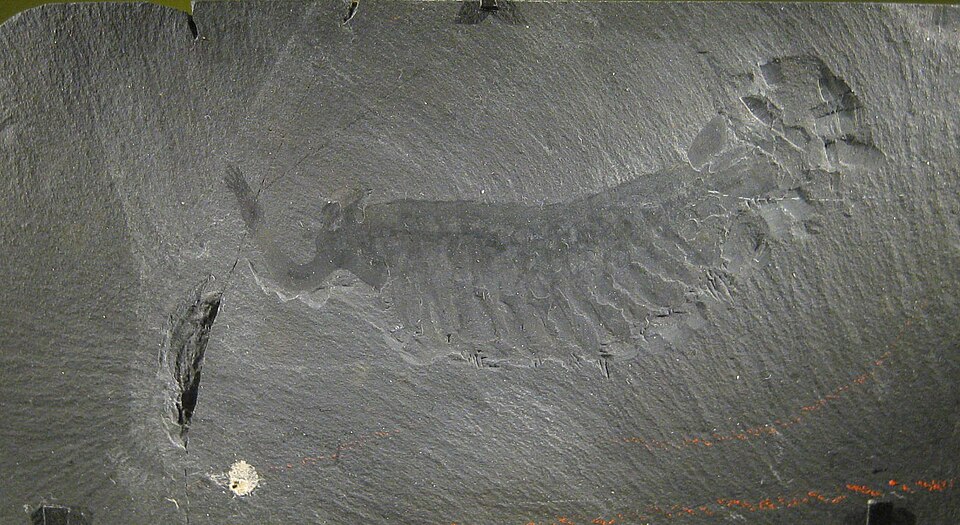

Discovery and early description
The first specimens of Opabinia were collected by Charles Doolittle Walcott during his systematic excavation of the Burgess Shale between 1909 and 1917. Walcott described the genus in 1912, assigning it to the Crustacea on the basis of its segmented body and what he interpreted as biramous (two-branched) appendages, in keeping with his general practice of forcing Burgess Shale organisms into existing taxonomic categories.1 Walcott's description was brief and his illustrations were crude, and the true morphology of Opabinia would not be understood for over sixty years.1, 3
The modern understanding of Opabinia began with Harry Whittington's meticulous redescription, published in 1975 as part of the Geological Survey of Canada's systematic restudy of the Burgess Shale fauna. Whittington prepared specimens by carefully removing overlying rock matrix with fine needles under a binocular microscope, a painstaking technique that revealed anatomical details invisible to Walcott. The resulting reconstruction was radically different from anything Walcott had envisioned: an animal with five eyes arranged across the top of the head, a long flexible proboscis projecting forward from beneath the head and terminating in a claw-like structure, a body bearing fifteen pairs of lateral lobes but no jointed walking legs, and a tail composed of three pairs of overlapping blades arranged in a fan.2
The 1972 lecture
Before the formal publication of his monograph, Whittington presented his reconstruction of Opabinia at a meeting of the Palaeontological Association in Oxford in 1972. According to accounts later recorded by Stephen Jay Gould and Simon Conway Morris, the audience burst into laughter when Whittington projected his reconstruction slide—not out of disrespect, but because the animal was so improbable, so unlike anything in the existing zoological framework, that the assembled paleontologists found it genuinely funny.3, 8 The five-eyed, proboscis-bearing creature defied every expectation of what a Cambrian animal should look like, and the laughter became one of the most frequently retold anecdotes in the history of paleontology, symbolizing the moment when researchers realized that the Cambrian fauna was far stranger than anyone had imagined.3
Gould used this episode as a narrative centerpiece in Wonderful Life, his 1989 popular account of the Burgess Shale reinterpretation. For Gould, Opabinia exemplified the "weird wonders" of the Cambrian—organisms that could not be fitted into any modern phylum and that, in his view, demonstrated that the Cambrian explosion produced a far greater range of fundamental body plans than survives today.3 Gould argued that Opabinia and similar forms represented extinct phylum-level lineages whose disappearance was a matter of historical contingency rather than competitive inferiority. This interpretation, while influential in popularizing the Burgess Shale, was contested by Conway Morris and others, who argued that many of the "weird wonders" could in fact be accommodated within the stem lineages of existing phyla once their anatomy was properly understood.8
Body plan and morphology
The body of Opabinia was elongated, soft-bodied, and approximately 4–7 centimeters in length, small by the standards of Cambrian predators such as Anomalocaris but large relative to most Burgess Shale organisms.2 The body was divided into a series of segments, each bearing a pair of lateral lobes that extended outward and slightly downward from the body flanks. There were fifteen pairs of these lobes in total, and they are interpreted as gill-bearing swimming and respiratory structures, potentially functioning in a manner similar to the lateral flaps of radiodonts.2, 7
The head bore five eyes mounted on short stalks, arranged in a pattern that has no parallel in any other known organism. Two pairs were positioned laterally, and a single median eye was situated between them on top of the head.2 Whether all five eyes were functional compound eyes or whether some served different sensory roles remains uncertain, as the internal structure of the eyes is not preserved in sufficient detail to resolve their optical properties. Regardless, the presence of five eyes suggests a visual system of considerable complexity, appropriate for an organism actively navigating its environment.2, 3
The most distinctive feature was the proboscis: a flexible, annulated tube projecting forward and slightly downward from beneath the head, terminating in a grasping structure armed with spines that could be opened and closed.2 Whittington interpreted the proboscis as a feeding organ, used to capture food items from the seafloor or water column and convey them backward to the ventrally positioned mouth, which was located beneath the head at the posterior end of the proboscis base.2 The proboscis was not rigid; its annulated construction allowed bending and extension, and the terminal claw could apparently open and close to grasp objects.2
The tail consisted of three pairs of overlapping blade-like structures arranged in a fan, likely functioning as a stabilizer and possibly as a steering mechanism during swimming. The overall impression is of an animal that swam using undulating movements of its lateral lobes and used its proboscis to feed on small organisms or organic matter on or near the seafloor.2, 7
Phylogenetic position
The phylogenetic placement of Opabinia has been debated since Whittington's redescription, but a broad consensus has emerged from successive cladistic analyses. Opabinia is consistently recovered as a stem-group arthropod: it falls outside the crown group Euarthropoda (which includes all living arthropods and their last common ancestor) but within the broader total group that includes the evolutionary lineage leading to arthropods.5, 6, 11
Graham Budd's influential 1996 analysis of Opabinia's head anatomy and segmentation identified features that linked it to the arthropod lineage rather than to any other animal phylum. Budd argued that the proboscis of Opabinia was a modified appendage of the first head segment, homologous with the frontal appendages of radiodonts and ultimately with the labrum (upper lip) of euarthropods.7 This interpretation placed Opabinia on the arthropod stem lineage, between lobopodians (velvet worm relatives) on the one hand and radiodonts plus euarthropods on the other.7
David Legg, Mark Sutton, and Gregory Edgecombe's 2013 phylogenetic analysis, which included a comprehensive matrix of morphological characters scored across dozens of Cambrian and modern arthropod taxa, recovered Opabinia as the sister group to a clade comprising the Radiodonta (Anomalocaris, Hurdia, and allies) plus Deuteropoda (the clade containing all segmented-limb arthropods).5 Javier Ortega-Hernández's 2016 panarthropod phylogeny confirmed this general placement, with Opabinia occupying a position on the arthropod stem between the lobopodians and the radiodonts.6 Gregory Edgecombe's 2020 review of euarthropod origins synthesized these results, noting that the consensus placement of Opabinia as a stem arthropod more closely related to radiodonts than to lobopodians has proven stable across different analytical methods.11
This phylogenetic position makes Opabinia critically important for understanding the stepwise assembly of the arthropod body plan. Its lateral lobes without jointed legs, its proboscis without the paired frontal appendages of radiodonts, and its non-mineralized cuticle all represent intermediate character states between the simple body plan of lobopodians and the more complex, appendage-rich body plan of euarthropods.5, 6, 11
The "weird wonders" debate
Opabinia was the original "weird wonder" of the Burgess Shale, and the interpretation of its taxonomic status became entangled with a broader debate about the nature of the Cambrian explosion. Gould's argument in Wonderful Life was that the Cambrian produced a vastly greater diversity of fundamental body plans (disparity) than exists today, and that organisms like Opabinia represented extinct phyla with no descendants among living animals.3 On this view, the subsequent history of animal evolution was one of progressive pruning, in which most of the original Cambrian experiments were eliminated by extinction, leaving only the relatively few surviving phyla to diversify into the modern fauna.3
Conway Morris, who had himself contributed to the reinterpretation of many Burgess Shale organisms, challenged Gould's framing in The Crucible of Creation. He argued that many of the supposed weird wonders, including Opabinia, could be understood as stem-group members of extant phyla rather than representatives of entirely extinct body plans.8 If Opabinia is a stem-group arthropod—as the phylogenetic evidence now strongly supports—then it is not a representative of a "lost phylum" but rather an early, morphologically divergent member of the lineage that eventually gave rise to the most species-rich phylum on Earth.5, 8
The resolution of this debate has generally favored Conway Morris's position in the case of Opabinia and most other Burgess Shale taxa, though it has not diminished the significance of Cambrian disparity. The Cambrian explosion genuinely produced an extraordinary range of morphological variation within lineages, even if that variation can now be accommodated within the stem groups of living phyla rather than requiring new phylum-level categories. Opabinia remains a vivid illustration of how much morphological experimentation occurred during the initial radiation of animal body plans, and its strange anatomy continues to inform our understanding of the evolutionary transitions that gave rise to the arthropods.6, 11
Significance for arthropod evolution
The enduring scientific importance of Opabinia lies in what it reveals about the sequence of character acquisitions that produced the arthropod body plan. Euarthropods are characterized by a hardened exoskeleton, jointed appendages, compound eyes, and a segmented body with regionally specialized tagmata (head, thorax, abdomen). The question of how and in what order these features evolved is central to understanding the origins of the most diverse animal phylum.11
Opabinia demonstrates that several key arthropod features—compound eyes, a segmented body with distinct head and trunk regions, and laterally arranged locomotory/respiratory structures—were present in stem-group forms that had not yet evolved jointed legs or a mineralized exoskeleton.2, 5 The combination of arthropod-like segmentation with lobopod-like lateral lobes (rather than jointed legs) places Opabinia at a critical intermediate grade of organization, after the evolution of head specialization and complex eyes but before the evolution of true arthropodized limbs.6, 7
The relationship between Opabinia and the radiodonts is particularly informative. Radiodonts such as Anomalocaris and Hurdia share with Opabinia the possession of lateral body flaps and a pre-oral feeding appendage, but their frontal appendages are paired and their oral apparatus is a radially symmetric cone, features absent in Opabinia.4, 10, 15 Recent work by Cédric Aria and Jean-Bernard Caron has further clarified the relationships among these stem arthropods, supporting a model in which the arthropod head was assembled through the progressive incorporation of anterior segments and their appendages, with Opabinia's proboscis and the radiodonts' frontal appendages representing different stages or variants of this process.12 Opabinia thus remains, more than a century after its discovery and half a century after its reinterpretation, one of the most important fossils for reconstructing the deep evolutionary history of arthropod diversity.5, 6, 11
References
The enigmatic animal Opabinia regalis, Middle Cambrian, Burgess Shale, British Columbia
The Burgess Shale anomalocaridid Hurdia and its significance for early euarthropod evolution
Cambrian lobopodians and extant onychophorans provide new insights into early cephalization